
Transform Your Future with Advanced Building Information Modeling Training: Become an Expert in Digital Construction and Smart Infrastructure
The construction and infrastructure industry has entered a new digital era where technology plays a central role in planning, designing, constructing, and managing projects. Companies are no longer relying solely on traditional drafting methods because modern projects demand greater precision, faster collaboration, and better cost control. This transformation has significantly increased the demand for professionals with expertise in Advanced Building Information Modeling. BIM has become much more than a three-dimensional modeling process. It is now an intelligent system that connects architectural design, structural engineering, MEP services, project scheduling, quantity estimation, facility management, and lifecycle maintenance into one integrated digital platform.
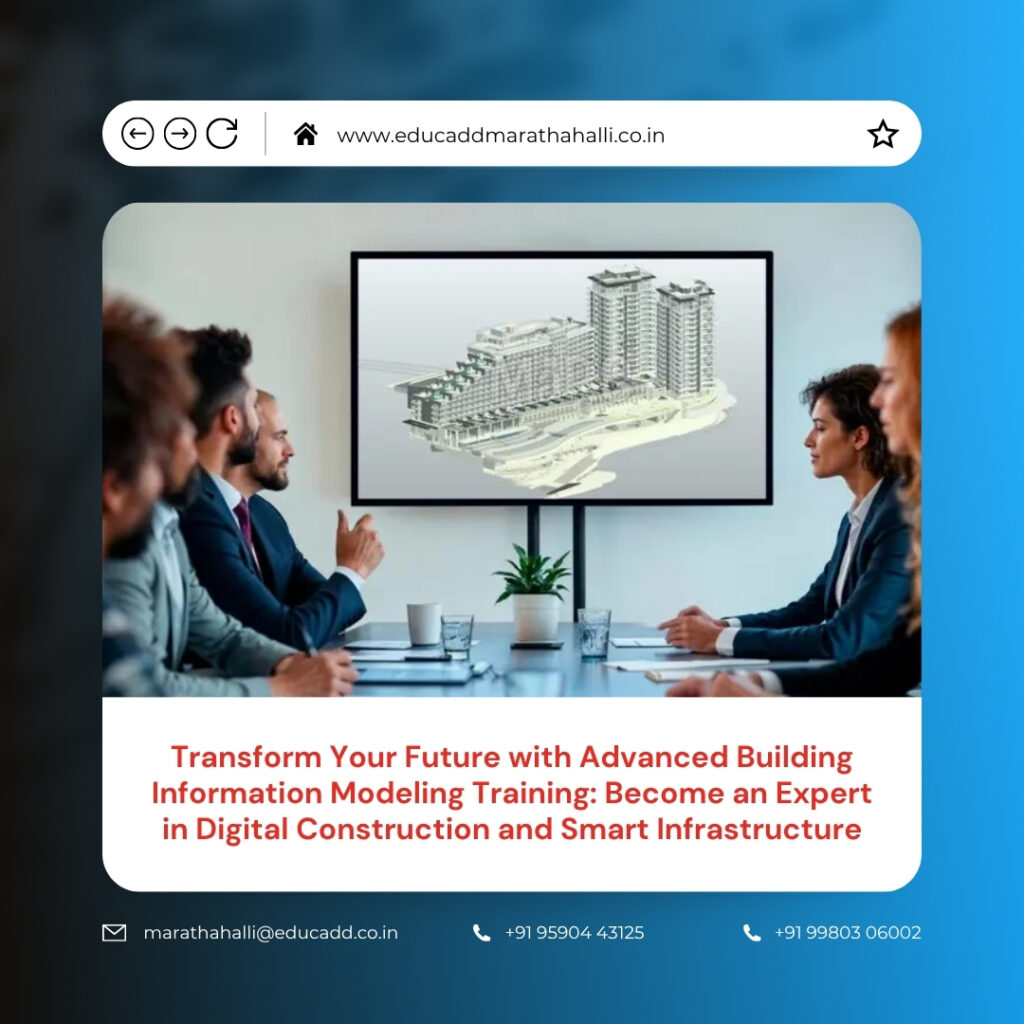
Advanced Building Information Modeling
As industries continue adopting digital construction practices, professionals who complete Advanced Building Information Modeling gain valuable technical skills, improve their career prospects, and become highly sought-after candidates across the global construction sector. Whether you are a student, engineer, architect, interior designer, or working professional, mastering BIM can help you stay competitive and build a successful future in the rapidly evolving construction industry.
Understanding the Growing Importance of Advanced Building Information Modeling Training
The construction industry has experienced remarkable technological progress over the past decade. Traditional design methods often created communication gaps between architects, engineers, contractors, and project managers, resulting in delays, increased expenses, and design conflicts. Today, organizations prefer digital workflows that improve collaboration while minimizing project risks. This shift has made Advanced Building Information Modeling an essential qualification for professionals who want to excel in engineering and construction.
Unlike conventional drafting software, BIM creates intelligent digital models containing complete information about every component of a building. Each wall, beam, pipe, duct, window, electrical panel, and structural member stores valuable project data that updates automatically whenever modifications are made. This intelligent workflow allows every department to work with accurate and synchronized information throughout the project lifecycle. As a result, organizations complete projects more efficiently while maintaining high standards of quality and accuracy.
Why Digital Construction Is Creating New Career Opportunities
Digital transformation is changing the way buildings and infrastructure projects are designed and executed. Governments, multinational companies, and private developers increasingly require BIM implementation because it improves project transparency, enhances collaboration, and reduces construction costs. Consequently, professionals with expertise gained through Advanced Building Information Modeling enjoy greater employment opportunities than ever before.
The growing adoption of BIM has expanded career options across various engineering disciplines. Professionals can contribute to residential projects, commercial buildings, airports, hospitals, educational institutions, industrial facilities, metro rail systems, highways, bridges, and smart city developments. Employers value candidates who understand digital workflows because they improve productivity and reduce project delays.
Moreover, BIM professionals often receive attractive salary packages due to their specialized technical skills. As construction technologies continue evolving, the demand for qualified BIM experts will continue to increase across domestic and international markets.
Building Strong Technical Foundations Through Advanced BIM Education
A comprehensive Advanced Building Information Modeling program begins by developing a strong understanding of BIM principles and digital engineering concepts. Before working on complex projects, students learn how BIM differs from traditional drafting methods and why intelligent modeling has become the preferred approach for modern construction.
The curriculum introduces learners to digital collaboration, project coordination, model development standards, engineering documentation, construction workflows, and interdisciplinary communication. Students gradually build their technical confidence while understanding how architectural, structural, mechanical, electrical, and plumbing disciplines interact within a unified BIM environment.
Instead of memorizing software commands, learners understand the practical purpose behind every modeling technique. This foundation enables them to solve engineering challenges more efficiently while preparing them for real construction projects where teamwork and coordination are equally important as technical knowledge.
Developing Expertise in Architectural BIM Modeling
Architectural modeling serves as the starting point for every successful BIM project. During Advanced Building Information Modeling Training, students learn how to create intelligent architectural models that accurately represent building designs while containing detailed project information.
Every building element is developed using intelligent objects rather than simple geometric shapes. Walls include material specifications, windows contain performance data, doors store hardware details, and rooms include area calculations. This intelligent approach allows architects and engineers to generate accurate floor plans, elevations, sections, schedules, and construction documents automatically from a single model.
Students also explore residential villas, apartment complexes, office buildings, shopping malls, hotels, educational campuses, healthcare facilities, and industrial structures. Through continuous practice, they develop the ability to produce professional architectural documentation that complies with industry standards while supporting seamless coordination with other engineering disciplines.
Mastering Structural Modeling for Safe and Reliable Construction
Structural engineering is one of the most important aspects of every construction project because it ensures the stability and safety of buildings. Advanced Building Information Modeling Training enables students to create detailed structural models that integrate perfectly with architectural and MEP systems.
Learners model reinforced concrete structures, steel frameworks, foundations, beams, slabs, columns, staircases, retaining walls, roof systems, and structural connections with exceptional precision. Each component contains engineering information that supports analysis, fabrication, and construction planning.
One of the greatest advantages of structural BIM is improved coordination. Engineers can identify potential conflicts before construction begins, allowing design modifications to be completed digitally instead of at the project site. This proactive approach minimizes costly rework, improves construction quality, and helps project teams maintain strict schedules.
Learning MEP Coordination for Highly Efficient Building Systems
Mechanical, Electrical, and Plumbing services are among the most technically demanding components of modern buildings. Proper coordination between these systems is essential because even small installation errors can delay entire projects. Advanced Building Information Modeling Training prepares students to manage these complex engineering disciplines within a collaborative BIM environment.
Students learn to develop intelligent models for HVAC systems, ventilation networks, plumbing pipelines, drainage systems, electrical conduits, cable trays, lighting layouts, fire protection systems, and equipment installations. Every service is accurately positioned within the building model to prevent conflicts with structural and architectural elements.
Furthermore, learners understand the importance of coordinated project delivery through practical exercises involving multidisciplinary collaboration. These experiences strengthen technical accuracy while improving communication between various engineering teams. Consequently, projects become more organized, installation errors decrease significantly, and construction activities progress smoothly from planning to execution.
Improving Project Coordination Through BIM Collaboration
One of the most valuable outcomes of Advanced Building Information Modeling Training is learning how to collaborate efficiently across multiple engineering disciplines. Modern construction projects involve architects, civil engineers, structural engineers, MEP consultants, contractors, project managers, quantity surveyors, and facility managers. When every team works independently, communication gaps often lead to design conflicts, construction delays, and budget overruns. BIM eliminates these challenges by providing a centralized digital model where every stakeholder works with the latest project information.
Students learn how to share models, review design updates, manage revisions, and coordinate project activities using collaborative BIM workflows. Since every modification is reflected throughout the project model, misunderstandings are greatly reduced. Furthermore, project teams can communicate more effectively because everyone has access to consistent and accurate information. This collaborative approach not only improves productivity but also builds stronger teamwork among professionals from different engineering backgrounds. As organizations increasingly adopt integrated project delivery methods, professionals with advanced BIM collaboration skills become valuable contributors to successful construction projects.
Enhancing Construction Quality Through Clash Detection
Construction projects often face unexpected problems when different building systems overlap during installation. A ventilation duct may interfere with a structural beam, or a plumbing pipeline may pass through an electrical cable tray. These issues can cause expensive modifications if discovered after construction begins. Advanced Building Information Modeling Training teaches students how to identify and resolve these conflicts before work reaches the construction site.
Using intelligent clash detection techniques, learners analyze architectural, structural, and MEP models together to locate potential conflicts early in the design process. Engineers can then revise their designs before materials are ordered or installations begin. This proactive strategy saves considerable time while reducing labor costs and material wastage.
The training also focuses on model validation and quality assurance. Students verify design standards, engineering specifications, component accuracy, and construction documentation to ensure every model meets professional requirements. These quality control practices help organizations deliver projects with greater confidence, improved efficiency, and higher customer satisfaction.
Understanding Quantity Take-Off and Cost Estimation
Accurate budgeting is essential for every successful construction project. Manual quantity calculations are often time-consuming and vulnerable to errors, especially when project designs change frequently. Advanced Building Information Modeling Training introduces learners to intelligent quantity take-off methods that automatically generate precise material estimates directly from BIM models.
Every building component contains detailed information that supports accurate calculations for concrete, reinforcement steel, masonry, flooring, ceilings, doors, windows, piping, ductwork, electrical systems, finishes, and other construction materials. Whenever designers modify the model, quantities update automatically, eliminating repetitive manual work.
Students also understand how BIM supports procurement planning, inventory management, tender preparation, budgeting, and financial forecasting. Reliable quantity estimation allows construction companies to minimize waste, improve purchasing decisions, and maintain better control over project expenses. Consequently, BIM-based cost estimation has become an indispensable skill for professionals involved in modern construction management.
Exploring 4D and 5D BIM Technologies
The evolution of BIM has introduced advanced dimensions that extend far beyond three-dimensional modeling. Advanced Building Information Modeling Training provides students with a comprehensive understanding of 4D and 5D BIM, enabling them to manage projects more efficiently throughout every stage of construction.
4D BIM integrates construction schedules with digital building models. Students learn how to visualize each phase of construction, monitor project progress, allocate resources efficiently, and identify scheduling conflicts before work begins. This visual planning approach helps project managers make informed decisions while improving coordination among contractors and consultants.
Similarly, 5D BIM combines cost information with project models. Every design modification instantly updates cost estimates, helping organizations maintain accurate budgets throughout project execution. This integration supports financial planning while reducing unexpected expenditures. By understanding these advanced BIM dimensions, professionals become capable of managing projects with greater accuracy, stronger planning capabilities, and improved overall performance.
Developing Practical Skills Through Real-Time Industry Projects
Theoretical knowledge alone cannot prepare students for today’s competitive engineering industry. Therefore, Advanced Building Information Modeling Training emphasizes practical learning through real-world projects that replicate actual construction environments. Students gain hands-on experience by developing complete BIM models, coordinating multiple engineering disciplines, generating construction documentation, and solving practical design challenges.
Project-based learning encourages critical thinking while strengthening technical confidence. Learners become familiar with engineering standards, client requirements, project deadlines, documentation procedures, and collaborative workflows commonly used by construction companies. Every practical assignment develops valuable professional skills that employers actively seek when recruiting BIM specialists.
Additionally, students learn how to manage revisions, prepare detailed reports, review design changes, and communicate effectively with multidisciplinary teams. This practical exposure significantly improves workplace readiness while allowing graduates to contribute immediately after joining engineering organizations.
Career Paths After Completing Advanced Building Information Modeling Training
The rapid expansion of digital construction has created exceptional career opportunities for professionals with BIM expertise. Completing Advanced Building Information Modeling Training opens doors to rewarding positions across architecture, civil engineering, structural engineering, mechanical engineering, electrical engineering, plumbing design, interior design, infrastructure development, and construction management.
Graduates can pursue a wide variety of professional roles, including:
- BIM Modeler
- BIM Coordinator
- BIM Engineer
- Architectural BIM Specialist
- Structural BIM Engineer
- MEP BIM Engineer
- BIM Manager
- BIM Consultant
- Project Planning Engineer
- Digital Construction Coordinator
These professionals are employed by architectural firms, engineering consultancies, infrastructure developers, real estate companies, EPC contractors, government organizations, and multinational construction corporations. Since BIM adoption continues to grow worldwide, skilled professionals often enjoy competitive salaries, excellent career growth, international job opportunities, and long-term professional stability. Continuous learning and industry certifications further enhance career prospects, making BIM one of the most promising fields in the construction sector.
Future Trends Driving the Evolution of BIM
Technology continues to reshape the construction industry, and Advanced Building Information Modeling Training prepares professionals to adapt to these exciting developments. Emerging innovations such as artificial intelligence, digital twins, cloud computing, virtual reality, augmented reality, laser scanning, drone mapping, automation, and the Internet of Things are expanding the capabilities of BIM beyond traditional design.
Digital twins allow engineers to monitor building performance throughout its entire lifecycle, while artificial intelligence assists in predictive maintenance, automated clash detection, and design optimization. Cloud-based BIM platforms enable project teams from different countries to collaborate in real time without geographical limitations. Virtual and augmented reality technologies improve client presentations by allowing stakeholders to explore projects before construction begins.
Sustainable construction is another important trend supported by BIM. Engineers can evaluate energy efficiency, environmental performance, material consumption, and lifecycle costs during the design stage. These innovations help organizations develop smarter, greener, and more efficient buildings that meet future environmental standards while improving operational performance.
Conclusion
The construction industry is embracing digital transformation at an unprecedented pace, making Advanced Building Information Modeling one of the most valuable educational investments for aspiring and experienced professionals alike. BIM has revolutionized the way buildings are planned, designed, coordinated, constructed, and managed by creating intelligent digital environments that improve collaboration, reduce errors, optimize resources, and enhance overall project quality. From architectural modeling and structural engineering to MEP coordination, quantity estimation, scheduling, cost management, and facility operations, BIM supports every phase of the construction lifecycle with exceptional efficiency.
Professionals who master advanced BIM workflows gain a competitive advantage in today’s rapidly evolving engineering landscape. They possess the technical expertise, collaborative skills, and practical knowledge required to contribute successfully to complex infrastructure and building projects across the world. As digital construction technologies continue to evolve, the demand for qualified BIM specialists will remain strong across multiple industries. By enrolling in Advanced Building Information Modeling, learners not only enhance their technical capabilities but also build a solid foundation for a successful, rewarding, and future-ready career in modern construction and smart infrastructure development.

