
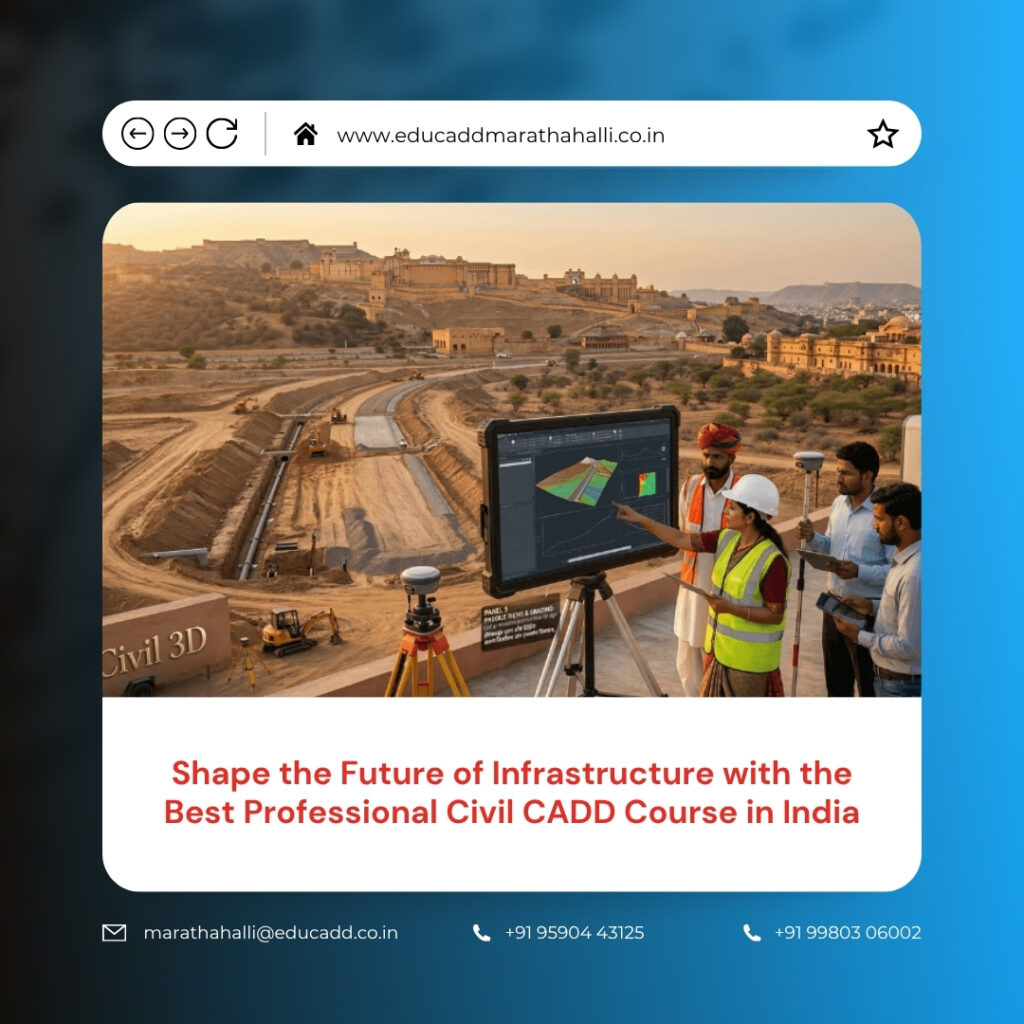
Shape the Future of Infrastructure with the Best Professional Civil CADD Course in India
India’s infrastructure sector is witnessing remarkable growth, creating thousands of employment opportunities for skilled civil engineering professionals. From smart cities and metro rail projects to highways, residential developments, industrial parks, and commercial complexes, every construction project begins with accurate planning and digital drafting. As a result, organizations actively seek professionals who can convert engineering concepts into precise technical drawings using modern design software. Enrolling in a Professional Civil CADD Course in India is one of the most effective ways to gain these industry-relevant skills and establish a successful engineering career. The course combines civil engineering fundamentals with advanced Computer-Aided Design and Drafting techniques, enabling students to work confidently on real-world projects.
Professional Civil CADD Course
Whether you are a student, diploma holder, engineering graduate, or working professional looking to upgrade your technical expertise, Civil CADD training opens doors to rewarding career opportunities. Moreover, practical software knowledge improves employability and prepares learners to meet the expectations of today’s construction and infrastructure industries. With proper training, dedication, and project exposure, aspiring professionals can become valuable contributors to India’s rapidly expanding engineering landscape.
Why Civil CADD Skills Are Driving Modern Engineering Careers
The construction industry has transformed significantly over the last decade. Earlier, engineers relied heavily on manual drafting methods, which consumed considerable time and often resulted in costly errors. Today, advanced Computer-Aided Design technologies have completely revolutionized engineering workflows. Civil CADD software enables professionals to prepare highly accurate construction drawings, structural layouts, site development plans, road alignments, drainage systems, contour maps, and infrastructure documentation with exceptional precision. Consequently, engineering firms complete projects faster while maintaining high-quality standards.
Furthermore, digital drawings allow architects, structural engineers, contractors, and project managers to collaborate more effectively throughout every stage of construction. Since project accuracy directly impacts construction quality, companies increasingly prefer professionals with specialized Civil CADD expertise. Therefore, students who acquire these practical skills enjoy greater career stability and improved employment opportunities. As infrastructure investments continue to rise across India, Civil CADD has become one of the most valuable technical competencies within the engineering profession.
Understanding the Scope of a Professional Civil CADD Course in India
A Professional Civil CADD Course offers much more than software training. Instead, it provides comprehensive technical education that combines engineering concepts with practical drafting skills. Students begin by learning drafting fundamentals before progressing to advanced civil engineering applications used in professional environments. Throughout the course, learners understand construction documentation, engineering standards, drawing interpretation, project planning principles, and software-based design workflows. This balanced learning approach ensures that students develop both theoretical knowledge and practical expertise.
Moreover, instructors explain how engineering drawings are created, reviewed, modified, and approved during different project phases. Such exposure helps learners understand actual industry practices instead of simply memorizing software commands. Consequently, graduates become confident professionals capable of handling engineering assignments efficiently from the beginning of their careers. This practical orientation distinguishes professional Civil CADD programs from ordinary software courses.
Advanced Software Knowledge Builds Strong Technical Foundations
Software proficiency plays a vital role in every Civil CADD professional’s career. Engineering organizations expect employees to work confidently with industry-standard applications that improve project accuracy and productivity. Therefore, a well-designed Civil CADD program introduces students to multiple software platforms rather than limiting them to a single application. Every software module focuses on solving practical engineering challenges encountered during real construction projects.
Students gradually learn drawing creation, structural detailing, land development planning, road design, surveying techniques, and Building Information Modeling. They also understand how different software applications integrate during complete project execution. By the end of the training, learners can confidently prepare engineering drawings that comply with professional drafting standards.
The course generally includes training in:
- AutoCAD for civil drafting and construction documentation.
- Civil 3D for road and infrastructure design.
- STAAD.Pro for structural analysis.
- Revit Structure for BIM-based modeling.
- Quantity estimation and engineering documentation tools.
Mastering these applications significantly improves technical competence and broadens employment opportunities across multiple engineering sectors.
Practical Training Creates Industry-Ready Professionals
Technical education becomes meaningful only when students apply classroom concepts to practical situations. That is why every reputed Professional Civil CADD Course emphasizes hands-on learning rather than theoretical instruction alone. Practical assignments enable students to develop confidence while strengthening their understanding of engineering principles. Instead of practicing isolated software exercises, learners work on complete engineering drawings similar to those prepared by professional design consultants. They gradually understand project workflows, drafting standards, design revisions, dimensioning techniques, and documentation requirements.
Furthermore, practical sessions encourage students to solve engineering challenges independently, improving analytical thinking and technical accuracy. Continuous instructor feedback helps learners correct mistakes early, ensuring steady progress throughout the course. This practical learning methodology prepares graduates to contribute effectively within professional engineering organizations immediately after completing their training.
Learning Through Real-Time Engineering Projects
One of the defining strengths of professional Civil CADD training is project-based learning. Real-world engineering assignments expose students to construction scenarios that closely resemble actual industry projects. Instead of merely following software tutorials, learners develop complete residential building plans, commercial layouts, foundation drawings, structural detailing sheets, drainage systems, road alignments, and land development projects. These practical experiences improve technical confidence while strengthening problem-solving abilities.
Additionally, students learn how engineers coordinate with architects, surveyors, contractors, and project managers during project execution. They also understand how revisions are managed without compromising drawing quality. Since employers highly value practical exposure, project-based learning significantly enhances employability.
Some major advantages of working on live projects include:
- Better understanding of engineering documentation.
- Improved drawing accuracy.
- Greater confidence during technical interviews.
- Enhanced project coordination skills.
- Stronger analytical and problem-solving abilities.
As students complete multiple projects, they gradually build an impressive technical portfolio that showcases their practical capabilities to future employers.
Expert Faculty and Personalized Mentorship Accelerate Professional Growth
The quality of training depends greatly on the knowledge and experience of the instructors. A reputed Professional Civil CADD Course is guided by industry experts who have worked on real construction, infrastructure, and structural engineering projects. Their practical experience enables them to explain not only how software functions but also why certain engineering practices are followed in professional environments. Instead of limiting lessons to theoretical concepts, experienced trainers introduce students to practical design standards, construction workflows, and real engineering challenges. As a result, learners develop a deeper understanding of the subject while gaining confidence in applying their knowledge.
Regular doubt-clearing sessions, one-on-one mentoring, project reviews, and performance assessments ensure that every student receives the guidance required to improve continuously. Furthermore, mentors often share valuable industry insights, helping learners stay informed about emerging technologies, design trends, and employer expectations. This combination of technical instruction and professional mentorship creates a strong foundation for long-term career success.
Industry-Oriented Curriculum That Matches Current Engineering Standards
A carefully designed curriculum is essential for preparing students to meet the demands of today’s engineering industry. The best Civil CADD training programs regularly update their syllabus to align with modern construction practices and technological advancements. Instead of focusing only on software commands, the curriculum integrates drafting principles, engineering drawing interpretation, surveying basics, structural concepts, project documentation, quantity estimation, and infrastructure planning. Every module builds progressively on previous lessons, ensuring that students understand both the technical and practical aspects of civil engineering design.
Moreover, assignments are structured to simulate real project environments where accuracy, efficiency, and coordination are equally important. Continuous assessments help learners identify areas for improvement while reinforcing essential concepts. Because the curriculum reflects actual industry requirements, graduates are better prepared to transition smoothly into professional roles without requiring extensive additional training after employment.
Developing Professional Skills Beyond Technical Expertise
Success in the engineering industry depends on much more than software knowledge alone. Employers seek professionals who can communicate effectively, solve technical challenges, collaborate with multidisciplinary teams, and manage project responsibilities with confidence. Therefore, a Professional Civil CADD Course also focuses on developing essential workplace skills that complement technical expertise. Throughout the training, students improve their analytical thinking, logical reasoning, attention to detail, time management, and decision-making abilities.
They also learn how to organize project documentation, maintain drafting standards, and coordinate revisions efficiently. Presentation skills and professional communication receive equal importance because engineers frequently interact with architects, consultants, contractors, and clients. These soft skills increase workplace efficiency and help professionals perform confidently under project deadlines. Consequently, graduates become well-rounded engineering professionals capable of contributing effectively in dynamic construction environments.
Excellent Career Opportunities Across Diverse Engineering Sectors
The demand for Civil CADD professionals continues to expand as India’s construction and infrastructure industries grow rapidly. Organizations involved in residential development, commercial construction, industrial projects, transportation, urban planning, water resource management, and smart city development actively recruit professionals with advanced drafting and design skills. Completing a Professional Civil CADD Course opens opportunities across multiple engineering domains, allowing graduates to choose career paths that match their interests and long-term goals. Since digital engineering has become standard practice, companies value candidates who can prepare accurate drawings, coordinate project documentation, and support engineering teams efficiently.
Additionally, multinational engineering firms frequently outsource design work to India, creating international career opportunities for qualified professionals. As experience increases, Civil CADD specialists often progress into senior engineering, design management, project coordination, and consulting roles, ensuring continuous professional growth throughout their careers.
Some of the most sought-after job roles include:
- Civil CADD Designer
- CAD Draftsman
- Structural Draftsman
- Civil Design Engineer
- Site Engineer
- Quantity Surveyor
- Estimation Engineer
- Infrastructure Design Engineer
- Highway Design Engineer
- BIM Modeler
- Project Coordinator
- Planning Engineer
These career options provide excellent learning opportunities, competitive salary packages, and long-term professional stability within India’s rapidly evolving engineering sector.
Placement Assistance Gives Students a Competitive Advantage
Professional training extends beyond classroom learning. Leading institutes understand that students require support while transitioning from education to employment. Therefore, many reputed institutes offering a Professional Civil CADD Course provide comprehensive placement assistance to improve students’ chances of securing rewarding jobs. Placement services typically include resume preparation, technical interview coaching, aptitude training, personality development sessions, communication workshops, and mock interviews. These activities help students present their skills confidently before recruiters while improving their overall professional image.
Furthermore, institutes often maintain strong relationships with construction companies, engineering consultancies, architectural firms, and infrastructure organizations, enabling students to access valuable employment opportunities. Campus recruitment drives and industry networking events further strengthen placement prospects. Students who have completed practical projects and developed strong software proficiency generally perform exceptionally well during interviews, making them preferred candidates among employers seeking industry-ready professionals.
How to Choose the Best Professional Civil CADD Course in India
Selecting the right training institute plays a significant role in shaping your career. While many institutes offer Civil CADD programs, not all provide the same level of quality, practical exposure, or placement support. Therefore, students should carefully evaluate several important factors before making a decision. A reputed institute should have experienced faculty members, updated computer laboratories, licensed software, well-designed classrooms, and a curriculum that reflects current industry standards. In addition, learners should verify whether the institute offers project-based training, regular workshops, technical seminars, certification, and dedicated placement assistance. Student reviews, alumni success stories, and placement records also provide valuable insights into the institute’s credibility.
Furthermore, flexible class schedules allow both students and working professionals to complete the course without disrupting their existing commitments. Choosing an institute that emphasizes practical learning and industry interaction ensures that graduates acquire the confidence and technical competence required to excel in the engineering field. Investing in quality education today lays the foundation for a successful and rewarding professional future.
Why Continuous Learning Is Essential for Long-Term Career Growth
Technology continues to reshape the civil engineering industry, making continuous learning an essential part of every professional’s career. Software applications receive regular updates, engineering standards evolve, and construction methodologies become more advanced with each passing year. Therefore, completing a Professional Civil CADD Course should be viewed as the beginning of a lifelong learning journey rather than the final destination. Professionals who consistently upgrade their knowledge remain competitive and adapt quickly to changing industry requirements. Learning advanced BIM workflows, project management concepts, sustainable construction practices, and emerging digital engineering technologies further enhances career prospects.
Additionally, attending technical workshops, certification programs, webinars, and engineering conferences helps professionals stay informed about industry innovations. Employers appreciate individuals who demonstrate a commitment to continuous improvement because such professionals contribute more effectively to organizational growth. By embracing lifelong learning, Civil CADD professionals can expand their expertise, assume leadership responsibilities, and build highly successful careers in both national and international engineering organizations.
Conclusion
India’s construction and infrastructure sectors are entering an exciting phase of rapid development, creating unprecedented opportunities for skilled engineering professionals. In this evolving landscape, enrolling in a Professional Civil CADD Course in India provides aspiring engineers with the technical expertise, practical exposure, and industry confidence needed to succeed. The course goes far beyond software training by combining engineering fundamentals, real-time project experience, professional mentoring, and career-oriented skill development. As organizations increasingly depend on digital design solutions for planning and executing complex infrastructure projects, the demand for qualified Civil CADD professionals continues to grow across residential, commercial, industrial, and public infrastructure sectors.
Students who invest in comprehensive Civil CADD training position themselves for rewarding careers with excellent growth potential, competitive salaries, and opportunities to contribute to landmark engineering projects. By choosing a reputed training institute, practicing consistently, and embracing continuous learning, learners can transform their passion for civil engineering into a fulfilling and future-ready profession. A strong technical foundation built today will empower you to design, innovate, and shape the infrastructure of tomorrow while enjoying lasting career success in one of India’s most dynamic industries.

