
SolidWorks vs. CATIA: Which Mechanical Design Software Drives the Automotive Industry?
The automotive manufacturing landscape relies heavily on advanced computer-aided design software to engineer vehicles from initial concept sketches to final assembly lines. Consequently, choosing between top-tier CAD platforms is a critical decision for aspiring mechanical engineers, product designers, and automotive enthusiasts. Enrolling in a targeted SolidWorks course or comprehensive CATIA training provides the exact technical foundation required to enter high-paying automotive engineering roles. Furthermore, mastering these powerful 3D parametric tools through structured CADD training enables designers to build complex chassis components, engine assemblies, and aerodynamic body panels. Joining an established CADD training institute ensures you gain hands-on proficiency in the software suites that power global automotive OEMs and Tier-1 suppliers.
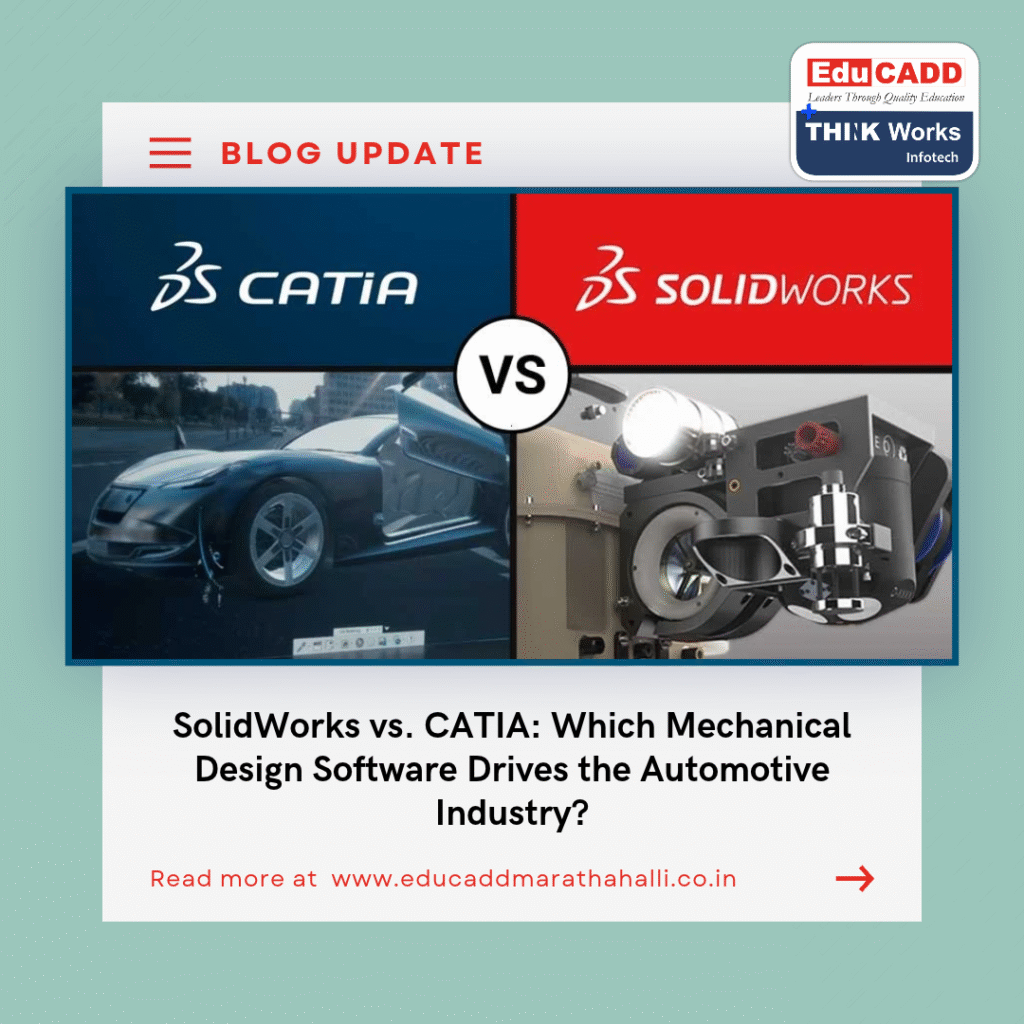
Navigating the CAD Landscape: SolidWorks vs. CATIA in Automotive Engineering
While both CAD platforms are developed by Dassault Systèmes, they serve distinctly different roles within the automotive design pipeline. Understanding their specific strengths, modeling capabilities, and industry applications is essential for planning a successful engineering career.
Key Comparisons: SolidWorks vs. CATIA
-
SolidWorks – Rapid Mechanical Part & Assembly Design: SolidWorks excels in intuitive 3D parametric modeling, machine design, sheet metal fabrication, and rapid prototyping. Therefore, Tier-1 and Tier-2 automotive suppliers widely use it to design brackets, engines, gearboxes, and mechanical fixtures quickly.
-
CATIA – Advanced Surface Modeling & Aerospace-Grade Assemblies: CATIA is the undisputed industry standard for Class-A surface modeling, aerodynamic body design, and massive multi-thousand-part assemblies. Consequently, major automotive original equipment manufacturers (OEMs) use it to style vehicle exteriors, interior dashboards, and complex sheet metal body-in-white (BIW) structures.
-
Learning Curve & Usability: SolidWorks features a user-friendly interface that allows engineers to learn 3D modeling fundamentals rapidly. In contrast, CATIA features a deeply complex, workbench-driven architecture tailored for specialized aerospace and automotive styling experts.
-
Cost & Enterprise Integration: SolidWorks offers cost-effective licensing suitable for mid-sized engineering firms and product design consultancies. CATIA provides heavy enterprise-level PLM (Product Lifecycle Management) integration designed for multi-national automotive corporations.
Developing hands-on expertise in these industry-leading software platforms through specialized job oriented courses prepares engineers to step directly into competitive automotive design roles.
Core Technical Tracks and Complementary Skill Sets for Engineers
A competitive technical skillset requires exposure across mechanical CAD, structural simulation, civil drafting, full stack programming, and digital marketing. Modern engineers benefit from mastering complementary tools that broaden their career horizons.
1. Mechanical Design, Simulation, and Industrial Manufacturing Suite
Automotive design demands an integrated suite of modeling, surfacing, and analytical software tools:
-
Core Mechanical Design: Understand machine component design and drawing creation by completing a Mechanical CADD course.
-
Parametric 3D Modeling & Surfacing: Master advanced product design using CATIA training, a SolidWorks course, and Creo training.
-
Finite Element Analysis (FEA): Evaluate vehicle crashworthiness, structural stress points, and thermal performance through HyperMesh training.
-
Manufacturing Precision: Apply precise dimensional tolerances and feature control frames with GD&T training.
2. Civil, Architectural, and Structural Design Suite
Automotive manufacturing plants, assembly facilities, and test tracks require civil and structural engineering coordination:
-
Foundational 2D Drafting: Master precise factory layout drawings by taking an AutoCAD course and an AutoCAD Civil course.
-
Specialized Infrastructure Tracks: Build broad domain knowledge through a Civil CADD course, an Architectural CADD course, and an Electrical CADD course.
-
Building Information Modeling: Understand plant facility layout coordination using a Revit Architecture course, a Revit Structure course, and a BIM course.
-
Structural Steel Framing: Analyze factory support structures and cranes using a STAAD Pro course, an ETABS course, and a Primavera P6 course.
-
Showroom Interior Layouts: Master commercial space planning via an Interior design course.
3. Software Engineering and Automation Tracks
Modern automotive engineering heavily integrates software code for autonomous driving algorithms, vehicle telematics, and CAD process automation:
-
Full Stack Programming: Engineers interested in automotive software development, script automation, or data analytics benefit greatly from a Python Full Stack course.
-
Technical Upskilling: Joining a premier technical training institute allows students to gain practical exposure to both mechanical engineering systems and emerging computer science skills.
4. Digital Marketing, Branding, and Business Growth
Automotive design agencies, aftermarket component manufacturers, and engineering consultants require digital marketing skills to launch products and attract global clients online:
-
Core Digital Marketing Knowledge: Learn modern digital lead generation and brand positioning by enrolling in a Digital marketing course, studying at a Digital marketing institute, or completing Digital marketing training.
-
Targeted Marketing Specializations: Master digital customer reach using an SEO course, a Google Ads course, a Social media marketing course, a Performance marketing course, and an AI digital marketing course.
-
Practical Agency Programs: Gain real-world marketing experience through a Job oriented digital marketing course, a Digital marketing course with placement, a Professional digital marketing course, a Masters in digital marketing course, an Online digital marketing course, a Digital marketing internship, and Digital marketing live project training.
Detailed Course Syllabus: What You Will Learn in Automotive CAD Programs
An industry-aligned automotive design curriculum takes learners step-by-step from fundamental part modeling to complex Class-A surface creation and digital mock-up assembly.
Module 1: Fundamental 3D Modeling & Parametric Sketching
-
Navigating user workspaces, managing feature trees, and establishing dynamic sketch planes.
-
Creating 3D solid features: Extrude, Revolve, Sweep, Loft, Fillet, and Chamfer.
-
Applying geometric constraints, dimensional relations, and global equations efficiently.
Module 2: Advanced Assembly Modeling & Mechanism Kinematics
-
Assembling complex automotive components: Pistons, crankshafts, suspension systems, and steering linkages.
-
Applying dynamic mates, collision detection, and physical interference checks.
-
Conducting motion simulation and kinematic analysis to validate moving mechanical parts.
Module 3: Class-A Surface Modeling & Sheet Metal Styling
-
Understanding surface continuity: G0 (Position), G1 (Tangency), and G2 (Curvature Continuity).
-
Creating complex vehicle body panels, door handles, headlamps, and aerodynamic wings.
-
Designing sheet metal components, bend allowances, un-folded patterns, and stamping dies.
Module 4: Engineering Drawings, Rendering & PLM Integration
-
Generating production-ready 2D engineering blueprints with automated bill of materials (BOM).
-
Creating photorealistic visual renderings and walk-through animations for client presentations.
-
Exporting CAD files to STEP, IGES, STL, and PLM database systems for manufacturing execution.
Rewarding Career Paths for Certified Automotive CAD Engineers
Obtaining certified skills from a recognized skill development institute opens up lucrative career avenues across global automotive OEMs, Tier-1 suppliers, and racing technology teams:
-
Automotive Body-in-White (BIW) Designer: Specializes in designing vehicle sheet metal structures, body frames, and chassis assemblies using CATIA.
-
Component Design Engineer: Focuses on modeling engine parts, transmission systems, and mechanical brackets using SolidWorks or Creo.
-
Class-A Surfacing Specialist: Focuses on converting aesthetic exterior vehicle sketches into high-precision, mathematical 3D surfaces.
-
Vehicle Interior Ergonomics Designer: Prepares 3D models for dashboards, seating arrangements, center consoles, and interior trims.
-
Automotive FEA Crash Analyst: Evaluates vehicle structural integrity and crash simulations using HyperMesh and advanced solvers.
Strategic Steps to Launch Your Automotive Design Career
To maximize your job prospects and secure a competitive role in the automotive industry, follow this four-step execution strategy:
-
Build Strong Fundamentals: Master 3D modeling commands, surface continuity rules, and CAD shortcuts at a professional training institute.
-
Create a Comprehensive Portfolio: Assemble a professional digital portfolio containing 5 to 10 complete automotive models featuring complex assemblies and styled body surfaces.
-
Earn Recognized Credentials: Validate your software proficiency by obtaining official certifications from accredited training centers.
-
Prepare for Technical Interviews: Practice solving timed CAD modeling challenges, reading complex engineering drawings, and demonstrating surfacing techniques during technical rounds.
Build a Successful Career in Automotive Engineering and Design
Gaining practical technical skills remains the single most reliable strategy to secure a lucrative career in automotive engineering, product design, software development, or digital growth. Whether you aspire to work as an automotive BIW designer, Class-A surfacing specialist, full stack developer, or digital marketer, obtaining hands-on software expertise ensures you stay ahead in today’s competitive job market. Enrolling in structured programs that provide expert mentorship, state-of-the-art computer labs, and dedicated placement guidance allows you to turn learning into long-term professional success. If you are ready to elevate your career and gain high-value CAD skills, get started with a leading center such as EduCADD Marathahalli to transform your engineering potential into professional achievement.

