
Designing the Future: SolidWorks Essentials for Engineering Students in EduCADD
The engineering landscape is evolving rapidly, and so are the tools that shape innovation. Modern industries demand more than theoretical knowledge; they expect engineers to bring ideas to life with precision and creativity. In this context, SolidWorks Essentials Training EduCADD emerges as a critical stepping stone for aspiring professionals.
SolidWorks, a leading 3D CAD software, empowers engineers to design, simulate, and refine projects efficiently. Its adoption spans across multiple domains—automotive, aerospace, civil, mechanical, and even product design. For students aiming to stand out, learning SolidWorks under expert guidance is a must. EduCADD bridges this gap by offering industry-ready training programs tailored to meet global standards.
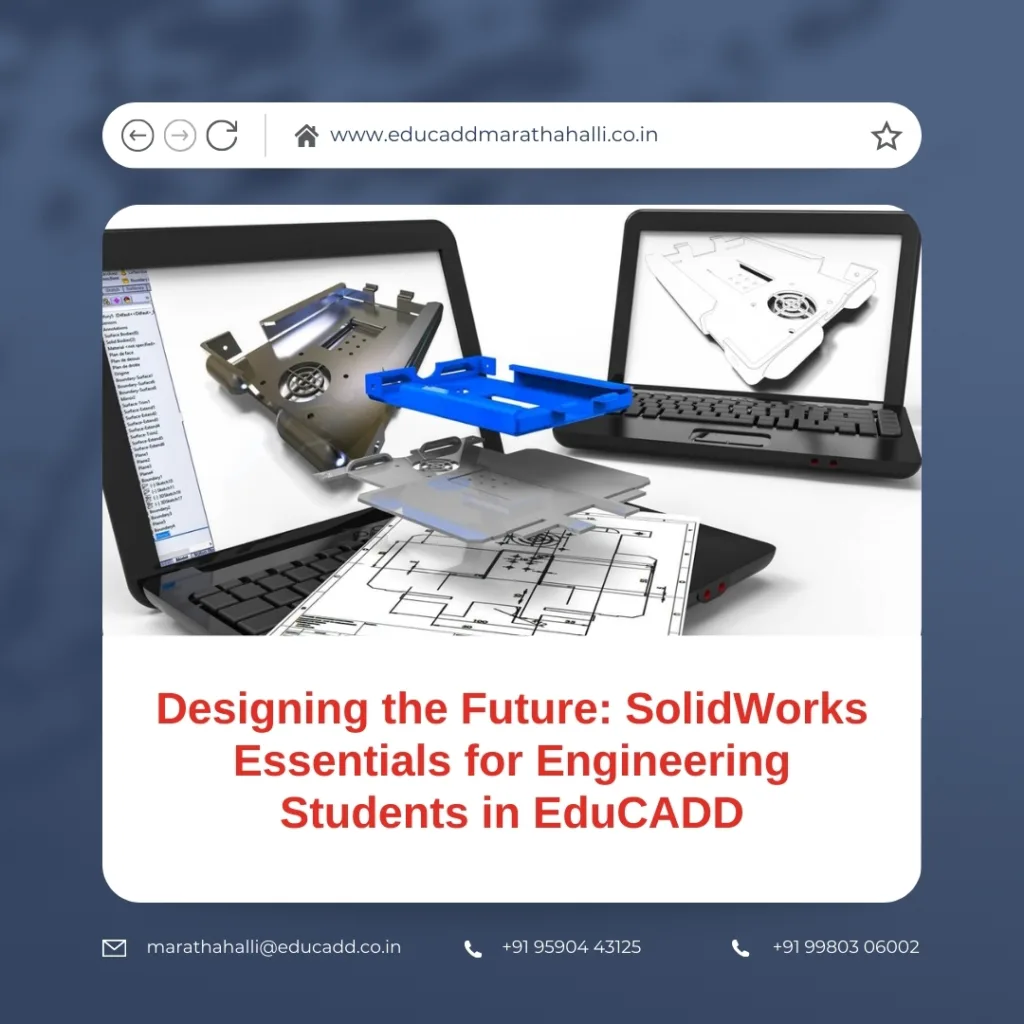
SolidWorks Essentials Training EduCADD
EduCADD has consistently equipped students with practical expertise, bridging the academic-industry divide. With a focus on applied learning, it ensures engineering graduates develop strong design and analysis skills that open doors to competitive careers. In this blog, we’ll uncover why mastering SolidWorks Essentials at EduCADD matters, how it shapes careers, and what unique benefits students gain from this training.
Importance of SolidWorks Essentials in Modern Engineering
Engineering today is no longer confined to textbooks or lectures. Students must transform theoretical knowledge into practical applications. That transformation becomes possible when they learn tools like SolidWorks. By enrolling in SolidWorks Essentials for Engineering Students in EduCADD, learners gain the ability to convert abstract concepts into accurate models and prototypes.
SolidWorks simplifies complex design processes. Its user-friendly interface enables beginners to adapt quickly, while its advanced features serve experienced designers equally well. From building 3D parts to simulating stress and motion, the software covers every stage of product development. For engineering students, this skillset ensures relevance in industries that prioritize efficiency and innovation.
EduCADD strengthens this journey by guiding students through every module systematically. Instead of learning isolated commands, students understand how each tool contributes to solving engineering challenges. As a result, they acquire not just software knowledge but also real problem-solving ability.
Another critical aspect is industry demand. Globally, SolidWorks remains a preferred software in design and manufacturing firms. Students trained at EduCADD are better positioned to secure internships, placements, and international career opportunities. Thus, SolidWorks Essentials becomes more than a course—it becomes a passport to success.
How EduCADD Delivers SolidWorks Essentials Effectively
Learning software is one thing; mastering it for real-world use is another. EduCADD has perfected the art of delivering SolidWorks Essentials for Engineering Students with a method that blends clarity, practice, and industry exposure.
The program begins with fundamentals. Students learn sketching, constraints, and parametric design—the building blocks of 3D modeling. As they progress, modules cover assembly design, advanced surface modeling, sheet metal tools, and simulation techniques. Each stage includes practical assignments, ensuring concepts are reinforced through application.
What sets EduCADD apart is its teaching philosophy. Trainers bring years of industry experience, offering insights that go beyond the software interface. They show students how SolidWorks is used in live projects across manufacturing, civil construction, and product design industries. This connection between learning and practice makes the training deeply relevant.
EduCADD also emphasizes certification. Students receive credentials recognized by employers, which enhances their resumes significantly. Additionally, the institute provides flexible learning options. Whether students prefer in-person training at state-of-the-art labs or online learning from home, EduCADD accommodates different needs without compromising quality.
Another strength is project-driven learning. Instead of just following exercises, students work on industry-relevant designs. This exposure builds confidence and prepares them for the collaborative environments they will encounter in their careers.
Features of SolidWorks Mastered at EduCADD
The real strength of SolidWorks Essentials for Engineering Students in EduCADD lies in the depth of features covered. SolidWorks is not limited to modeling—it is a complete design platform. EduCADD ensures students gain mastery over every critical aspect.
1. Sketching and Parametric Design
Students begin by developing 2D sketches with dimensions and constraints. They then create parametric models where changes update automatically, saving time and increasing accuracy.
2. Part and Assembly Creation
From simple machine components to complex systems, students learn how to design parts and integrate them into assemblies. They explore mates, constraints, and motion analysis to visualize product behavior.
3. Drafting and Documentation
EduCADD trains students to generate professional engineering drawings. These include accurate dimensions, tolerances, material specifications, and bills of materials—all essential for manufacturing.
4. Simulation and Validation
Through simulation, students test designs for stress, load, motion, and thermal behavior. This eliminates costly trial-and-error methods and ensures designs are production-ready.
5. Sheet Metal and Surface Modeling
Modern products often require intricate forms. EduCADD covers advanced modules like sheet metal design, bending operations, and freeform surface modeling for complex geometries.
6. Visualization and Rendering
Students also learn SolidWorks Visualize, enabling them to produce photorealistic renders. This skill is valuable for presentations, prototyping, and client communication.
By the end of the program, students become confident in handling diverse design challenges. This holistic approach ensures they can transition seamlessly into professional roles.
Career Benefits of Learning SolidWorks at EduCADD
The ultimate purpose of mastering SolidWorks Essentials for Engineering Students in EduCADD is career growth. Employers across industries value practical skills, and EduCADD-trained students meet those expectations with ease.
First, learning SolidWorks boosts employability. Recruiters prefer candidates who can contribute from day one. With EduCADD’s certification and practical training, students showcase both expertise and readiness.
Second, SolidWorks skills offer flexibility. Engineers can work across automotive, aerospace, architecture, heavy machinery, or consumer product industries. This versatility opens multiple career pathways, ensuring job security and growth.
Third, EduCADD enhances credibility. As a trusted training provider, EduCADD’s name on a resume signals quality. Certification further assures employers that candidates possess globally benchmarked skills.
Additionally, project experience adds immense value. Students present real designs in portfolios, which differentiates them during interviews. Hiring managers value this evidence of ability far more than academic grades alone.
Furthermore, SolidWorks training cultivates innovation. Students learn to optimize designs for efficiency and sustainability. These problem-solving skills are critical in industries that focus on cost-effective and environmentally responsible solutions.
Salary prospects also improve. Engineers proficient in SolidWorks consistently secure better compensation compared to peers without design expertise. By investing in this course, students ensure long-term professional and financial growth.
Why EduCADD Remains the Best Choice for SolidWorks
While many institutes claim to teach CAD, EduCADD has established itself as a pioneer in delivering skill-based training. The uniqueness of SolidWorks Essentials for Engineering Students in EduCADD lies in its holistic approach.
EduCADD has more than two decades of experience in CAD/CAM/CAE training. With centers across India, it provides access to advanced labs and the latest software versions. Students receive training in professional environments that mirror actual workplaces.
Another strength is faculty expertise. Trainers are not just instructors—they are engineers with real project experience. This ensures that teaching goes beyond theory and addresses practical applications.
The curriculum is constantly updated. EduCADD aligns its training with the latest SolidWorks features and industry requirements. This ensures students remain future-ready.
Placement support is another standout feature. EduCADD assists students with interview preparation, soft skills training, and direct placement opportunities with partner companies. This career focus adds tremendous value to the learning journey.
Finally, EduCADD fosters a lifelong learning community. Students benefit from alumni networks, peer collaboration, and ongoing support even after completing the course. This makes EduCADD more than an institute—it becomes a partner in career success.
Conclusion: Building Future-Ready Engineers
For engineering students aiming to excel, mastering design software is non-negotiable. With SolidWorks Essentials Training EduCADD, learners gain a competitive edge that textbooks alone cannot provide. They acquire not only software proficiency but also industry insights, hands-on experience, and career guidance.
SolidWorks transforms ideas into reality, and EduCADD ensures students master that transformation. From fundamentals to advanced simulations, from real-world projects to certifications, EduCADD equips learners with everything they need to thrive.
In a world where industries demand innovation and precision, EduCADD-trained engineers stand out. SolidWorks Essentials is not just another course—it is the key to designing the future. For ambitious students, the choice is clear: EduCADD is the path toward engineering excellence.

