
Revit for Plumbing & Fire Safety Engineering: Build Intelligent, Code‑Ready Systems
The construction industry is undergoing a deep digital transformation, and at the center of this shift stands Building Information Modeling. Revit Plumbing Fire Safety professionals, the move from conventional drafting to intelligent BIM workflows is no longer a trend but a necessity. Revit enables designers to think beyond drawings and focus on system behavior, constructability, and long‑term performance. Learning Revit for plumbing and fire protection systems allows professionals to design safer buildings, reduce coordination issues, and respond quickly to design changes. This blog explores Revit from a practical and career‑focused perspective, explaining how it reshapes MEP workflows and why mastering it delivers long‑term value.
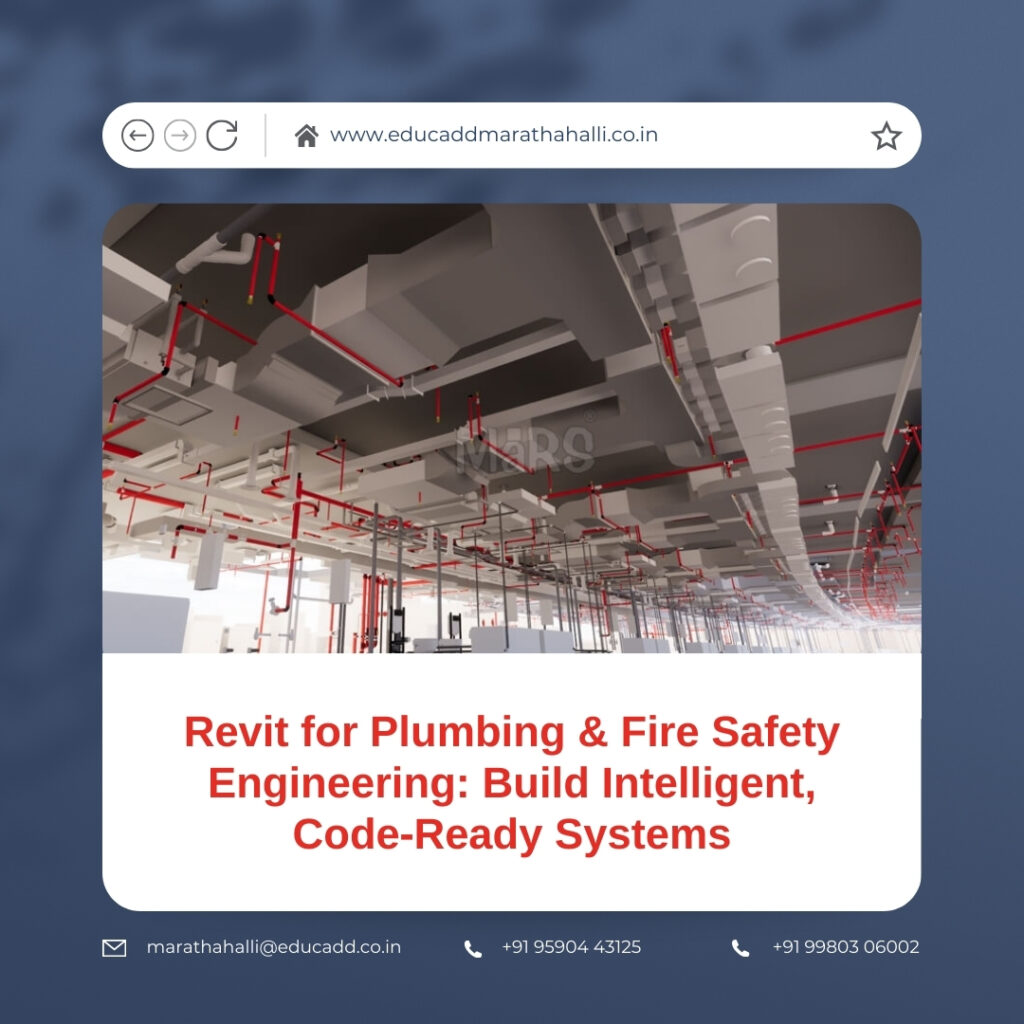
Revit Plumbing Fire Safety
The Evolution from 2D Drafting to Intelligent BIM Modeling
For decades, plumbing and fire protection systems relied heavily on 2D CAD drawings. While effective in the past, these methods often led to coordination errors, unclear system relationships, and costly on‑site changes. Revit introduces an intelligent model‑based approach where every pipe, valve, and fitting contains data. This evolution improves accuracy and clarity across project teams. Learning Revit for plumbing and fire protection systems enables professionals to participate in a collaborative design process where changes update automatically, improving efficiency and reducing rework throughout the project lifecycle.
Understanding Revit’s Role in Plumbing System Design
Plumbing systems demand careful planning to ensure proper flow, pressure, and drainage. Revit supports this complexity by allowing designers to model water supply, sanitary, vent, and storm systems within a unified environment. Each system follows predefined rules that mirror real‑world behavior. When designers learn Revit for plumbing systems, they gain control over slopes, pipe sizing, and fixture connectivity. This approach improves compliance with building codes and ensures that systems function as intended from design through installation.
Fire Protection Modeling as a Life‑Safety Responsibility
Fire protection design carries a unique responsibility because it directly impacts occupant safety. Revit offers dedicated tools for modeling sprinklers, standpipes, fire pumps, and risers with precision. Designers can ensure correct coverage, spacing, and elevations while coordinating with ceilings and structural elements. Learning Revit for fire protection systems allows professionals to visualize safety strategies clearly, support authority approvals, and minimize installation conflicts. This clarity enhances trust among stakeholders and contributes to safer buildings.
Navigating the Revit Interface for MEP Workflows
A solid understanding of the Revit interface forms the foundation of efficient modeling. MEP professionals work with views, levels, worksets, and system browsers tailored to building services. Learning how to manage these elements improves productivity and model organization. When designers master navigation and visibility controls, they spend less time troubleshooting and more time refining engineering solutions. Learning Revit for plumbing and fire protection systems becomes smoother when the interface feels intuitive rather than overwhelming.
Creating Accurate Plumbing Systems from Setup to Execution
Successful plumbing modeling begins with proper project setup. Designers define pipe types, materials, and system classifications that align with design standards. Revit allows seamless connection between fixtures, equipment, and vertical risers. When changes occur, the model updates instantly, maintaining consistency across drawings and schedules. Learning Revit for plumbing systems empowers professionals to produce coordinated designs that support efficient installation and long‑term maintenance.
Designing Fire Protection Networks with Confidence
Fire protection networks require strict adherence to codes and design intent. Revit simplifies this process by enabling automatic routing, precise elevation control, and consistent tagging. Designers can maintain clarity even in complex layouts. Learning Revit for fire protection systems helps professionals manage design complexity while ensuring compliance. This confidence reduces approval delays and supports smoother project execution.
Multi‑Discipline Coordination and Clash Prevention
One of Revit’s greatest strengths lies in coordination. Plumbing and fire protection systems rarely exist in isolation. They intersect with architectural elements, structural beams, and electrical services. Revit allows designers to identify clashes early and resolve them digitally. Learning Revit for plumbing and fire protection systems improves collaboration and reduces costly on‑site modifications. This proactive coordination enhances project quality and protects schedules.
Producing Construction‑Ready Documentation
Revit transforms models into reliable construction documents. Plans, sections, and details remain linked to the model, ensuring accuracy across revisions. Schedules extract quantities and specifications directly from the design. Learning documentation workflows within Revit helps professionals deliver clear and consistent drawings. Contractors benefit from reduced ambiguity, while project teams gain confidence in the design intent.
Leveraging Advanced Revit Features for MEP Excellence
Beyond basic modeling, Revit offers advanced tools that elevate design quality. Parameter control, system analysis, and custom families allow designers to tailor solutions to project needs. Plumbing professionals can analyze flow behavior, while fire protection designers can refine layouts for performance. Learning advanced Revit tools positions professionals as problem‑solvers rather than draftspersons, increasing their value within project teams.
Industry Demand for Revit‑Skilled MEP Professionals
The demand for BIM‑enabled plumbing and fire protection professionals continues to grow. Construction firms, consultants, and developers seek individuals who can deliver coordinated, data‑rich models. Learning Revit for plumbing and fire protection systems opens pathways to roles such as BIM Modeler, MEP Engineer, and BIM Coordinator. These roles offer strong career stability and opportunities for advancement in global markets.
Effective Learning Strategies for Long‑Term Mastery
Learning Revit requires a structured approach and consistent practice. Beginners benefit from starting with fundamentals and gradually progressing to complex systems. Working on real‑world scenarios reinforces understanding and builds confidence. Learning Revit for plumbing and fire protection systems becomes more effective when supported by industry‑aligned training and mentorship. This approach ensures skills remain relevant and practical.
Overcoming Common Challenges in Revit MEP Projects
Every learner faces challenges, from managing large models to maintaining standards. These obstacles decrease with experience and proper workflows. Using templates, naming conventions, and quality checks improves efficiency. Learning problem‑solving techniques within Revit helps professionals maintain control even on complex projects. These skills separate confident practitioners from beginners.
The Future of Plumbing and Fire Protection Design with Revit
As digital construction advances, Revit continues to evolve with cloud collaboration, automation, and data integration. Plumbing and fire protection systems will increasingly rely on simulation and lifecycle data. Learning Revit today prepares professionals for future innovations such as smart buildings and digital twins. Staying current ensures long‑term relevance in a competitive industry.
Conclusion
Revit Plumbing Fire Safety systems are designed, coordinated, and delivered. Learning Revit for plumbing and fire protection systems empowers professionals to create intelligent, compliant, and constructible designs. From improved coordination to stronger career prospects, the benefits extend far beyond software proficiency. By mastering Revit, designers and engineers contribute to safer buildings and position themselves at the forefront of modern MEP practice.

