
Building Project Foundations with WBS, Activities & Resources in Primavera
Project management thrives on clarity, structure, and accountability. Without these, even the best teams struggle to deliver results. Primavera P6, a leading project management software, helps project managers create order in complex environments. One of its strongest capabilities lies in breaking projects down into Primavera WBS Activities Resources.
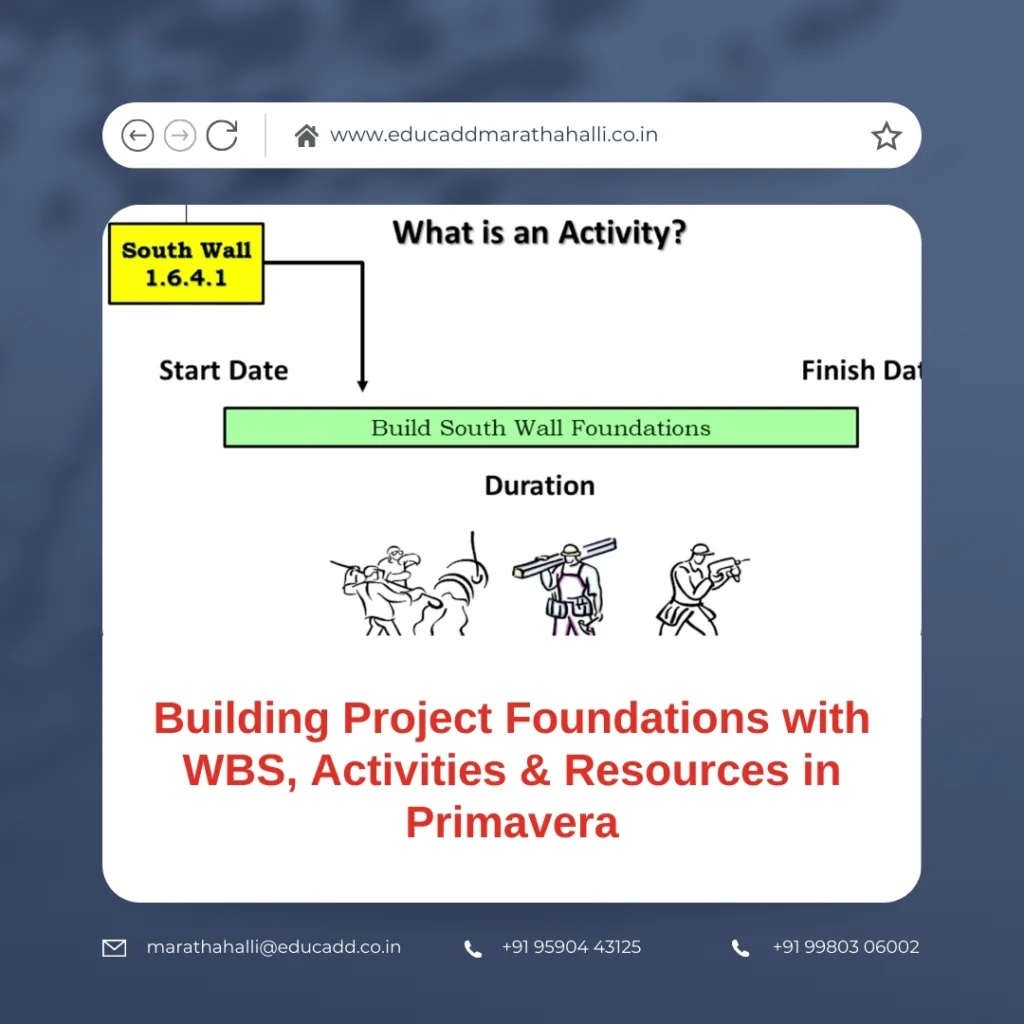
Primavera WBS Activities Resources
When professionals learn WBS, Activities & Resources in Primavera, they gain the ability to plan with precision, monitor progress effectively, and allocate resources wisely. This article explores how these three components form the backbone of structured project execution. With a clear understanding, you can apply them to real projects and achieve measurable success.
Understanding WBS in Primavera
A Work Breakdown Structure (WBS) divides a project into smaller, manageable parts. Instead of dealing with one massive task, WBS allows managers to focus on clear and trackable sections.
In Primavera, WBS becomes the skeleton of the project plan. It creates a hierarchy that defines deliverables, phases, and sub-deliverables. Each branch of the WBS clarifies responsibilities, ensuring no task gets overlooked.
-
Hierarchy and Clarity: At the top level, the WBS reflects the overall project. Below, it branches into phases, then into specific deliverables, and finally into manageable work packages.
-
Better Tracking: Managers can quickly identify which phase is on track and which one needs attention.
-
Flexibility: As projects evolve, the WBS in Primavera can adapt without losing historical records.
For example, a construction project WBS might break down into design, permits, foundation, structure, and finishing. Each of these categories contains detailed sub-sections. This systematic approach simplifies reporting and aligns the team with project goals.
Defining Activities in Primavera
Once the WBS is in place, activities bring motion to the structure. Activities in Primavera represent the actual tasks required to complete each work package.
Each activity has attributes such as duration, start date, finish date, and dependencies. Primavera uses this information to build a logical project sequence, ensuring smooth workflow.
Key aspects of Activities in Primavera include:
-
Task Breakdown: Every WBS element converts into activities. For instance, “foundation” may split into “excavation,” “concrete pouring,” and “curing.”
-
Dependencies: Primavera allows defining predecessor and successor relationships. For example, walls cannot start before the foundation is complete.
-
Scheduling Accuracy: Activities determine the project timeline by connecting tasks logically.
-
Progress Tracking: Managers update activity status to track real progress against planned schedules.
By learning WBS, Activities & Resources in Primavera, managers transition from vague planning to highly detailed project maps. This clarity reduces risks, shortens delays, and improves communication across teams.
Assigning Resources in Primavera
While WBS provides structure and activities provide tasks, resources bring life to the plan. Primavera resources include manpower, equipment, and materials. Without them, even the best-designed schedule is just a paper exercise.
Primavera allows assigning resources directly to activities. This step ensures that every task has the necessary support for execution.
-
Types of Resources: Primavera classifies them into labor, non-labor (such as equipment), and materials.
-
Allocation: Managers can assign resources to multiple activities but must balance workloads to avoid conflicts.
-
Costs and Budgets: Primavera links resource usage with cost estimation, giving managers real-time financial insights.
-
Leveling: Primavera automatically adjusts workloads when resources are over-assigned, creating a balanced schedule.
Consider a scenario in a software development project. Resources include developers, testers, licenses, and servers. By allocating them accurately in Primavera, managers avoid bottlenecks and keep projects on track.
Integrating WBS, Activities & Resources in Primavera
While WBS, activities, and resources can be studied separately, their real power emerges when integrated. Primavera connects these elements seamlessly, creating a dynamic project model.
Here’s how the integration works:
-
WBS as Structure: It sets the project’s framework.
-
Activities as Action: They define the steps required within the structure.
-
Resources as Fuel: They provide the people, equipment, and materials to execute each step.
This integration allows Primavera to generate project schedules, cost forecasts, and performance reports. When managers update progress, Primavera recalculates timelines, resource usage, and budgets instantly.
The result is a living project plan. It doesn’t just sit in a file; it adapts to reality and provides accurate guidance for decision-making.
Benefits of Learning WBS, Activities & Resources in Primavera
Professionals who learn WBS, Activities & Resources in Primavera gain a competitive edge in project-driven industries. Some of the standout benefits include:
-
Clearer Planning: Breaking down projects makes them easier to understand and communicate.
-
Efficient Execution: Activities ensure tasks flow in the right order with no wasted time.
-
Resource Optimization: Balanced allocation avoids overuse and idle time.
-
Cost Control: Linking resources to activities gives accurate budget insights.
-
Performance Tracking: Managers can identify delays early and act quickly.
Industries such as construction, IT, oil and gas, and manufacturing rely on Primavera for these exact reasons. Professionals trained in WBS, Activities & Resources are often more confident and in demand.
Conclusion
Strong project management depends on structure, detail, and resources. In Primavera, these three elements come together seamlessly through WBS, activities, and resources. By learning how to use them effectively, professionals can transform chaotic projects into well-managed successes.
When you learn WBS, Activities & Resources in Primavera, you are not just adopting a tool—you are adopting a framework for clarity, accountability, and success. Whether you manage small teams or global projects, mastering these concepts equips you to deliver on time, on budget, and with confidence.

