
Navigating Project Complexity: How Primavera P6 Simplifies Modern Project Management
Managing complex projects has never been easy. Large-scale initiatives often involve thousands of activities, multiple stakeholders, strict deadlines, and significant budgets. Without proper tools, project managers struggle to balance tasks, allocate resources, and mitigate risks. That is why organizations across industries rely on advanced project management solutions. Among them, Primavera P6 Project Management stands out as one of the most effective.
Renowned for its scalability and precision, Primavera P6 offers powerful features for planning, scheduling, resource allocation, and reporting. From construction and engineering to IT and manufacturing, this software helps teams handle projects of any size with confidence. More importantly, it empowers managers to stay in control even when challenges arise.
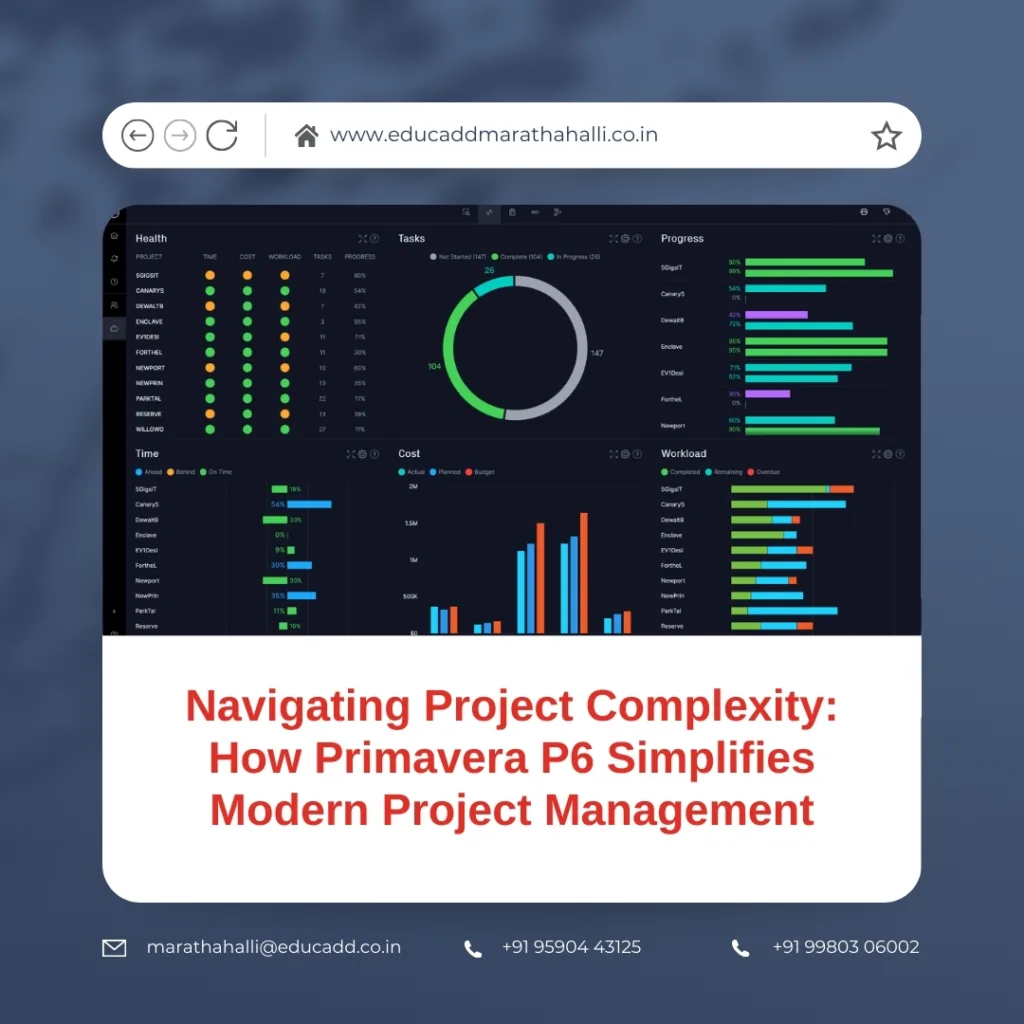
Primavera P6 Project Management
In this blog, we will explore how Primavera P6 helps in complex project management and why it has become a trusted choice for professionals aiming to deliver projects successfully.
1. Structured Planning for Complex Initiatives
Complex projects demand clarity in planning. When multiple tasks depend on one another, a single misstep can derail progress. Primavera P6 tackles this challenge by enabling managers to design structured work breakdown systems.
The software allows detailed mapping of activities, milestones, and dependencies. Each task can be visualized through Gantt charts, making it easier to identify priorities and deadlines. With built-in critical path analysis, managers can pinpoint the most time-sensitive activities and prevent bottlenecks.
Another strength is its adaptability. Complex projects rarely remain static; scope adjustments and client demands often require changes. Primavera P6 makes it possible to reconfigure schedules quickly without affecting the overall framework. This flexibility ensures projects stay aligned with goals, regardless of unexpected shifts.
2. Smarter Resource Utilization and Cost Control
In large-scale projects, resource management often determines success or failure. Primavera P6 provides advanced tools to allocate resources effectively while avoiding waste. Managers can assign staff, equipment, and materials to tasks while monitoring their availability in real time.
The system also integrates resource usage with cost tracking. For example, when machinery hours or workforce allocation changes, Primavera P6 updates financial forecasts automatically. This creates visibility across both operational and financial aspects of a project.
Beyond tracking, the platform helps balance workloads. Overburdened teams often experience reduced productivity, while underutilized resources increase costs. Primavera P6 highlights imbalances so managers can redistribute tasks efficiently. This leads to higher productivity and controlled project spending.
3. Proactive Risk Management and Scenario Planning
Every complex project carries risks—from supplier delays to unforeseen expenses. Primavera P6 gives managers the ability to anticipate and prepare for these risks before they disrupt progress.
Through “what-if” analysis, managers can simulate different project outcomes. This feature helps create contingency plans by showing how certain risks could affect schedules or costs. For instance, if a material delivery is delayed, Primavera P6 calculates its impact on timelines and suggests alternative strategies.
It also integrates risk evaluation directly into scheduling. Managers can assess which risks affect critical tasks and prioritize accordingly. By combining forecasting with risk planning, Primavera P6 equips teams to respond to challenges proactively rather than reactively.
4. Better Collaboration Across Diverse Teams
Large projects often involve multiple teams, contractors, and stakeholders working in different locations. Miscommunication between them can easily lead to errors or delays. Primavera P6 minimizes this risk by providing a centralized system where all project data is stored and updated.
Team members can access real-time information, ensuring transparency across the project lifecycle. When one department updates progress, the entire system reflects it immediately. This eliminates confusion caused by outdated or conflicting records.
The software also integrates with enterprise solutions such as ERP and financial tools, creating a seamless flow of information across departments. Role-based access ensures that everyone—from top management to field staff—receives only the information relevant to their role.
With this streamlined collaboration, Primavera P6 builds trust, improves accountability, and aligns diverse teams toward shared project goals.
5. Advanced Monitoring, Reporting, and Project Control
Tracking performance in complex projects is vital. Without reliable monitoring, managers cannot identify risks early or make effective decisions. Primavera P6 offers advanced monitoring tools that provide a complete picture of project performance.
The software tracks critical metrics like schedule variance, cost variance, and earned value. These indicators allow managers to compare progress against the baseline and spot deviations. With real-time dashboards, decision-makers can instantly identify areas needing attention.
Customizable reports further enhance communication with stakeholders. Instead of spending hours compiling manual data, managers can generate precise reports that highlight performance trends, challenges, and forecasts. This ensures stakeholders remain informed and engaged.
Perhaps most importantly, Primavera P6 supports corrective actions. When issues arise, managers can adjust schedules, reassign resources, or modify budgets with minimal disruption. This level of control ensures that even highly complex projects stay on course.
Conclusion: Why Primavera P6 is Essential for Complexity
Complex projects require more than effort—they demand structure, foresight, and advanced tools. Primavera P6 delivers all three by simplifying planning, optimizing resource usage, managing risks, enabling collaboration, and strengthening control.
By adopting Primavera P6, organizations gain a strategic advantage in managing projects of any scale. They can ensure on-time delivery, efficient resource utilization, and budget discipline. More importantly, project teams remain confident even in the face of uncertainty.
Ultimately, how Primavera P6 Project Management goes beyond efficiency—it transforms uncertainty into manageable strategy and complexity into successful execution. For companies aiming to thrive in competitive markets, Primavera P6 is not just useful; it is indispensable.

