
Premier AutoCAD Civil Course in Bangalore Skill Guide
The construction and infrastructure sectors are expanding rapidly across India today. Consequently, this massive growth creates a strong demand for skilled civil drafters and project planners. Enrolling in a specialized AutoCAD Civil course gives fresh graduates and working site engineers the exact technical roadmap needed to secure high-paying design jobs. Furthermore, mastering computer-aided drafting through structured CADD training helps civil engineers convert complex land survey data into clear municipal blueprints. Joining a well-known CADD training institute guarantees you gain hands-on skills in the modern software tools that power urban real estate and highway development.
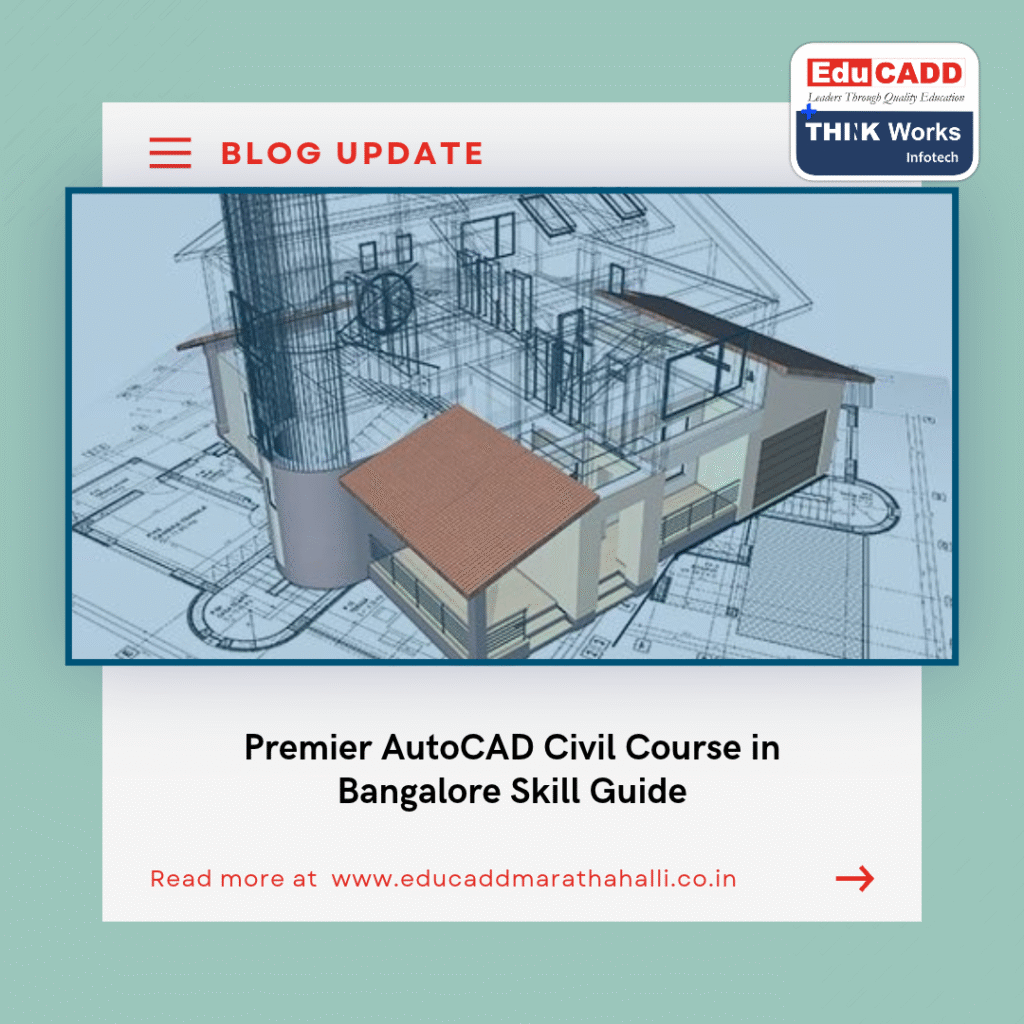
The Vital Role of Civil Drafting in Modern Construction
Modern civil engineering projects require exact measurements, fast design updates, and strict adherence to local building codes. Manual hand drafting simply cannot keep up with modern building timelines. Because human errors on paper blueprints cause expensive site delays, engineering firms now rely entirely on digital software.
Computer-aided design software brings speed and accuracy to every stage of a construction project. Designers create digital layouts that teams share easily across offices and building sites. Moreover, engineers check structural alignments in seconds rather than spending weeks recalculating measurements by hand.
Key Benefits of Digital Civil Drafting Workflows
-
Exact Measurement Accuracy: Digital drafting tools guarantee precise geometric lines. As a result, engineers remove costly calculation mistakes in building layouts and land boundaries.
-
Standardized Municipal Drawings: Construction firms use clean layer setups, clear line weights, and standard plot scales. Therefore, blueprints easily pass government approval checks without delays.
-
Dynamic Terrain Modeling: Civil design tools help engineers map land contours and plan road paths quickly. In addition, calculating earthwork cut-and-fill volumes becomes fast and simple.
-
Instant Sheet Updates: Changing a wall layout updates every connected view and dimension across the entire drawing set automatically.
Developing these vital drafting abilities through practical job oriented courses prepares young engineers to step straight into productive office roles.
Essential Technical Skills and Complementary Tracks for Engineers
A strong engineering resume requires skills that go beyond basic 2D line drawing. Today, top construction and design firms look for candidates who understand 3D modeling, structural analysis, and project management. Learning complementary software tools widens your job choices and increases your starting salary.
Civil, Architectural, and Structural Design Tools
Civil drafting serves as the starting point for many advanced building design platforms. Once you master basic coordinates, you can explore deeper engineering software.
-
Core 2D Drafting: Learn essential drawing commands, layer control, and layout scales by completing an AutoCAD course alongside an AutoCAD Civil course.
-
Specialized Engineering Fields: Expand your practical knowledge by studying a Civil CADD course, an Architectural CADD course, and an Electrical CADD course.
-
Building Information Modeling: Move from flat 2D plans into smart 3D modeling through a Revit Architecture course, a Revit Structure course, and a BIM course.
-
Structural Analysis and Planning: Test concrete building frames and manage project schedules using a STAAD Pro course, an ETABS course, and a Primavera P6 course.
-
Interior Space Design: Create attractive room layouts, lighting plans, and 3D views by taking an Interior design course.
Mechanical Design and Precision Manufacturing Tools
Civil engineers working on steel factories, industrial plants, and heavy equipment foundations often work closely with mechanical teams. Understanding mechanical tools helps civil designers coordinate steel connections and pipe layouts smoothly.
Mechanical modeling relies on parametric 3D design principles. Engineers build digital machine parts and test how they fit together before factory production begins.
-
Core Mechanical Principles: Learn machine part assemblies, sheet metal layouts, and drafting rules through a Mechanical CADD course.
-
3D Surface and Part Modeling: Master industrial product design and complex curves using CATIA training, a SolidWorks course, and Creo training.
-
Stress and Load Testing: Check structural weak points, material limits, and heat distribution via HyperMesh training.
-
Manufacturing Precision: Apply exact size limits, surface finishes, and assembly fits with GD&T training.
Software Programming and Automation Skills
Modern engineering companies increasingly use custom computer scripts and web tools to speed up repetitive design tasks. Engineers who understand basic coding stand out quickly during technical job interviews.
Writing simple automation scripts saves hours of manual data entry on large infrastructure projects. Furthermore, database tools help project managers track material costs and worker schedules in real time.
-
Full Stack Web Coding: Engineers interested in custom design tools, mapping apps, and data tracking benefit greatly from a Python Full Stack course.
-
Practical Technical Growth: Joining a trusted technical training institute gives learners hands-on practice with both core engineering software and modern coding tools.
Digital Marketing and Business Growth Strategies
Freelance civil consultants, independent architects, and small engineering firms need strong online visibility to win new building contracts. Traditional word-of-mouth referrals alone no longer bring steady commercial leads.
Learning how to market your engineering services online opens doors to global design clients. In addition, showcasing 3D building walkthroughs on social media builds instant trust with property developers.
-
Core Online Marketing: Master digital lead generation and brand building by taking a Digital marketing course, studying at a Digital marketing institute, and completing Digital marketing training.
-
Targeted Growth Channels: Reach local property builders using an SEO course, a Google Ads course, a Social media marketing course, a Performance marketing course, and an AI digital marketing course.
-
Career Focused Programs: Gain real agency experience through a Job oriented digital marketing course, a Digital marketing course with placement, a Professional digital marketing course, a Masters in digital marketing course, an Online digital marketing course, a Digital marketing internship, and Digital marketing live project training.
Complete Syllabus Breakdown: What You Will Master
An industry-ready civil drafting curriculum guides learners step-by-step from basic screen setup to full municipal building submission sets. Every module focuses on real-world construction tasks rather than dry textbook theory.
First, students master the user interface, drawing units, and grid limits. Instructors teach absolute, relative, and polar coordinate systems so learners draw lines with zero guesswork. You also practice core creation commands like Line, Polyline, Circle, Arc, and Hatching.
Next, training moves into fast editing commands and clean layer management. You learn how to copy, move, rotate, scale, trim, extend, and fillet complex shapes quickly. Furthermore, instructors show how to organize layers with distinct colors and line weights so contractors read blueprints easily on noisy construction sites.
In the third phase, students build reusable blocks and link external reference files. Creating smart dynamic blocks for doors, windows, and structural columns saves massive amounts of drafting time. Moreover, you practice drawing complete residential floor plans, front elevations, structural cross-sections, and foundation layouts.
Finally, the course covers land surveying data, road alignments, and print setup. You import real survey points, draw land contour maps, and calculate earthwork volumes. Additionally, instructors guide you through paper space viewports, title block creation, and exporting clean PDF files for city building approvals.
High-Paying Career Opportunities for Civil Drafters
Earning practical drafting skills from a recognized skill development institute unlocks steady, well-paid jobs across private builders, engineering consultancies, and public infrastructure firms.
Companies actively hire certified drafters because they produce accurate work from day one. Consequently, trained candidates move quickly from junior drafting roles into senior project coordination positions.
-
Civil Structural Drafter: Creates detailed reinforced concrete drawings, steel bar bending schedules, and deep foundation layouts.
-
Land Development Technician: Designs site grading plans, land contour maps, drainage networks, and highway alignments.
-
Architectural Detailer: Prepares working floor plans, building elevations, staircase details, and municipal approval sheets.
-
Quantity Estimation Engineer: Uses exact digital drawings to measure concrete volumes, steel weights, and total project costs.
-
Site CAD Coordinator: Reviews incoming contractor drawings, resolves layout clashes, and updates master project files daily.
Actionable Roadmap to Launch Your Civil Design Career
Turning software knowledge into a rewarding engineering job requires a clear, step-by-step plan. Following proven career habits helps fresh graduates beat the competition during technical hiring rounds.
Start by practicing keyboard shortcuts every single day to build drafting speed. Employers value designers who finish clean drawings quickly without sacrificing geometric accuracy. Joining a reputable professional training institute gives you structured lab hours to master these fast workflows.
Second, build a strong portfolio containing five to eight complete civil projects. Include a multi-story residential floor plan, a structural beam layout, a site contour map, and a municipal submission sheet. Showing real drawings proves your practical ability far better than listing software names on a resume.
Third, earn an official course certificate to validate your technical skills. Recruiters scan resumes quickly, and recognized credentials immediately highlight your dedication to professional growth.
Fourth, prepare thoroughly for live practical tests before attending job interviews. Most engineering firms ask candidates to draft a floor plan within a strict time limit during hiring. Practicing under timed conditions keeps you calm and confident when the clock starts ticking.
Build a Thriving Future in Civil Design
Acquiring hands-on drafting skills remains the smartest way to build a lasting, high-income career in civil engineering and construction. Whether you aim to become a structural detailer, land development technician, BIM modeler, or project planner, practical software mastery puts you ahead in today’s competitive job market. Choosing structured courses that provide expert mentors, modern computer labs, and dedicated placement help turns classroom learning into real career success. When you feel ready to upgrade your engineering skills, start your journey with a trusted center like EduCADD Marathahalli and build a bright future in modern infrastructure design.

