
Innovating Construction Projects: Essential Modern Tools for Management
The construction industry has undergone a remarkable transformation in recent years. Gone are the days when project managers relied solely on manual records, physical blueprints, and on-site inspections to oversee construction projects. Today, Modern Construction Management Tools the integration of technology has become vital, enabling construction teams to enhance efficiency, reduce risks, and maintain high standards of quality.
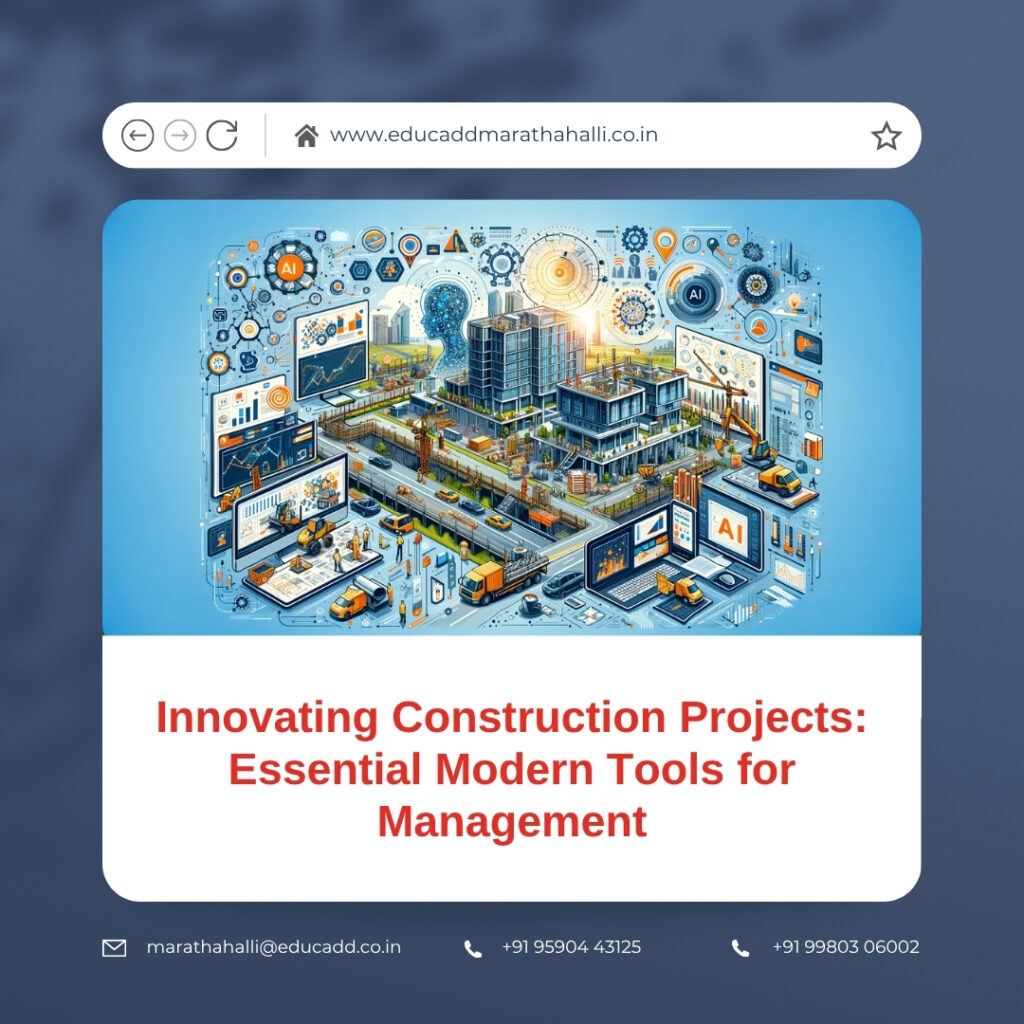
Modern Construction Management Tools
Modern construction management revolves around precision, communication, and real-time decision-making. With complex projects, tight timelines, and increasing costs, construction professionals need the right tools to stay ahead. Leveraging technology not only improves productivity but also ensures projects are delivered on schedule and within budget.
This blog highlights the Modern Construction Management Tools and explores how they contribute to smarter project execution. Each tool addresses a specific challenge and collectively transforms the construction process from planning to completion.
1. Building Information Modeling (BIM) – The Foundation of Modern Planning
Building Information Modeling (BIM) has redefined how construction projects are conceptualized and executed. Unlike traditional blueprints, BIM provides a dynamic 3D digital model that integrates data about materials, dimensions, schedules, and costs. This model becomes a central source of truth, accessible to architects, engineers, and contractors.
One of BIM’s biggest advantages is its ability to enhance collaboration. Teams can work simultaneously on the same model, identifying potential design conflicts before construction begins. For instance, clashes between electrical wiring and plumbing layouts can be resolved digitally, preventing costly rework on site.
BIM also allows for simulation and scenario analysis. Project managers can assess how design changes impact costs, timelines, and energy efficiency. By predicting outcomes in advance, BIM reduces risks and ensures smoother project execution.
Beyond planning, BIM supports maintenance and facility management post-construction. Digital models continue to provide valuable information about building systems, making long-term operations more efficient. With these capabilities, BIM has become indispensable in modern construction management.
2. Advanced Construction Project Management Software
Managing a construction project involves juggling numerous tasks, including scheduling, resource allocation, budgeting, and reporting. Advanced project management software simplifies these processes by consolidating information into a single, centralized platform.
Tools like Procore, Buildertrend, and Oracle Primavera offer real-time updates on project progress, making communication seamless across office and site teams. Supervisors can update task completion, while project managers instantly monitor timelines and budgets. This transparency minimizes miscommunication and ensures accountability.
Project management software also automates many routine processes. For example, generating progress reports, tracking change orders, and maintaining compliance documentation become faster and less error-prone. Cloud-based platforms provide the added benefit of accessibility from any location, enabling teams to respond quickly to challenges.
By leveraging these tools, construction managers can maintain a clear overview of complex projects, optimize resource allocation, and minimize delays.
3. Drone Technology – Eyes in the Sky
Drone technology has rapidly gained traction in the construction sector, providing a bird’s-eye view of project sites that was previously difficult and expensive to obtain. Drones capture high-resolution aerial images, create 3D site maps, and monitor project progress with remarkable accuracy.
Drones significantly improve site surveying. Traditional surveys may take weeks, whereas drones can capture precise data within hours. They are also invaluable for inspecting tall structures, dangerous zones, or inaccessible areas without compromising worker safety.
Project managers can use drone data to track stockpiles, monitor site conditions, and document progress. These visuals help in verifying contractor claims, preventing disputes, and maintaining accurate records. Additionally, drone footage provides stakeholders with a clear perspective of ongoing activities, strengthening communication and transparency.
Incorporating drones into construction management improves both efficiency and safety, ensuring projects stay on schedule while reducing risks associated with manual inspections.
4. Artificial Intelligence and Predictive Analytics
Artificial Intelligence (AI) is reshaping decision-making in construction management. By analyzing historical data and real-time inputs, AI predicts potential risks, schedule deviations, and budget overruns. This predictive capability empowers managers to take proactive measures, avoiding costly delays.
For instance, AI algorithms can detect patterns in past projects, identifying areas prone to errors or inefficiencies. Predictive maintenance tools alert managers when equipment is likely to fail, allowing timely repairs and reducing downtime. AI can also optimize workforce management by monitoring labor productivity and suggesting resource allocation adjustments.
Data analytics combined with AI enhances planning accuracy. Managers can forecast project timelines, estimate material needs, and control costs with greater precision. When integrated with project management software, AI becomes a powerful decision-support tool that reduces human error and drives operational efficiency.
5. Mobile Applications and Cloud Collaboration
Construction teams are constantly on the move, and traditional methods of communication are often slow and fragmented. Mobile applications have emerged as essential tools, giving teams instant access to project documents, schedules, and updates directly on their devices.
Cloud-based collaboration platforms complement mobile apps by enabling real-time file sharing, task tracking, and approval workflows. Changes in designs, schedules, or task assignments are immediately visible to all team members, eliminating delays caused by outdated information.
Mobile and cloud tools also support on-site documentation. Photos, videos, and progress updates can be uploaded instantly, creating accurate records for quality control, safety compliance, and client reporting. These tools foster transparency, improve coordination between multiple teams, and enhance overall project efficiency.
By combining mobility with cloud accessibility, construction management becomes a seamless, connected process rather than a series of fragmented tasks.
Conclusion: Technology as the Backbone of Modern Construction
The construction industry is evolving rapidly, and technology is at the heart of this transformation. The Modern Construction Management Tools—BIM, project management software, drones, AI, and mobile/cloud applications—collectively empower managers to plan, monitor, and execute projects with precision.
These tools not only enhance efficiency and safety but also provide a competitive edge. Companies that adopt advanced construction technologies are better positioned to meet deadlines, control costs, and deliver high-quality projects. As construction demands grow, embracing digital solutions is no longer optional—it is essential for sustainable success.
In a field where every delay and error can lead to significant financial and operational consequences, modern tools are more than conveniences; they are strategic investments. By integrating these technologies, construction teams can build smarter, safer, and more efficiently, paving the way for a future where projects are executed with confidence and accuracy.

