
Designing Tomorrow: The Future of CAD – Why Learning Advanced Modeling Tools Pays Off
Technology has reshaped the way industries innovate, manufacture, and deliver products to the world. Among the many forces driving this transformation, Computer-Aided Design (CAD) stands as one of the most influential. Today, CAD is no longer just a digital drawing tool—Future of CAD Tools has become a sophisticated ecosystem that powers innovation in engineering, construction, product design, healthcare, and many other fields.
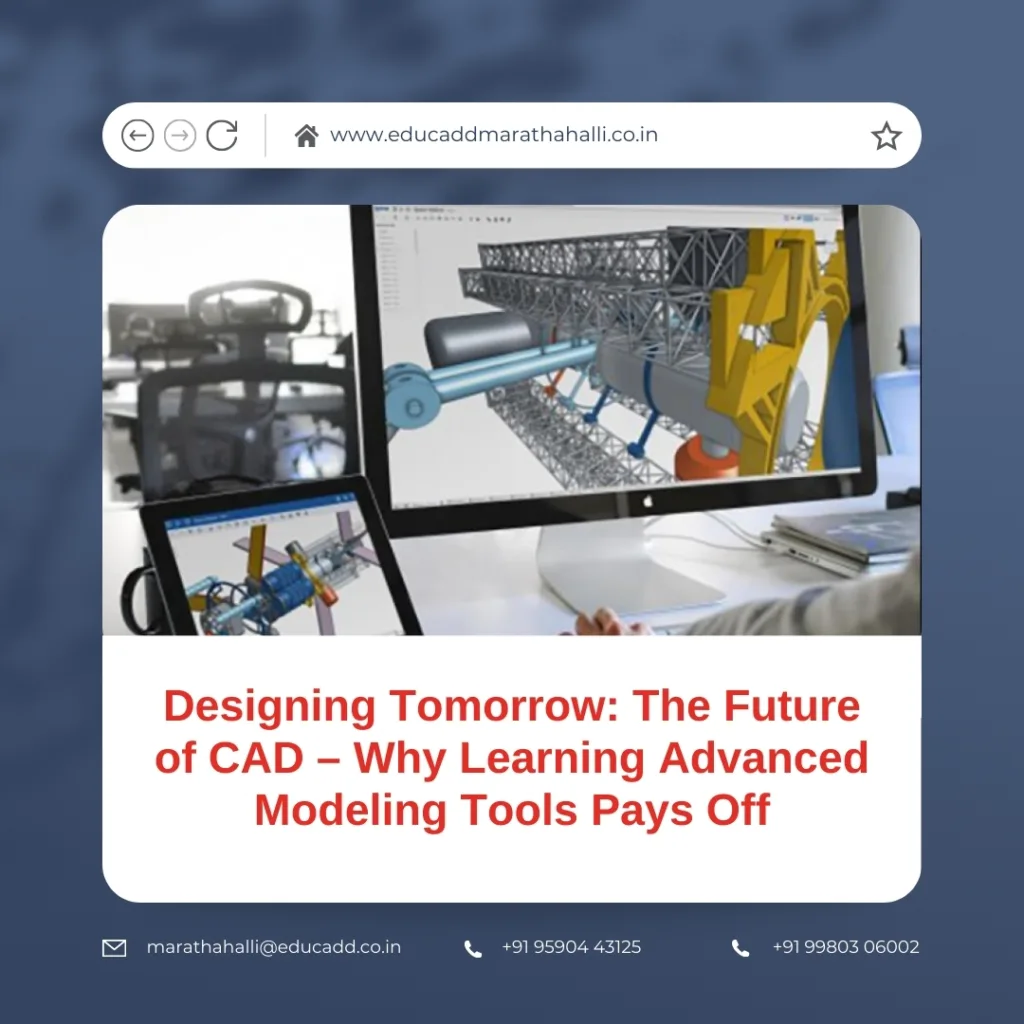
Future of CAD Tools
The central idea of “The Future of CAD – Why Learning Advanced Modeling Tools Pays Off” highlights how crucial these tools are for professionals who want to stay relevant, competitive, and future-ready. This blog dives into how CAD has evolved, why advanced modeling tools are essential, and how mastering them can unlock endless career and business opportunities.
CAD’s Journey: From Drafting Tables to Digital Intelligence
To appreciate The Future of CAD – Why Learning Advanced Modeling Tools Pays Off, we must first look at how it started. CAD originated as a way to replace manual drafting. Engineers and architects initially used it for two-dimensional schematics that mimicked traditional drawings. Over the years, CAD advanced into three-dimensional design platforms capable of handling highly detailed assemblies.
Today, CAD is more than visualization. It has become a decision-making tool that enables simulation, real-time testing, and advanced collaboration. For example, before manufacturing begins, engineers use CAD to test strength, durability, and efficiency. This approach reduces waste, lowers costs, and accelerates product delivery.
With emerging integrations of Artificial Intelligence (AI), Augmented Reality (AR), and cloud-based collaboration, CAD tools are becoming smarter every year. Such developments prove that The Future of CAD – Why Learning Advanced Modeling Tools Pays Off for professionals and industries committed to innovation.
The Career Advantage of Mastering Advanced CAD
One of the most compelling reasons why The Future of CAD – Why Learning Advanced Modeling Tools Pays Off lies in the job market. The demand for skilled professionals with advanced CAD expertise has never been higher. Employers across aerospace, automotive, construction, and manufacturing prioritize candidates who can move beyond simple drafting and fully utilize advanced 3D modeling features.
Learning advanced CAD tools brings multiple benefits. First, it significantly increases employability. Candidates with strong CAD skills reduce design errors, enhance efficiency, and accelerate project timelines, making them highly valuable. Second, advanced skills open doors to international opportunities. Since global corporations rely heavily on CAD, professionals with expertise in platforms like SolidWorks, CATIA, Creo, and NX CAD can find jobs worldwide.
Additionally, Industry 4.0 is reshaping the workforce. Digital twins, generative design, and smart manufacturing systems are becoming standard. Those who invest in advanced CAD training align themselves with these new trends and remain indispensable to their organizations. Clearly, The Future of CAD – Why Learning Advanced Modeling Tools Pays Off for anyone who aspires to secure long-term success in engineering or design.
Transformative Power of CAD Across Industries
The significance of The Future of CAD – Why Learning Advanced Modeling Tools Pays Off is not just about personal careers. Industries across the globe rely on CAD as a backbone of innovation and transformation.
Aerospace and Automotive
In aerospace, CAD helps engineers design safer, lighter, and more efficient aircraft. Simulations within CAD platforms reduce the need for physical prototypes, saving both money and time. Similarly, in the automotive industry, CAD enables the creation of vehicles with advanced aerodynamics, electric propulsion systems, and optimized weight distribution.
Architecture and Construction
Architects now use CAD for Building Information Modeling (BIM), which combines structural, electrical, and environmental factors into one cohesive model. Sustainable design has become critical, and CAD tools allow professionals to create buildings that save energy, reduce waste, and withstand environmental challenges.
Healthcare and Biotechnology
In healthcare, CAD demonstrates why The Future of CAD – Why Learning Advanced Modeling Tools Pays Off. Surgeons practice on CAD-based simulations, reducing risks during real surgeries. Medical device companies design implants, prosthetics, and surgical instruments with unmatched precision, often customized for individual patients.
Consumer Electronics and Manufacturing
From smartphones to home appliances, CAD accelerates innovation in consumer goods. It ensures ergonomic design, functionality, and cost-effective production. Advanced modeling tools enable faster iterations, giving companies a competitive edge.
Renewable Energy and Sustainability
As industries shift to green technologies, CAD plays an essential role. Engineers design wind turbines, solar cells, and other renewable energy systems using advanced CAD simulations. This reduces testing costs and helps create energy-efficient solutions that meet global sustainability goals.
Each of these examples shows how entire industries validate why The Future of CAD – Why Learning Advanced Modeling Tools Pays Off not just for individuals but for the progress of society as a whole.
Key Skills for Future-Ready CAD Professionals
Adapting to The Future of CAD – Why Learning Advanced Modeling Tools Pays Off requires developing the right skill set. Knowing only the basics is no longer enough. To stand out, professionals must strengthen their expertise in advanced areas.
-
Parametric Modeling: It enables designs that automatically update when dimensions change, saving time and ensuring accuracy.
-
Simulation and Analysis: Proficiency in running stress tests, fluid dynamics, and thermal studies is now a critical skill.
-
Collaboration Tools: Cloud-based CAD systems allow real-time teamwork across different regions and departments.
-
Integration with Manufacturing: Knowledge of CAD-CAM integration, CNC machining, and 3D printing adds practical value.
-
Adaptability: With AI-driven design, generative modeling, and AR visualization on the rise, adaptability ensures professionals keep pace with evolving tools.
These skills not only guarantee relevance but also reinforce why The Future of CAD – Why Learning Advanced Modeling Tools Pays Off for long-term success.
Investing in CAD Training: A Path to Success
The final piece of understanding The Future of CAD – Why Learning Advanced Modeling Tools Pays Off lies in education and training. Without proper training, even the most motivated professionals cannot unlock the true potential of CAD.
Today, numerous institutions and online platforms offer comprehensive CAD training programs. These range from beginner to advanced levels, covering design, simulation, and industry-specific applications. Certifications from credible platforms enhance credibility and provide professionals with a competitive edge.
The flexibility of online learning also makes advanced CAD accessible. Students, working professionals, and entrepreneurs can learn at their own pace without disrupting their schedules. This accessibility ensures anyone can invest in CAD skills and reap long-term rewards.
The payoff from CAD training is substantial. With industries adopting automation, sustainability, and advanced design processes, professionals who invest in CAD today position themselves for leadership tomorrow. That’s exactly why The Future of CAD – Why Learning Advanced Modeling Tools Pays Off is not just a statement but a proven strategy for career advancement.
Conclusion: The Road Ahead with CAD Mastery
In summary, The Future of CAD – Why Learning Advanced Modeling Tools Pays Off is more than a phrase—it is a vision that professionals and industries must embrace. CAD has evolved from basic drawing software into an advanced ecosystem that powers innovation, efficiency, and sustainability across sectors.
Professionals who master advanced modeling tools gain a powerful advantage in employability, global opportunities, and entrepreneurship. Industries from aerospace to healthcare rely heavily on CAD, making it the backbone of modern innovation. By investing in training and continuously adapting to technological progress, individuals ensure lifelong career growth.
The future belongs to those who prepare today. By mastering advanced CAD tools, you not only secure your professional path but also contribute to shaping the innovations of tomorrow. That is why The Future of CAD – Why Learning Advanced Modeling Tools Pays Off for every ambitious learner who chooses to grow with technology.

