
Digital to Physical Excellence: Reimagining the Complete CAD/CAM Workflow
In an era Digital to Physical CADCAM where manufacturing speed and accuracy directly influence competitiveness, the journey from drafting to manufacturing. Modern industries no longer rely on isolated drawings or manual interpretations. Instead, they depend on an integrated CAD/CAM workflow that transforms ideas into manufacturable products with precision and confidence. This workflow connects creativity, engineering logic, and production efficiency into a single continuous process. From the first conceptual sketch to the final machined component, CAD/CAM ensures clarity, consistency, and control. This blog presents a fresh, in-depth exploration of the complete CAD/CAM workflow, explaining how each stage contributes to reliable, scalable, and cost-effective manufacturing.
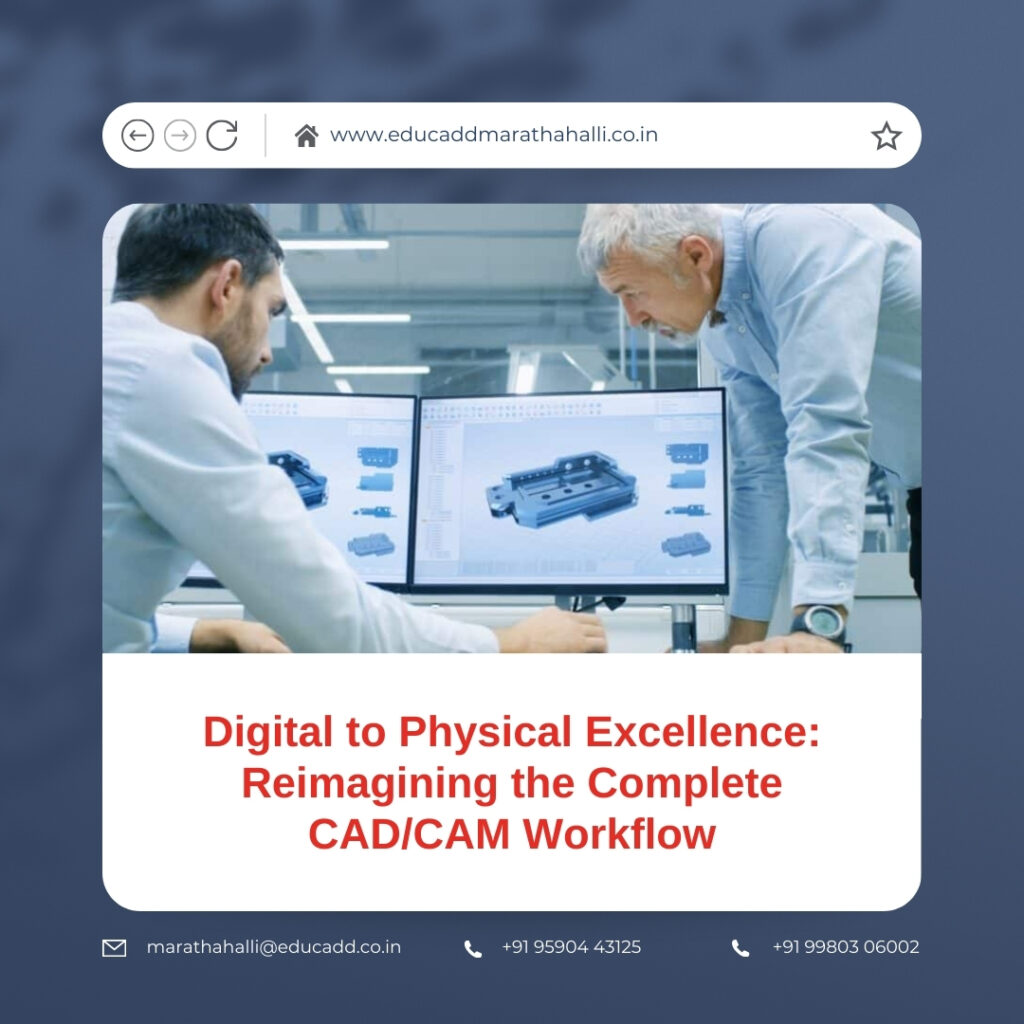
Digital to Physical CADCAM
The Strategic Importance of CAD/CAM in Today’s Industries
CAD/CAM has evolved from a technical aid into a strategic business enabler. Computer-Aided Design empowers engineers to visualize products digitally, while Computer-Aided Manufacturing converts those designs into executable production instructions. Together, they create a digital backbone that supports faster decision-making and higher quality standards. Industries such as automotive, aerospace, construction, medical devices, and consumer goods rely heavily on CAD/CAM to maintain precision and repeatability. By unifying design and manufacturing data, organizations reduce miscommunication, shorten development cycles, and achieve predictable outcomes.
Concept Development and Design Planning
Every successful product begins with thoughtful planning. During the concept development phase, teams define functional goals, performance expectations, material constraints, and regulatory requirements. Designers translate these requirements into preliminary digital drafts using CAD tools. These early representations allow stakeholders to evaluate feasibility and aesthetics simultaneously. Because changes are easy to implement digitally, teams can refine ideas rapidly. This stage builds a strong foundation for the entire CAD/CAM workflow by aligning vision with technical reality.
Technical Drafting and 2D Design Foundations
Before advancing to complex modeling, designers create accurate 2D drawings. These technical drafts define dimensions, tolerances, reference points, and annotations. Although 3D modeling dominates modern workflows, 2D drafting remains essential for documentation, approvals, and compliance. Clear drafting standards ensure that every team member interprets the design correctly. When done properly, this stage eliminates ambiguity and prepares designs for smooth progression into three-dimensional environments.
Comprehensive 3D CAD Modeling
The transition from 2D drafting to 3D modeling marks a significant milestone. Designers develop detailed digital models that replicate real-world geometry and behavior. These models include material properties, assemblies, and parametric relationships. Parametric modeling allows engineers to modify dimensions without rebuilding the entire design. This flexibility accelerates design iterations and improves accuracy. Three-dimensional visualization also enhances collaboration, enabling stakeholders to understand the product clearly before manufacturing begins.
Assembly Design and Functional Coordination
Complex products rarely consist of a single component. Assembly design ensures that all parts fit and function together seamlessly. CAD systems support interference detection, tolerance analysis, and motion simulation. Designers can identify clashes or alignment issues early in the process. By resolving assembly challenges digitally, manufacturers avoid costly rework during production. This coordinated approach improves reliability and ensures smooth assembly on the shop floor.
Engineering Analysis and Performance Validation
Before releasing designs for production, engineers conduct in-depth analysis. Simulation tools integrated into CAD software evaluate structural integrity, thermal performance, and mechanical behavior. Finite Element Analysis identifies stress concentrations, while motion analysis validates dynamic performance. These virtual tests replace many physical trials, saving time and resources. Performance validation ensures that designs meet safety standards and functional requirements under real operating conditions.
Design for Manufacturability and Process Alignment
Design for Manufacturability plays a critical role in bridging design and production. Engineers review CAD models to ensure compatibility with available manufacturing methods. They consider machining limitations, tooling access, material behavior, and production costs. Simplifying features and optimizing tolerances improves efficiency. This stage ensures that designs move into manufacturing without unnecessary complexity, delays, or cost escalations.
Transition from CAD to CAM Systems
Once designs are manufacturing-ready, CAM systems take over. CAM software imports CAD models and interprets them into machining strategies. This transition preserves design accuracy while eliminating manual data transfer. CAM platforms support multiple manufacturing processes, including CNC milling, turning, and drilling. By maintaining a digital link, the workflow minimizes errors and ensures consistent execution across machines.
Toolpath Creation and Machining Strategy
Toolpath generation defines how machines shape raw material into finished components. Engineers select tools, cutting paths, and machining sequences based on material and design complexity. CAM simulations visualize the entire machining process, highlighting potential collisions or inefficiencies. Optimized toolpaths improve surface quality, reduce cycle times, and extend tool life. This stage directly impacts productivity and manufacturing cost control.
CNC Programming and Machine Preparation
After validating toolpaths, CAM software generates CNC programs that control machine operations. Operators prepare machines by installing tools, securing workpieces, and configuring fixtures. Accurate preparation ensures machines follow instructions precisely. Because CNC code originates directly from verified CAD/CAM data, the risk of human error decreases significantly. This seamless digital flow strengthens reliability across production runs.
Prototyping and Process Verification
Prototyping serves as a critical validation step before full-scale production. Manufacturers produce sample parts to verify design accuracy, machining quality, and functional performance. Rapid prototyping methods accelerate feedback cycles. Any issues identified during testing can be corrected without major disruption. Successful prototypes confirm that the CAD/CAM workflow performs as intended under real conditions.
Production Planning and Manufacturing Execution
With validated processes, manufacturers move into full production. CAD/CAM data supports scheduling, capacity planning, and cost estimation. Engineers analyze machining times and optimize workflows to maximize efficiency. Digital planning tools allow quick adjustments to meet changing demand. This structured execution phase ensures consistent output, reduced downtime, and predictable delivery timelines.
Quality Control and Digital Inspection
Quality assurance integrates seamlessly into the CAD/CAM workflow. Digital models serve as references for inspection systems such as coordinate measuring machines. Automated inspections compare manufactured parts against original design specifications. Deviations trigger immediate corrective action. This closed-loop quality system improves consistency and builds long-term customer trust.
Data Management and Collaborative Platforms
Effective data management ensures long-term workflow stability. Product Lifecycle Management systems store design revisions, manufacturing data, and documentation centrally. Teams access accurate information at every stage. Version control prevents conflicts and supports traceability. Collaborative platforms improve coordination across departments, suppliers, and production teams.
Smart Manufacturing and Future-Ready CAD/CAM
The future of Digital to Physical CADCAM lies in smart manufacturing integration. Industry 4.0 technologies connect machines, sensors, and analytics platforms. Real-time data improves decision-making and predictive maintenance. Digital twins simulate manufacturing scenarios before execution. CAD/CAM acts as the digital foundation for automation, scalability, and innovation.
Conclusion
The Digital to Physical CADCAM represents a powerful transformation from digital drafting to physical manufacturing. By unifying design, analysis, programming, and production, it delivers speed, accuracy, and consistency. Organizations that master this workflow reduce costs, improve quality, and accelerate innovation. As manufacturing continues to evolve, CAD/CAM will remain a cornerstone of efficient, future-ready production systems.

