
The CAM Mastery Blueprint: Essential Software Tools Shaping the Future of Mechanical Engineers
Mechanical engineering has entered an era where digital intelligence defines manufacturing success. Traditional machining knowledge alone is no longer sufficient to meet modern industry expectations. Today, companies demand engineers who can seamlessly translate complex designs into efficient, error-free production processes. This is where Computer-Aided Manufacturing, widely known as CAM, becomes indispensable. CAM Software for Engineers empowers mechanical engineers to control machining operations with unmatched accuracy, speed, and consistency. By automating toolpath generation and optimizing machine performance, CAM tools reduce production costs while enhancing quality. As global manufacturing standards rise, mastering CAM software is no longer an added advantage but a professional necessity. This blog presents a comprehensive, plagiarism-free exploration of CAM software tools every mechanical engineer must understand to remain competitive and future-ready.
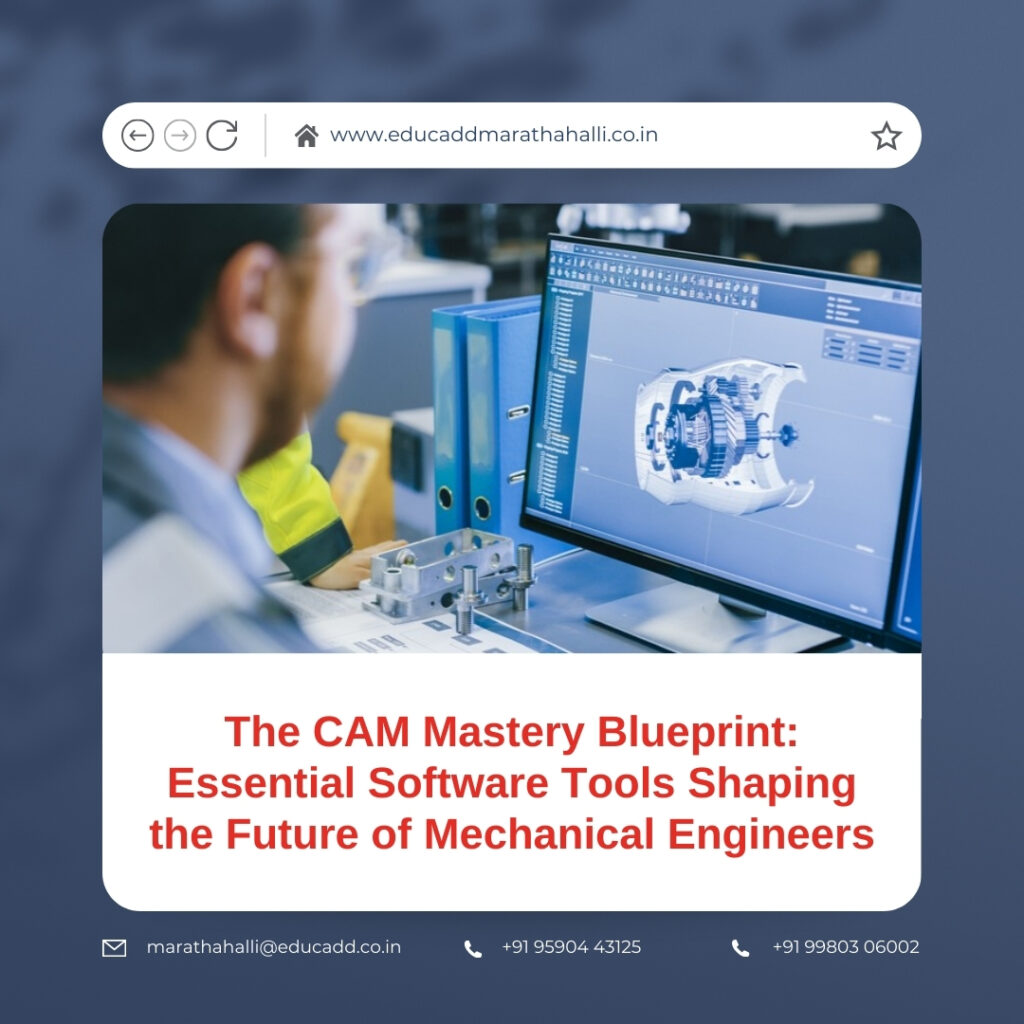
CAM Software for Engineers
CAM Software Explained: The Digital Backbone of Modern Manufacturing
CAM Software for Engineers serves as the digital backbone that connects engineering design with physical manufacturing. Mechanical engineers use CAM tools to convert CAD models into machine-readable instructions, commonly known as G-code. These instructions guide CNC machines to perform precise cutting, drilling, milling, and turning operations. Furthermore, CAM software allows engineers to simulate machining processes before execution. This capability significantly reduces material waste and prevents costly machine collisions. As manufacturing complexity increases, CAM systems provide engineers with greater control over tolerances, surface finishes, and cycle times. Therefore, CAM software plays a critical role in improving efficiency, reliability, and scalability across manufacturing industries.
Mastercam: A Global Standard in CNC Programming
Mastercam continues to be one of the most recognized CAM software tools across the manufacturing world. Mechanical engineers favor this software because it supports a wide range of machining operations, including 2D, 3D, and multi-axis CNC programming. Its intuitive interface allows engineers to create efficient toolpaths without extensive programming complexity. Additionally, Mastercam offers advanced simulation features that visually represent machining processes in real time. This visualization helps engineers detect errors early and optimize cutting strategies. As a result, production accuracy improves while setup time decreases. Due to its widespread adoption, Mastercam proficiency significantly enhances career opportunities for mechanical engineers.
Siemens NX CAM: Precision Engineering for High-End Manufacturing
Siemens NX CAM is designed for industries that demand extreme precision and advanced manufacturing control. Mechanical engineers working in aerospace, automotive, and defense sectors rely heavily on this software. NX CAM integrates design, analysis, and manufacturing within a single environment, enabling seamless data flow. Moreover, its multi-axis machining capabilities allow engineers to handle complex geometries with confidence. Automation features further reduce programming time while maintaining consistency. By simulating complete manufacturing environments, NX CAM helps engineers validate processes before production begins. Consequently, this software supports high-quality output and reduces operational risks.
SolidCAM: Intelligent Manufacturing Within SolidWorks
SolidCAM stands out for its deep integration with SolidWorks, making it a preferred choice for design-centric mechanical engineers. Since it operates within the CAD environment, any design modification automatically updates machining operations. This associative workflow minimizes errors and saves valuable time. SolidCAM’s advanced machining technologies optimize cutting conditions to extend tool life and reduce cycle durations. Mechanical engineers benefit from improved productivity and consistent part quality. Furthermore, SolidCAM supports a wide range of CNC machines, including milling, turning, and Swiss-type systems. As a result, it remains highly relevant in modern manufacturing workflows.
Fusion 360 CAM: Cloud-Based Innovation for Agile Engineers
Fusion 360 CAM represents a new generation of manufacturing software built for collaboration and flexibility. Mechanical engineers increasingly adopt this platform due to its cloud-based architecture. It enables teams to work on the same project simultaneously, regardless of location. Fusion 360 CAM combines CAD, CAM, and simulation tools into a single ecosystem, simplifying product development. Additionally, it supports advanced machining operations such as 5-axis milling. Its affordability and accessibility make it particularly attractive for startups, small enterprises, and engineering students. Consequently, Fusion 360 CAM is reshaping how engineers approach digital manufacturing.
PowerMill: Advanced Surface Machining and High-Speed Control
PowerMill is widely recognized for its expertise in high-speed and complex surface machining. Mechanical engineers involved in mold, die, and tooling industries rely on this software for superior surface finish quality. PowerMill generates smooth, optimized toolpaths that reduce machining time while maintaining precision. Its robust collision detection and simulation features enhance operational safety. Moreover, the software supports multi-axis machining, allowing engineers to manufacture intricate components with confidence. Through continuous innovation, PowerMill enables manufacturers to meet demanding production standards efficiently.
Edgecam: Feature-Based Machining for Productivity Enhancement
Edgecam focuses on intelligent automation and feature-based machining strategies. Mechanical engineers benefit from its ability to automatically recognize part features from CAD models. This automation significantly reduces manual programming efforts. Edgecam then applies appropriate machining cycles based on predefined strategies. As a result, programming consistency improves across multiple projects. The software supports milling, turning, and combined mill-turn operations. Its emphasis on efficiency makes Edgecam highly suitable for high-volume production environments where time optimization is critical.
CATIA CAM: Engineering-Driven Manufacturing Excellence
CATIA CAM is part of the broader CATIA ecosystem used extensively in large-scale engineering projects. Mechanical engineers working in aerospace and automotive sectors frequently rely on this software. CATIA CAM supports complex surface machining and advanced manufacturing processes. Its tight integration with design data ensures accuracy throughout the production cycle. Additionally, the software allows engineers to manage highly detailed assemblies with ease. By maintaining design intent during manufacturing, CATIA CAM enhances overall product quality and reliability.
HyperMill: High-Performance Strategies for Complex Parts
HyperMill is known for delivering high-performance machining solutions tailored to complex components. Mechanical engineers value its advanced toolpath algorithms that optimize cutting efficiency. The software supports simultaneous 5-axis machining, enabling precise control over challenging geometries. HyperMill’s simulation environment provides clear insights into machining operations. This visibility allows engineers to refine processes before production begins. Consequently, manufacturers achieve reduced cycle times and improved surface quality using HyperMill.
GibbsCAM: Simplified Programming Without Compromising Power
GibbsCAM focuses on ease of use while delivering powerful CNC programming capabilities. Mechanical engineers appreciate its streamlined interface, which reduces training time. Despite its simplicity, GibbsCAM supports complex milling and turning operations. It also accommodates multi-task machining centers, allowing engineers to program diverse setups efficiently. By balancing usability and performance, GibbsCAM serves job shops and mid-sized manufacturers effectively.
FeatureCAM: Automated Intelligence for Faster CNC Output
FeatureCAM emphasizes automation through feature recognition technology. Mechanical engineers can quickly generate machining strategies by identifying holes, pockets, and contours directly from CAD models. This automation ensures consistent results while reducing manual intervention. FeatureCAM supports milling, turning, and mill-turn processes. Its intelligent approach minimizes errors and accelerates production timelines. Therefore, it is highly valuable in environments where speed and repeatability matter most.
CAMWorks: Knowledge-Based Manufacturing for Consistency
CAMWorks introduces a knowledge-based manufacturing approach that allows engineers to capture and reuse machining expertise. Mechanical engineers can store proven strategies and apply them to future projects. This capability ensures standardization and reduces dependency on individual programmers. CAMWorks integrates seamlessly with SolidWorks, maintaining design-to-manufacturing continuity. Its simulation tools further enhance machining accuracy. As a result, CAMWorks helps organizations achieve reliable and scalable manufacturing operations.
Conclusion
CAM Software for Engineers have become fundamental to modern mechanical engineering practice. From widely adopted solutions like Mastercam and SolidCAM to advanced platforms such as Siemens NX CAM and CATIA CAM, each tool addresses specific manufacturing challenges. By mastering these CAM systems, mechanical engineers strengthen their technical expertise and professional value. As industries continue to embrace automation and digital manufacturing, CAM proficiency ensures long-term career stability and growth. Engineers who invest in CAM mastery position themselves at the forefront of innovation, ready to shape the future of manufacturing.

