
From Physical Reality to Intelligent Design: Mastering CAD Model Creation from 3D Scan Data
In today’s rapidly evolving engineering landscape, accuracy and speed play a crucial role in product development and manufacturing. Organizations across industries are constantly searching for smarter ways to capture real-world objects and transform them into usable digital assets. This need has fueled the growing adoption of 3D scanning and CAD modeling technologies. While 3D scanners can accurately capture the shape and dimensions of physical components, the resulting scan data often requires further processing before it becomes useful for engineering and design purposes. This is where the process of creating CAD Models from 3D Scans becomes essential.
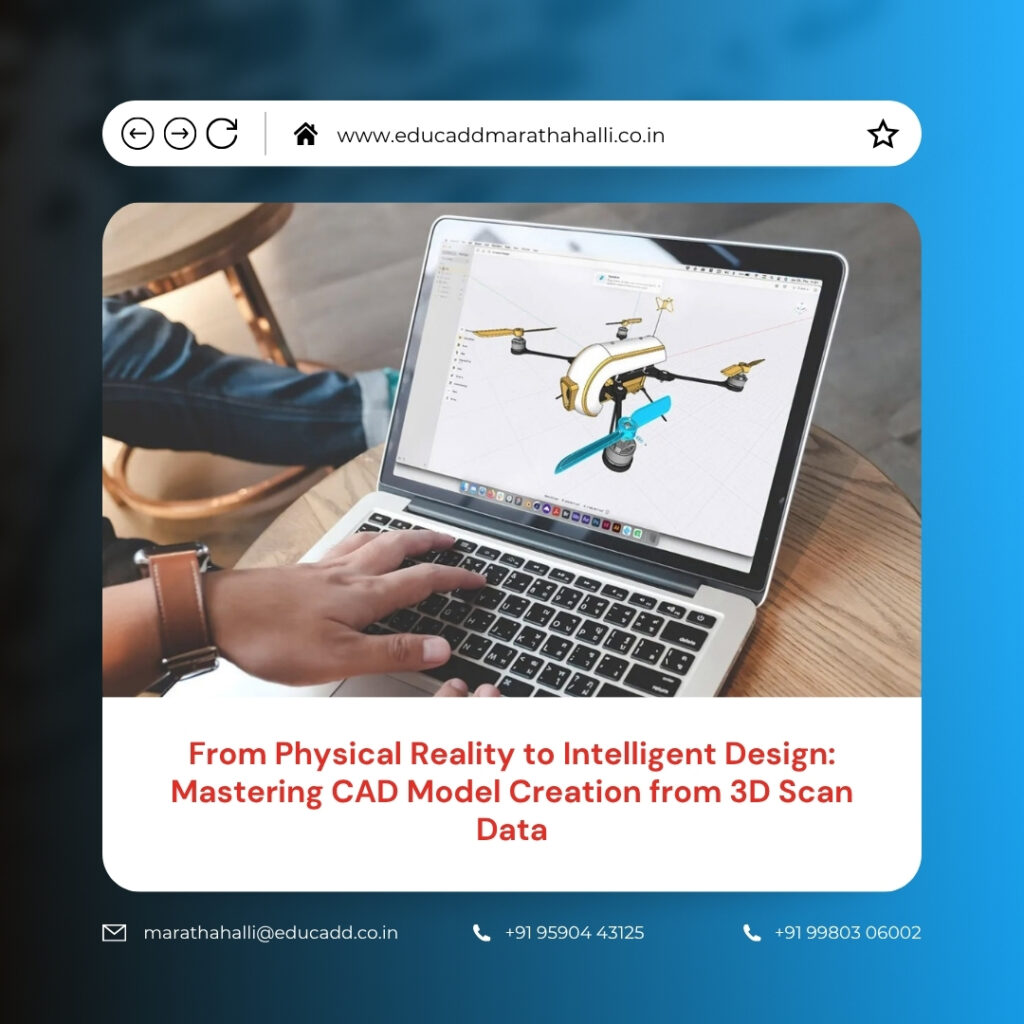
CAD Models from 3D Scans
The ability to convert physical objects into intelligent digital models offers tremendous benefits for manufacturers, designers, architects, automotive engineers, and aerospace professionals. It allows companies to recreate legacy parts, improve existing products, validate designs, and streamline production workflows. Moreover, this technology supports innovation by enabling organizations to work with highly accurate digital representations of real-world objects. As digital engineering continues to expand, the importance of transforming scan data into editable CAD models grows stronger every year. Understanding this workflow can help professionals unlock new levels of efficiency, precision, and creativity throughout the product development cycle.
Understanding the Foundation of CAD Models from 3D Scans
The process begins with capturing the geometry of a physical object through advanced scanning equipment. These scanners collect millions of measurement points across the object’s surface and generate what is commonly known as a point cloud. Every point contains precise spatial information that collectively represents the object’s shape and dimensions.
However, point clouds alone cannot serve as complete engineering models. They lack the structured information required for design modifications, manufacturing documentation, and simulation activities. CAD models provide these capabilities by organizing geometry into editable features and dimensions. Therefore, scan-to-CAD technology acts as a bridge between physical objects and intelligent engineering data. By combining real-world measurements with sophisticated modeling techniques, organizations can create digital assets that support a wide range of engineering and manufacturing applications.
Why Businesses Are Investing in Scan-Based CAD Modeling
Industries around the world are increasingly investing in scan-to-CAD workflows because they deliver significant operational advantages. Traditional measurement methods often require extensive manual effort and can introduce inconsistencies into the design process. In contrast, modern scanning technologies collect highly detailed information within a fraction of the time.
Manufacturers use these workflows to recreate discontinued components, improve existing products, and accelerate development cycles. Design teams benefit from accurate reference models that reduce guesswork and minimize costly revisions. Furthermore, organizations gain access to reliable digital records of physical assets, which proves valuable for maintenance, redesign, and future upgrades. As competition continues to intensify across industries, businesses recognize that scan-based CAD modeling offers a practical way to improve productivity while maintaining exceptional quality standards.
The Importance of High-Quality Data Acquisition
Every successful CAD reconstruction project begins with accurate scan data. Even the most advanced software cannot compensate for poor scanning practices or incomplete data collection. Therefore, engineers must carefully select the appropriate scanning technology based on project requirements and object characteristics.
Different scanning systems serve different purposes. Laser scanners perform exceptionally well for large industrial structures, while structured-light scanners excel at capturing intricate details on smaller components. Operators must also consider factors such as surface reflectivity, environmental conditions, and accessibility during the scanning process. Proper planning ensures that all critical features are captured without gaps or distortions. As a result, the subsequent modeling stages become more efficient and deliver higher-quality outcomes.
Preparing Point Cloud Data for CAD Reconstruction
Raw scan data often contains unwanted elements that must be removed before modeling can begin. Noise, overlapping scans, misalignments, and irrelevant background information can complicate the reconstruction process if left unaddressed. Therefore, preprocessing becomes a critical stage within the workflow.
Specialized software tools help engineers clean and organize the point cloud. Multiple scans are aligned into a unified coordinate system, ensuring that every section of the object fits together accurately. Excessive data density may also be reduced to improve processing performance without sacrificing important details. Once the point cloud has been refined, it provides a reliable foundation for developing precise CAD geometry. This preparation stage significantly improves both modeling efficiency and final model accuracy.
Transforming Point Clouds into Usable Surface Geometry
After processing the point cloud, engineers convert the collected data into a polygon mesh. This mesh consists of interconnected triangles that create a continuous representation of the scanned object’s surface. The mesh provides a clearer visualization of the geometry and serves as an important intermediate step in the reconstruction workflow.
Creating a high-quality mesh requires careful attention to detail. Engineers inspect the model for holes, surface irregularities, and unwanted artifacts that may have resulted from the scanning process. Repairs and refinements help create a smooth and accurate surface representation. Once completed, the mesh becomes a valuable reference for extracting dimensions, curves, and geometric features that will ultimately form the CAD model. This stage transforms raw measurement data into a format that designers can effectively utilize.
Reverse Engineering Existing Products and Components
One of the most powerful applications of CAD Models from 3D Scans data is reverse engineering. Many organizations work with products that lack original drawings, CAD files, or technical documentation. In such situations, scanning technology provides a practical solution for recreating accurate digital models.
Engineers begin by scanning the physical component and analyzing its geometry. They then reconstruct key features within CAD software while preserving dimensional accuracy. This process enables manufacturers to reproduce replacement parts, improve existing products, and modernize aging equipment. Furthermore, reverse engineering allows organizations to study competitor products and develop innovative design improvements. As a result, businesses can reduce development costs while extending the useful life of valuable equipment and assets.
Creating Parametric CAD Models for Greater Flexibility
Unlike static scan data, parametric CAD models provide dynamic control over design features and dimensions. Engineers can modify specific parameters without rebuilding the entire model, making future changes faster and more efficient. This flexibility represents one of the greatest advantages of scan-to-CAD conversion.
Benefits of parametric CAD models include:
- Quick modification of dimensions and design features.
- Simplified generation of engineering drawings and documentation.
Parametric models also support simulation studies, stress analysis, manufacturing planning, and product optimization activities. Because every feature remains editable, designers can adapt products to evolving requirements while maintaining consistency throughout the design process. This capability makes parametric modeling a valuable asset in modern engineering environments.
Software Solutions Driving Modern Scan-to-CAD Workflows
Technological advancements have led to the development of sophisticated software platforms designed specifically for scan-to-CAD applications. These solutions streamline data processing, feature extraction, surface reconstruction, and model validation activities.
Popular software tools used in the industry include Geomagic Design X, SolidWorks, Autodesk Fusion 360, CATIA, Siemens NX, and Inventor. Many of these platforms incorporate automated feature recognition capabilities that significantly reduce modeling time. In addition, artificial intelligence continues to enhance software performance by improving geometry interpretation and surface generation. As these technologies evolve, engineers can complete complex reconstruction projects more efficiently while achieving higher levels of accuracy.
Ensuring Precision During CAD Reconstruction
Accuracy remains a fundamental requirement throughout the entire modeling process. Even minor deviations between the scanned object and the reconstructed CAD model can affect manufacturing quality, assembly performance, and product reliability. Therefore, engineers must continuously verify model accuracy at each stage.
Deviation analysis tools compare reconstructed geometry against the original scan data and identify dimensional discrepancies. This process helps engineers make necessary corrections before finalizing the design. Additionally, validation procedures ensure that critical features maintain their intended dimensions and relationships. By emphasizing precision throughout the workflow, organizations can produce digital models that accurately reflect physical reality and support reliable engineering decisions.
Applications Across Manufacturing and Product Development
Manufacturing companies increasingly rely on scan-based CAD models to improve efficiency and accelerate innovation. Accurate digital representations of physical products enable engineers to optimize designs, create prototypes, and streamline production processes. This capability significantly reduces development time while enhancing product quality.
Key manufacturing applications include:
- Product redesign and performance enhancement.
- Tooling, fixture, and mold development.
Beyond manufacturing, product development teams use scan-derived models to test concepts, evaluate design alternatives, and improve collaboration among stakeholders. Consequently, organizations can bring products to market faster while minimizing costly design revisions and production delays.
Enhancing Quality Inspection and Verification Processes
Quality control departments have embraced scan-to-CAD technology as an effective inspection solution. By comparing manufactured components against their original CAD models, organizations can identify dimensional deviations and production inconsistencies with exceptional accuracy.
Modern scanning systems capture detailed measurements within minutes, allowing inspectors to evaluate entire surfaces rather than isolated points. This comprehensive analysis helps detect defects that traditional measurement tools may overlook. Furthermore, inspection reports provide valuable data for process optimization and continuous improvement initiatives. As manufacturing tolerances become increasingly stringent, scan-based inspection methods continue to play a critical role in maintaining product quality and compliance.
Supporting Digital Twins and Smart Manufacturing Strategies
The rise of Industry 4.0 has expanded the importance of creating CAD models from 3D scan data. Digital twins, which serve as virtual representations of physical assets, rely heavily on accurate geometric information. Scan-derived CAD models provide the foundation for building these intelligent digital environments.
Engineers use digital twins to monitor equipment performance, predict maintenance requirements, and simulate operational scenarios. Additionally, these virtual models improve collaboration between design, production, and maintenance teams. As smart factories become more common, scan-to-CAD workflows will continue supporting data-driven decision-making and operational optimization. Organizations that embrace these technologies position themselves for long-term success in an increasingly digital industrial landscape.
Overcoming Challenges in Scan-to-CAD Projects
Although scan-to-CAD technology offers numerous advantages, it also presents certain challenges. Complex freeform surfaces, reflective materials, and inaccessible areas can complicate data acquisition efforts. Large datasets may require significant processing power and specialized expertise to manage effectively.
Another challenge involves converting highly detailed organic shapes into structured engineering models. This task often demands a combination of technical knowledge, software proficiency, and practical experience. Fortunately, advances in automation and machine learning continue to simplify many aspects of the reconstruction process. As software capabilities improve, organizations can overcome these obstacles more efficiently and achieve better project outcomes.
Future Innovations Shaping Scan-Based CAD Modeling
The future of scan-to-CAD technology promises exciting developments that will further transform engineering workflows. Artificial intelligence is already improving automated feature recognition, surface fitting, and geometry reconstruction capabilities. These advancements reduce manual effort while increasing modeling speed and consistency.
Cloud-based collaboration platforms are also making it easier for global teams to share scan data and work on projects simultaneously. Meanwhile, next-generation scanning hardware continues to deliver faster capture speeds and greater measurement accuracy. Together, these innovations will enable organizations to create digital models more efficiently than ever before. As industries continue embracing digital transformation, scan-based CAD modeling will remain a vital component of modern engineering and manufacturing strategies.
Conclusion
Creating CAD Models from 3D Scans data has revolutionized the way industries capture, analyze, and utilize real-world geometry. By converting physical objects into intelligent digital assets, organizations can improve product development, accelerate manufacturing processes, and enhance quality control efforts. From reverse engineering and product redesign to digital twin development and smart manufacturing, the applications of this technology continue to expand across multiple sectors.
As scanning systems, software platforms, and artificial intelligence technologies advance, the process becomes increasingly efficient and accessible. Companies that adopt scan-to-CAD workflows gain valuable advantages in accuracy, productivity, and innovation. More importantly, they establish a strong foundation for future digital engineering initiatives. In an era where precision and speed determine competitive success, transforming scan data into powerful CAD models has become an essential capability for forward-thinking organizations worldwide.

