
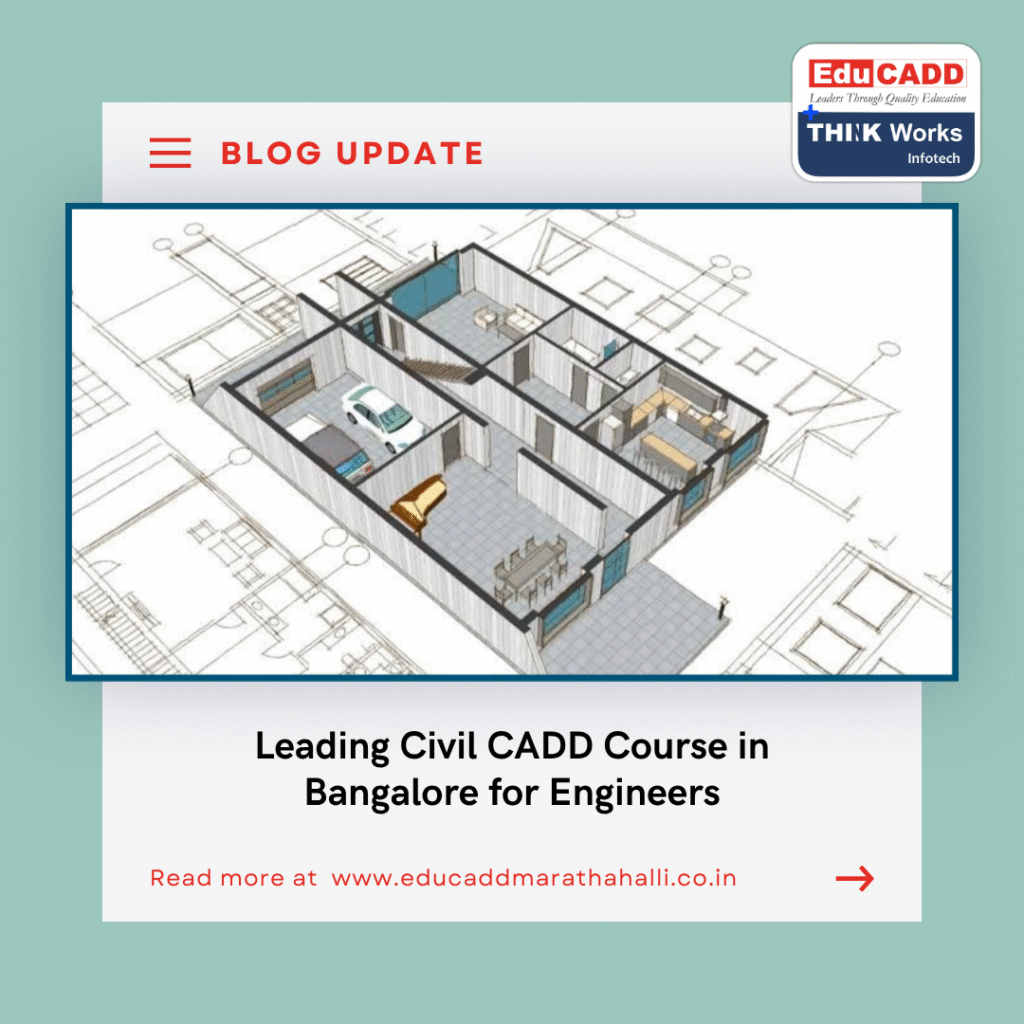
Leading Civil CADD Course in Bangalore for Engineers
The rapid expansion of infrastructure, Smart City initiatives, and commercial real estate across India has reshaped the construction sector. Today, civil engineering goes beyond manual site supervision and hand-drawn blueprints. Instead, the industry increasingly relies on digital modeling, parametric design, and Building Information Modeling (BIM) workflows. For fresh graduates and experienced site engineers, enrolling in a leading Civil CADD course in Bangalore for engineers can provide a practical pathway into design, structural, and project management roles. Moreover, Bangalore continues to be a major hub for infrastructure consultancies, engineering service firms, and real estate developers. Therefore, mastering computer-aided drafting and design can help engineers develop relevant technical skills for today’s construction industry.
The Digital Transformation in Civil Engineering & Construction
Modern civil engineering requires precision, faster design iterations, and effective collaboration. As a result, traditional 2D drawings are increasingly becoming part of connected digital workflows. These workflows can connect architectural drafting with structural engineering, terrain analysis, quantity estimation, and project documentation. Furthermore, digital tools allow design teams to review and modify project information more efficiently.
Why Civil Computer-Aided Design (CADD) Skills Are Critical
- Error Reduction & Precision: Computer-aided drafting can reduce manual measurement errors. Consequently, structural dimensions, reinforcement details, and site plans can be prepared with greater consistency.
- Multi-Disciplinary Synergy: Civil designers often work with electrical, mechanical, and architectural teams. Therefore, standardized CADD workflows can support smoother coordination across different project disciplines.
- Automated Quantity Takeoffs & Estimation: Modern civil design platforms can generate material schedules and quantity information from digital models. As a result, concrete volume calculations and rebar takeoffs become more efficient.
- Faster Project Delivery: Standardized blocks, parametric terrain modeling, and digital design tools can reduce repetitive work. In turn, design teams can complete many project tasks more efficiently.
By enrolling in a dedicated technical training institute in Bangalore, civil graduates can develop practical skills for these evolving project requirements.
Core Pillars of a Modern Engineering & Design Curriculum
A competitive technical education should extend beyond a single software tool. Modern civil engineers can benefit from understanding different technical disciplines and digital workflows. In addition, exposure to related technologies can improve collaboration across multidisciplinary projects.
1. Civil, Architectural & Structural Design Stack
Building infrastructure requires a connected suite of design software. These tools support projects ranging from preliminary site layouts to advanced 3D building models. Consequently, learning multiple design applications can help students understand different stages of project development.
- 2D Drafting & Municipal Blueprints: Develop essential drafting, layer management, and geometric layout skills through a structured AutoCAD course in Bangalore or an AutoCAD Civil course in Bangalore.
- Specialized Infrastructure & Design Tracks: Build domain knowledge through a comprehensive Civil CADD course in Bangalore, Architectural CADD course in Bangalore, or Electrical CADD course in Bangalore.
- Parametric Modeling & BIM Workflows: Modern structural and architectural projects increasingly use Building Information Modeling. Therefore, students can explore intelligent 3D modeling through a Revit Architecture course in Bangalore or an advanced BIM course in Bangalore.
2. Mechanical Design, Product Modeling & Manufacturing
Civil engineers involved in heavy industrial projects, steel plants, and MEP integration may also encounter mechanical design workflows. For this reason, related software skills can support multidisciplinary project coordination. Additionally, these skills can help engineers understand how different technical teams contribute to large projects.
- Core Mechanical Design: Understand machine components and structural steel fabrication through a Mechanical CADD course.
- Parametric 3D Tools: Develop industrial assembly and parametric surface modeling skills through CATIA training in Bangalore, a SolidWorks course, or Creo training.
- Finite Element Analysis (FEA): Explore structural stress testing, thermal analysis, and load distribution through HyperMesh training in Bangalore.
- Geometric Tolerancing: Learn manufacturing and fabrication tolerances through GD&T training.
3. IT, Full Stack Development & Software Automation
Engineering automation and computational design increasingly connect civil engineering with software development. Consequently, programming knowledge can provide additional technical exposure for engineers interested in digital workflows. For example, coding can support automation, data processing, GIS applications, and customized engineering solutions.
- Full Stack Development: Civil engineers interested in computational design, GIS applications, or web-based asset management can expand their technical skills through a Python Full Stack course in Bangalore.
- Practical Skill Upskilling: Joining a recognized skill development institute in Marathahalli or Kammanahalli can help engineering graduates develop additional career-oriented technical skills.
4. Digital Marketing, Branding & Business Growth
Design consultants, freelance structural engineers, and agency owners also need effective marketing strategies. Strong digital visibility can help professionals showcase portfolios, connect with potential clients, and promote their services. Moreover, digital marketing skills can support professionals who want to develop their own consulting or freelance businesses.
- Foundational Digital Exposure: Learn brand positioning and online client acquisition through a Digital marketing course in Bangalore, Digital marketing training in Bangalore, Digital marketing course in Marathahalli, or a Digital marketing institute in Marathahalli.
- Specialized Online Growth Tracks: Develop targeted online marketing skills through an SEO course in Bangalore, Google Ads course in Bangalore, Social media marketing course in Bangalore, Performance marketing course in Bangalore, or an AI digital marketing course in Bangalore.
- Career & Agency Growth: Practical programs such as a Job oriented digital marketing course in Bangalore, Digital marketing course with placement in Bangalore, Professional digital marketing course in Bangalore, Masters in digital marketing course in Bangalore, Online digital marketing course in Bangalore, Digital marketing internship in Bangalore, or Digital marketing live project training can provide exposure to real-world campaign management.
Comprehensive Modules Covered in a Premier Civil CADD Curriculum
A practical civil design program should guide students from basic drafting commands to advanced design and documentation workflows. Furthermore, project-based learning allows students to apply these skills to realistic engineering scenarios. As their knowledge develops, learners can gradually move from basic drawings to more complex project requirements.
Module 1: Fundamental Drafting & Municipal Drawing Standards
- Learn interface navigation, coordinate systems, and precision drawing tools.
- Create site boundary plans, residential floor plans, building elevations, and cross-sections.
- Manage layers, line weights, dimension styles, and annotation standards.
- Apply consistent drafting practices to improve drawing accuracy and presentation.
Module 2: Land Development, Surveying & Transportation Design
- Import survey data, contours, and topographical points.
- Design road alignments, corridor models, grading plans, and pipe networks.
- Calculate cut-and-fill earthwork volumes for site development projects.
- Apply surveying and land development concepts to practical design exercises.
Module 3: Structural Detailing & RCC Analysis
- Detail reinforced concrete structures (RCC), including footings, columns, beams, and slabs.
- Generate Bar Bending Schedules (BBS) and structural rebar layouts.
- Understand structural steel detailing and connection drawings according to applicable IS, BS, and ACI codes.
- Develop accurate detailing practices for construction documentation.
Module 4: Project Management, Plotting & Documentation
- Create paper space layouts, scale viewports, and custom title blocks.
- Export project files to PDF and DWG formats for project coordination and review.
- Prepare municipal submission drawings and tender documentation packages.
- Organize drawings and documentation for professional project delivery.
Career Opportunities for Certified Civil CADD Specialists
Earning credentials at a recognized professional training institute in Bangalore can support career development across infrastructure, construction, and engineering sectors. Depending on their interests and technical skills, graduates can explore several roles. In addition, practical CADD experience can help candidates demonstrate their capabilities through project portfolios.
- Civil Structural Drafter: Converts structural calculations into detailed reinforcement drawings and structural layouts.
- Transportation & Highway Design Technician: Works on road alignments, earthwork estimations, and corridor modeling using civil design platforms.
- BIM Civil Modeler: Integrates civil infrastructure models with architectural and MEP systems within BIM environments.
- Land Development Design Assistant: Prepares site grading plans, utility network layouts, and contour mappings for development projects.
- Quantity Surveyor / Estimation Engineer: Uses CADD data to estimate material quantities, concrete volumes, and project costs.
Step-by-Step Career Roadmap for Civil Engineering Graduates
Building a career in structural design and computer-aided drafting requires both technical knowledge and practical experience. Therefore, civil engineering graduates can follow a structured approach. Each step can contribute to building stronger technical knowledge and a more professional portfolio.
- Master Core Drafting Principles: Build speed, accuracy, and shortcut efficiency through a certified CADD training institute in Bangalore or CADD training institute in Marathahalli.
- Develop a Professional Portfolio: Create a portfolio containing 5 to 8 practical project drawings. For instance, include multi-story floor plans, structural rebar details, and site grading layouts.
- Obtain Recognized Certification: Strengthen your professional profile by earning industry-recognized certifications that demonstrate software proficiency. Additionally, certification can help document your training and technical exposure.
- Prepare for Technical Design Tests: Practice drafting assessments, structural drawing interpretation, and material quantity calculations. As a result, you can approach technical interviews with greater familiarity with common design tasks.
Secure Your Future in Civil Design & Engineering
Industry-aligned technical skills can help civil engineering graduates adapt to changing design and construction workflows. Whether the goal is structural detailing, BIM modeling, infrastructure design, or another technical specialization, practical software knowledge can support continued professional development.
Furthermore, structured learning programs that combine computer lab training, project assignments, and placement support can provide valuable practical exposure. Through hands-on projects, students can apply classroom concepts and gain a clearer understanding of professional design workflows. In addition, consistent practice can help improve drafting speed, accuracy, and software familiarity.
If you are ready to expand your engineering capabilities and explore job oriented courses in Bangalore, consider developing your skills through a leading Civil CADD course in Bangalore for engineers. Programs offered by learning centers such as EduCADD Marathahalli Bangalore can provide practical exposure to modern engineering and infrastructure workflows.

