
Mastering BIM 5D Cost Estimation: Transforming Construction Cost Management Through Intelligent Digital Planning
The construction industry is moving toward a future where digital technologies play a vital role in planning, designing, and executing projects. Among the most impactful innovations is BIM 5D Cost Estimation, a technology that combines three-dimensional building models with project scheduling and real-time cost information. Unlike traditional estimation methods that rely on manual calculations and disconnected spreadsheets, BIM 5D provides an integrated environment where costs automatically update as project designs evolve. This capability allows construction professionals to make informed financial decisions from the earliest planning stages to project completion.
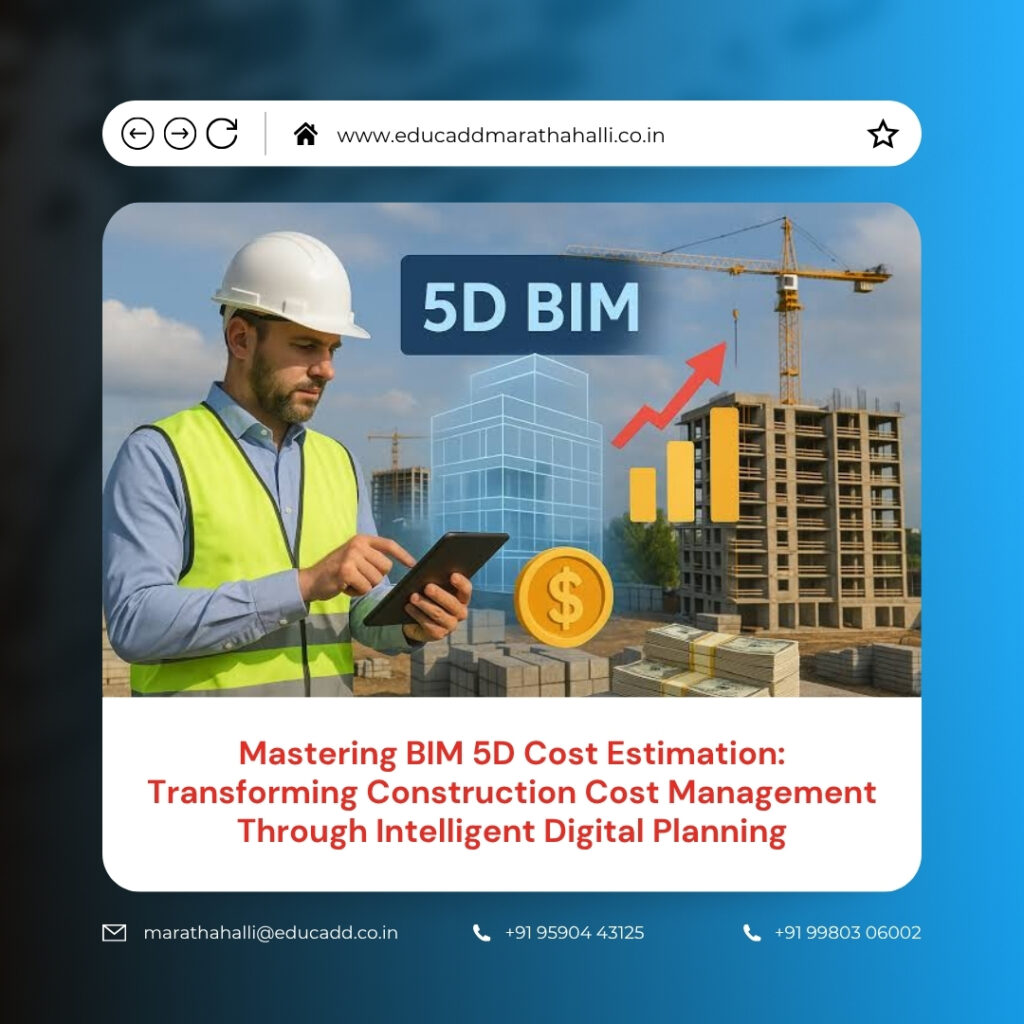
BIM 5D Cost Estimation
As infrastructure development continues to expand worldwide, companies increasingly depend on BIM 5D Cost Estimation to improve budgeting accuracy, reduce project risks, and maximize profitability. Learning this advanced methodology has become essential for engineers, architects, quantity surveyors, project managers, and construction professionals who want to remain competitive in today’s digital construction landscape.
What Is BIM 5D Cost Estimation?
Cost Estimation is the process of integrating financial data into a Building Information Modeling (BIM) environment to create an intelligent construction planning system. While 3D BIM focuses on visual building models and 4D BIM introduces project scheduling, the fifth dimension adds cost information linked directly to every building component. This integration enables automatic quantity calculations, material costing, labor estimation, and budget tracking whenever the project model changes. Instead of preparing estimates manually, professionals work with a dynamic digital model that continuously reflects current project costs.
This approach improves estimation accuracy while saving considerable time during project planning and execution. As a result, stakeholders gain complete visibility into project finances before construction begins.
Why BIM 5D Cost Estimation Is Revolutionizing Construction
Construction projects often involve multiple disciplines, changing client requirements, and strict financial targets. Traditional estimation methods struggle to keep pace with frequent design revisions, leading to inaccurate budgets and unexpected expenses. Cost Estimation solves these challenges by connecting design modifications directly to project costs. Whenever architects or engineers adjust the BIM model, quantity takeoffs and budget calculations update automatically. Consequently, project teams can identify cost implications immediately without repeating manual calculations.
This real-time cost visibility enables faster decision-making, minimizes financial uncertainty, and supports better collaboration between all project stakeholders. Organizations that adopt BIM 5D consistently achieve greater budget control and improved project performance.
Core Elements That Make BIM 5D Cost Estimation Effective
The success of BIM 5D Cost Estimation depends on several interconnected components working together. Intelligent 3D building models provide precise geometric and technical information about every structural element. Quantity takeoff tools automatically calculate material volumes directly from these models, eliminating manual measurement errors. Cost databases assign current pricing to materials, labor, and equipment, ensuring reliable budget calculations.
Scheduling information links project timelines with resource planning, allowing organizations to forecast expenditures over time. Cloud-based collaboration platforms further enhance efficiency by enabling architects, engineers, contractors, and quantity surveyors to access updated project information simultaneously. Together, these technologies create a unified workflow that improves accuracy, transparency, and productivity throughout construction.
Major Advantages of Cost Estimation
Organizations implementing BIM 5D Cost Estimation experience significant improvements in both financial management and operational efficiency. Automated cost calculations reduce estimation errors while accelerating project planning. Real-time budget updates help decision-makers respond quickly to design changes without delaying project schedules. Furthermore, improved visualization enables clients and stakeholders to understand the financial impact of construction decisions before execution begins. Additional benefits include:
- Automatic quantity takeoffs from intelligent BIM models.
- Improved budget forecasting throughout every project stage.
- Reduced material waste and unnecessary expenditures.
- Faster cost comparison between multiple design alternatives.
- Enhanced communication among project stakeholders.
- Better financial transparency and stronger client confidence.
These advantages contribute directly to higher productivity and more successful project outcomes.
Improving Budget Planning with BIM 5D Cost Estimation
Effective budget planning is one of the most valuable capabilities offered by BIM 5D Cost Estimation. Since every building component contains associated cost information, project teams can evaluate financial performance before construction activities begin. This proactive planning helps organizations allocate resources more efficiently while identifying cost-saving opportunities during the design phase. Moreover, project managers can compare different construction methods, materials, and layouts based on their budget impact.
Such flexibility supports value engineering initiatives without compromising project quality. Better planning ultimately reduces cost overruns, minimizes delays, and strengthens overall project management performance.
The Importance of BIM Estimation for Quantity Surveyors
Quantity surveyors have traditionally spent significant time measuring drawings and preparing detailed cost estimates manually. However, BIM 5D Cost Estimation has transformed their responsibilities by automating repetitive measurement tasks. Digital models generate accurate quantities instantly, allowing surveyors to focus on cost analysis, procurement strategies, and financial planning instead of manual calculations.
Whenever project designs change, updated quantities become available immediately without repeating the estimation process. This increased efficiency improves reporting accuracy while reducing workload during large-scale construction projects. Consequently, quantity surveyors can deliver greater value by supporting strategic financial decision-making throughout the project lifecycle.
Software Tools Used in BIM 5D Cost Estimation
Modern construction professionals use several advanced software applications to perform Cost Estimation effectively. Autodesk Revit serves as a leading platform for intelligent BIM modeling, while Navisworks supports project coordination and model review. CostX is widely recognized for automated quantity takeoffs and detailed estimating capabilities. Autodesk Construction Cloud enables collaborative project management with centralized data access.
Other powerful solutions include Bentley OpenBuildings, Synchro 4D, Vico Office, and Trimble applications. These software platforms integrate design information, scheduling, and cost databases into a single digital environment. Learning these industry-standard tools significantly enhances technical skills and increases employment opportunities within the Architecture, Engineering, and Construction (AEC) industry.
Industries Benefiting from Cost Estimation
The applications of BIM 5D Cost Estimation extend across virtually every construction sector. Residential housing projects benefit from improved budgeting and resource management. Commercial developments such as shopping complexes, office buildings, and hotels use BIM 5D to control large-scale investments effectively. Infrastructure projects including highways, railways, airports, bridges, and metro systems rely on intelligent cost planning to manage complex budgets.
Healthcare facilities, educational institutions, manufacturing plants, industrial complexes, and government projects also utilize BIM technologies to improve financial transparency. As digital construction becomes the global standard, organizations across every sector continue adopting BIM 5D to improve efficiency and project success.
Skills Required to Excel in BIM 5D Cost Estimation
Professionals aiming to build successful careers in Cost Estimation should develop a combination of technical expertise and analytical thinking. Understanding construction drawings, estimation principles, quantity surveying, and project management provides a strong foundation. Knowledge of BIM software enhances the ability to create intelligent digital models and perform accurate cost analysis. Strong communication skills help professionals coordinate effectively with multidisciplinary project teams. Essential competencies include:
- BIM modeling and digital coordination.
- Quantity takeoff and measurement techniques.
- Construction cost planning and budgeting.
- Resource allocation and financial reporting.
- Project scheduling and timeline analysis.
- Critical thinking and problem-solving abilities.
Developing these skills enables professionals to deliver greater value throughout every phase of construction.
Career Growth Through Cost Estimation Expertise
As digital transformation reshapes the construction industry, employers actively seek professionals with expertise in Cost Estimation. Graduates and experienced engineers can pursue rewarding careers as BIM Cost Engineers, Quantity Surveyors, Estimation Engineers, BIM Coordinators, Cost Consultants, Project Planning Engineers, BIM Managers, Construction Project Managers, and Digital Construction Specialists. International engineering firms, infrastructure developers, and multinational construction companies continue expanding their BIM departments to support large-scale projects.
Since skilled BIM professionals remain in high demand globally, individuals with specialized training often enjoy competitive salaries, rapid career progression, and opportunities to work on prestigious infrastructure developments.
Emerging Trends Shaping the Future of Cost Estimation
Technological innovation continues to enhance the capabilities of Cost Estimation. Artificial Intelligence now assists professionals by analyzing historical construction data to produce faster and more reliable cost forecasts. Machine learning algorithms improve estimation accuracy by identifying cost patterns across previous projects. Cloud computing enables real-time collaboration among globally distributed project teams, while digital twins provide continuous monitoring of operational costs even after project completion.
Sustainable construction practices also benefit from BIM 5D by evaluating lifecycle costs alongside environmental performance. These advancements demonstrate how intelligent digital technologies will continue transforming financial management within the global construction industry.
Why Learning BIM 5D Cost Estimation Is a Valuable Investment
The demand for professionals skilled in Cost Estimation continues to increase as construction companies adopt digital project delivery methods. Organizations require experts who can combine technical knowledge with advanced software skills to improve budgeting accuracy and project efficiency. Learning BIM 5D not only enhances employability but also prepares professionals for leadership roles in digital construction management.
Whether an individual is an engineering student, architect, contractor, quantity surveyor, or project manager, acquiring BIM 5D expertise provides a strong competitive advantage in today’s rapidly evolving construction industry. Continuous learning in this field also opens opportunities for international careers and long-term professional growth.
Conclusion
BIM 5D Cost Estimation represents a significant advancement in construction cost management by integrating intelligent building models with real-time financial information. This technology empowers construction professionals to plan projects more accurately, control budgets effectively, reduce costly errors, and improve collaboration among stakeholders. Its ability to automate quantity takeoffs, monitor expenses continuously, and support informed decision-making has made it an indispensable solution for modern construction projects.
As digital transformation accelerates across the Architecture, Engineering, and Construction industry, professionals with expertise in BIM 5D Cost Estimation will continue to play a crucial role in delivering efficient, profitable, and sustainable projects. Investing in BIM 5D knowledge today creates a strong foundation for future success in one of the world’s fastest-growing technology-driven industries.

