
Shape Your Future in Interior Design with a Career-Driven Professional Certification
The world of interior design is evolving faster than ever, creating exciting opportunities for individuals who possess the right combination of creativity, technical expertise, and practical knowledge. Modern clients expect designers to deliver spaces that are visually stunning, highly functional, sustainable, and aligned with current trends. Because of these growing expectations, employers now prioritize candidates who are ready to contribute from day one. A career-driven Professional Interior Design Certification provides much more than theoretical knowledge. It develops practical skills, software proficiency, project management capabilities, and industry awareness that employers actively seek.
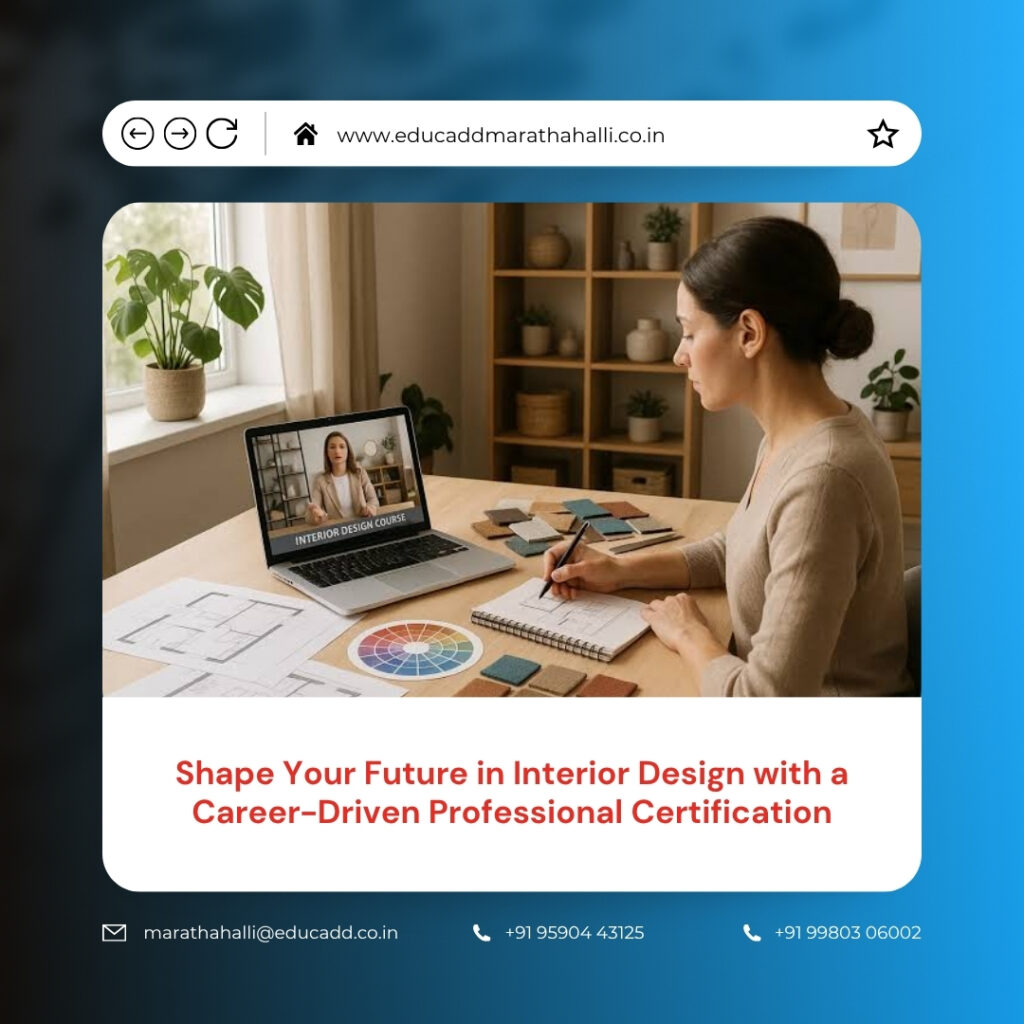
Professional Interior Design Certification
Whether you are a recent graduate, an aspiring designer, or a working professional looking for a career transition, enrolling in a professionally structured certification program can help you build a successful future in one of the fastest-growing creative industries.
Transforming Creative Passion into Professional Expertise
Many people possess a natural sense of creativity and aesthetics, but professional success requires much more than artistic talent. Interior designers must understand architecture, construction techniques, space planning, materials, lighting, and user requirements. A career-focused Professional Interior Design Certification transforms creative ideas into practical design solutions by combining artistic thinking with technical knowledge.
Students learn how to analyze client requirements, prepare functional layouts, select suitable materials, create attractive interiors, and develop complete design concepts. This balanced learning approach helps aspiring professionals gain confidence while preparing them for real workplace responsibilities.
Learning Through Practical Industry-Based Training
The most successful designers learn by doing rather than simply reading textbooks. Practical exposure allows students to understand how interior projects move from concept to completion. Instead of relying only on classroom lectures, modern certification programs emphasize project-based learning and real design assignments.
Learners work on residential homes, office spaces, retail stores, hospitality interiors, educational facilities, and commercial environments. Every assignment strengthens problem-solving abilities while improving decision-making skills. As students complete multiple projects, they become familiar with actual industry standards and professional workflows.
Building Strong Technical Skills with Design Software
Technology has become an essential part of interior design. Clients now expect realistic visual presentations before approving projects, making software expertise a mandatory skill for every designer. Professional certification programs therefore include extensive software training alongside design theory.
Students gain hands-on experience with industry-leading applications such as AutoCAD, SketchUp, Revit, 3ds Max, V-Ray, Photoshop, and Lumion. These tools help designers prepare technical drawings, develop detailed floor plans, create three-dimensional models, generate photorealistic renderings, and produce impressive client presentations. Software proficiency not only increases productivity but also significantly improves career opportunities.
Understanding Space Planning and Functional Design
Beautiful interiors are meaningful only when they function efficiently. Space planning forms the foundation of every successful design project because it determines how people interact with their surroundings. Effective planning improves comfort, accessibility, movement, and productivity within a space.
Professional certification programs teach students how to optimize available areas without compromising aesthetics. They learn furniture placement, circulation planning, storage solutions, zoning techniques, and ergonomic principles. As a result, every design becomes visually attractive while meeting practical user requirements.
Exploring Materials, Finishes, and Modern Design Trends
Interior designers must stay informed about the latest materials and design innovations. Every project requires thoughtful selection of flooring, wall finishes, ceiling treatments, fabrics, furniture, lighting fixtures, and decorative elements. The right choices influence durability, functionality, maintenance, and overall visual appeal.
Students explore traditional materials alongside modern sustainable alternatives. They also study current interior styles such as contemporary, minimalist, Scandinavian, industrial, luxury, biophilic, and modern classic design. This broad understanding enables future designers to create customized interiors that reflect individual client preferences.
Developing Professional Communication Skills
Interior designers interact with various stakeholders throughout every project. They communicate with clients, architects, contractors, suppliers, engineers, and project managers on a regular basis. Strong communication therefore becomes just as important as technical expertise.
Certification programs help learners improve verbal communication, presentation skills, negotiation techniques, and client relationship management. Students practice presenting design concepts using mood boards, material samples, digital presentations, and visual renderings.
Essential communication abilities include:
- Explaining design concepts clearly and professionally.
- Managing client expectations throughout project execution.
These skills strengthen professional credibility while improving overall project outcomes.
Creating a Portfolio That Impresses Employers
A professional portfolio serves as a designer’s visual resume. Employers often evaluate portfolios before scheduling interviews because they reveal creativity, technical ability, and project understanding. Therefore, developing a strong portfolio becomes an essential part of career preparation.
Certification courses guide students in documenting their best work through floor plans, elevation drawings, 3D renderings, conceptual sketches, lighting layouts, furniture details, and completed projects. Every portfolio demonstrates problem-solving abilities while showcasing individual design style. A polished portfolio greatly increases confidence during job interviews and freelance client meetings.
Preparing for Multiple Career Opportunities
The interior design industry offers a wide variety of career paths across different sectors. Professionals can choose specialized roles based on their interests, strengths, and long-term goals. The demand for skilled designers continues to rise as urban development and commercial construction expand worldwide.
Graduates may pursue careers as residential interior designers, commercial designers, office planners, retail designers, exhibition designers, furniture consultants, lighting specialists, kitchen designers, CAD professionals, 3D visualization experts, project coordinators, or independent design consultants. This flexibility allows professionals to build rewarding careers across diverse industries.
Understanding Sustainable and Smart Interior Solutions
Modern interior design increasingly focuses on sustainability, environmental responsibility, and smart living. Clients now prefer spaces that reduce energy consumption while promoting healthier lifestyles. Consequently, professional training introduces students to eco-friendly design principles.
Learners study sustainable materials, energy-efficient lighting, green building concepts, natural ventilation strategies, recyclable products, water-saving fixtures, and environmentally responsible construction practices. They also gain insight into smart home automation systems that enhance convenience, security, and energy management. These emerging skills prepare designers for the future of the industry.
Gaining Confidence Through Live Projects and Industry Exposure
Confidence develops through consistent practical experience rather than theoretical learning alone. Professional certification programs therefore provide opportunities for workshops, site visits, internships, industry seminars, and live project participation. These experiences expose students to real construction environments and professional workflows.
Working alongside experienced mentors allows learners to understand project coordination, budgeting, vendor communication, quality control, and construction timelines. Every practical assignment strengthens technical knowledge while preparing students to perform effectively in professional settings.
Career Support and Placement Assistance
Quality education extends beyond classroom instruction. Career guidance plays an important role in helping students secure meaningful employment after completing their certification. Many leading training institutes offer structured placement support to simplify this transition.
Students receive assistance with resume preparation, portfolio refinement, interview practice, personality development, aptitude training, and recruitment opportunities. Industry networking events and internship programs further improve employment prospects. These career services help graduates enter the workforce with greater confidence and stronger professional readiness.
Staying Competitive in a Rapidly Changing Industry
Interior design continues to evolve through technological advancements, changing customer preferences, and innovative construction methods. Successful professionals remain competitive by continuously updating their knowledge and adapting to new industry developments.
Professional certification programs encourage lifelong learning by introducing students to Building Information Modeling (BIM), virtual reality presentations, artificial intelligence applications in design, sustainable construction techniques, and advanced visualization tools. Keeping pace with these innovations enables designers to deliver modern solutions while maintaining long-term career growth.
Choosing the Right Certification for Long-Term Success
Selecting the right certification program is one of the most important career decisions for aspiring interior designers. Students should evaluate factors such as curriculum quality, faculty experience, software training, infrastructure, project exposure, placement assistance, industry partnerships, and certification recognition before enrolling.
An ideal program should combine technical education, creative development, practical assignments, software mastery, and career guidance within a structured learning environment. This balanced approach ensures graduates develop the skills required to meet current industry expectations while preparing for future opportunities.
Conclusion
Interior design has become a highly rewarding profession that blends creativity, innovation, technology, and practical problem-solving. However, achieving success requires much more than artistic talent alone. Professional training equips aspiring designers with the technical knowledge, software expertise, project experience, communication skills, and industry exposure needed to excel in today’s competitive market. A career-driven Professional Interior Design Certification serves as the bridge between education and employment by preparing learners for real workplace challenges.
With comprehensive practical training, a strong portfolio, and continuous skill development, aspiring professionals can confidently pursue rewarding opportunities in residential, commercial, retail, hospitality, and corporate design sectors. Investing in quality education today creates the foundation for a successful, stable, and fulfilling career in the dynamic world of interior design.

