
Precision Under Pressure: Solving Accuracy Challenges in Reverse Engineering for Reliable Digital Reconstruction
Reverse engineering has become a cornerstone of modern engineering, manufacturing, product development, and technology innovation. Organizations across various industries use reverse engineering to analyze existing products, recreate missing designs, improve legacy systems, and develop accurate digital models. However, despite the availability of advanced scanners, software platforms, and automation technologies, maintaining accuracy remains one of the most difficult aspects of the process. The topic of Accuracy Challenges Reverse Engineering is increasingly important because even minor deviations can create significant problems in production, design validation, and system performance.
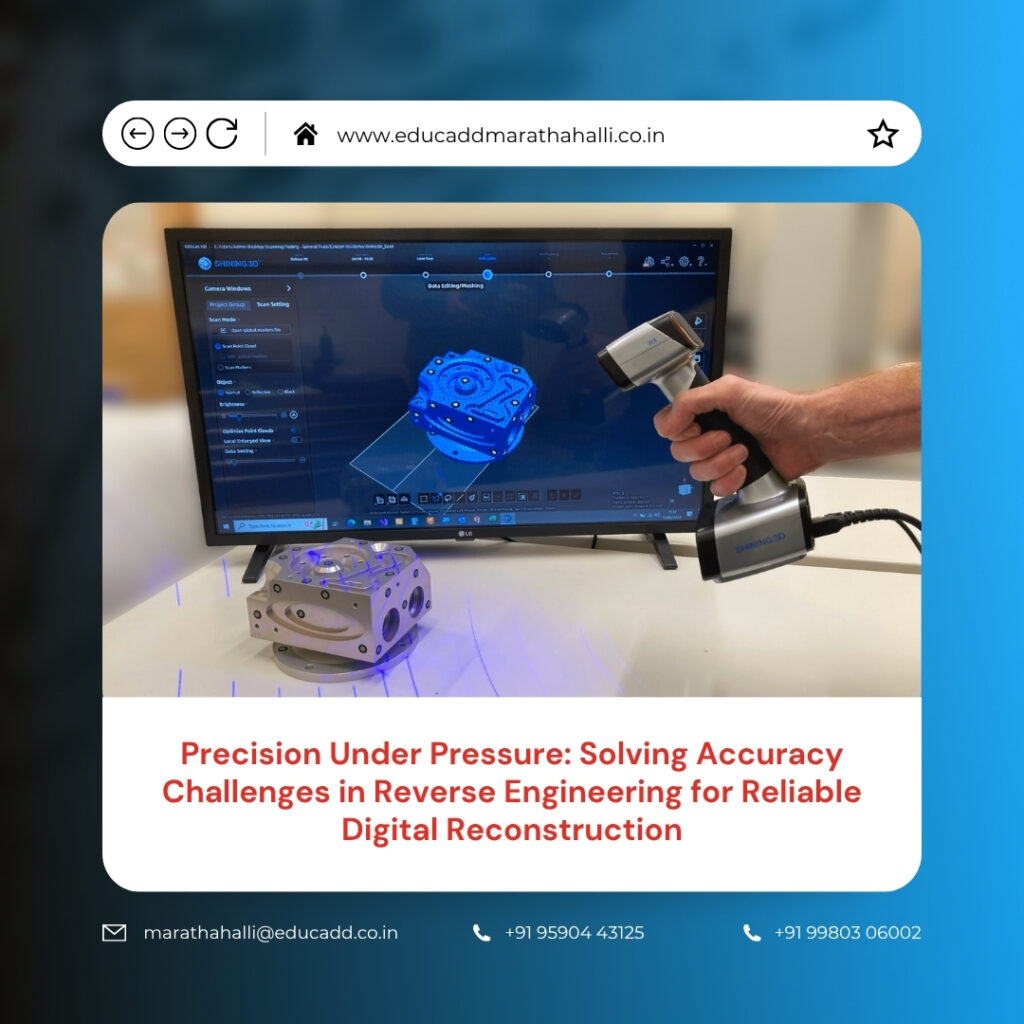
Accuracy Challenges Reverse Engineering
Whether engineers are reconstructing mechanical parts, industrial equipment, consumer products, or architectural structures, achieving precise results requires careful planning and execution. As industries move toward digital transformation and smart manufacturing, overcoming accuracy-related challenges has become essential for delivering dependable outcomes and maximizing the value of reverse engineering projects.
Understanding the Foundation of Reverse Engineering
Accuracy Challenges Reverse Engineering is the process of examining an existing object, system, or product to understand its structure, dimensions, functionality, and design intent. Engineers collect information from physical components and transform that information into digital models that can be analyzed, modified, or reproduced. This process is widely used when original drawings are unavailable, documentation has been lost, or existing products need modernization.
The success of reverse engineering depends heavily on data quality. Every stage, from scanning and measurement to modeling and validation, contributes to the final result. If errors occur at any point, those inaccuracies can spread throughout the project and affect the finished design. Therefore, understanding the foundation of reverse engineering is the first step toward addressing accuracy concerns. Organizations that focus on precision from the beginning are better equipped to produce dependable and usable models.
Why Accuracy Determines Project Success
Accuracy is the defining factor that separates successful reverse engineering projects from unsuccessful ones. A highly accurate model represents the original object with minimal deviation, ensuring that all dimensions, shapes, and features align with real-world conditions. When accuracy is compromised, the resulting model may fail to function as intended or may require extensive rework.
In industries such as aerospace, automotive, and healthcare, precision is especially critical because even tiny dimensional variations can affect safety and performance. A replacement component that does not fit correctly can lead to costly delays and operational disruptions. Therefore, organizations invest significant effort in minimizing errors throughout the reverse engineering workflow.
Furthermore, accurate models improve communication between design teams, manufacturers, and stakeholders. They provide confidence that engineering decisions are based on reliable information, ultimately supporting better business outcomes and faster project completion.
Challenges During Data Collection and Scanning
One of the most common sources of error occurs during the initial data acquisition phase. Engineers typically use laser scanners, structured-light scanners, photogrammetry systems, and coordinate measuring machines to capture information from physical objects. Although these technologies provide impressive capabilities, they are not immune to limitations.
Environmental factors can significantly affect scanning accuracy. Variations in temperature, lighting conditions, dust levels, and vibration can influence measurement results. In addition, operator mistakes such as improper scanner positioning or incorrect calibration may introduce unwanted inaccuracies.
Another challenge arises when capturing large or highly detailed objects. The greater the complexity of the object, the more difficult it becomes to obtain complete and consistent data. Missing information during scanning often creates gaps that require additional processing and correction later in the project. Therefore, careful preparation and equipment setup are essential for achieving reliable measurements.
Complex Geometries Create Significant Difficulties
Modern products often contain intricate curves, hidden cavities, detailed textures, and irregular shapes. These complex geometries present substantial challenges during reverse engineering because many scanning technologies struggle to capture every feature accurately.
Deep recesses and concealed surfaces frequently remain inaccessible to scanners. As a result, incomplete datasets can emerge, forcing engineers to estimate or reconstruct missing areas. Such estimations increase the likelihood of dimensional deviations and modeling errors.
Moreover, highly detailed geometries generate large volumes of data. Processing these extensive datasets requires sophisticated software and powerful computing resources. Without efficient data management, critical information may be lost or simplified during processing. Consequently, engineers often combine multiple scanning methods to ensure complete coverage and improve overall accuracy when working with complex objects.
Material Properties and Surface Conditions Affect Results
The physical characteristics of a component can greatly influence reverse engineering accuracy. Different materials interact with scanning technologies in unique ways, creating challenges that require specialized solutions.
Reflective metal surfaces often cause laser scattering, which can distort measurement data. Transparent materials may allow scanning beams to pass through instead of reflecting back to the sensor. Dark-colored surfaces sometimes absorb light, reducing data quality and consistency.
Several material-related factors commonly affect scanning accuracy:
- Highly reflective surfaces can generate noisy or distorted scan data.
- Flexible materials may deform during measurement, leading to inaccurate dimensions.
Engineers frequently apply temporary surface coatings or use alternative scanning techniques to overcome these issues. By understanding how materials behave during scanning, teams can select the most appropriate methods and improve data reliability.
Human Interpretation Remains a Critical Factor
While advanced technologies automate many aspects of reverse engineering, human expertise continues to play a central role. Engineers must interpret collected data, identify design intent, and convert raw measurements into meaningful digital models.
Unfortunately, human judgment introduces the possibility of inconsistency. Different engineers may analyze the same dataset differently, particularly when dealing with incomplete information. Personal experience, assumptions, and interpretation methods can influence design decisions.
This challenge becomes even more pronounced when reverse engineering older products that lack documentation. In such situations, engineers must rely heavily on observation and technical knowledge. Organizations can reduce interpretation-related errors by implementing standardized workflows, conducting peer reviews, and encouraging collaboration among multidisciplinary teams.
Software Processing and Modeling Challenges
After data collection, engineers use specialized software to convert point clouds and scan data into three-dimensional models. Although modern software offers powerful capabilities, the processing stage introduces its own accuracy challenges.
Data conversion often requires filtering, smoothing, and mesh generation. These operations help create usable models but can also alter important geometric details. Excessive smoothing may remove fine features, while automatic corrections can unintentionally change dimensions.
Additionally, software compatibility issues may occur when transferring data between different platforms. Information loss during file conversion can compromise model integrity and introduce errors that are difficult to detect.
To maintain accuracy, engineers should verify processed models against original scan data and perform regular quality checks throughout the modeling process. Careful validation helps ensure that digital representations remain faithful to the physical object.
The Impact of Incomplete or Damaged Components
Many reverse engineering projects involve worn, damaged, or partially missing components. Reconstructing such objects accurately presents a significant challenge because engineers must determine the original geometry despite physical deterioration.
Wear caused by long-term use can alter dimensions and surface characteristics. Corrosion, fractures, and material loss may obscure important design features. Consequently, captured data often reflects the current condition of the component rather than its original state.
To address this issue, engineers analyze multiple reference points and compare similar components whenever possible. Historical documentation, maintenance records, and engineering knowledge can also provide valuable insights into the original design. These resources help reduce uncertainty and improve reconstruction accuracy.
Legacy Systems and Outdated Documentation
Reverse engineering is frequently used to modernize legacy systems and support equipment that remains in service despite aging technology. However, working with older systems introduces unique accuracy challenges.
Original drawings may no longer exist, or available documentation may contain outdated information. Components often undergo modifications throughout their operational life, making it difficult to determine their original specifications.
Common legacy system challenges include:
- Missing or incomplete technical documentation.
- Design changes that were never formally recorded.
Engineers must carefully evaluate available information and verify measurements through extensive testing. Combining historical research with modern scanning techniques helps create more accurate digital representations of aging systems and equipment.
The Importance of Calibration and Equipment Maintenance
Even the most advanced measurement tools require proper calibration to produce reliable results. Equipment that is not regularly calibrated can generate systematic errors that affect every stage of the reverse engineering process.
Calibration ensures that scanners, measuring devices, and sensors operate within specified accuracy ranges. Without routine verification, gradual deviations may occur without being immediately noticeable. These small discrepancies can accumulate and lead to significant inaccuracies in final models.
Preventive maintenance also plays a vital role. Worn components, damaged sensors, and outdated firmware can reduce measurement reliability. Organizations that establish regular calibration schedules and maintenance programs are better positioned to achieve consistent and accurate results across multiple projects.
Validation and Quality Control Strategies
Accuracy cannot be achieved solely through data collection and modeling. Validation and quality control procedures are necessary to confirm that reconstructed models accurately represent the original object.
Validation involves comparing digital models against physical measurements and functional requirements. Engineers use inspection tools, simulation software, and dimensional analysis techniques to identify discrepancies and verify accuracy.
Quality control measures help maintain consistency throughout the project lifecycle. Continuous monitoring enables teams to detect issues early and implement corrective actions before errors become costly. By integrating validation into every phase of reverse engineering, organizations can significantly improve project reliability and reduce the risk of failure.
How Emerging Technologies Improve Accuracy
Technological innovation continues to transform reverse engineering by providing new tools and techniques for improving precision. Artificial intelligence, machine learning, and advanced automation systems are helping engineers address many traditional accuracy challenges.
AI-driven software can analyze large datasets more efficiently than conventional methods. These systems identify patterns, detect anomalies, and assist in reconstructing missing features with greater consistency. Machine learning algorithms also improve over time by learning from previous projects.
In addition, high-resolution scanners now capture more detailed information than ever before. Enhanced sensor technology allows engineers to obtain accurate measurements even under challenging conditions. As these innovations continue to evolve, reverse engineering workflows will become faster, smarter, and more precise.
Best Practices for Achieving Higher Accuracy
Organizations seeking superior reverse engineering results should adopt a structured approach focused on precision and quality. Success depends not only on technology but also on planning, training, and process management.
Engineers should begin by selecting appropriate scanning methods based on object size, complexity, and material characteristics. Thorough project planning helps identify potential challenges before data collection begins. Regular training ensures that operators remain proficient in using advanced equipment and software.
Furthermore, maintaining detailed documentation throughout the process supports traceability and consistency. Combining skilled personnel with proven methodologies creates a strong foundation for achieving accurate and dependable outcomes in reverse engineering projects.
The Future of Precision in Reverse Engineering
The future of reverse engineering will be shaped by increasing automation, intelligent data analysis, and seamless integration with digital engineering ecosystems. Technologies such as digital twins, cloud-based collaboration platforms, and real-time monitoring systems will further enhance accuracy and efficiency.
Engineers will gain access to more powerful tools capable of capturing, processing, and validating data with unprecedented precision. Automated workflows will reduce human error while accelerating project timelines. At the same time, advanced analytics will provide deeper insights into design intent and product performance.
As industries continue embracing digital transformation, the demand for highly accurate reverse engineering solutions will only increase. Organizations that invest in emerging technologies and best practices will be better prepared to meet future challenges and remain competitive in a rapidly evolving marketplace.
Conclusion
The growing importance of reverse engineering across engineering, manufacturing, and technology sectors makes accuracy a critical priority. The various Accuracy Challenges Reverse Engineering, including measurement errors, complex geometries, material limitations, software processing issues, and human interpretation factors, can significantly influence project outcomes. However, these challenges are not impossible to overcome. Through proper planning, advanced scanning technologies, rigorous validation procedures, skilled expertise, and continuous innovation, organizations can achieve highly accurate digital reconstructions.
As artificial intelligence, automation, and next-generation measurement systems continue to evolve, reverse engineering will become even more reliable and efficient. Companies that prioritize precision today will gain substantial advantages in product development, operational efficiency, and long-term technological advancement.

