
Master BIM Skills Through Live Projects and Build a Future-Ready Career in Construction
The construction industry is evolving faster than ever before, and digital technology now plays a major role in every stage of project development. Traditional drafting methods and disconnected workflows are gradually disappearing because modern construction companies demand smarter, faster, and more accurate project execution. As a result, Building Information Modeling has become one of the most valuable technologies in the Architecture, Engineering, and Construction industry. Today, companies expect professionals to possess practical BIM expertise instead of only theoretical software knowledge. Organizations require skilled individuals who can coordinate projects, create intelligent models, identify design conflicts, and improve construction efficiency through advanced digital tools. Therefore, students and professionals who invest in Master BIM Live Projects gain a strong advantage in the competitive job market.
Many learners understand software commands but struggle to work on real-time projects because they lack practical exposure. This gap often affects job opportunities and career growth. However, live project training helps students experience actual industry workflows and prepares them for professional responsibilities from the beginning.
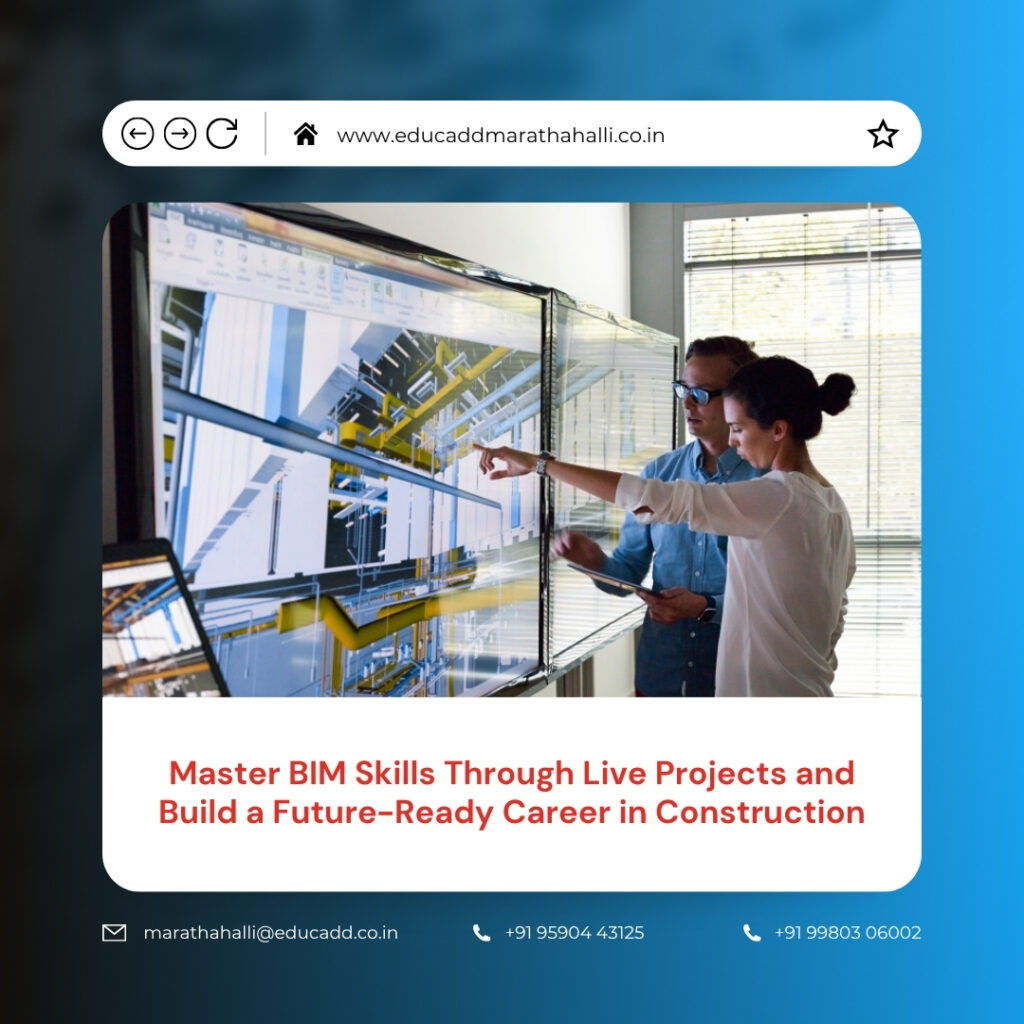
Master BIM Live Projects
Practical BIM learning not only improves technical skills but also builds confidence, communication abilities, and project management understanding. Moreover, industries across India and abroad actively hire BIM professionals for commercial buildings, residential developments, smart infrastructure, industrial projects, and urban planning initiatives.
This blog explains why Master BIM Live Projects is essential for career growth, how practical exposure transforms learning, and why BIM professionals continue to remain in high demand worldwide.
The Rapid Growth of BIM Technology in the Construction Industry
The global construction sector has undergone massive transformation in recent years. Earlier, project teams relied heavily on manual drafting, paper documentation, and isolated workflows. These traditional systems often resulted in communication gaps, design errors, delays, and increased project costs. BIM technology solved many of these challenges by introducing intelligent digital collaboration.
Building Information Modeling enables architects, engineers, contractors, and project managers to work together through a centralized digital model. Every design element, material specification, and project update becomes connected within one integrated platform. Because of this, construction companies can improve accuracy, minimize errors, and optimize project execution.
Governments and private organizations worldwide now encourage BIM adoption for large-scale infrastructure projects. Smart cities, airports, hospitals, metro stations, and commercial buildings increasingly depend on BIM workflows for efficient construction management.
This growing adoption has created significant demand for skilled BIM professionals. Companies actively seek candidates who understand practical project coordination and digital construction workflows. Therefore, students who pursue BIM training with hands-on project experience gain access to better career opportunities and long-term professional growth.
Why Live Project Exposure Is Essential for BIM Students
Many students complete software courses but still feel uncertain while attending interviews or working on professional assignments. The primary reason behind this issue is the absence of practical learning. Theoretical knowledge alone cannot prepare students for real construction environments.
Live project exposure changes the entire learning experience. Instead of practicing only sample exercises, students work on actual building models and real industry scenarios. This practical approach allows learners to understand how BIM processes function within professional construction projects.
Students gain experience in project coordination, documentation management, model development, and clash detection. Additionally, they learn how multiple departments collaborate during project execution. These practical experiences improve problem-solving skills and technical confidence significantly.
Live project training also helps students understand industry standards and project deadlines. Learners become familiar with real client expectations and workflow management systems. Consequently, they develop the ability to handle professional responsibilities more efficiently.
Most importantly, practical BIM exposure creates job-ready professionals. Employers prefer candidates who already understand project execution because they require less training after recruitment.
Industry-Oriented BIM Training Creates Strong Technical Foundations
Strong technical knowledge is essential for building a successful BIM career. Industry-oriented training programs focus on practical implementation instead of limiting students to theoretical concepts. This approach enables learners to understand real construction workflows and advanced digital processes.
During training, students learn how to create architectural, structural, and MEP models using industry-standard software applications. Trainers guide learners through actual project coordination techniques, helping them understand how different disciplines interact within construction projects.
Practical BIM training also improves analytical thinking. Students learn how to identify design conflicts, optimize workflows, and improve project efficiency. Since learners work on real project scenarios, they develop a deeper understanding of construction systems and engineering coordination.
Additionally, technical training improves project accuracy and attention to detail. Students understand how minor modeling errors can affect construction execution and project timelines. Therefore, practical exposure encourages a more professional and responsible approach toward project development.
Industry-oriented BIM courses help students gain confidence while strengthening their technical expertise for future job roles.
BIM Software Tools That Students Learn During Practical Training
Master BIM Live Projects programs introduce students to several advanced software applications used in the construction industry. Every software tool serves a specific purpose in project planning, modeling, coordination, and management.
Some of the major BIM software tools include:
- Autodesk Revit for architectural, structural, and MEP modeling
- Navisworks for project coordination and clash detection
Students may also learn AutoCAD, BIM 360, Dynamo, SketchUp, Primavera, and other advanced applications depending on the course structure. These tools help professionals improve project visualization, automate workflows, and manage construction activities effectively.
Practical training enables students to apply these tools within live projects instead of relying only on theoretical exercises. Consequently, learners understand how software workflows integrate within actual construction environments.
Hands-on learning also improves software efficiency because students repeatedly perform real project tasks. This practical experience becomes highly valuable during interviews and professional assignments.
How BIM Training Improves Career Opportunities Worldwide
The demand for BIM professionals continues to grow rapidly across global construction markets. Countries like the United States, Canada, the United Kingdom, Singapore, Australia, and the UAE actively hire BIM experts for infrastructure and commercial projects.
India has also experienced tremendous BIM growth due to smart city developments, metro rail projects, industrial expansion, and modern urban planning initiatives. As more companies adopt digital construction methods, the requirement for skilled BIM professionals increases continuously.
Students who complete BIM training with live projects can apply for roles such as BIM Engineer, BIM Coordinator, BIM Modeler, Revit Technician, Project Planner, and Design Coordinator. These positions offer attractive salary packages and strong long-term career potential.
Practical BIM knowledge also creates international job opportunities. Many multinational companies prefer candidates who understand collaborative workflows and real project coordination systems.
Furthermore, BIM careers continue evolving alongside technologies like digital twins, automation, and artificial intelligence. Therefore, students entering the BIM industry today can expect stable and future-focused career growth.
Live Projects Improve Collaboration and Communication Skills
Modern construction projects involve multiple teams working together throughout project execution. Architects, structural engineers, MEP consultants, contractors, and project managers must coordinate efficiently to achieve successful outcomes.
Live project training helps students understand the importance of collaboration within BIM workflows. Learners gain practical experience in working with shared project models, exchanging updates, and resolving coordination issues effectively.
This teamwork-oriented approach develops communication skills alongside technical abilities. Students learn how to present ideas clearly, coordinate with different departments, and participate in project discussions professionally.
Cloud-based BIM platforms further improve collaborative learning experiences. Students understand how real-time updates help teams maintain project accuracy and reduce communication delays.
These collaboration skills become highly valuable during professional careers because companies prefer candidates who can work effectively within multidisciplinary project environments.
The Importance of Clash Detection in BIM Workflows
Clash detection is one of the most valuable features of BIM technology. In traditional construction methods, design conflicts often become visible only during site execution. Such problems lead to project delays, rework, and increased costs.
BIM software allows professionals to identify these conflicts digitally before construction begins. During live project training, students learn how to detect clashes between architectural, structural, and MEP systems.
For example, HVAC ducts may interfere with beams, or plumbing lines may intersect electrical pathways. BIM tools identify these issues early, allowing teams to make corrections before site implementation.
Practical clash detection training improves problem-solving abilities and technical understanding. Students learn how to analyze conflicts systematically and develop efficient solutions.
Companies highly value professionals who can reduce construction risks and improve project coordination. Therefore, clash detection expertise significantly enhances employability in the BIM industry.
Practical BIM Training Builds Professional Confidence
Confidence is essential for succeeding in interviews and professional assignments. Students who only study theoretical concepts often struggle to explain project workflows and technical processes during job interviews.
Practical BIM training changes this completely. When learners work on live projects, they gain firsthand experience in project coordination, modeling, documentation, and construction workflows. This exposure improves confidence naturally.
Students also become familiar with industry standards, client requirements, and project deadlines. As a result, they feel more prepared to handle professional responsibilities after completing their training.
Practical learning environments encourage students to ask questions, solve problems, and participate actively in project discussions. These experiences improve communication skills and professional behavior significantly.
Moreover, live project exposure helps learners build strong portfolios. Employers often prefer candidates who can showcase real project experience instead of relying solely on course certificates.
BIM Visualization Helps Teams Understand Projects Better
Visualization plays a major role in modern construction workflows. Traditional 2D drawings often make it difficult for clients and project teams to understand design concepts clearly. BIM technology solves this challenge through intelligent 3D modeling.
During practical BIM training, students learn how to create realistic building models with accurate details and visual presentations. These models improve project understanding for engineers, contractors, and clients.
Visualization also supports better decision-making during project planning. Stakeholders can identify design improvements, space utilization issues, and construction challenges more effectively.
Some key advantages of BIM visualization include:
- Better communication between project teams and clients
- Improved understanding of construction layouts and sequences
Students trained in visualization techniques also develop stronger presentation skills. They learn how to create walkthroughs, renderings, and project demonstrations that improve client engagement and project approval processes.
BIM Training Helps Students Understand Real Construction Workflows
Construction projects involve multiple stages, including planning, design, coordination, scheduling, execution, and maintenance. Many students understand software operations but fail to connect them with actual construction workflows.
Live project training bridges this gap successfully. Students learn how BIM supports every phase of the construction lifecycle. They understand project coordination methods, documentation standards, and workflow management systems used in real industries.
Practical training also introduces learners to quantity estimation, scheduling concepts, and project sequencing strategies. These additional skills improve overall project understanding and technical competency.
By working on real projects, students gain insight into how construction teams solve challenges and maintain project efficiency. This industry exposure prepares learners for practical workplace responsibilities more effectively.
Consequently, BIM-trained professionals become more adaptable and productive when they enter the construction industry.
Digital Transformation Is Increasing the Value of BIM Professionals
The construction industry is rapidly moving toward digital transformation. Automation, cloud collaboration, artificial intelligence, and smart infrastructure technologies are reshaping traditional construction processes.
BIM serves as the foundation for many of these modern technologies. Therefore, professionals with practical BIM expertise remain highly valuable in the evolving construction market.
Live project training helps students adapt to digital workflows and advanced project management systems. Learners understand how technology improves construction efficiency, reduces waste, and supports sustainable building practices.
Additionally, BIM professionals contribute to smarter project planning and resource management. Organizations increasingly rely on digital tools to improve productivity and maintain project accuracy.
As technology continues advancing, BIM professionals will play an even greater role in shaping future construction systems worldwide.
Why Employers Prefer Candidates With Live Project Experience
Employers today focus heavily on practical skills while hiring BIM professionals. Companies want candidates who can contribute immediately without requiring extensive additional training.
Students with live project exposure understand real construction workflows, project coordination, and software implementation methods. Consequently, they adapt faster to workplace environments and perform tasks more efficiently.
Practical experience also demonstrates professionalism and industry readiness. Employers trust candidates who can explain project challenges, coordination methods, and workflow processes confidently.
Additionally, live projects help students develop time management and teamwork skills. These qualities are extremely important in fast-paced construction environments where multiple teams work together simultaneously.
Candidates with practical BIM portfolios often stand out during interviews because they can showcase real technical capabilities instead of theoretical understanding alone.
Selecting the Right BIM Training Institute Matters
Choosing the right BIM training institute is extremely important for career development. Students should always prioritize institutes that focus on practical learning and live project exposure.
A good training institute provides experienced trainers, updated software tools, project-based learning, and industry-relevant curriculum. Hands-on workshops and real project assignments help students build stronger technical foundations.
Placement assistance and career guidance also play important roles while selecting a BIM institute. Institutes with strong industry connections often provide better employment opportunities for students.
Additionally, students should evaluate infrastructure quality, software availability, certification value, and trainer expertise before joining any BIM program.
The right training environment helps learners gain both technical knowledge and professional confidence necessary for long-term success in the AEC industry.
Conclusion
Master BIM Live Projects has become one of the most effective ways to prepare for successful careers in the modern construction industry. Companies today require professionals who possess practical expertise, collaborative skills, and real project understanding instead of only theoretical software knowledge.
Live project exposure helps students develop technical competency, communication abilities, problem-solving skills, and industry confidence. Learners understand how real construction workflows operate and become prepared for professional responsibilities from the beginning of their careers.
Additionally, BIM technology continues expanding across global markets, creating strong demand for trained professionals in architecture, engineering, infrastructure, and construction sectors. From smart cities to advanced commercial developments, BIM plays a critical role in shaping modern construction systems.
Students who invest in industry-oriented BIM training gain a major advantage in the competitive job market. They become future-ready professionals capable of adapting to evolving technologies and digital construction practices.
Therefore, practical BIM training is not simply about learning software tools. It is about building real-world expertise, improving career opportunities, and creating a strong foundation for long-term success in the rapidly growing AEC industry.

