
From Physical Objects to Smart Digital Models: A Complete Guide to the 3D Scanning to CAD Process
The engineering and manufacturing industries have entered a new digital era where speed, precision, and innovation drive every stage of production. Companies no longer rely only on manual measurements and traditional drafting methods to create accurate designs. Instead, advanced digital technologies now help professionals capture real-world objects and transform them into intelligent 3D models within a short period. Among these technologies, the 3D Scanning CAD Process has become one of the most valuable solutions for modern industries.
Today, organizations across automotive, aerospace, construction, healthcare, industrial manufacturing, and product design sectors use this workflow to improve efficiency and reduce operational errors. The process allows engineers to scan physical objects and convert them into highly accurate CAD models that can be edited, analyzed, tested, and manufactured digitally. As industries continue moving toward automation and smart manufacturing, the demand for accurate digital modeling grows rapidly.
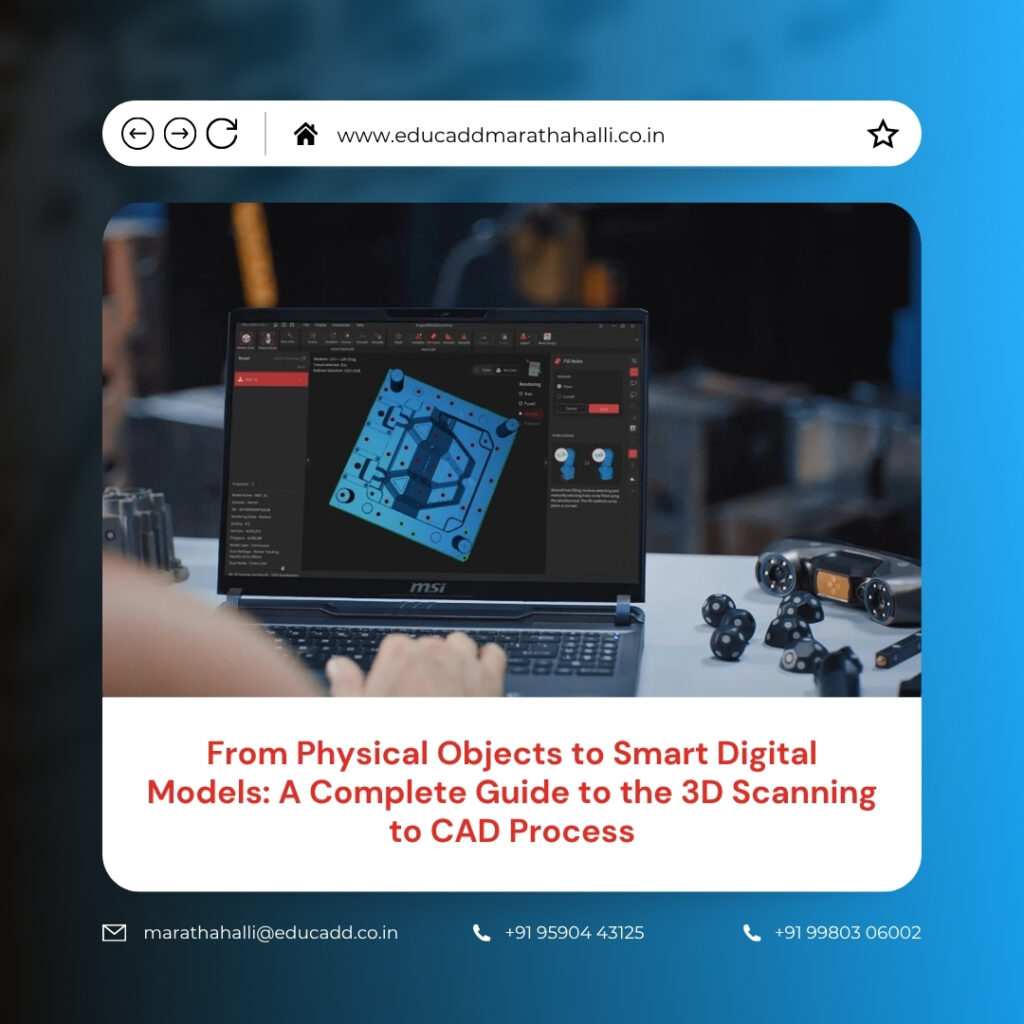
3D Scanning CAD Process
Moreover, businesses now focus heavily on reducing production time while maintaining excellent quality standards. The 3D Scanning CAD Process supports these goals by simplifying reverse engineering, quality inspection, redesign, and prototyping activities. Because of its versatility and precision, this workflow has become an essential part of digital engineering environments worldwide.
Understanding the Role of 3D Scanning Technology
3D scanning technology helps professionals capture the exact shape, dimensions, and surface details of a physical object. The scanner records millions of points from the object’s surface and creates a digital dataset known as a point cloud. This digital information represents the geometry of the object with remarkable accuracy.
Unlike traditional measurement methods, 3D scanning captures highly complex surfaces quickly and efficiently. Engineers no longer need to spend hours measuring curves, edges, or irregular geometries manually. Instead, the scanner collects detailed information in real time, reducing both effort and human error.
Different scanning technologies serve different industrial requirements. Laser scanners are widely used for industrial precision applications, while structured light scanners offer faster scanning for medium-sized objects. Photogrammetry systems use multiple photographs to create 3D models and provide cost-effective solutions for large-scale projects.
The Importance of CAD Modeling in Modern Engineering
Computer-Aided Design, commonly referred to as CAD, forms the backbone of modern engineering and product development. CAD software enables designers and engineers to create accurate digital models, technical drawings, assemblies, and simulations with exceptional efficiency.
Before digital technologies became common, engineers relied heavily on manual drafting techniques. However, CAD software revolutionized the design industry by simplifying modifications, calculations, and documentation processes. Today, engineers can instantly update models, test product performance, and share designs globally within seconds.
When integrated with 3D scanning technology, CAD software becomes even more powerful. The scanned object data acts as the foundation for creating intelligent digital models that engineers can modify and optimize according to project requirements. Consequently, businesses save time, reduce development costs, and improve overall product quality.
Why Industries Depend on the 3D Scanning to CAD Workflow
The growing popularity of the 3D Scanning CAD Process comes from its ability to simplify complex engineering tasks. Companies often face situations where physical objects exist without original design files or technical drawings. In such cases, scanning technology provides a fast and accurate solution.
Reverse engineering represents one of the biggest reasons industries adopt this workflow. Manufacturers frequently scan old machine components to recreate replacement parts or redesign outdated products. Without scanning technology, recreating these parts manually would require significant time and effort.
Another major advantage involves collaboration. Since CAD models are digital, teams across different locations can work together efficiently. Designers, manufacturers, and quality engineers can access the same data instantly, improving communication and reducing project delays.
As businesses continue focusing on automation and smart manufacturing, the demand for reliable digital workflows continues increasing across multiple industries.
Preparing Objects Before the Scanning Process
Successful scanning begins with proper object preparation. Before scanning starts, technicians inspect the object carefully to identify factors that may affect data accuracy. Reflective surfaces, transparent materials, and dark finishes can interfere with scanner performance and create incomplete datasets.
To overcome these challenges, operators often apply matte sprays or temporary coatings to reflective surfaces. These coatings improve light diffusion and help scanners capture accurate surface details. Additionally, technicians place reference markers on large objects to improve alignment during scanning.
Environmental conditions also influence scanning quality. Stable lighting and vibration-free surroundings help maintain accurate data collection throughout the process. Moreover, technicians position the object carefully to ensure scanners can access hidden areas effectively.
Because data accuracy plays a critical role in engineering applications, industries prioritize preparation before beginning any scanning operation.
Capturing Physical Geometry Through 3D Scanning
Once preparation is complete, the actual scanning process begins. During this stage, the scanner captures detailed geometric information from the object’s surface. The device records millions of data points and generates a digital representation of the object.
Operators move the scanner around the object carefully to ensure complete coverage from multiple angles. Modern scanning systems display captured data in real time, allowing technicians to identify gaps immediately and rescan missing areas if necessary.
Handheld scanners provide excellent flexibility for scanning complex shapes and large objects. Fixed scanners, on the other hand, offer extremely high precision for industrial inspection applications. Depending on project requirements, professionals select the most suitable scanning solution.
The quality of scanned data directly affects the success of the CAD conversion process. Therefore, operators focus heavily on maintaining proper scanner positioning, speed, and alignment throughout the procedure.
Processing and Cleaning the Scan Data
Raw scan data usually contains unwanted noise, duplicate points, and alignment inconsistencies. Therefore, professionals must process and clean the collected data before converting it into a CAD model.
During processing, software applications align multiple scans into a single unified dataset. Technicians remove unnecessary points, repair gaps, and improve surface consistency to create a cleaner digital model. This stage ensures the scanned geometry becomes suitable for engineering applications.
Mesh generation also plays a major role in this phase. The software converts point cloud data into polygon meshes that represent the object’s surface more clearly. These meshes provide a better visual understanding of the object’s geometry and simplify CAD reconstruction tasks.
Efficient data processing improves project speed while ensuring reliable engineering results. Therefore, industries invest heavily in advanced processing software and skilled professionals.
Transforming Scan Data into Accurate CAD Models
Converting scanned data into CAD geometry represents one of the most critical stages of the workflow. Engineers use reverse engineering software to create editable CAD models based on the scanned mesh or point cloud information.
This process often requires technical expertise because scanned surfaces may contain irregular geometries and complex features. Engineers identify key elements such as curves, cylinders, edges, and planes before rebuilding them using parametric CAD tools.
The goal is not simply to replicate the object visually but to create an intelligent and editable engineering model. Therefore, professionals focus on generating clean geometry suitable for manufacturing, analysis, and future modifications.
Reverse Engineering and Product Redesign Applications
Reverse engineering remains one of the most valuable applications of the 3D Scanning CAD Process. Many industries use this workflow to recreate products when original CAD files are unavailable or outdated.
Manufacturers often scan damaged or obsolete machine components to produce replacement parts. Automotive restoration companies also rely heavily on scanning technologies to recreate vintage vehicle components accurately.
Some important reverse engineering benefits include:
- Faster recreation of old components
- Reduced manual measurement errors
- Improved product redesign efficiency
- Better compatibility with modern manufacturing systems
Because reverse engineering saves both time and resources, it continues becoming more important across industrial sectors worldwide.
Enhancing Quality Inspection and Manufacturing Accuracy
Quality inspection represents another major advantage of the scanning-to-CAD workflow. Manufacturers use 3D scanning systems to compare finished products against original CAD designs and detect deviations instantly.
Traditional inspection methods often require manual measurements using calipers and gauges. However, these techniques consume significant time and may not capture complex geometries accurately. In contrast, 3D scanning delivers comprehensive dimensional analysis within minutes.
Additionally, accurate inspection helps companies reduce material waste, minimize production errors, and improve customer satisfaction significantly.
Key Advantages of the 3D Scanning to CAD Workflow
The widespread adoption of this workflow comes from the numerous advantages it offers modern industries. One of the biggest benefits involves speed. Scanning technology captures detailed geometry much faster than manual measurement methods.
Another major advantage is accuracy. Modern scanners provide extremely precise data, enabling engineers to create reliable CAD models for manufacturing and analysis purposes.
The workflow also improves productivity because digital models are easier to modify, duplicate, and share across teams. Consequently, companies experience faster project completion and better collaboration.
Additional benefits include:
- Reduced product development time
- Improved engineering precision
- Faster prototyping and testing
- Better documentation and digital storage
As industries continue embracing automation and digital manufacturing, the value of accurate digital workflows will continue increasing globally.
Challenges Faced During Scanning and CAD Conversion
Although the workflow offers many advantages, certain challenges still exist. Reflective and transparent surfaces remain difficult to scan accurately because they interfere with light and laser reflection patterns.
Large scan files also create processing challenges. High-resolution scans generate massive datasets that require powerful computers and advanced software capabilities for smooth operation.
Another challenge involves converting highly organic or irregular shapes into clean CAD geometry. Automated tools help simplify this task, yet skilled engineers often need to refine the models manually for optimal results.
Despite these challenges, technological advancements continue improving workflow efficiency and accessibility every year.
Industries Driving the Growth of Scanning Technology
Several industries now depend heavily on 3D scanning and CAD integration for daily operations. The automotive industry uses scanning for vehicle customization, inspection, prototyping, and restoration projects.
Aerospace companies scan aircraft components to support maintenance, inspection, and reverse engineering activities. Since aerospace parts require extremely high precision, scanning technology provides reliable digital accuracy.
Architecture and construction firms use scanning systems to document buildings, monitor infrastructure, and support renovation projects. Similarly, industrial manufacturers use scanning for mold design, tooling, and machine optimization.
As digital transformation accelerates globally, more industries continue adopting scanning solutions to improve operational efficiency and innovation capabilities.
Future Innovations in 3D Scanning and CAD Integration
The future of 3D scanning to CAD technology looks extremely promising. Artificial intelligence and machine learning technologies are now improving scan processing and automatic feature recognition capabilities.
Cloud computing also enables faster collaboration between global teams. Engineers can upload scan data to cloud platforms and access projects remotely from different locations.
Real-time scanning and automated CAD generation systems are becoming more advanced as well. These innovations reduce manual intervention and help companies accelerate product development significantly.
As Industry 4.0 continues expanding, smart factories will increasingly depend on accurate digital twins and automated inspection systems. Therefore, professionals skilled in scanning and CAD technologies will remain highly valuable in the future workforce.
Conclusion
The 3D Scanning CAD Process has transformed modern engineering by connecting physical objects with intelligent digital environments. This advanced process enables industries to capture real-world geometry accurately and convert it into editable CAD models for design, manufacturing, inspection, and innovation.
From reverse engineering and quality control to healthcare and aerospace applications, the workflow supports countless industrial operations. Moreover, it reduces manual effort, improves precision, accelerates development cycles, and enhances overall productivity.
Professionals who understand the scanning-to-CAD process gain valuable expertise that opens opportunities across multiple engineering sectors. Therefore, mastering this technology not only supports modern industrial requirements but also prepares businesses and individuals for the future of digital engineering and smart manufacturing.

