
Precision in Every Beam: How Civil CADD Elevates Structural Design Quality and Eliminates Engineering Errors
Civil CADD Structural Design has entered an era where precision, speed, and coordination determine project success. Modern infrastructure projects involve complex calculations, multiple stakeholders, and strict compliance requirements, making design accuracy more important than ever. Even a small drafting oversight can create serious construction challenges, increase costs, and compromise safety. This is where Civil CADD becomes an essential technological companion for engineers and designers. By combining intelligent drafting tools, automated workflows, and advanced visualization capabilities, Civil CADD helps professionals produce dependable structural plans with confidence.
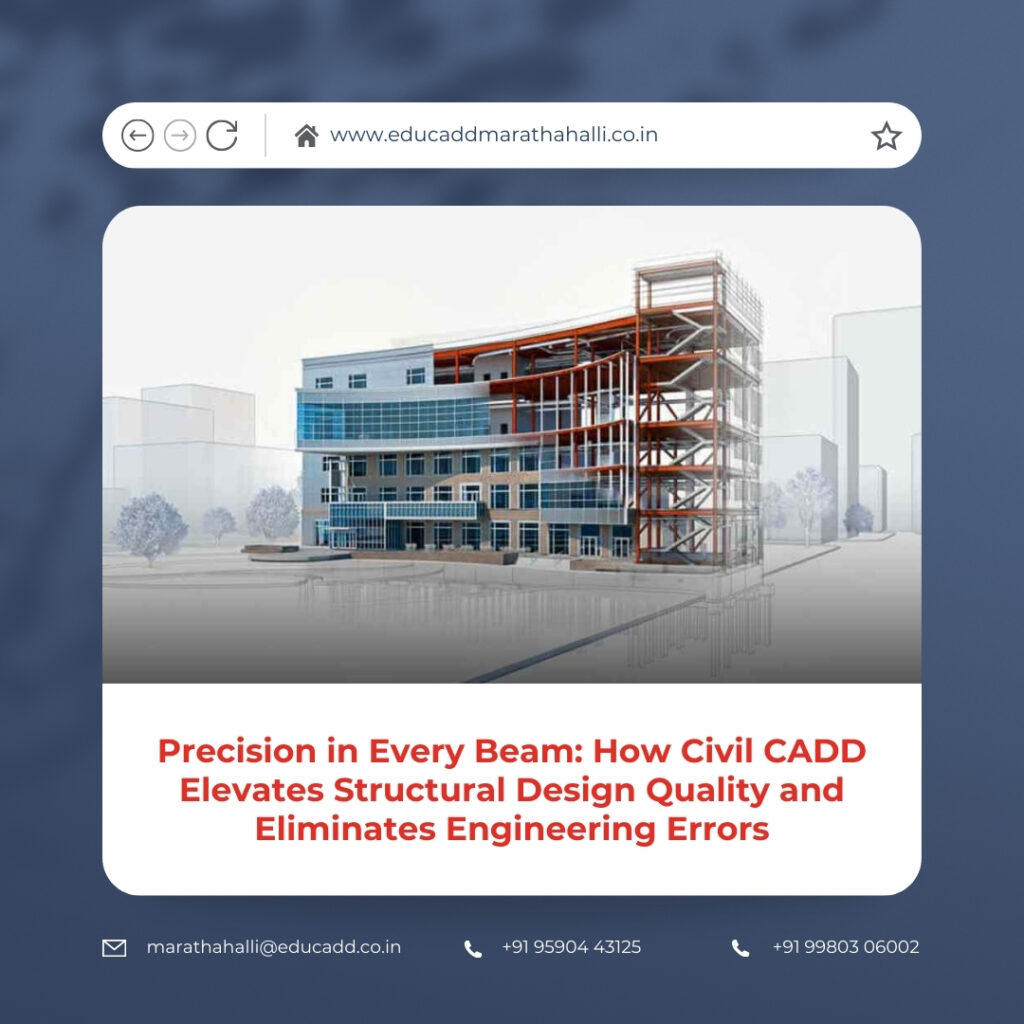
Civil CADD Structural Design
It reduces manual intervention, minimizes the risk of miscalculations, and improves consistency across documentation. Engineers can design, modify, and validate structural elements efficiently while maintaining high technical standards. As project demands grow, digital precision ensures that structures are planned with clarity and executed with reliability. The following sections explore how Civil CADD strengthens structural design processes and significantly reduces engineering mistakes across various project stages.
1. Smart Drafting Tools That Deliver Exceptional Accuracy
Civil CADD Structural Design provides engineers with intelligent drafting features that greatly enhance precision in structural drawings. Traditional drafting methods often involve repetitive manual input, which increases the possibility of dimension errors and alignment problems. Civil CADD simplifies this process through automated drawing aids that maintain exact measurements and geometric consistency. Engineers can define parameters once and apply them throughout the project without worrying about scaling mismatches. Alignment guides and snap controls ensure structural components fit perfectly within defined layouts.
These tools help eliminate common inaccuracies that occur when elements are positioned manually. With digital precision governing every line and curve, designers achieve greater confidence in their plans. Civil CADD also maintains uniformity across related design elements, ensuring that modifications in one area do not create inconsistencies elsewhere. The result is a clean, technically accurate drawing set that reflects the engineer’s true design intent without distortion or measurement flaws.
2. Automated Computation That Removes Calculation Risks
Civil CADD Structural Design depends heavily on numerical accuracy because load distribution, dimensions, and material strength calculations determine structural stability. Manual computations increase mental workload and often introduce arithmetic errors that affect design integrity. Civil CADD addresses this challenge through integrated computational tools that perform measurements and engineering calculations instantly. Engineers can obtain accurate values for distances, areas, gradients, and volumes without relying on separate spreadsheets or handheld calculators. Automated recalculation features also ensure that design updates reflect instantly across all related drawings.
This prevents inconsistencies that may arise when revisions are applied manually. By reducing dependency on repetitive number-crunching tasks, Civil CADD allows professionals to focus more on design logic and safety considerations. Automation not only improves efficiency but also safeguards projects from the hidden risks of human miscalculations. Reliable numerical output strengthens structural planning and significantly reduces design-stage uncertainties.
3. Uniform Design Standards That Prevent Interpretation Errors
Structural projects involve collaboration among architects, engineers, contractors, and regulatory authorities. Inconsistent drawing styles and varying documentation formats can lead to serious misunderstandings during execution. Civil CADD promotes uniformity by offering standardized templates that maintain consistent presentation across structural plans. Engineers can use predefined dimension styles, annotation formats, and symbol libraries to ensure clarity. Standardization improves communication and allows all stakeholders to interpret drawings accurately. Civil CADD also enables organizations to customize templates according to regional building regulations and internal quality standards. This alignment ensures that projects remain compliant while preserving professional consistency.
When every drawing follows a unified structure, contractors can execute plans with fewer clarifications. Uniform documentation reduces ambiguity and prevents costly mistakes caused by misinterpretation. Civil CADD therefore strengthens communication reliability and ensures structural details remain clear across every stage of project development.
4. Continuous Design Verification That Detects Errors Early
Identifying structural issues during construction can be expensive and time-consuming. Civil CADD integrates intelligent verification systems that help engineers detect design conflicts before execution begins. Real-time validation tools monitor layouts and highlight inconsistencies instantly, allowing corrections during the drafting phase. Engineers can identify overlapping components, improper spacing, and dimensional inaccuracies without manual cross-checking. Early detection prevents small drafting oversights from evolving into major structural flaws. Civil CADD Structural Design also supports rule-based validation aligned with engineering best practices, ensuring designs follow required safety parameters.
Visual alerts guide professionals toward problematic areas, reducing dependency on lengthy manual inspections. Continuous design verification improves quality assurance and minimizes unexpected challenges during site implementation. By shifting error detection to early project stages, Civil CADD helps teams save time, reduce expenses, and maintain structural integrity throughout the development cycle.
5. Advanced Visualization That Enhances Structural Clarity
Understanding complex structural layouts through flat drawings can be challenging, especially in projects involving intricate frameworks. Civil CADD enhances visualization by enabling engineers to inspect designs with greater clarity and detail. Zooming features and flexible viewing controls allow professionals to analyze specific components closely. Clear representation of joints, reinforcements, and support systems reduces the likelihood of oversight. Enhanced visual depth also helps engineers evaluate spatial relationships between different structural elements.
Civil CADD enables designers to identify alignment issues and irregularities quickly, improving design accuracy. Improved visualization benefits communication with clients and contractors who may lack technical expertise. When project stakeholders understand structural layouts clearly, execution errors decrease significantly. Visual precision strengthens confidence in design decisions and ensures every structural component integrates seamlessly within the overall framework.
6. Flexible Editing Features That Preserve Design Integrity
Engineering projects often undergo revisions due to evolving requirements, environmental factors, or client preferences. Manual editing introduces risks because changes made in one section may disrupt related components elsewhere. Civil CADD offers synchronized modification tools that maintain structural relationships automatically during revisions. Engineers can update dimensions, layouts, and configurations while preserving proportional balance. Linked elements adjust automatically, ensuring consistency across the entire drawing set. Version control systems also allow professionals to track modifications and compare alternatives efficiently.
Civil CADD minimizes the possibility of accidental deletions or inconsistencies during editing. Flexible design adjustments encourage experimentation without compromising accuracy. Engineers can refine structural plans confidently, knowing that the software maintains alignment and coherence throughout the process. This capability significantly reduces revision-related design errors and improves overall project reliability.
7. Organized Layer Control That Simplifies Complex Drawings
Structural drawings contain multiple interconnected components that require systematic organization for clarity. Without proper categorization, overlapping details create confusion and increase the chance of design mistakes. Civil CADD introduces advanced layer management systems that organize structural elements logically. Engineers can assign separate layers to foundations, beams, reinforcements, utilities, and annotations. This classification allows focused editing and prevents unintended changes to unrelated elements. Designers can isolate specific layers for inspection, improving review accuracy.
Controlled visibility reduces clutter and enhances drafting efficiency. Civil CADD also simplifies troubleshooting by enabling engineers to trace errors within targeted layers. Organized digital environments promote disciplined workflows and reduce oversight risks. By maintaining structured drawing hierarchies, Civil CADD ensures that complex structural information remains manageable and precise.
8. Accurate Scaling Systems That Maintain Dimensional Reliability
Incorrect scaling distorts structural representations and leads to execution errors during construction. Civil CADD ensures dimensional reliability through precise scaling controls that remain consistent across drawings. Engineers can define measurement units and scale ratios that apply uniformly throughout the design process. Automated adjustments update related dimensions whenever modifications occur. This eliminates mismatches that typically arise when resizing elements manually. Accurate scaling ensures that every drawing reflects true structural proportions.
Contractors can rely on precise measurements without second-guessing design specifications. Civil CADD also maintains clarity in large-format layouts that contain dense technical details. Reliable dimension systems reduce confusion and prevent material estimation errors. By maintaining consistent measurement integrity, Civil CADD safeguards projects against costly scaling-related inaccuracies.
9. Integration With Real-World Site Data for Practical Accuracy
Structural feasibility depends on how well designs align with actual site conditions. Civil CADD integrates survey information and topographical data directly into the design environment. Engineers can reference terrain levels, contours, and soil conditions while creating structural layouts. Accurate site integration reduces discrepancies between theoretical plans and on-ground realities. Designers can position foundations and supports according to elevation variations precisely. Civil CADD helps prevent stability issues caused by uneven landscapes or incorrect slope assumptions.
This practical alignment improves load management and structural durability. Engineers can also evaluate environmental constraints before finalizing designs. Seamless data integration bridges the gap between digital planning and physical construction requirements. Civil CADD therefore ensures structural systems adapt effectively to real-world site conditions.
10. Collaborative Workflows That Reduce Communication Gaps
Large-scale structural projects involve multidisciplinary coordination among various professionals. Communication barriers and document inconsistencies often create execution challenges. Civil CADD enhances collaboration by enabling seamless digital file sharing across teams. Engineers, architects, and contractors can access synchronized project data without compatibility concerns. Standardized annotation systems improve technical communication clarity. Teams can review, comment, and update drawings efficiently within shared workflows.
Quick incorporation of expert feedback strengthens design quality and reduces oversight. Civil CADD ensures that every stakeholder works with accurate and updated information. Improved collaboration prevents conflicting interpretations and minimizes structural planning errors. Strong communication channels enhance teamwork efficiency and ensure reliable project outcomes.
11. Digital Documentation That Strengthens Record Accuracy
Traditional paper-based documentation creates storage challenges and increases the risk of version confusion. Civil CADD replaces manual paperwork with organized digital documentation systems. Engineers can store drawings securely and retrieve files instantly when needed. Centralized data management eliminates duplication and prevents outdated drawing usage. Digital archives maintain clear revision histories, improving project traceability. Civil CADD simplifies approval workflows by enabling quick document sharing with regulatory authorities.
Organized records help professionals verify structural decisions accurately during audits. Reduced paperwork also minimizes administrative burden and clerical mistakes. Reliable documentation supports long-term project maintenance and future upgrades. Civil CADD enhances record accuracy while improving overall information management efficiency.
12. Faster Completion Timelines With Minimal Rework
Time efficiency plays a crucial role in infrastructure development because delays increase project expenses. Civil CADD accelerates structural drafting through automation and intelligent design assistance. Engineers can complete detailed layouts faster without compromising technical precision. Built-in validation systems detect errors early, reducing rework cycles significantly. Automated labeling and dimensioning tools streamline repetitive tasks effectively. Faster workflows allow professionals to focus on optimizing structural safety and performance.
Civil CADD Structural Design shortens project timelines while maintaining consistent quality standards. Reduced revision requirements help organizations save resources and meet deadlines confidently. Efficient design cycles contribute to smoother construction processes and improved project profitability.
13. Code-Compliant Design Support That Enhances Safety
Adherence to engineering codes ensures structural safety and regulatory approval. Civil CADD supports compliance by enabling standardized design practices aligned with national guidelines. Engineers can incorporate safety parameters and specification requirements directly into their workflows. Built-in checks help professionals verify reinforcement spacing, load limits, and material standards. Civil CADD reduces the risk of non-compliance caused by oversight or outdated references. Organized compliance documentation simplifies regulatory reviews and approval procedures. Engineers can demonstrate adherence to safety norms through clear and structured design records. Code-aligned workflows protect projects from legal complications and safety hazards. Civil CADD therefore strengthens structural reliability while ensuring regulatory readiness.
14. Long-Term Digital Preservation for Future Engineering Needs
Infrastructure projects require long-term documentation for maintenance, renovation, and expansion planning. Paper drawings deteriorate over time and may lose clarity, creating information gaps. Civil CADD preserves structural designs in durable digital formats that remain accessible for decades. Engineers can retrieve historical plans easily without quality degradation. Accurate digital archives support structural assessments and modernization initiatives efficiently.
Civil CADD ensures that original design data remains intact for reference during repairs or extensions. Reliable preservation also assists in safety evaluations and lifecycle management. Long-term accessibility enhances infrastructure sustainability and informed decision-making. Civil CADD provides a dependable digital foundation for preserving structural intelligence beyond project completion.
Conclusion
Civil CADD Structural Design the safety, durability, and cost-effectiveness of engineering projects. Civil CADD empowers professionals with advanced tools that minimize drafting inaccuracies, computational errors, and documentation inconsistencies. Its automation capabilities, visualization strengths, and intelligent validation systems transform traditional design workflows into efficient digital processes. Engineers benefit from seamless editing, organized data management, and reliable collaboration environments that improve overall productivity.
Civil CADD also ensures compliance with safety regulations while preserving records for future reference. By reducing manual intervention and enhancing technical clarity, the software prevents common structural design mistakes effectively. Organizations that implement Civil CADD gain stronger quality control, faster project delivery, and improved infrastructure reliability. As modern construction demands higher precision and coordination, Civil CADD remains an essential solution for achieving accurate and dependable structural engineering outcomes.

