
The Structural Blueprint Code: Advanced Beam, Column, and Slab Drafting in Civil CADD
Every structure that stands strong over time begins as a concept, evolves through calculations, and finally takes shape through precise drawings. Structural drafting acts as the bridge between engineering theory and on-site construction. Among all structural components, beams, columns, and slabs form the essential load-carrying system of any building. Therefore, drafting these members with clarity and accuracy determines the overall success of a project. Advanced Structural CADD Drafting empowers engineers and drafters to convert structural analysis into clear, professional, and construction-ready drawings. Instead of relying on manual drafting methods, professionals now use digital platforms that ensure speed, precision, and flexibility. Civil CADD enables seamless detailing, efficient revisions, and systematic organization of drawings.
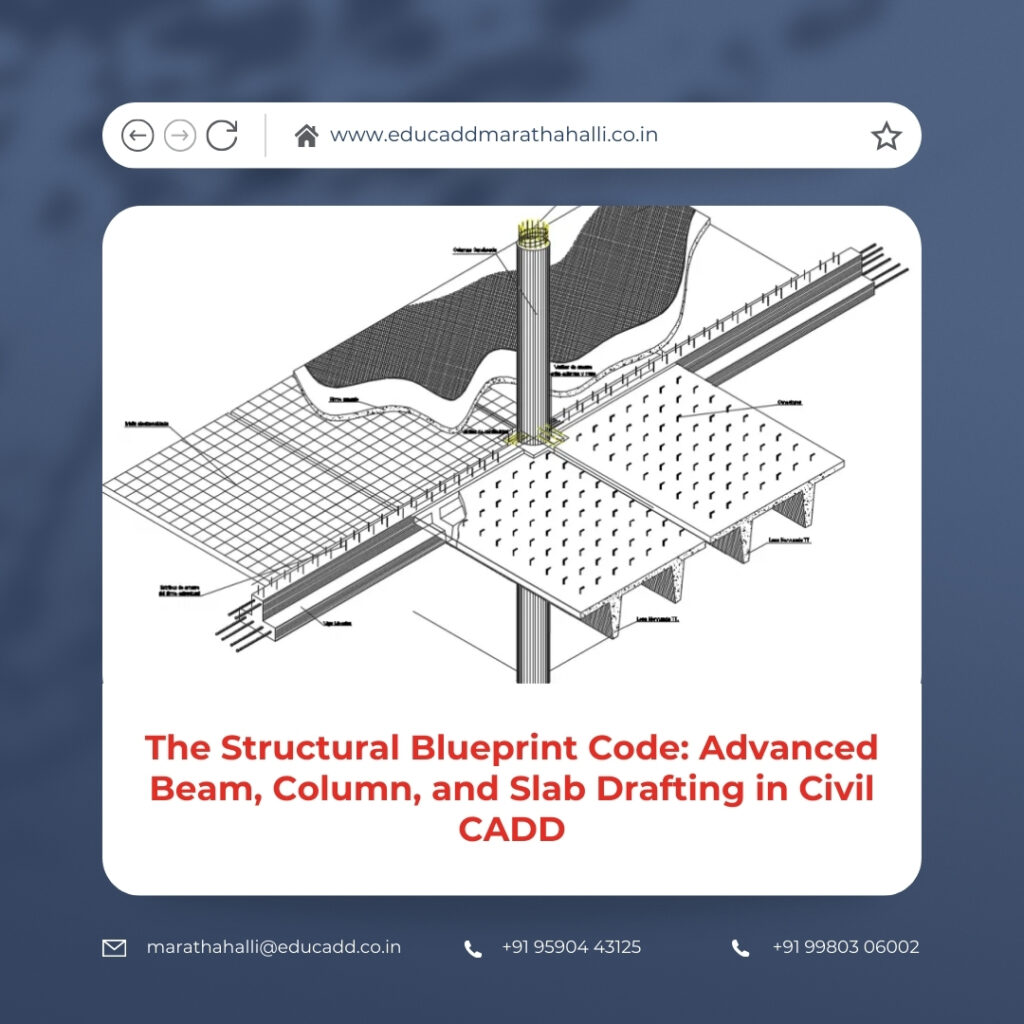
Advanced Structural CADD Drafting
This detailed guide explores every dimension of Beam, Column, and Slab Drafting in Civil CADD. It explains core principles, workflows, detailing standards, coordination strategies, and professional best practices. By the end, you will gain a thorough understanding of how structural drafting supports safe construction and enhances technical excellence.
1. The Foundation of Structural Drafting in Modern Construction
Structural drafting forms the backbone of engineering communication. Engineers calculate loads, bending moments, shear forces, and reinforcement requirements. However, construction teams depend on graphical drawings rather than numerical sheets. Therefore, drafting transforms engineering intent into visual instructions that workers can follow accurately.
Advanced Structural CADD Drafting ensures that structural members appear clearly in plans, sections, and elevation views. Drafters define dimensions, reinforcement placement, cover specifications, and connectivity between structural elements. Each line in a drawing carries technical meaning.
Moreover, digital drafting enhances clarity. Civil CADD allows precise alignment, standardized text styles, and consistent dimensioning. As a result, drawings remain professional and easy to interpret. This clarity reduces confusion on-site and prevents costly errors during execution.
Structural drafting also improves coordination among engineers, architects, and contractors. When drawings communicate accurately, collaboration becomes smooth and productive.
2. Beam Drafting: Representing Load Transfer with Accuracy
Beams play a critical role in transferring loads from slabs to columns. They resist bending and shear forces while maintaining structural stability. Therefore, beam drafting demands careful attention to detailing and alignment.
In Beam, Column, and Slab Drafting in Civil CADD, beam drafting begins with layout planning. Drafters position beams according to structural grids and architectural walls. They then assign beam sizes and unique identification numbers.
After preparing the layout, professionals develop longitudinal sections. These sections illustrate top reinforcement, bottom reinforcement, crank bars, stirrups, and development lengths. Clear dimensioning ensures that contractors understand spacing and placement accurately.
Civil CADD simplifies beam drafting through commands such as offset, trim, and hatch. Additionally, layering systems allow drafters to separate structural outlines from reinforcement details. Consequently, drawings remain organized and readable.
Accurate beam drafting prevents structural imbalance and supports safe load distribution across the building.
3. Column Drafting: Ensuring Vertical Stability
Columns carry vertical loads from beams and slabs down to the foundation. They form the skeleton that holds the structure upright. Therefore, drafting columns with precision becomes essential.
Advanced Structural CADD Drafting includes creating column layout plans aligned with structural grids. Each column receives a specific mark that corresponds to a detailed schedule. The schedule outlines dimensions, reinforcement details, and bar diameters.
Drafters prepare cross-sectional views that show longitudinal bars and ties. They clearly indicate lap lengths and splice positions. Proper annotation ensures that site engineers understand how reinforcement should be placed.
Civil CADD enhances efficiency by allowing the creation of reusable column blocks. Drafters modify dimensions while maintaining uniformity across floors. This consistency reduces drafting time and improves accuracy.
Correct column drafting prevents misalignment and ensures smooth vertical continuity throughout the building height.
4. Slab Drafting: Designing Horizontal Strength
Slabs distribute loads to beams and provide usable floor space. They must resist bending and deflection while supporting live and dead loads. Therefore, slab drafting requires systematic detailing.
In Beam, Column, and Slab Drafting in Civil CADD, slab layout plans define panel boundaries based on beam arrangements. Drafters specify slab thickness, reinforcement direction, and bar spacing. They highlight main reinforcement and distribution reinforcement clearly.
Openings for staircases, ducts, and shafts require special attention. Drafters prepare sectional views at critical points to explain reinforcement arrangements. Civil CADD enables easy modification of spacing and annotations when design revisions occur.
Clear slab drafting ensures balanced load distribution and enhances structural durability.
5. Comprehensive Workflow for Structural Drafting
A structured workflow improves drafting efficiency and reduces errors. Professionals begin by importing architectural drawings into Civil CADD. They then establish grids and reference points.
Next, they draft beams, columns, and slabs according to structural design data. After completing layouts, they focus on reinforcement detailing. They annotate bar diameters, spacing, and lengths carefully.
Beam, Column, and Slab Drafting in Civil CADD also includes preparing sectional drawings and schedules. Layer management remains crucial throughout the process. Drafters assign specific colors and line types to structural elements for clarity.
Finally, they conduct thorough quality checks before releasing drawings for construction. This systematic approach ensures technical reliability.
6. Importance of Codes and Compliance
Structural safety depends on adherence to building standards. Each country follows specific design codes that define reinforcement rules and detailing practices.
Advanced Structural CADD Drafting must reflect these code requirements accurately. Drafters indicate concrete cover, lap lengths, and spacing as specified by structural guidelines.
Compliance ensures structural integrity and legal approval. Moreover, standardized drawings improve communication among stakeholders.
Therefore, understanding structural codes strengthens drafting accuracy and professional credibility.
7. Essential Civil CADD Commands for Structural Drafting
Civil CADD provides numerous tools that simplify drafting tasks. Commands such as line, polyline, and rectangle help create structural outlines. Offset and trim refine shapes quickly. Hatch patterns represent concrete sections effectively.
In Beam, Column, and Slab Drafting in Civil CADD, dimension and text commands clarify reinforcement details. Block creation enables reuse of repetitive components like column sections.
Layer properties maintain organization and reduce visual clutter. Proper use of these commands enhances speed and accuracy.
Mastering these tools significantly improves drafting productivity.
8. Reinforcement Detailing and Bar Bending Schedule Preparation
Reinforcement detailing ensures that structures resist applied loads effectively. Drafters illustrate hooks, bends, anchorage lengths, and lap joints clearly.
Beam, Column, and Slab Drafting in Civil CADD includes preparing bar bending schedules. A BBS lists bar marks, diameters, lengths, quantities, and weights.
Accurate schedules reduce material wastage and improve cost planning. They also help contractors procure reinforcement efficiently.
Careful detailing enhances structural strength and minimizes site errors.
9. Avoiding Errors in Structural Drafting
Drafting errors can cause serious structural issues. However, systematic verification reduces risks significantly.
Common issues include incorrect scaling, missing reinforcement notes, and unclear dimensioning. In Beam, Column, and Slab Drafting in Civil CADD, professionals must cross-check drawings against structural calculations.
Regular reviews and peer verification improve accuracy. Attention to detail ensures safe construction and smooth execution.
10. Coordination Between Structural and Architectural Plans
Coordination prevents design conflicts. Structural members must align with architectural layouts.
Beam, Column, and Slab Drafting in Civil CADD involves overlaying architectural plans to verify alignment. Drafters ensure beams do not clash with door openings or service ducts.
Early coordination saves time and prevents costly modifications. Effective communication strengthens project efficiency.
11. Advantages of Digital Drafting Over Manual Methods
Digital drafting offers unmatched precision. Civil CADD enables easy revisions and accurate scaling.
Beam, Column, and Slab Drafting in Civil CADD improves productivity through reusable templates and organized layers. Digital storage simplifies sharing and archiving.
Moreover, electronic files reduce paper usage and enhance environmental sustainability.
These benefits make Civil CADD indispensable in modern construction.
12. Career Opportunities in Structural Drafting
Structural drafting skills create diverse career paths. Construction firms and design consultancies require skilled CADD professionals.
Beam, Column, and Slab Drafting in Civil CADD qualifies individuals for roles such as Structural Drafter, CAD Technician, and BIM Coordinator.
Infrastructure growth continues to increase demand for technical expertise. Therefore, mastering drafting opens long-term professional opportunities.
13. Integration with BIM and Future Developments
Building Information Modeling integrates 3D modeling with structural detailing. However, foundational drafting knowledge remains essential.
Advanced Structural CADD Drafting provides the technical base required for advanced BIM tools. Professionals who understand both systems gain competitive advantages.
As construction technology evolves, drafting expertise will remain a core competency.
14. Professional Best Practices for Excellence in Drafting
Continuous improvement enhances drafting performance. Professionals should maintain standardized templates and naming conventions. They should verify dimensions carefully and conduct regular audits.
Beam, Column, and Slab Drafting in Civil CADD demands consistent practice and attention to detail. Staying updated with software upgrades improves efficiency.
Clear communication, systematic organization, and dedication to quality ensure long-term success in structural drafting.
Conclusion
Beams, columns, and slabs define the structural strength of every building. Their accurate representation ensures safe load transfer and construction reliability.
Advanced Structural CADD Drafting transforms complex engineering calculations into precise, understandable drawings that guide real-world construction. Through proper detailing, code compliance, and digital efficiency, professionals deliver drawings that support structural excellence.
As infrastructure development accelerates globally, the importance of accurate structural drafting continues to grow. By mastering Beam, Column, and Slab Drafting in Civil CADD, professionals not only enhance construction quality but also strengthen their career prospects in the dynamic field of civil engineering.

