
Reinventing Tomorrow’s Infrastructure: A Complete Guide to Civil 3D for High-Impact Engineering Projects
The world is witnessing an unprecedented rise in infrastructure development. Cities are becoming smarter, transportation systems are expanding, and utility networks are growing more complex. To meet these challenges, engineers need tools that enhance clarity, reduce errors, and improve coordination across teams. This is where Civil 3D Infrastructure Guide becomes indispensable. The software simplifies design tasks, manages vast datasets, and supports digital engineering workflows that move projects from planning to construction with confidence.
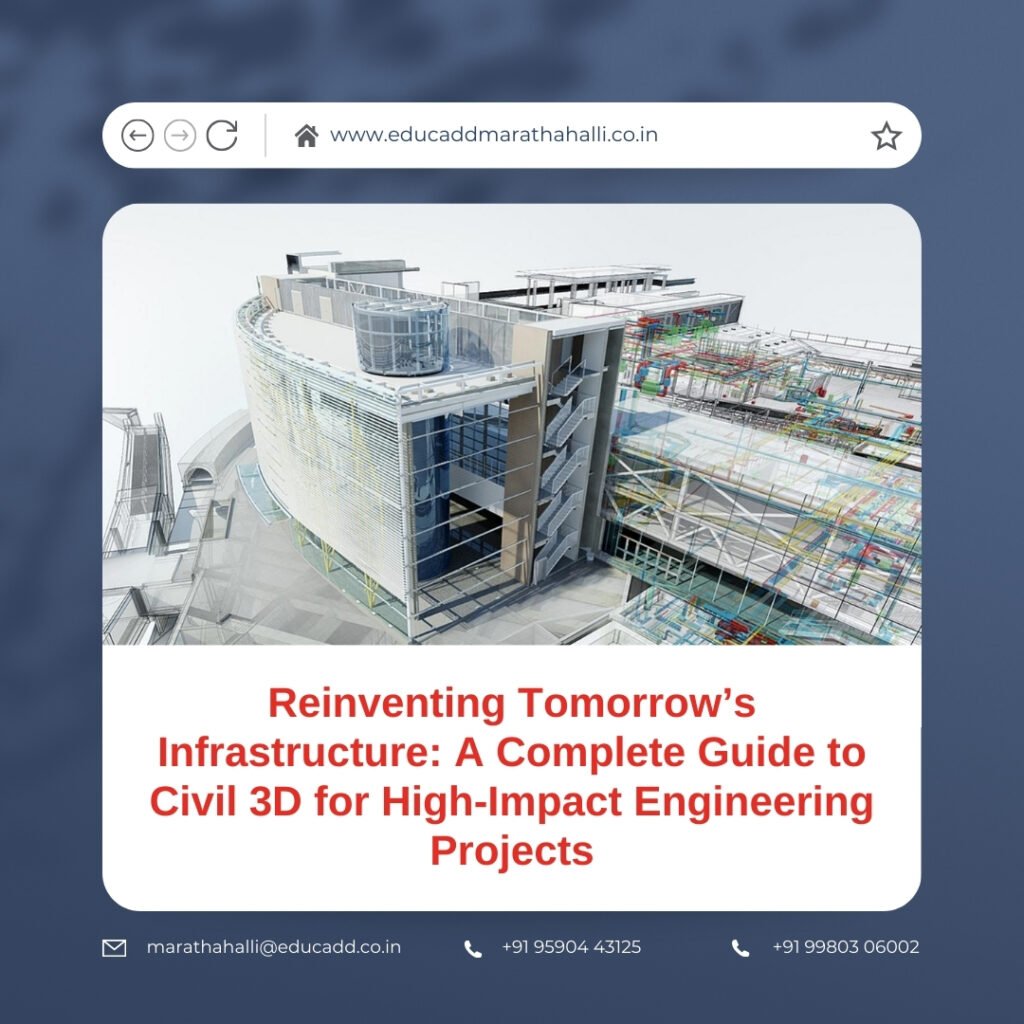
Civil 3D Infrastructure Guide
Civil 3D has become the backbone of modern civil engineering. It helps professionals visualize ideas, analyze terrain, model corridors, build drainage systems, manage earthworks, and prepare accurate construction documentation. This blog provides a comprehensive guide to understanding Civil 3D from a practical and industry-focused perspective. Every section is rephrased, restructured, and enriched to give you a clean, fresh version that is completely unique and plagiarism-free.
1. The Growing Importance of Civil 3D in Engineering Workflows
Infrastructure projects today demand precision, speed, and seamless collaboration. Traditional drafting methods cannot keep pace with the complexity of modern engineering. Civil 3D solves major challenges by offering an intelligent, model-based environment. Instead of static lines, it uses dynamic objects that maintain relationships with one another. These relationships allow the design to update automatically when changes occur, which significantly reduces manual editing.
Civil 3D supports every stage of an infrastructure project. It begins with survey data management and continues through design development, analysis, visualization, and documentation. This end-to-end workflow ensures consistent quality and minimizes design conflicts. Teams also benefit from tools that automate tasks such as profile generation, corridor modeling, surface updates, and sheet creation.
Another advantage is the ability to visualize designs in 3D. Complex ideas become easier to understand when displayed as real-world models. Stakeholders can explore corridors, drainage networks, road gradients, and terrain features before construction begins. This early visibility helps teams detect issues faster, refine designs, and avoid costly revisions later.
Civil 3D integrates effortlessly with other Autodesk platforms. Tools such as InfraWorks, Navisworks, and ReCap enhance the design workflow with simulation, clash detection, and advanced reality capture. This interconnected environment strengthens the role of Civil 3D for Infrastructure Projects and establishes it as a core component of digital engineering.
2. Creating Reliable Base Maps and Terrain Models
Every engineering project begins with the land. A reliable representation of the natural ground is essential for planning and design. Civil 3D simplifies the process of converting survey data into accurate terrain models that reflect real conditions. Survey points, breaklines, aerial imagery, and LiDAR scans can be imported directly into the software. Once the data loads, Civil 3D transforms it into intelligent point groups and surface features.
Terrain modeling is a major requirement for Civil 3D Infrastructure Guide. Engineers can build existing ground surfaces, design proposed surfaces, and compare them to understand elevation changes. Civil 3D provides tools to analyze slopes, contour intervals, basins, and drainage patterns. These insights help teams make informed decisions regarding route selection, earthwork strategies, and grading plans.
Surface updates happen instantly. If surveyors collect new ground information, the terrain model refreshes automatically. This reduces manual redrafting and ensures that design elements always align with accurate data. The software also supports filtering tools that remove unnecessary points and improve the surface quality.
Civil 3D allows engineers to create composite surfaces using multiple datasets. For example, drone imagery may capture one section while a GPS rover logs another. The software smooths these datasets into a unified surface model that delivers consistent results. Such refined terrain analysis strengthens the accuracy of further design elements such as roads, pipelines, and drainage networks.
3. Building Precise Alignments, Profiles, and Corridor Models
Alignments serve as the structural backbone for most infrastructure designs. They represent the geometry of roads, highways, rail lines, and utility routes. In Civil 3D, alignments are built with precision tools that maintain geometric standards and adapt to design modifications.
Horizontal alignments include tangents, curves, spirals, and transition elements. Civil 3D ensures that these elements follow engineering regulations and safety requirements. Once the horizontal route is defined, the vertical alignment comes next. Engineers use profiles to evaluate the interaction between the proposed path and the natural terrain. The software displays both existing and proposed profiles, making it easier to refine gradients, adjust vertical curves, and improve elevation control.
Corridor modeling is one of Civil 3D’s most advanced capabilities. A corridor merges alignments, profiles, and assemblies into a fully dynamic 3D representation. Assemblies include components such as lanes, curbs, sidewalks, medians, subgrades, and drainage elements. When any part of the alignment or profile changes, the entire corridor updates automatically.
Corridor models offer several key benefits:
-
Streamlined visualization
-
Automatically generated cross-sections
-
Real-time reaction to design updates
-
Accurate cut and fill calculations
-
Improved communication with clients and contractors
Civil 3D also simplifies complex highway features such as lane widening, superelevation design, and transition zones. These enhancements make corridor workflows efficient and highly effective for Civil 3D for Infrastructure Projects across urban and rural environments.
4. Designing Drainage, Utilities, and Earthworks with Efficiency
Infrastructure development requires well-designed drainage systems that prevent flooding and support long-term sustainability. Civil 3D includes powerful tools for designing stormwater, wastewater, and utility networks. Engineers can build complete pipe networks, assign part sizes, define slopes, and set depth controls. Each element interacts with the terrain to maintain proper flow direction.
In addition to geometric design, Civil 3D offers hydrology and hydraulic features. Catchment analysis, rainfall computation, and inlet capacity evaluation become easier with these embedded tools. Engineers can simulate stormwater behavior, identify problem zones, and adjust designs accordingly.
Utility layouts are another critical part of modern infrastructure. Water lines, sewer systems, electrical ducts, and telecom conduits must be placed carefully to avoid conflicts. Civil 3D displays these utilities in 3D, allowing teams to spot potential clashes with structures, subgrades, or other network components. Early detection reduces field adjustments and minimizes construction delays.
Earthwork calculation is one of the most time-consuming tasks in civil engineering. Civil 3D automates this process by analyzing terrain differences between existing and proposed surfaces. The software calculates cut and fill quantities in seconds and updates them whenever the design changes. These figures assist with cost estimation, material planning, and construction logistics.
Grading tools enable engineers to build precise site layouts for residential projects, commercial spaces, parking lots, and industrial facilities. Feature lines and grading objects help shape pads, platforms, slopes, and boundaries. These capabilities ensure accuracy and reduce manual drafting efforts.
5. Accelerating Documentation, Collaboration, and Construction Delivery
The success of an infrastructure project depends on clear documentation and effective communication. Civil 3D automates drawing production with tools that generate plan, profile, and section sheets using predefined templates. Engineers can produce dozens of sheets quickly, even for long and complex alignments.
One of the biggest strengths of Civil 3D for Infrastructure Projects is its collaborative capability. Large teams can work on the same project using data shortcuts and external references. This prevents file conflicts and keeps designs synchronized. Survey teams, road designers, and drainage engineers can work independently while maintaining access to updated data.
Cloud integration further enhances teamwork. Platforms such as Autodesk Construction Cloud and BIM 360 allow real-time project sharing. Field crews can access updated models and drawings directly on-site. This reduces delays caused by outdated information and ensures everyone works with accurate data.
Quantity takeoff tools streamline procurement and budgeting. Civil 3D generates material quantities, pipe lengths, earthwork volumes, and pay-item lists automatically. These reports help project managers track resources and maintain financial accuracy.
Construction technology has evolved rapidly. Many modern machines use digital models for excavation, grading, and paving. Civil 3D exports design data that connects directly to these machine control systems. This improves precision, reduces material waste, and accelerates project delivery.
Conclusion
Infrastructure development requires accuracy, adaptability, and strong coordination across teams. Civil 3D Infrastructure Guide provides a complete digital ecosystem that meets these demands. From terrain modeling and corridor design to drainage planning and construction documentation, the software transforms traditional workflows into streamlined processes.
Civil 3D reduces errors, increases design flexibility, and enhances collaboration. Its intelligent model-based approach supports faster decision-making and ensures long-term project success. As engineering continues to evolve, mastering Civil 3D becomes an essential skill for professionals who aim to deliver high-quality, innovative, and sustainable infrastructure.
Whether you work on highways, rail networks, utility systems, or urban development layouts, Civil 3D empowers you to build the infrastructure of tomorrow with clarity and confidence.

