
Master Mechanical Drafting Skills and Build a Future-Ready Engineering Career
Mechanical drafting plays an important role in modern engineering and manufacturing. It transforms design ideas into clear technical drawings that engineers, machinists, and manufacturers can understand. For students and professionals who want to build a strong career in mechanical design, choosing the right training can make a major difference. Top Mechanical Drafting Skills Training helps learners understand drafting principles, industry software, technical standards, and practical design methods.
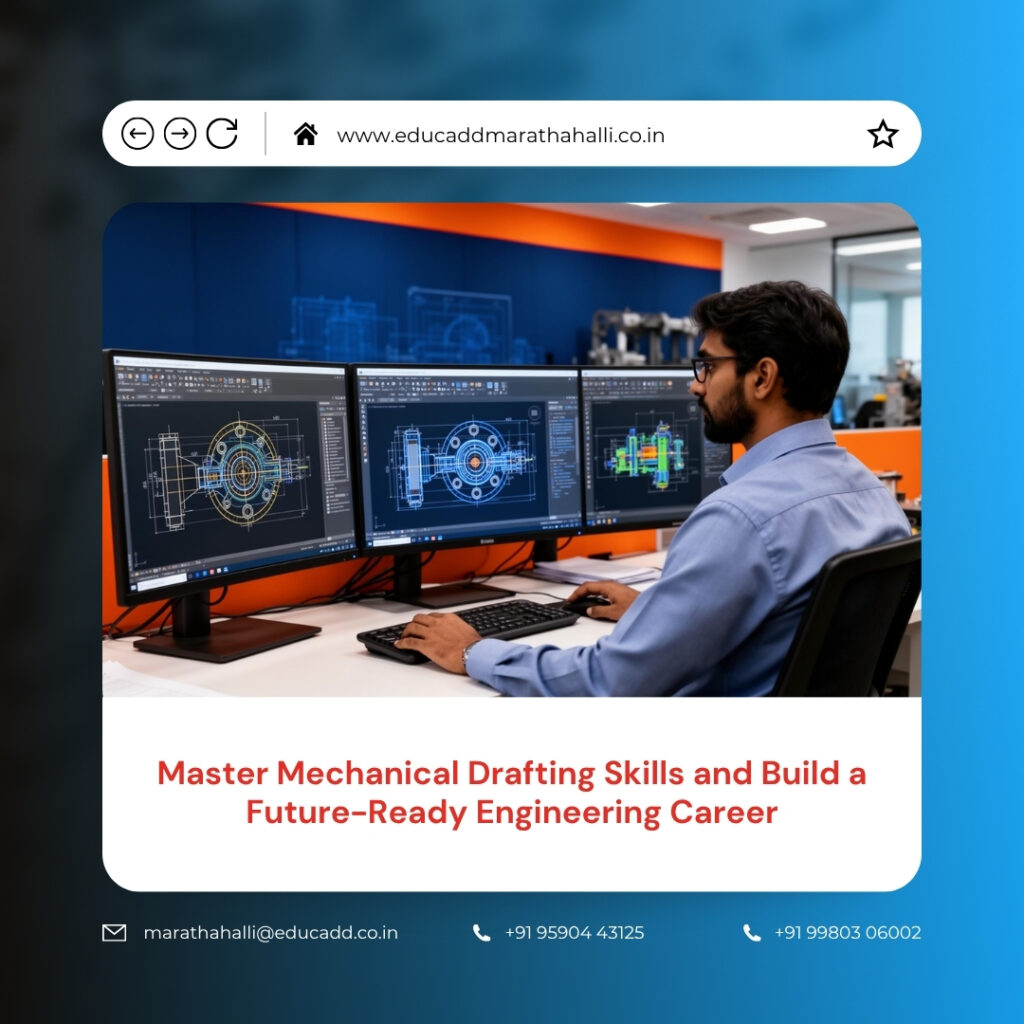
Top Mechanical Drafting Skills Training
Moreover, structured training builds confidence and prepares learners for real engineering projects. With industries adopting advanced design technologies, skilled mechanical drafters continue to have valuable career opportunities.
Understand the Fundamentals of Mechanical Drafting
Mechanical drafting begins with strong knowledge of engineering drawing principles. Learners study lines, dimensions, scales, symbols, sections, projections, and geometric constructions. These concepts create the foundation for accurate technical drawings. Furthermore, students learn how to interpret engineering drawings and understand how different components fit together.
A good training program explains these concepts through practical examples instead of relying only on theory. As a result, learners can develop the technical understanding required to create accurate and professional drawings for engineering applications.
Build Confidence With Industry-Standard CAD Software
Computer-Aided Design has transformed traditional drafting practices. Today, mechanical designers use CAD software to create precise two-dimensional drawings and detailed three-dimensional models. Quality training introduces learners to essential tools, commands, layers, dimensions, annotations, and drawing layouts. Students also learn how to modify designs quickly and maintain organized drawing files.
Therefore, choosing Top Mechanical Drafting Skills Training can help learners gain practical software skills that match modern workplace expectations. Regular practice also improves speed, accuracy, and confidence while working on different design requirements.
Learn Through Practical Mechanical Design Projects
Practical projects help students connect classroom concepts with real engineering situations. Instead of completing only simple exercises, learners can work on components such as brackets, shafts, gears, flanges, couplings, and machine assemblies. These projects encourage students to understand dimensions, tolerances, material requirements, and manufacturing considerations. Additionally, project-based learning develops problem-solving abilities.
When students complete multiple mechanical drafting projects, they become more comfortable handling design changes and technical instructions. This practical exposure can also make their portfolios stronger when they apply for internships or entry-level positions.
Develop Accuracy and Attention to Detail
Precision remains one of the most important qualities in mechanical drafting. Even a small dimensional error can affect manufacturing, assembly, or product performance. Effective training therefore teaches students to check dimensions, tolerances, annotations, views, and drawing standards carefully. Learners also understand the importance of maintaining consistency throughout a drawing.
Furthermore, regular design exercises help improve attention to detail. With continuous practice, students learn to identify mistakes before drawings reach the manufacturing stage. This habit can become a valuable professional skill in engineering design environments.
Understand Engineering Drawing Standards
Mechanical drawings must communicate information clearly across different teams. For this reason, learners should understand commonly used drafting standards and conventions. Training can introduce students to dimensioning practices, symbols, section views, title blocks, tolerances, and drawing presentation methods. These standards help ensure that engineers and manufacturers interpret drawings correctly.
Moreover, understanding technical documentation improves communication between design, production, inspection, and maintenance teams. Students who develop this knowledge through Top Mechanical Drafting Skills Training can approach professional assignments with greater clarity and confidence.
Explore 2D Drafting and 3D Modeling
Modern mechanical design often combines 2D drafting with 3D modeling. Two-dimensional drawings communicate manufacturing details, while three-dimensional models help designers visualize components and assemblies. A comprehensive course introduces learners to both approaches and explains when each method is appropriate. Students can create individual parts, modify dimensions, develop assemblies, and generate technical drawings from models. Consequently, they gain a broader understanding of the design process. This combination also prepares learners for workplaces where designers frequently move between detailed drawings and three-dimensional engineering models.
Learn Mechanical Components Through Design
Mechanical drafting becomes easier when students understand the purpose of common machine components. Training can cover fasteners, bearings, gears, shafts, springs, couplings, pulleys, brackets, and other frequently used elements. Learners can then understand how these components function within larger assemblies. This knowledge improves design decisions and helps students interpret technical drawings more effectively.
In addition, component-based projects encourage students to consider manufacturing methods and assembly requirements. Understanding both drafting and mechanical functionality can make a learner more valuable to engineering and production teams.
Improve Your Manufacturing Awareness
A drawing should not only look accurate; it should also communicate information that supports manufacturing. Therefore, mechanical drafting students benefit from learning basic manufacturing processes such as machining, drilling, turning, milling, fabrication, and finishing. This knowledge helps them create drawings that are practical to produce. Students can also learn how material selection, tolerances, surface finishes, and production methods influence design decisions. As a result, Top Mechanical Drafting Skills Training can provide a stronger connection between digital design and actual manufacturing processes.
Develop a Professional Design Portfolio
A professional portfolio can help demonstrate technical ability to potential employers. Students should consider including their best 2D drawings, 3D models, assemblies, mechanical components, and project work. Each project can briefly explain the design objective, software used, and technical skills applied. Furthermore, a well-organized portfolio shows consistency and attention to detail. It can give recruiters a clearer picture of what a candidate can accomplish. Building a portfolio during training also encourages students to take every practical assignment seriously and continuously improve their work.
Learn From Experienced Industry Trainers
The quality of instruction can strongly influence the learning experience. Experienced trainers can explain technical concepts using practical engineering examples and guide students through common design challenges. They can also provide feedback on drawing accuracy, software usage, and project execution. Additionally, trainers with industry exposure can share insights about workplace practices and expectations. This guidance helps learners understand how drafting skills are applied beyond the classroom. Therefore, students should consider trainer experience, practical learning, software coverage, and project exposure when selecting a mechanical drafting program.
Prepare for Different Career Opportunities
Mechanical drafting skills can support several career paths within engineering and manufacturing. Depending on their interests and additional qualifications, learners may explore roles such as CAD Drafter, Mechanical Draftsman, CAD Designer, Junior Design Engineer, and Design Assistant. Industries such as automotive, machinery, manufacturing, fabrication, construction equipment, and product development regularly use technical drawings. However, career growth depends on skill level, experience, software knowledge, and continuous learning. A strong foundation from Top Mechanical Drafting Training can help candidates begin their careers with greater technical confidence.
Strengthen Your Employability With Continuous Learning
Technology continues to change the way engineering teams design and manufacture products. Consequently, professionals need to keep improving their technical skills. After learning drafting fundamentals, students can explore advanced CAD tools, 3D modeling, assemblies, GD&T, product design, and other specialized areas. Certifications can also support a professional profile when combined with genuine practical skills. Moreover, regular practice helps learners remain comfortable with new software features and evolving design workflows. Continuous learning can therefore create better opportunities for professionals who want long-term growth in mechanical design.
Choose Training That Matches Your Career Goals
Not every course provides the same learning experience. Before enrolling, students should evaluate the syllabus, software coverage, project work, trainer expertise, practical sessions, certification, and learning support. It is also useful to understand whether the course focuses on beginner-level concepts or advanced professional skills. A suitable program should match the learner’s current knowledge and career objectives. Furthermore, students should prioritize practical exposure rather than choosing a course based only on certification. The right Top Mechanical Drafting Training can provide a structured path from basic drafting knowledge to workplace-ready design skills.
Turn Drafting Skills Into a Strong Engineering Future
Mechanical drafting is more than creating technical drawings. It combines engineering knowledge, precision, visualization, software skills, and practical problem-solving. With consistent training, learners can understand design processes and communicate engineering ideas more effectively. They can also build portfolios that demonstrate their abilities to potential employers. As industries continue to rely on digital design and manufacturing workflows, skilled drafting professionals can find opportunities across several engineering sectors. For students and working professionals seeking a practical engineering skill, focused mechanical drafting education can be an excellent step toward professional growth.
Conclusion
Choosing Top Mechanical Drafting Skills Training can be an important step for anyone interested in mechanical design and engineering. A strong program should combine drafting fundamentals, CAD software, practical projects, industry standards, manufacturing awareness, and career-focused learning. Most importantly, learners should practice consistently and develop accuracy through real design assignments. With the right training and continuous improvement, mechanical drafting skills can become a strong foundation for a rewarding engineering career. Start with the fundamentals, build practical expertise, and keep learning as technology evolves to create a future in modern mechanical design.

