
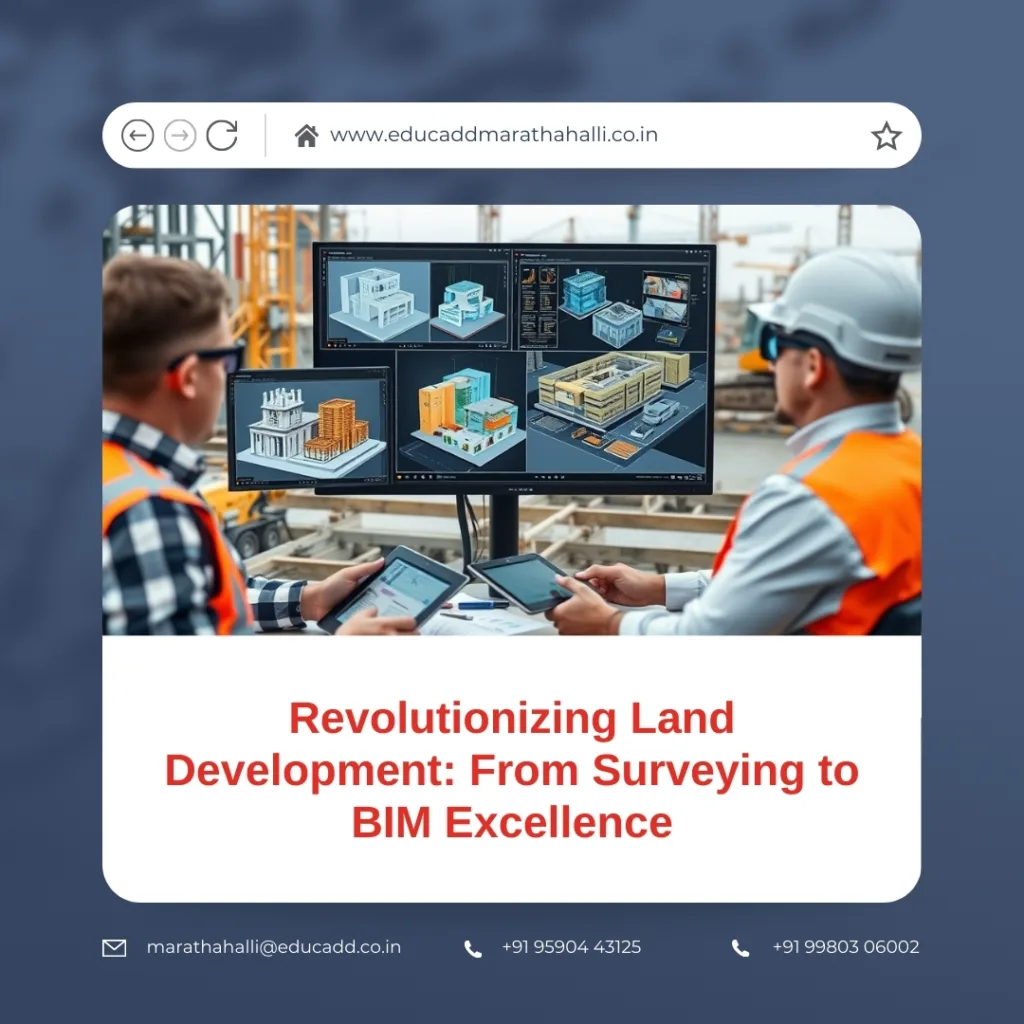
Revolutionizing Land Development: From Surveying to BIM Excellence
In modern land development, relying solely on traditional surveying methods is no longer sufficient. The transition from surveying to BIM (Building Information Modeling) is reshaping how professionals plan, design, and execute projects. BIM transforms survey data into intelligent, interactive models, allowing developers, engineers, and architects to make informed decisions with precision and efficiency.
Surveying to BIM
This blog explores the techniques, benefits, and challenges of adopting surveying to BIM, guiding professionals toward smarter land development practices while enhancing collaboration and reducing errors.
Why the Shift from Surveying to BIM is Essential
Surveying forms the backbone of land development. Historically, it involved field measurements, leveling, and drafting—tools that often limited visualization and collaboration. Although effective, traditional methods could not capture the full complexity of modern projects.
BIM changes the landscape by converting survey data into dynamic 3D models. These models integrate terrain, utilities, and site features, creating a comprehensive digital representation of the land. The advantages are clear:
-
Enhanced accuracy and visualization.
-
Reduced miscommunication among stakeholders.
-
Early identification of design conflicts.
-
Efficient planning of resources and timelines.
Surveying is no longer just a measurement activity; it becomes a strategic input for intelligent land development.
Key Advantages of Implementing Surveying to BIM
Adopting BIM in land development provides tangible benefits that streamline workflows and improve outcomes.
1. Unmatched Accuracy
Surveying data, collected through GPS, LiDAR, and drones, integrates directly into BIM platforms. This ensures every boundary, elevation, and slope is represented accurately, reducing errors during design and construction phases.
2. Improved Collaboration
BIM centralizes project information, enabling real-time sharing between surveyors, engineers, architects, and contractors. This transparency reduces miscommunication and accelerates decision-making.
3. Cost and Time Efficiency
By identifying potential issues early—such as utility clashes or topographical challenges—BIM minimizes rework and project delays. Efficient planning directly translates into cost savings.
4. Environmentally Conscious Design
BIM tools allow developers to simulate environmental impacts and optimize land usage. From stormwater management to energy-efficient site layouts, sustainable land development becomes feasible.
5. Streamlined Construction Execution
Integrating survey data into BIM ensures construction teams can work with precise models, improving productivity, reducing waste, and maintaining project timelines.
Techniques to Master Surveying to BIM
Transitioning successfully requires not just tools, but practical techniques and skills.
1. Leveraging Advanced Surveying Technology
Modern surveying uses technologies such as:
-
Drones for high-resolution aerial imagery.
-
LiDAR for detailed 3D terrain mapping.
-
GPS and GNSS systems for precise geospatial measurements.
Mastering these tools ensures survey data can be effectively transformed into BIM models.
2. Developing BIM Expertise
Software like Autodesk Civil 3D, Revit, and InfraWorks are essential for processing survey data. Learning to create terrain models, infrastructure layouts, and clash detection simulations is critical for land development success.
3. Integrating Regulatory Knowledge
BIM is not just technical—it also requires understanding zoning laws, property boundaries, and municipal regulations. Incorporating these constraints ensures compliant, realistic project designs.
4. Efficient Data Management
BIM models serve as central repositories of project data. Professionals should adopt standardized naming conventions, version control, and cloud storage to facilitate smooth collaboration.
5. Ongoing Professional Development
Land development technology evolves quickly. Regular training, certification programs, and workshops help professionals stay ahead and leverage new tools and techniques effectively.
Common Challenges in Adopting Surveying to BIM
Even with its advantages, transitioning to BIM can present obstacles.
Initial Investment
BIM requires investment in software, hardware, and employee training. Smaller firms may face budget constraints, but the long-term efficiency and accuracy benefits outweigh initial costs.
Resistance to Change
Surveyors and engineers accustomed to traditional methods may hesitate to adopt BIM. Clear communication, leadership support, and hands-on training can ease this transition.
Data Integration Complexity
Survey data comes in multiple formats, and integrating it into BIM software can be challenging. Standardized workflows and compatible software choices help mitigate integration issues.
Skill Gaps
Not all teams have the technical expertise for BIM modeling. Addressing this gap through training or hiring specialists ensures successful adoption.
Project-Specific Constraints
Some smaller projects may not require full BIM implementation. In such cases, partial integration or hybrid workflows can still provide benefits without overcomplicating the process.
The Future of Land Development with Surveying to BIM
The future of land development is digital, collaborative, and data-driven. Key trends include:
-
AI and Machine Learning: Predicting land use, resource allocation, and project risks.
-
Digital Twins: Real-time virtual models of sites for monitoring and simulation.
-
Cloud Collaboration: Allowing global teams to access and update BIM models seamlessly.
-
AR/VR Visualization: Enhancing stakeholder engagement and design understanding.
-
Sustainable Practices: Leveraging BIM to optimize environmental impact and resource usage.
Professionals who master surveying to BIM will lead the next generation of land development projects, combining efficiency, precision, and sustainability.
Conclusion
Transitioning from Surveying to BIM is no longer optional—it’s essential for modern land development. By converting field data into intelligent, collaborative models, professionals can improve accuracy, reduce costs, enhance sustainability, and streamline construction workflows.
Mastering this integration equips surveyors, engineers, and developers with the tools and insights to plan smarter, execute faster, and build better communities. The shift to BIM marks the dawn of a new era in land development—one defined by technology, collaboration, and innovation.

