
Unlocking Electrical Power Mastery: Learn Short Circuit and Load Flow Analysis for Smarter Energy Systems
The heartbeat of every modern society lies in its power system. From the lights in our homes to the machines in industries, electricity fuels daily life and economic progress. Behind the seamless delivery of electricity are complex networks of generators, transformers, and transmission lines working together in perfect balance. For engineers, understanding how these systems behave under both normal and fault conditions is not just an academic pursuit—it is a professional necessity. Two critical techniques make this possible: short circuit analysis and load flow analysis.
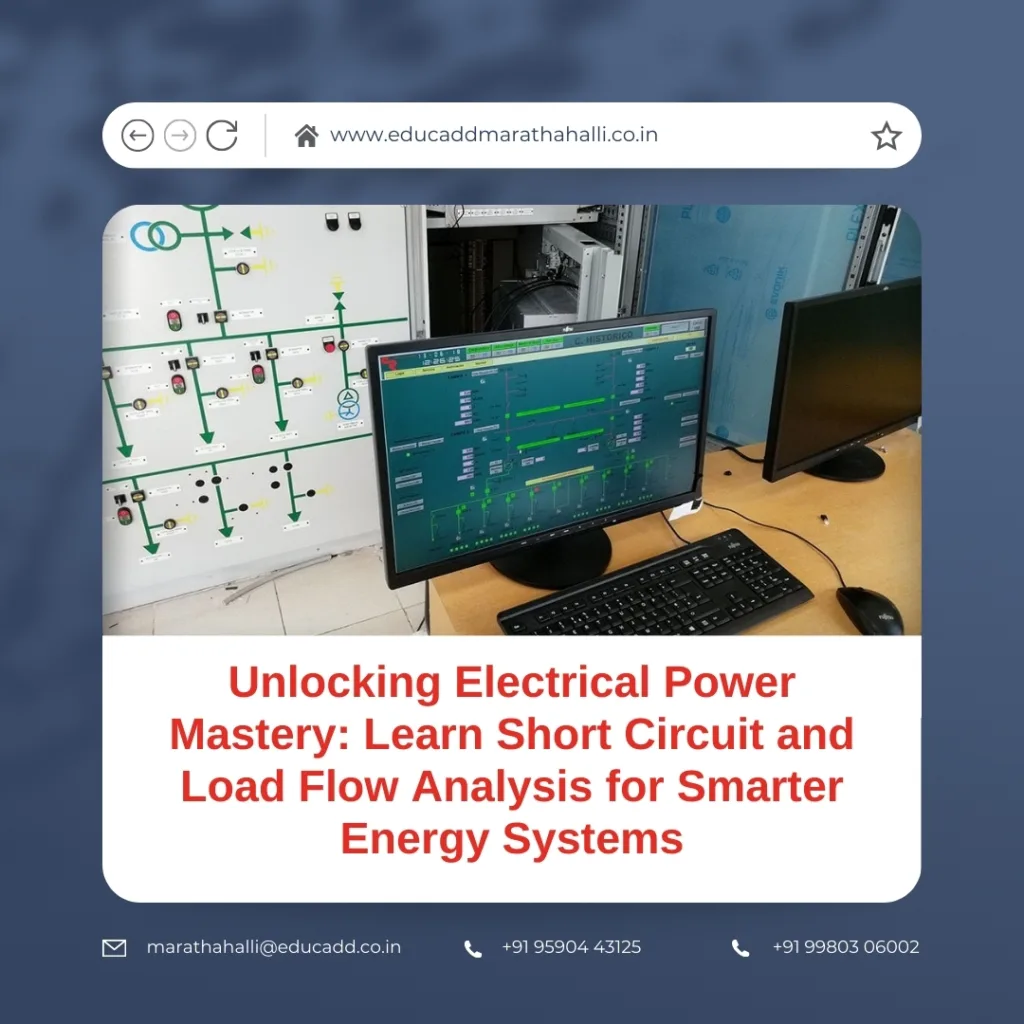
Short Circuit Load Flow
This guide provides a comprehensive roadmap for those who want to learn short circuit and load flow analysis in detail. You’ll explore their fundamentals, discover their applications, and gain practical strategies to master these skills for both career growth and real-world problem-solving.
Grasping the Foundations: What Short Circuit and Load Flow Analysis Really Mean
Before diving deeper, it’s vital to clarify the essence of these studies.
Short circuit analysis is all about predicting what happens when faults occur in a power system. Faults may be caused by equipment failure, lightning strikes, or insulation breakdown. By identifying the magnitude of fault currents and voltages, engineers can design protective mechanisms to prevent damage and keep the system stable.
On the other hand, load flow analysis focuses on the steady-state operation of a network. It determines how power flows through transmission lines, what voltage levels are maintained at each bus, and how efficiently the system operates. Load flow studies are essential for planning, expansion, and ensuring electricity reaches consumers without unnecessary losses.
Why Engineers Must Learn Short Circuit and Load Flow Analysis
There are three main reasons every power engineer should master these studies:
-
Safety and Reliability: Short circuit analysis ensures that protective devices like circuit breakers and relays act promptly during faults.
-
Efficiency and Planning: Load flow analysis provides insights into network performance, reducing losses and guiding future upgrades.
-
Professional Growth: Employers across industries seek engineers skilled in these techniques, making them crucial for advancing one’s career.
By choosing to learn short circuit and load flow analysis, you are equipping yourself with tools that blend academic knowledge with practical industry relevance.
Deep Dive into Short Circuit Analysis: Principles, Tools, and Real-World Use
Short circuit analysis is the backbone of protection and safety in electrical engineering. It helps predict extreme conditions that could otherwise harm equipment or people.
Core Concepts Behind Short Circuit Analysis
When studying short circuits, engineers focus on:
-
Types of Faults: Single line-to-ground, line-to-line, double line-to-ground, and three-phase faults all affect systems differently.
-
Impedance Role: Network impedance values define the magnitude of fault currents.
-
Fault Currents: Knowing expected fault currents allows selection of suitable breaker ratings.
-
Protection Schemes: Fault studies guide protective relays and fuse settings, ensuring timely fault isolation.
Common Methods of Fault Analysis
-
Per-Unit Method: Normalizes values to simplify calculations in large systems.
-
Symmetrical Components: Breaks down unbalanced conditions into balanced sets for easier computation.
-
Simulation Tools: ETAP, DIgSILENT, and MATLAB automate fault analysis for greater accuracy.
Real-World Applications
Short circuit analysis plays a role in:
-
Specifying protective equipment ratings.
-
Designing safe substation layouts.
-
Preparing for contingencies like lightning or equipment failure.
-
Meeting compliance requirements under IEEE and IEC standards.
With these tools, engineers not only avoid failures but also increase trust in the resilience of the power grid.
Load Flow Analysis: The Roadmap to Efficient System Performance
While short circuit studies are about abnormal conditions, load flow analysis deals with everyday operation. It provides an overview of how the system distributes power under steady-state conditions.
The Building Blocks of Load Flow
Load flow involves solving equations that model how electricity moves through a network. Engineers look at:
-
Bus Types: Slack bus, PQ bus, and PV bus, each defined by specific variables.
-
System Variables: Voltage, power, and phase angle at different buses.
-
Equations: Nonlinear algebraic equations govern active and reactive power flow.
Popular Computational Techniques
-
Gauss-Seidel Method: Simple, best for smaller systems.
-
Newton-Raphson Method: Highly accurate, suitable for large, complex grids.
-
Fast Decoupled Load Flow: A balance between speed and accuracy for large-scale applications.
Practical Applications
Load flow analysis supports:
-
Identifying undervoltage or overvoltage conditions.
-
Planning new transmission lines or system expansions.
-
Integrating renewable sources like solar and wind.
-
Improving overall efficiency by minimizing system losses.
Thus, mastering load flow ensures that electrical networks are not only reliable but also economically viable.
A Step-by-Step Guide to Learn Short Circuit and Load Flow Analysis
Acquiring expertise requires structured learning and consistent practice. Here’s a roadmap to help you build mastery.
Step 1: Strengthen Your Fundamentals
Start with basics such as Ohm’s law, Kirchhoff’s laws, AC/DC analysis, and network theory. A solid foundation in circuit theory ensures a smoother transition to advanced studies.
Step 2: Develop Mathematical Proficiency
Matrix operations, linear algebra, and complex number calculations form the backbone of both analyses. Regular practice in these areas sharpens problem-solving ability.
Step 3: Gain Hands-On Software Skills
Master tools like:
-
ETAP – popular in industrial power studies.
-
DIgSILENT PowerFactory – widely used for planning and optimization.
-
MATLAB/Simulink – flexible for custom modeling.
Step 4: Solve Real-Life Scenarios
Practice makes perfect. Start with small test systems, then move to more complex networks. Calculate short circuit currents, perform load flow for multi-bus systems, and simulate different operating conditions.
Step 5: Stay Industry-Informed
Learn standards like IEEE 141 and IEC 60909 for short circuit analysis, and ANSI/IEEE C37 for protection. Staying updated makes your work globally relevant and compliant.
Challenges, Solutions, and Advanced Learning Insights
The road to mastering these studies is rewarding but not without obstacles.
Common Challenges
-
Complex Models: Representing large networks accurately can be difficult.
-
Convergence Problems: Load flow methods sometimes fail to converge for weak systems.
-
Protective Device Complexity: Understanding relay coordination requires both theory and practice.
-
Data Dependence: Accurate results rely on precise input data.
Advanced Learning Insights
-
Renewable Energy Integration: Modern grids need fault and load flow studies that account for variable sources.
-
Dynamic Simulations: Go beyond steady-state and explore time-domain simulations.
-
Optimization Algorithms: Use AI and optimization techniques for load dispatch and voltage control.
Practical Tips
-
Blend theory with simulation-based learning.
-
Enroll in specialized courses or certifications.
-
Join engineering communities and forums.
-
Study case studies from industry projects.
With perseverance and structured learning, anyone can confidently learn short circuit and load flow analysis and apply it to real-world engineering challenges.
Final Thoughts: Why Learning These Analyses Matters
To sum up, Short Circuit Load Flow analysis form the foundation of modern power system engineering. They help prevent accidents, optimize performance, and support the integration of new energy sources. By dedicating time to learn short circuit and load flow analysis, engineers unlock the ability to design networks that are safe, efficient, and future-ready.
Through theory, software practice, and industry awareness, you can build expertise that benefits both your career and the energy sector. Ultimately, mastering these analyses is more than an academic achievement—it’s a step toward shaping smarter, sustainable power systems for tomorrow.

