
From Dream Homes to Design Careers: Discover the Right Residential Interior Design Course Near Me
A home tells a story through its colours, furniture, lighting, textures, and layout. Every room has a purpose, yet it can also express the personality of the people who live there. This makes residential interior design an exciting field for creative individuals who enjoy transforming spaces. If you are searching for a Residential Interior Design Course Near Me, professional training can help you turn your interest into practical expertise. Instead of learning only through online inspiration, you can develop structured knowledge about planning, designing, drafting, materials, and visual presentation.
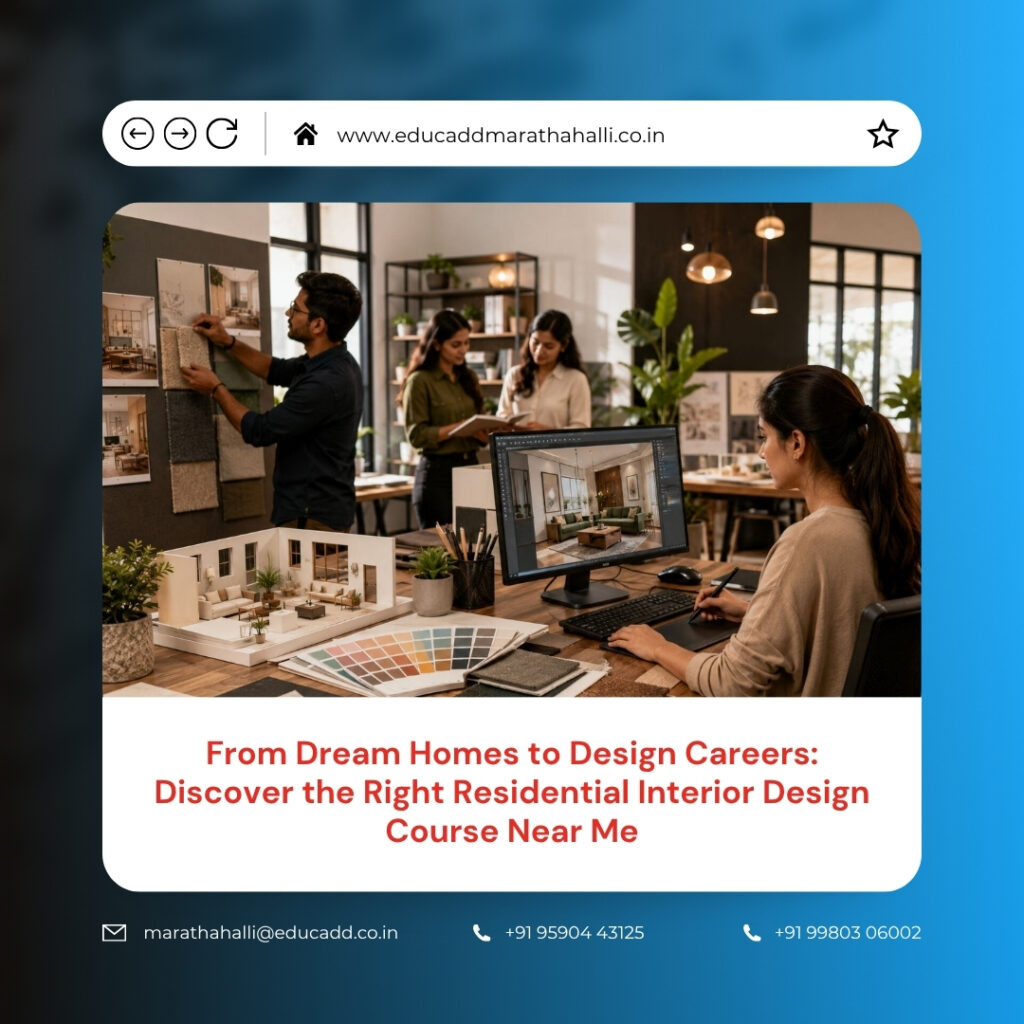
Residential Interior Design Course
With the right guidance, you can understand how professional designers approach real homes and client requirements. Moreover, practical education can give you the confidence to develop original concepts and present them effectively. As residential spaces continue to evolve, skilled designers have opportunities to work on apartments, villas, independent houses, renovations, and modern living spaces.
Discover the Art and Science Behind Interior Design
Interior design is not simply about making a room look attractive. It involves careful planning, creative thinking, technical understanding, and functional decision-making. A professional course introduces students to important design principles such as balance, proportion, rhythm, harmony, contrast, and emphasis. These principles help designers create interiors that look coordinated and feel comfortable.
Furthermore, students learn how to connect visual appeal with everyday requirements. A beautiful living room, for example, should also provide comfortable movement and suitable storage. Similarly, a stylish kitchen must support cooking, cleaning, and organisation. Therefore, learning the fundamentals allows students to make thoughtful design decisions instead of relying only on personal taste. This combination of creativity and logic forms the foundation of professional residential interior design.
Build Strong Space Planning and Layout Skills
Effective space planning can completely change the way people experience a home. Even a small property can feel comfortable when every area is planned carefully. During professional training, students learn how to examine dimensions, circulation, furniture positions, entrances, windows, and functional zones. They can then develop layouts that use available space efficiently. For instance, a compact bedroom may require multifunctional storage and carefully positioned furniture. On the other hand, a large living room may need defined areas for seating, entertainment, and interaction. As a result, designers must understand how different spaces connect with one another.
Practical exercises can help learners improve their ability to read floor plans and develop suitable arrangements. These skills become particularly valuable when working on actual residential projects where every square foot can influence comfort and usability.
Learn Digital Tools Used in Modern Design
Technology has become an important part of the interior design profession. Designers now rely on digital applications to create floor plans, technical drawings, three-dimensional models, presentations, and visual concepts. Therefore, anyone considering a Residential Interior Design Course Near Me should look for training that includes practical software learning. Digital skills can help students convert their creative ideas into professional drawings and presentations. They can also make communication easier because clients can understand a visual proposal more quickly than a verbal explanation.
In addition, digital models allow designers to explore furniture arrangements, colours, finishes, and spatial concepts before implementation. Regular software practice can improve accuracy and efficiency. Consequently, students who combine design knowledge with digital capabilities can become better prepared for modern workplace requirements.
Explore Colours, Materials, and Interior Finishes
Colour selection and material coordination play a major role in residential interiors. A designer must understand how different shades, surfaces, patterns, and textures interact within a space. Professional training introduces students to colour combinations, wall finishes, flooring, furniture materials, fabrics, laminates, glass, wood, stone, and other interior elements. However, selecting materials is not only about appearance. Designers must also consider durability, maintenance, budget, availability, and suitability for the intended space. For example, a material that looks impressive may not be appropriate for an area exposed to heavy daily use.
Similarly, certain colours may create different visual effects depending on natural and artificial lighting. Therefore, students learn to evaluate several factors before making recommendations. This practical understanding can help them create interiors that remain attractive, functional, and suitable for the homeowner.
Understand the Importance of Residential Lighting
Lighting can influence the mood, functionality, and visual character of an interior. A well-designed space can lose its impact when lighting is poorly planned. For this reason, interior design education often covers natural lighting, ambient lighting, task lighting, accent lighting, and decorative fixtures. Students learn how lighting can highlight architectural details and improve the usability of different rooms. A kitchen, for example, may need focused illumination for work surfaces, while a bedroom may benefit from softer and more relaxing lighting. Living rooms can use multiple lighting layers to support conversations, entertainment, reading, and relaxation.
Furthermore, lighting affects how colours and materials appear. By understanding these relationships, aspiring designers can create more balanced interiors. Practical assignments can also help learners experiment with lighting concepts and understand their effect on the overall design.
Gain Confidence Through Practical Residential Projects
Practical learning gives students an opportunity to apply classroom concepts to realistic design situations. A strong Residential Interior Design Course Near Me should provide project-based activities that cover different areas of a home. Students may work on living rooms, bedrooms, kitchens, dining spaces, study areas, balconies, and complete residential layouts. Each assignment can introduce a different design challenge.
For example, a small apartment may require creative storage solutions, while a luxury villa may demand detailed coordination across several rooms. Through such projects, learners can practise measurements, layouts, materials, colours, furniture selection, and visual presentations. They also learn how to manage multiple design decisions within a single concept. Most importantly, project work encourages students to solve problems independently. This experience can make the transition from classroom learning to professional work much easier.
Develop the Skills Needed to Understand Clients
An interior designer works closely with homeowners, so communication is just as important as creativity. Clients may have specific lifestyle requirements, preferences, budgets, family needs, and expectations. Designers must understand these factors before creating a proposal. During professional training, students can learn how to discuss requirements, collect information, present concepts, receive feedback, and suggest suitable alternatives.
This process teaches them to design for the client rather than designing only according to personal preferences. Moreover, clear communication can reduce misunderstandings during project execution. A professional designer should be able to explain why a particular layout, material, or colour combination has been recommended. Therefore, developing listening and presentation skills can help students become more effective when dealing with homeowners and project teams.
Create a Portfolio That Represents Your Abilities
A professional portfolio can make a significant difference when beginning an interior design career. It provides employers and clients with a visual representation of your skills. During a Residential Interior Design Course Near Me, students can develop portfolio projects based on the assignments they complete. A good portfolio can include floor plans, furniture layouts, mood boards, colour palettes, material boards, elevations, three-dimensional views, and completed design concepts. Each project should demonstrate a clear design thought process. Furthermore, presentation quality matters because interior design is a highly visual profession.
Students should organise their projects carefully and explain the purpose behind their design decisions. As the portfolio grows, it can become a useful tool for interviews, internships, freelance opportunities, and client discussions. Consistent project development can therefore strengthen both confidence and professional credibility.
Explore Diverse Career Opportunities After Training
Interior design training can open doors to several career paths. Graduates may explore positions such as junior interior designer, interior design assistant, CAD designer, 3D visualiser, space planner, design consultant, or residential design professional. Some may also find opportunities with architecture studios, construction companies, furniture brands, property developers, and specialised interior design firms.
In addition, experienced professionals can consider freelance work or establish their own design services. However, career development requires more than completing a certificate. Employers and clients also value software skills, creativity, communication, project experience, and portfolio quality. Therefore, students should continue developing their abilities after completing formal training. Keeping up with new materials, technologies, design styles, and customer expectations can help professionals remain competitive in a changing industry.
Learn to Balance Design Ideas with Budgets
Every residential project has financial limitations. A designer may have a creative concept, but the final proposal must also fit the client’s budget. This makes cost awareness an important part of professional interior design. Training can introduce students to basic budgeting, material comparisons, quantity considerations, and practical alternatives. These skills help designers create attractive spaces without recommending unnecessary expenses.
For example, a designer may achieve a premium appearance by combining cost-effective materials with carefully selected statement elements. Similarly, furniture choices can be adjusted according to the client’s priorities. Learning to balance aesthetics, functionality, quality, and affordability can make design proposals more realistic. As a result, students can develop a more professional approach to residential projects and build stronger relationships with clients.
Strengthen Technical Drawing and Documentation Skills
Creative concepts need accurate technical information before they can become physical spaces. Technical drawings help contractors and other professionals understand dimensions, positions, finishes, furniture arrangements, and construction requirements. A professional course can introduce learners to floor plans, elevations, sections, ceiling layouts, and detailed drawings. Students can practise converting their design ideas into clear technical documents.
Accuracy is essential because even small mistakes can create difficulties during implementation. Therefore, learners should develop precision alongside creativity. With regular practice, they can become more comfortable working with measurements, dimensions, annotations, and drawing standards. These skills can also improve communication with architects, contractors, carpenters, electricians, and other professionals involved in residential projects.
Understand Modern and Sustainable Residential Design
Residential design continues to change as homeowners seek greater comfort, efficiency, flexibility, and environmental responsibility. Modern designers increasingly consider natural light, ventilation, energy efficiency, durable materials, smart technology, multifunctional furniture, and efficient storage. A contemporary Residential Interior Design Course Near Me can help students understand these developments and apply relevant ideas to their projects.
Sustainability does not always require expensive solutions. Simple choices, such as improving daylight, selecting durable finishes, reducing unnecessary materials, or using efficient lighting, can contribute to better design. At the same time, designers must ensure that modern features support the client’s lifestyle. Trends can provide inspiration, but functionality should remain a priority. Learning this balance allows aspiring designers to create interiors that are stylish while remaining practical and comfortable.
Choose the Right Course for Your Career Goals
Finding the right course requires more than searching for the nearest training centre. Students should carefully examine the curriculum, practical sessions, software training, faculty support, project assignments, portfolio development, and overall learning environment. A course should provide opportunities to practise rather than relying entirely on classroom theory. It should also introduce learners to the workflow followed in professional residential projects.
Furthermore, students should consider whether the course matches their current skill level and future career plans. Beginners may need strong foundational training, while existing design professionals may prefer advanced learning. Comparing these factors can help students make an informed decision. The right training environment can provide valuable guidance while allowing learners to experiment, practise, make mistakes, and improve their design abilities.
Conclusion
Choosing a Residential Interior Design Course Near Me can be the beginning of an exciting professional journey. Residential interior design brings together imagination, planning, technology, technical knowledge, communication, and problem-solving. With structured training, students can learn how to transform ideas into functional and visually appealing spaces. They can also develop software skills, technical drawings, material knowledge, client-handling abilities, and professional portfolios.
Most importantly, successful designers continue learning throughout their careers. Design preferences change, technology develops, and homeowners constantly seek new ways to improve their living spaces. Therefore, aspiring designers should practise regularly and remain curious about new ideas. The right course can provide the foundation, but dedication turns that foundation into expertise. If transforming homes into meaningful and comfortable spaces inspires you, professional residential interior design training can help you take that passion toward a rewarding career.

