
Transform Creative Concepts into Photorealistic Masterpieces with a Professional V-Ray Rendering Course
In today’s competitive design industry, presenting ideas with realistic visuals is no longer an option—it has become a necessity. Architects, interior designers, civil engineers, product designers, and 3D artists rely on high-quality renderings to communicate their concepts effectively before execution. A Professional V-Ray Rendering Course provides the practical skills needed to create stunning, lifelike images that impress clients and strengthen project presentations. By learning advanced rendering techniques, students can bridge the gap between imagination and reality while enhancing their professional value. Whether you are a beginner entering the design field or an experienced professional aiming to upgrade your expertise, mastering V-Ray can significantly improve your career prospects and creative capabilities.
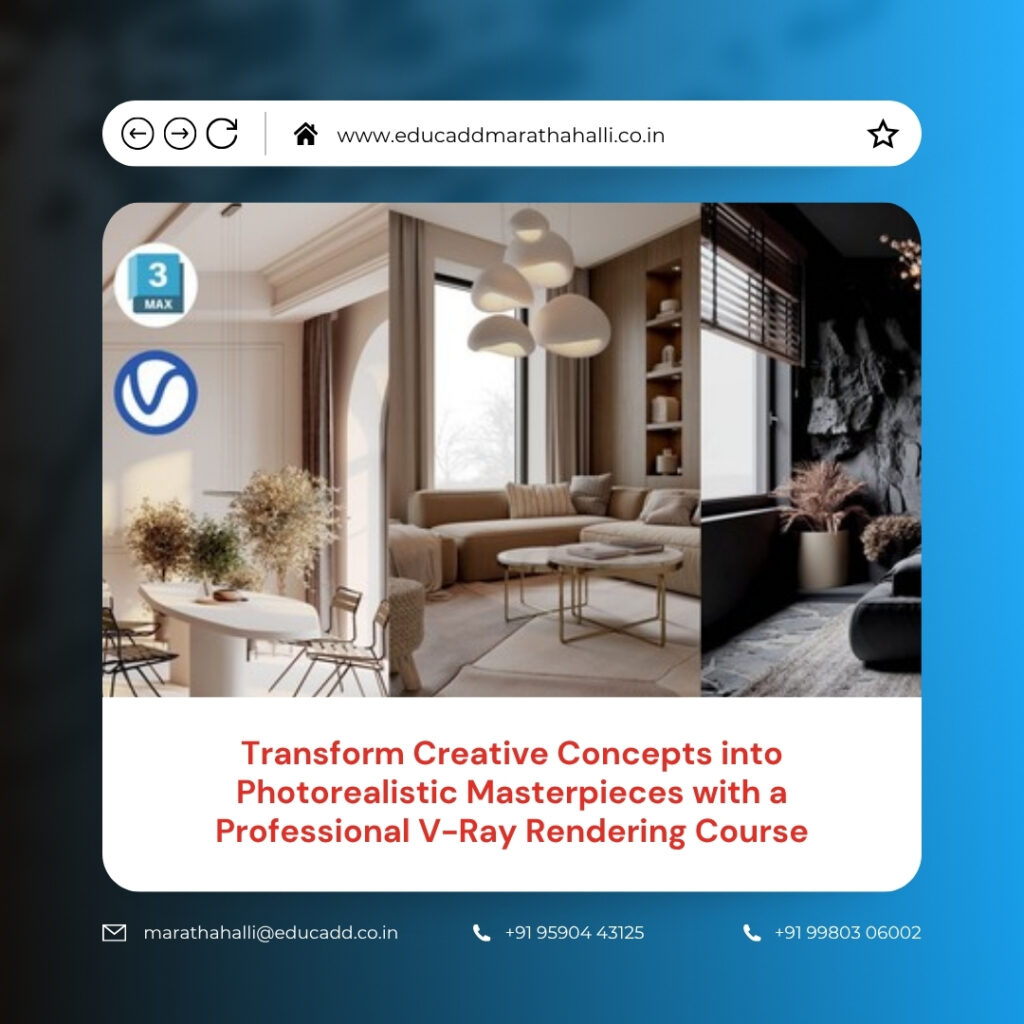
Professional V-Ray Rendering Course
Unlocking the Importance of a V-Ray Rendering Course
Digital visualization has transformed the way designs are presented across industries. Instead of relying solely on technical drawings, professionals now use realistic renderings to showcase projects in extraordinary detail. A Professional V-Ray Rendering Course enables learners to produce visuals that accurately represent lighting, textures, materials, and environments.
As businesses increasingly demand high-quality presentations, rendering skills have become highly desirable. Moreover, organizations prefer professionals who can create compelling visual content that helps clients make informed decisions. Therefore, learning V-Ray gives designers a competitive advantage in today’s rapidly evolving marketplace.
Discover the Capabilities of V-Ray Rendering Software
V-Ray is recognized globally as one of the most powerful rendering engines available for architectural visualization, interior design, product rendering, and animation. It integrates seamlessly with industry-standard software such as SketchUp, Autodesk Revit, 3ds Max, Rhino, Cinema 4D, and several other modeling applications.
Additionally, V-Ray provides exceptional control over lighting, reflections, shadows, materials, and rendering quality. This flexibility allows professionals to produce highly realistic images that closely resemble real-world environments. Consequently, V-Ray has become the preferred rendering solution for design professionals worldwide.
Build Strong Foundations with Practical Training
Every successful rendering artist begins by mastering the fundamentals. A comprehensive Professional V-Ray Rendering Course introduces students to the software interface, essential tools, rendering workflows, and project organization before advancing toward professional-level techniques.
Furthermore, learners gain hands-on experience through practical exercises that reinforce theoretical concepts. Working on real-world projects helps students understand how each rendering parameter influences the final image while developing confidence in handling complex visualization tasks independently.
Learn Advanced Lighting Techniques for Realism
Lighting is one of the most important factors that determine the quality of a rendered image. Even a perfectly modeled structure can appear unrealistic without proper lighting. Therefore, a professional Professional V-Ray Rendering Course focuses extensively on mastering illumination techniques.
Students learn natural daylight systems, artificial lighting setups, global illumination, exposure adjustments, color temperature, and realistic shadow creation. As they practice different lighting conditions, they develop the ability to create visually balanced scenes that closely replicate real-life environments.
Master Materials and Textures Like an Expert
Creating convincing materials is essential for producing photorealistic renderings. Every surface, whether it is concrete, glass, marble, wood, fabric, or metal, requires carefully configured material properties. A Professional V-Ray Rendering Course teaches learners how to develop realistic materials using reflection, refraction, glossiness, bump maps, displacement maps, and procedural textures.
In addition, students explore advanced texture mapping techniques that eliminate stretching and improve surface accuracy. These skills significantly enhance the visual quality of every rendering project while creating believable design presentations.
Improve Visual Storytelling Through Camera Composition
Professional renderings are not only technically accurate but also visually engaging. Camera placement, viewing angles, composition, and perspective all influence how viewers experience a design. A quality Professional V-Ray Rendering Course explains how to use virtual cameras effectively for impactful presentations.
Learners also understand concepts such as focal length, depth of field, exposure, field of view, and cinematic framing. As a result, they create renderings that communicate design intent more effectively while capturing the viewer’s attention naturally.
Create Stunning Exterior Visualizations
Exterior rendering demands realistic skies, landscape elements, weather conditions, and environmental lighting. During a Professional V-Ray Rendering Course, students learn how to use HDRI environments, realistic sunlight, vegetation assets, water reflections, and atmospheric effects to create immersive outdoor scenes.
Moreover, learners understand how seasonal variations and environmental settings affect the overall mood of a visualization. These techniques allow them to produce high-quality architectural presentations suitable for residential, commercial, and landscape development projects.
Design Beautiful Interior Renderings
Interior visualization requires careful coordination of lighting, furniture placement, decorative elements, and material selection. A professional Professional V-Ray Rendering Course provides practical knowledge for creating attractive residential and commercial interiors that appear warm, inviting, and realistic.
Students practice rendering bedrooms, kitchens, offices, hotels, retail spaces, restaurants, and luxury apartments. Consequently, they become capable of producing presentation-ready visuals that help clients visualize completed spaces before construction begins.
Optimize Rendering Speed Without Losing Quality
Rendering large projects can consume significant time if proper optimization techniques are not applied. Therefore, a V-Ray Rendering Course introduces efficient workflows that improve rendering performance while maintaining exceptional image quality.
Students learn adaptive sampling, render elements, denoising tools, memory management, GPU acceleration, and scene optimization techniques. These methods reduce rendering time considerably, enabling professionals to meet project deadlines without sacrificing visual excellence.
Develop an Industry-Ready Professional Portfolio
A strong portfolio demonstrates practical expertise more effectively than certifications alone. Throughout a V-Ray Rendering Course, learners complete multiple industry-based projects that showcase different rendering styles and visualization techniques.
Their portfolios often include architectural exteriors, luxury interiors, commercial buildings, product renderings, landscape designs, furniture visualization, and conceptual presentations. A well-developed portfolio increases credibility, attracts potential employers, and creates more freelance opportunities.
Explore Exciting Career Opportunities
Professionals with advanced rendering skills are in high demand across numerous industries. After completing a V-Ray Rendering Course, learners can pursue careers as architectural visualizers, rendering artists, BIM visualization specialists, interior visualization experts, product rendering designers, animation professionals, CAD visualization consultants, or freelance 3D artists.
Furthermore, architecture firms, engineering consultancies, construction companies, furniture manufacturers, real estate developers, advertising agencies, and gaming studios actively recruit skilled rendering professionals. This wide range of opportunities makes V-Ray an excellent career investment.
Strengthen Your Skills by Integrating Multiple Software
Although V-Ray serves as a rendering engine, its full potential is realized when combined with professional modeling software. A V-Ray Rendering Course helps students integrate V-Ray with SketchUp, Revit, AutoCAD, Rhino, 3ds Max, and other leading design applications.
This integrated workflow allows professionals to complete projects efficiently from drafting and modeling to rendering and client presentation. Consequently, employers value candidates who possess expertise across multiple software platforms while maintaining advanced rendering capabilities.
Select the Right Training Institute for Long-Term Success
Choosing a reputable institute plays a vital role in achieving career success. Before enrolling in a V-Ray Rendering Course, students should evaluate trainer experience, updated curriculum, practical assignments, certification, laboratory facilities, placement assistance, and industry exposure.
Institutes that emphasize project-based learning and personalized mentoring often produce highly skilled professionals. Additionally, continuous support, portfolio guidance, and interview preparation help students transition smoothly into the professional workforce.
Keep Practicing to Stay Ahead in the Visualization Industry
Rendering technology continues to evolve with new features, workflows, and industry standards emerging regularly. Therefore, completing a V-Ray Rendering Course should be viewed as the beginning of a continuous learning journey rather than the final destination.
Professionals who consistently practice lighting experiments, material creation, camera composition, and rendering optimization continue improving their visualization skills over time. By exploring new creative techniques and analyzing industry-leading projects, they remain competitive while delivering exceptional photorealistic renderings that exceed client expectations.
Conclusion
A Professional V-Ray Rendering Course provides the technical knowledge and creative expertise required to build a successful career in architectural visualization, interior design, engineering, product design, and 3D graphics. From understanding realistic lighting and advanced materials to optimizing rendering performance and building an impressive portfolio, every stage of the training contributes to professional growth. As industries increasingly depend on immersive visual presentations for decision-making and marketing, skilled V-Ray professionals continue to enjoy excellent career opportunities worldwide. Investing in quality training, practicing consistently, and staying updated with the latest rendering innovations will help you create breathtaking visualizations while establishing yourself as a highly valued expert in the ever-growing world of digital design.

