
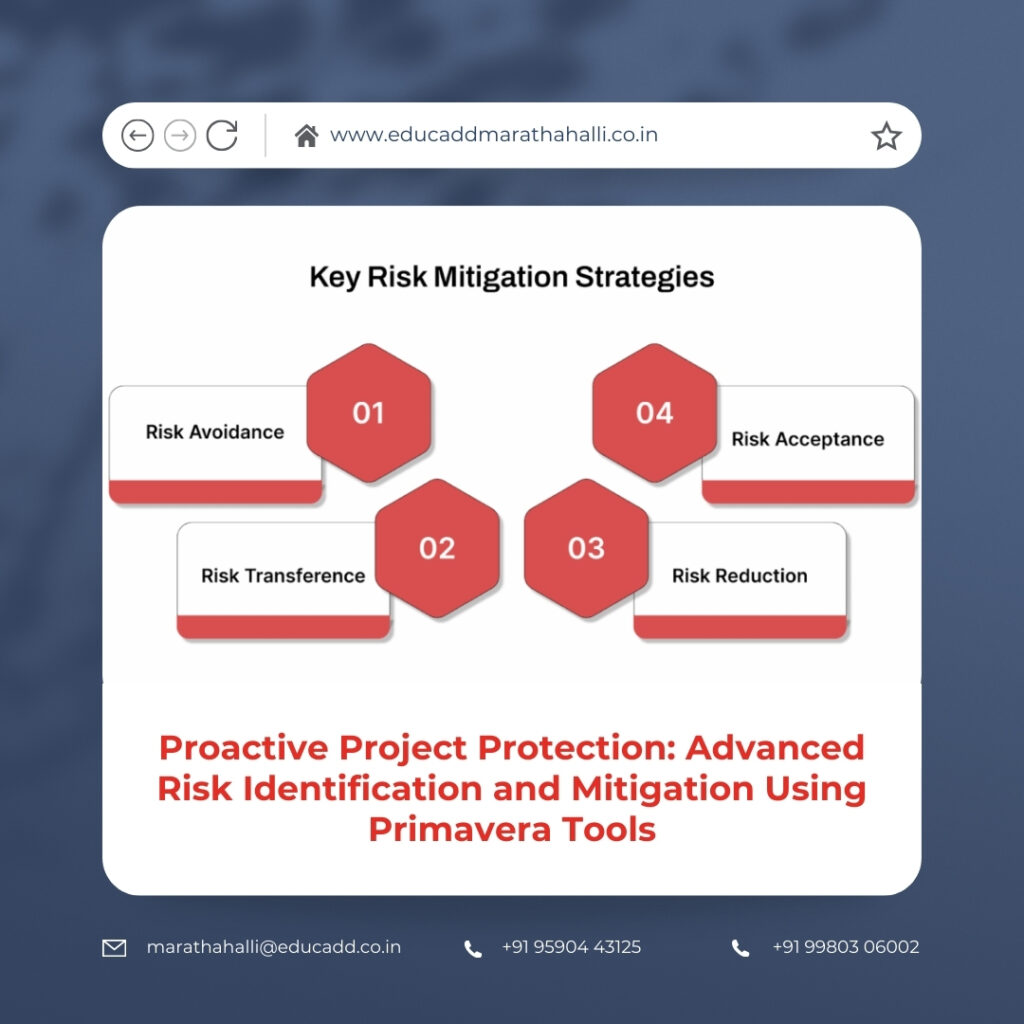
Proactive Project Protection: Advanced Risk Identification and Mitigation Using Primavera Tools
Primavera Project Risk Management tools enables organizations to manage uncertainty with clarity and precision. Primavera provides an integrated project management ecosystem where risks can be documented, analyzed, prioritized, and controlled alongside schedules, resources, and budgets. Instead of reacting to crises, teams gain the ability to forecast disruptions and prepare responses in advance. This proactive approach strengthens decision-making and improves overall project resilience.
Every complex project operates in an environment filled with uncertainty. Deadlines shift, costs fluctuate, resources become unavailable, and external factors influence progress without warning. When such uncertainties are not managed systematically, they grow into serious risks that disrupt schedules, inflate budgets, and damage stakeholder confidence. Successful project delivery therefore depends on the ability to anticipate potential problems early and respond with structured mitigation strategies. Modern project environments demand digital solutions that go far beyond manual tracking methods and disconnected spreadsheets.
Primavera Project Risk Management
Furthermore, Primavera’s centralized platform enhances coordination across departments. Engineering teams, planners, financial analysts, procurement officers, and leadership stakeholders can collaborate using shared risk data. This unified visibility eliminates information gaps and ensures that everyone works toward common project objectives. When risks are managed within Primavera, accountability improves and response strategies become faster and more effective.
This article presents a comprehensive guide to risk identification and mitigation using Primavera tools. It explores foundational principles, platform capabilities, practical workflows, and strategic benefits that help organizations build risk-aware project operations capable of handling uncertainty with confidence.
Understanding the Nature of Project Risks
Primavera Project Risk Management are uncertain events that can influence objectives either positively or negatively. While some uncertainties create opportunities for innovation and efficiency, most risks threaten timelines, financial stability, resource availability, and quality standards. Therefore, structured risk management becomes essential for maintaining project control.
Risks originate from multiple sources. Internal risks emerge due to planning gaps, design errors, workforce limitations, scope changes, and technical integration challenges. External risks arise from regulatory shifts, market volatility, political instability, environmental conditions, and supply chain disruptions. Since these uncertainties evolve continuously, project teams must adopt dynamic monitoring systems that allow early detection.
Risk identification and mitigation using Primavera tools begins with understanding how uncertainties influence interconnected project components. Primavera enables teams to link risk events directly with affected tasks, resources, and financial elements. This interconnected mapping clarifies how small issues can escalate into major disruptions if ignored.
Additionally, risks must be evaluated based on probability and potential impact. High-probability risks with severe consequences demand immediate mitigation planning, while lower-priority risks may require monitoring and contingency reserves. Primavera’s structured evaluation tools support objective prioritization so that management attention remains focused on critical vulnerabilities.
By recognizing the multi-dimensional nature of project risks, organizations create a strong foundation for effective digital risk management.
Importance of Digital Risk Management in Modern Projects
As projects grow larger and more complex, traditional risk logs and spreadsheet-based tracking methods become inadequate. Manual systems often lack real-time updates, integrated analysis, and collaborative accessibility. Consequently, project teams struggle to maintain accurate oversight of emerging threats.
Primavera Project Risk Management and mitigation using Primavera tools transforms risk management into a live, data-driven process. Primavera integrates scheduling, cost control, resource allocation, and risk tracking within a single digital environment. This integration ensures that risk assessments reflect current project conditions rather than outdated assumptions.
Digital platforms also enable predictive planning. Instead of waiting for problems to occur, teams can simulate various risk scenarios and evaluate their potential effects on deadlines and budgets. This forecasting ability allows managers to implement preventive measures early, reducing the likelihood of severe disruptions.
Collaboration improves significantly when digital risk systems replace isolated documentation. Primavera supports multi-user access, enabling geographically dispersed teams to contribute risk data simultaneously. Updates become visible instantly, ensuring that stakeholders always work with accurate information.
Moreover, digital audit trails enhance accountability. Primavera records every modification, approval, and mitigation action, creating transparent governance structures that satisfy compliance requirements. This documentation strengthens stakeholder trust and protects organizations during contractual reviews.
Digital risk management therefore becomes a strategic necessity rather than an optional enhancement.
Core Primavera Features That Enable Risk Identification
Risk identification and mitigation using Primavera tools relies on specialized features designed to detect, organize, and monitor project uncertainties systematically.
Centralized Risk Repository
Primavera offers a unified database where all project risks are recorded in standardized formats. This centralization ensures consistency across departments and prevents critical threats from being overlooked.
Key benefits include:
-
Uniform risk documentation standards
-
Clear classification based on project phases
-
Ownership assignment for accountability
-
Easy retrieval of historical risk data
-
Simplified coordination across teams
Activity-Level Risk Mapping
Each risk can be linked directly to schedule activities, enabling precise impact evaluation.
Important advantages include:
-
Immediate identification of vulnerable tasks
-
Accurate forecasting of potential delays
-
Visibility into milestone exposure
-
Faster development of response strategies
-
Enhanced schedule protection
Risk Evaluation Frameworks
Primavera supports customizable scoring systems that measure risk severity objectively.
Notable features include:
-
Probability-impact matrices
-
Automated risk ranking systems
-
Custom evaluation parameters
-
Priority-based mitigation planning
-
Reduced subjectivity in assessments
Scenario Simulation Tools
Project teams can model alternate outcomes if specific risks occur.
Simulation capabilities include:
-
Timeline disruption forecasting
-
Budget overrun projections
-
Resource shortage modeling
-
Alternative schedule testing
-
Evidence-based contingency planning
Visual Reporting Dashboards
Interactive dashboards present risk metrics in clear graphical formats.
Reporting strengths include:
-
Real-time exposure summaries
-
Trend analysis across project stages
-
Department-specific visual reports
-
Executive-friendly performance indicators
-
Quick stakeholder presentations
Structured Process for Risk Identification in Primavera
A systematic workflow ensures comprehensive risk identification and mitigation using Primavera tools throughout the project lifecycle.
The process begins with collecting risk inputs from brainstorming workshops, technical reviews, stakeholder consultations, and analysis of past projects. Identified uncertainties are then documented within Primavera’s risk register using detailed descriptions and relevant classifications.
Each recorded risk is mapped to affected schedule elements, allowing Primavera Project Risk Management to calculate potential consequences automatically. This linkage ensures that risk visibility remains embedded within everyday project planning activities.
Risk ownership is assigned to responsible individuals or teams. Assigned owners monitor triggers, evaluate developments, and implement mitigation actions when necessary. Clear responsibility prevents oversight and delays in response.
Next, teams evaluate risks using scoring models that measure probability and impact. Primavera prioritizes threats based on severity, guiding managers toward issues requiring immediate attention.
Mitigation strategies are documented within the system, including contingency plans, fallback options, cost reserves, and schedule buffers. Primavera maintains a complete lifecycle record, allowing teams to track risk progression from identification to closure.
Periodic reviews ensure that new uncertainties are added while resolved risks are archived. Continuous updates keep risk data accurate and actionable.
Risk Categorization for Better Analytical Clarity
Organizing risks into structured categories strengthens risk identification and mitigation using Primavera tools by improving analytical precision and response planning.
Technical risks involve engineering challenges, design inconsistencies, integration failures, and technology performance issues. Primavera allows tagging these risks to technical deliverables and design milestones.
Financial risks relate to funding gaps, budget overruns, inflation, currency fluctuations, and procurement cost escalations. Primavera’s financial modules track budget variance and forecast cost impacts.
Operational risks stem from workforce shortages, productivity inefficiencies, logistical bottlenecks, and equipment malfunctions. Resource management dashboards provide early warning signals.
External risks arise from regulatory changes, environmental disruptions, geopolitical conditions, and supply chain instability. Primavera supports external dependency mapping to highlight exposure.
Strategic risks involve stakeholder disagreements, contractual conflicts, market competition, and policy changes. Communication tracking features ensure alignment among decision-makers.
Categorization enhances reporting clarity and enables targeted mitigation planning across departments.
Developing Effective Risk Mitigation Plans
After identification and prioritization, practical mitigation planning becomes essential. Risk identification and mitigation using Primavera tools transforms response strategies into structured action plans.
Mitigation tasks can be inserted directly into project schedules, ensuring preventive measures align with execution timelines. Examples include design validation reviews, supplier diversification, and alternative resource planning.
Budget contingencies are allocated using Primavera’s cost control systems. Financial reserves help absorb unexpected expenses without disrupting overall funding structures.
Schedule buffers protect critical path activities from delays. Primavera recalculates dependencies automatically when buffers are adjusted.
Resource reallocation features help managers redistribute manpower and equipment to prevent bottlenecks. Workload balancing ensures optimal productivity.
Automated notification systems inform stakeholders when mitigation actions are triggered. Approval workflows accelerate response implementation.
Performance dashboards measure mitigation effectiveness and support timely strategy adjustments.
Quantitative Risk Analysis for Data-Driven Decisions
Advanced analytical methods enhance risk identification and mitigation using Primavera Project Risk Management tools by converting uncertainty into measurable insights.
Monte Carlo simulations model thousands of potential project scenarios to estimate realistic completion timelines. Managers gain probability-based forecasts instead of relying on optimistic assumptions.
Sensitivity analysis identifies tasks with the highest vulnerability to disruptions. Targeted mitigation strategies can then protect critical areas.
Cost risk modeling estimates financial deviations under different threat conditions. Budget planning becomes more resilient.
Probabilistic branching evaluates alternate execution paths when risks occur. Flexible workflows improve adaptability.
Confidence interval reporting helps stakeholders understand delivery likelihoods and risk exposure levels.
These quantitative techniques elevate Primavera from a tracking platform to a predictive intelligence system.
Integrating Risk Planning with Project Scheduling
Schedules become more realistic when risk identification and mitigation using Primavera tools incorporates uncertainty into planning structures.
Risk-adjusted scheduling introduces buffers that absorb potential delays without affecting final delivery targets.
Critical path analysis highlights activities requiring priority mitigation focus.
Dependency mapping reveals cascading effects of upstream disruptions.
Milestone trend evaluations track risk influence on key deliverables.
Schedule compression strategies become safer when supported by risk simulations.
Integrated planning ensures proactive control instead of reactive corrections.
Resource Risk Forecasting and Optimization
Resource instability remains a major cause of project delays. Primavera strengthens workforce and equipment planning through predictive analytics.
Labor availability forecasting identifies shortages early, allowing proactive recruitment or outsourcing.
Skill mapping ensures qualified professionals handle specialized tasks.
Equipment utilization dashboards prevent overbooking and idle time.
Vendor capacity monitoring reduces procurement uncertainties.
Fatigue analysis protects workforce productivity and safety.
Optimized resource planning improves operational reliability and schedule stability.
Financial Risk Control Through Primavera Systems
Strong financial oversight supports risk identification and mitigation using Primavera tools by preventing budgetary surprises.
Budget variance tracking reveals deviations from planned spending patterns.
Earned value management measures performance against financial baselines.
Contingency planning protects projects from unforeseen expenses.
Cash flow forecasting ensures liquidity during mitigation implementation.
Procurement monitoring prevents supplier-related cost escalations.
Contract compliance tracking reduces legal and financial exposure.
Financial dashboards enhance executive decision-making visibility.
Communication Management for Stakeholder Risk Alignment
Transparent communication minimizes misunderstandings that create project risks. Primavera centralizes stakeholder coordination through integrated collaboration tools.
Shared dashboards provide consistent project insights.
Automated alerts notify teams of emerging threats promptly.
Approval tracking accelerates decision-making processes.
Document version control prevents misinformation.
Meeting logs record accountability trails.
Collaborative visibility strengthens stakeholder trust and reduces conflict.
Overcoming Implementation Challenges in Primavera Risk Management
While Primavera offers advanced capabilities, certain challenges may arise during implementation.
Complex system interfaces may discourage new users. Structured training programs improve adoption.
Incomplete data entry reduces analysis accuracy. Standardized templates ensure consistency.
Resistance to digital transformation slows workflow integration. Leadership support encourages compliance.
Excessive dashboard data may overwhelm managers. Custom reporting simplifies insights.
Legacy system incompatibility restricts integration efficiency. API solutions enable connectivity.
Addressing these barriers ensures successful Primavera deployment.
Conclusion
Uncertainty is unavoidable in modern project environments, but its impact can be controlled through structured planning and intelligent tools. Primavera Project Risk Management and mitigation using Primavera tools empowers organizations to anticipate disruptions, prioritize vulnerabilities, and implement effective response strategies before problems escalate. By integrating risk data with schedules, financial systems, and resource planning modules, Primavera creates a resilient project ecosystem capable of adapting to change.
Organizations that embed Primavera-based risk practices into their governance frameworks gain improved schedule reliability, stronger financial discipline, better collaboration, and enhanced stakeholder confidence. Digital risk intelligence replaces reactive firefighting with proactive control, allowing teams to deliver projects with greater accuracy and predictability.
As industries continue embracing digital transformation, Primavera will remain a cornerstone of strategic project risk management. Its predictive analytics, integrated workflows, and collaborative platforms ensure that organizations stay prepared, responsive, and competitive in increasingly complex project landscapes.

