
Mastering Project Control: Advanced Construction Project Monitoring with Primavera Dashboards
Construction projects today operate in an environment defined by complexity, tight deadlines, rising costs, and demanding stakeholders. Large infrastructure developments, commercial buildings, and industrial facilities all require precise coordination across multiple teams and phases. In this context, monitoring is no longer a simple review of weekly reports. It is a strategic process that determines whether a project succeeds or struggles. This is where Primavera Project Monitoring Dashboards becomes a transformative solution.
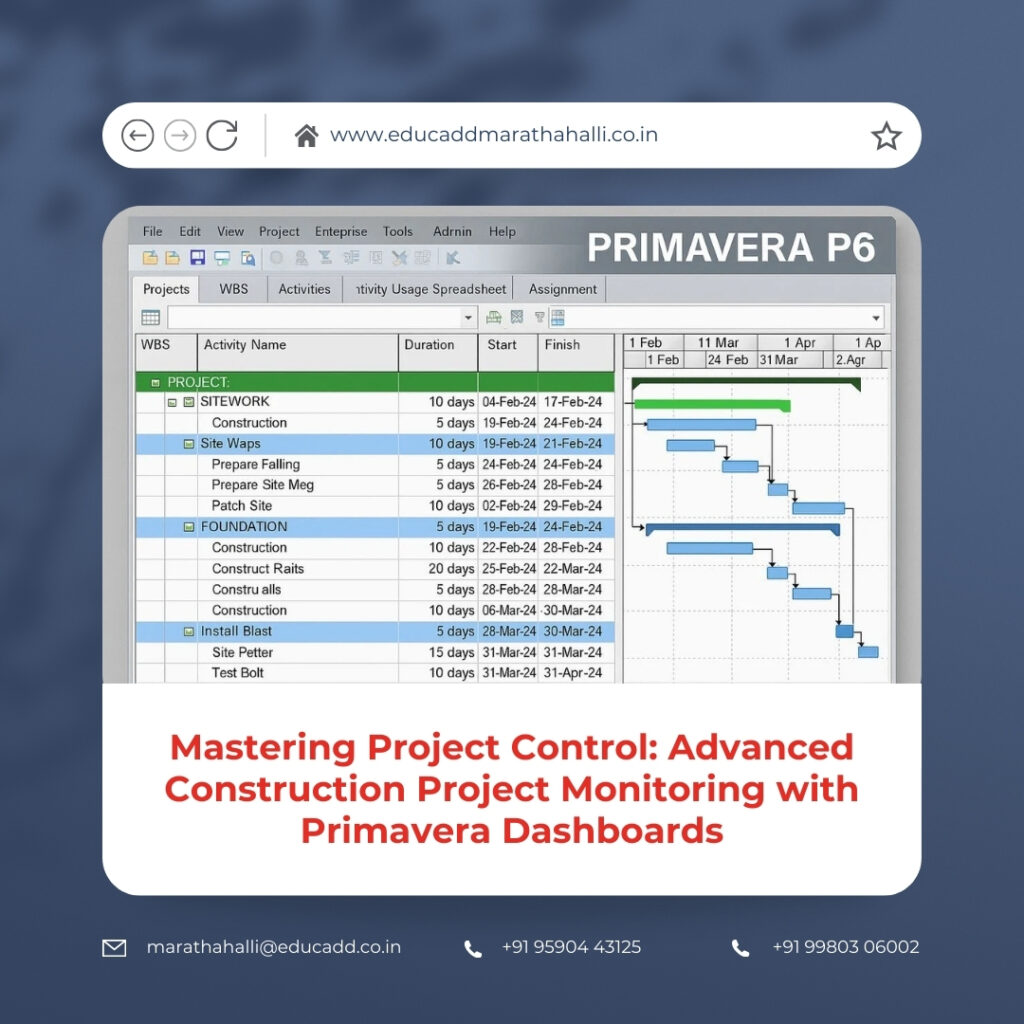
Primavera Project Monitoring Dashboards
Primavera dashboards provide a structured and intelligent approach to tracking performance. They convert large volumes of project data into meaningful visual insights that decision-makers can understand instantly. Instead of analyzing disconnected spreadsheets or waiting for manual updates, project leaders gain immediate access to live performance indicators. This proactive visibility improves accountability, strengthens forecasting, and enhances control. As construction projects continue to grow in scale and technical complexity, Primavera dashboards stand at the center of efficient project governance.
1. The Strategic Importance of Construction Project Monitoring
Primavera Project Monitoring Dashboards is the continuous evaluation of schedule, cost, scope, quality, and resources throughout the project lifecycle. It ensures that every activity aligns with defined objectives and contractual commitments. Without consistent monitoring, minor issues quickly escalate into costly delays and disputes.
In modern construction, monitoring must go beyond simple tracking. It should identify patterns, highlight performance trends, and support early corrective action. Construction Project Monitoring with Primavera Dashboards fulfills this requirement by offering a centralized platform where all critical metrics are visible in real time.
When project managers rely on data-driven insights, they reduce uncertainty. They no longer make decisions based on assumptions. Instead, they act on measurable indicators. This strategic control strengthens risk management and supports long-term project stability.
2. How Primavera Enhances Project Visibility
Primavera has established itself as one of the most powerful project management systems in the construction industry. Its scheduling engine, cost management tools, and resource planning capabilities allow teams to build comprehensive project plans. However, dashboards elevate its functionality to a higher level.
Construction Project Monitoring with Primavera Dashboards translates detailed schedules and financial records into clear graphical representations. Rather than reviewing thousands of activity lines, managers see summary views of progress, variances, and resource distribution.
This visual clarity accelerates decision-making. Furthermore, dashboards reduce dependency on manual consolidation of reports. Since data updates automatically, project leaders receive accurate insights without delay. Enhanced visibility ensures that stakeholders remain aligned with project objectives.
3. Converting Raw Data into Actionable Intelligence
Construction projects generate massive volumes of information daily. Each progress update, cost entry, and resource adjustment adds to the dataset. While data abundance offers opportunity, it also creates confusion without proper structure.
Primavera Project Monitoring Dashboards transform raw information into actionable intelligence. Charts, performance indicators, and trend lines highlight critical aspects of project performance. Construction Project Monitoring with Primavera Dashboards ensures that decision-makers focus on relevant insights instead of overwhelming details.
For example, earned value charts reveal cost efficiency at a glance. Schedule performance indicators show whether the project advances as planned. By interpreting these visuals, managers can implement corrective measures before problems intensify.
4. Strengthening Schedule Control and Timeline Management
Schedule adherence defines the success of any construction project. Delays not only increase costs but also damage client relationships and organizational reputation. Therefore, precise schedule monitoring is essential.
Primavera dashboards present planned versus actual progress in dynamic charts. They highlight critical path activities and show float values clearly. Construction Project Monitoring with Primavera Dashboards enables teams to identify potential bottlenecks early.
When managers detect schedule deviations, they can reallocate resources or adjust sequencing. Instead of reacting after delays occur, they act proactively. This disciplined approach protects contractual deadlines and ensures steady project momentum.
5. Advanced Cost Monitoring and Financial Transparency
Financial control remains one of the most challenging aspects of construction management. Budgets fluctuate due to market changes, material price variations, and scope adjustments. Without structured monitoring, cost overruns quickly escalate.
Primavera dashboards integrate cost metrics such as budget at completion, actual expenditure, and cost performance index. Construction Project Monitoring with Primavera Dashboards provides immediate visibility into financial health.
Managers compare planned costs with actual spending in real time. If discrepancies appear, they investigate root causes promptly. This proactive oversight improves forecasting accuracy and prevents financial surprises. Moreover, stakeholders gain confidence in transparent reporting.
6. Optimizing Resource Allocation for Maximum Productivity
Construction projects rely heavily on human resources, equipment, and materials. Efficient allocation determines overall productivity and profitability. Overloading teams reduces quality, while underutilization wastes budget.
Primavera dashboards display resource histograms and allocation charts. Construction Project Monitoring with Primavera Dashboards allows managers to analyze workload distribution across activities and phases.
When imbalances appear, leaders adjust assignments strategically. They shift labor, modify schedules, or coordinate subcontractors more effectively. Balanced resource planning improves efficiency and reduces last-minute conflicts.
7. Enhancing Risk Management Through Early Detection
Risk is inevitable in construction. Weather conditions, supply chain disruptions, regulatory changes, and design revisions introduce uncertainty. Successful projects anticipate these risks rather than respond after damage occurs.
Primavera dashboards incorporate risk indicators into performance metrics. Construction Project Monitoring with Primavera Dashboards highlights high-risk activities and deviations from baseline plans.
By identifying early warning signals, project teams implement mitigation strategies promptly. This structured approach reduces exposure to costly delays and strengthens overall project resilience.
8. Facilitating Seamless Communication Among Stakeholders
Construction involves diverse participants, including clients, contractors, engineers, consultants, and suppliers. Effective communication ensures alignment across all parties.
Dashboards provide a unified information source accessible to authorized stakeholders. Construction Project Monitoring with Primavera Dashboards eliminates conflicting data versions and improves collaboration.
During review meetings, visual summaries replace lengthy textual reports. Clear charts and graphs communicate complex information quickly. Consequently, discussions focus on solutions rather than data clarification.
9. Driving Performance Improvement Through Analytics
Continuous improvement depends on accurate performance measurement. Primavera dashboards offer analytical tools that reveal productivity trends and efficiency levels.
Construction Project Monitoring with Primavera Dashboards allows organizations to compare planned performance with actual outcomes. Over time, these comparisons create valuable historical data.
Project managers analyze this information to refine scheduling techniques and cost estimation methods. Lessons learned from one project enhance future planning accuracy. Thus, dashboards contribute not only to monitoring but also to organizational growth.
10. Customizing Dashboards for Diverse Project Needs
Every construction project has unique requirements. Infrastructure developments differ significantly from residential projects. Therefore, monitoring systems must adapt accordingly.
Primavera dashboards support customization of layout, metrics, and reporting formats. Construction Project Monitoring with Primavera Dashboards enables organizations to tailor dashboards to specific objectives.
For instance, highway projects may prioritize resource productivity metrics, while commercial developments emphasize cost tracking. Customization ensures relevance and enhances user engagement.
11. Supporting Multi-Project and Portfolio Oversight
Large construction firms often manage multiple projects simultaneously. Coordinating performance across different sites requires centralized oversight.
Primavera Project Monitoring Dashboards consolidate data from multiple projects into portfolio-level views. Construction Project Monitoring with Primavera Dashboards provides executives with comprehensive insights into overall performance.
Leaders evaluate which projects remain on schedule and which require intervention. Portfolio monitoring improves strategic allocation of resources and capital.
12. Integration with Digital Construction Technologies
Digital transformation continues to reshape the construction industry. Technologies such as Building Information Modeling (BIM), ERP systems, and cloud collaboration platforms enhance operational efficiency.
Primavera dashboards integrate seamlessly with these technologies. Construction Project Monitoring with Primavera Dashboards ensures synchronized data exchange across systems.
This integration eliminates duplication of effort and enhances data accuracy. As digital ecosystems expand, dashboards remain central to unified project management.
13. Implementation Best Practices for Maximum Impact
Effective dashboard implementation requires structured planning. Organizations should define key performance indicators aligned with strategic objectives.
Training sessions help teams interpret dashboard metrics accurately. Construction Project Monitoring with Primavera Dashboards delivers value only when users understand performance indicators clearly.
Regular data updates and governance protocols maintain reliability. Additionally, periodic review of dashboard configurations ensures alignment with evolving project goals.
14. The Future of Construction Monitoring with Intelligent Dashboards
As construction projects become more sophisticated, monitoring tools must evolve accordingly. Emerging technologies such as artificial intelligence and predictive analytics are enhancing dashboard capabilities.
Construction Project Monitoring with Primavera Dashboards is moving toward predictive performance insights. Instead of reporting past events, dashboards will forecast potential deviations before they occur.
This forward-looking approach will redefine project control. Organizations that embrace intelligent dashboards will maintain competitive advantage in an increasingly demanding industry.
Conclusion
The construction industry demands precision, transparency, and adaptability. Traditional monitoring methods cannot meet the challenges of modern projects. Digital transformation has introduced tools that redefine how teams track and control performance.
Primavera Project Monitoring Dashboards stands at the forefront of this transformation. By converting complex data into clear visual insights, dashboards empower managers to make confident decisions. They strengthen schedule adherence, enhance cost control, optimize resource utilization, and support risk mitigation.
Furthermore, dashboards improve stakeholder communication and promote accountability across teams. Their scalability allows organizations to manage single projects or entire portfolios with equal efficiency. As predictive analytics and advanced integrations expand, Primavera dashboards will continue to shape the future of construction management.
Ultimately, organizations that adopt structured monitoring through Primavera dashboards build stronger governance frameworks and achieve consistent project success. Through data-driven control and proactive leadership, they transform construction challenges into measurable achievements.

