
Driving Predictable Project Success with Earned Value Management (EVM) Using Primavera P6
Modern projects demand more than basic scheduling and budget tracking. Organizations operate in competitive environments where delays, cost overruns, and scope changes directly impact profitability and reputation. Therefore, leaders require an integrated performance control system that connects planning, execution, and financial monitoring into one reliable framework. Primavera P6 Earned Value provides that structured solution.
This methodology combines scope, schedule, and cost into measurable performance indicators. Instead of simply reviewing how much money has been spent or how many activities have been completed, project teams gain a unified view of actual progress compared to planned expectations. When integrated with Primavera P6, the system becomes even more powerful because the software automates calculations, manages baselines, and generates detailed performance reports.
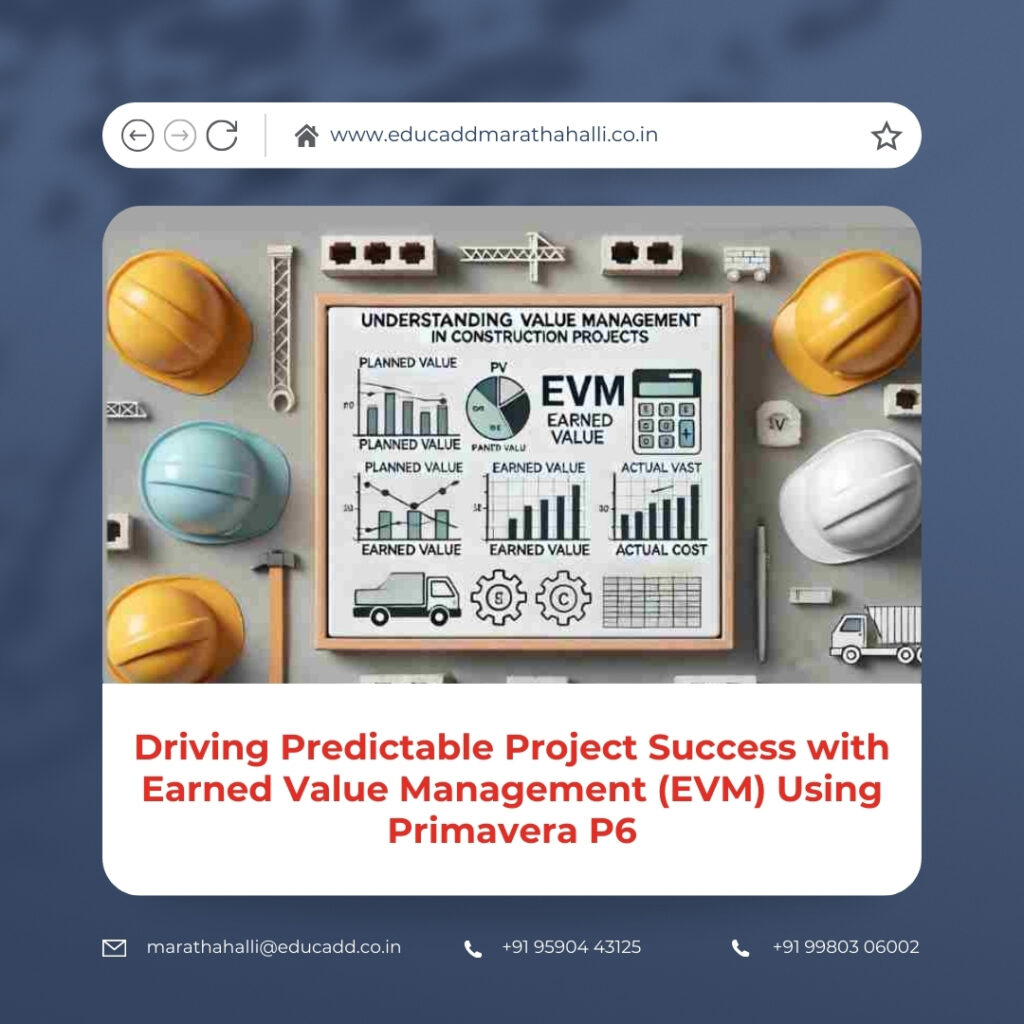
Primavera P6 Earned Value
In this in-depth guide, you will explore the practical application, configuration process, performance metrics, forecasting techniques, reporting standards, and strategic benefits of Primavera P6 Earned Value. Each section explains concepts clearly and builds progressively toward advanced implementation strategies that support large and complex projects.
1. The Evolution of Integrated Project Performance Control
Project control practices have evolved significantly over the past decades. Earlier approaches relied heavily on comparing planned versus actual schedules or reviewing accounting reports at the end of each month. While these methods provided useful information, they lacked integration. Managers could not easily determine whether money spent actually reflected completed work.
Earned Value Management (EVM) Using Primavera P6 addresses this limitation by linking three essential elements: planned work, accomplished work, and actual expenditure. This integration transforms project monitoring from reactive reporting into proactive performance management.
As projects increased in complexity, especially in construction, oil and gas, infrastructure, and manufacturing sectors, the need for structured performance metrics became critical. Primavera P6 emerged as a powerful enterprise scheduling platform capable of supporting multi-project environments. When organizations combine its scheduling capabilities with EVM principles, they create a highly disciplined performance governance system that promotes accountability and transparency.
2. Core Principles Behind Earned Value Management
Before applying the methodology in Primavera P6, understanding the underlying principles is essential. Earned Value Management measures project performance by comparing how much work was planned, how much work has actually been completed, and how much it cost to complete that work.
Three primary components form the foundation. Planned Value represents the authorized budget assigned to scheduled activities. Earned Value reflects the budgeted amount of work actually completed at a given point in time. Actual Cost captures the real expenditure incurred for completed activities.
Primavera P6 Earned Value uses these three variables to calculate variances and performance indices. These metrics allow managers to determine whether a project is ahead or behind schedule and under or over budget. Because the system relies on measurable data rather than subjective opinion, it supports evidence-based decision-making across all project phases.
3. Why Primavera P6 Enhances EVM Effectiveness
Primavera P6 stands as one of the most widely adopted project scheduling tools in complex industries. Its structured framework aligns naturally with Earned Value Management requirements.
The software allows users to create detailed Work Breakdown Structures, define activities with logical dependencies, allocate resources, assign cost rates, and establish performance baselines. These features provide the necessary foundation for implementing Earned Value Management (EVM) Using Primavera P6 successfully.
Additionally, Primavera P6 performs automated calculations for cost and schedule variances once progress updates are entered. This automation reduces manual errors and increases reporting accuracy. Its dashboard customization capabilities also enable managers to present performance insights clearly to executives and stakeholders.
Because Primavera P6 integrates time and cost data within a centralized database, it becomes an ideal platform for comprehensive EVM implementation.
4. Structuring the Work Breakdown for Accurate Measurement
A well-defined Work Breakdown Structure ensures that every project deliverable receives proper cost and schedule allocation. Without a clear WBS hierarchy, Earned Value calculations may become unreliable.
In Earned Value Management (EVM) Using Primavera P6, each WBS element represents a logical segment of project scope. Activities under these elements must be clearly defined and measurable. When activities remain vague or excessively broad, percent completion updates become inconsistent and distort performance results.
Therefore, planners should break down the project into manageable components. Each activity must have defined durations, logical predecessors and successors, and assigned resources. This disciplined structuring process establishes the foundation for accurate cost loading and performance tracking.
5. Cost Loading and Budget Allocation in Primavera P6
Cost loading involves assigning financial values to project activities. Primavera P6 allows users to allocate costs directly through resource assignments or expense entries. Resource rates determine the budgeted cost automatically based on planned units.
Earned Value Management (EVM) Using Primavera P6 requires precise cost distribution across activities. If cost assignments remain inaccurate, performance metrics lose credibility. Therefore, planners must verify that labor, materials, equipment, and subcontract costs reflect realistic market rates and contractual agreements.
Once cost loading is complete, the system calculates the total Budget at Completion. This value becomes a reference for performance evaluation and forecasting. Careful budgeting ensures that Earned Value indicators reflect actual project realities rather than theoretical assumptions.
6. Creating and Maintaining a Reliable Baseline
A baseline represents the approved project plan against which actual performance is measured. Primavera P6 allows users to capture and store multiple baselines. However, for Earned Value Management (EVM) Using Primavera P6, the primary baseline must remain stable unless formal change control procedures justify revision.
After finalizing schedule logic, resource assignments, and cost loading, planners create a baseline copy. This preserved version becomes the Performance Measurement Baseline. It captures the original approved scope, duration, and budget values.
Frequent or informal baseline adjustments weaken performance analysis. Therefore, organizations should enforce strict governance around baseline management. A stable reference point ensures meaningful variance identification throughout the project lifecycle.
7. Measuring Progress with Appropriate Percent Complete Methods
Progress measurement plays a decisive role in Earned Value accuracy. Primavera P6 supports various percent complete types, including Duration Percent Complete, Units Percent Complete, and Physical Percent Complete.
Earned Value Management (EVM) Using Primavera P6 often benefits most from Physical Percent Complete because it reflects actual work accomplishment rather than time elapsed. Duration-based progress may overstate achievement if delays occur. Physical measurement, on the other hand, aligns directly with tangible deliverables.
Project teams must define clear criteria for updating progress. Site engineers, supervisors, and planners should coordinate regularly to confirm accurate status reporting. Consistent update cycles strengthen the reliability of EVM indicators and prevent misleading performance trends.
8. Interpreting Cost and Schedule Variances
Once progress updates are entered, Primavera P6 calculates performance metrics automatically. Cost Variance equals Earned Value minus Actual Cost. Schedule Variance equals Earned Value minus Planned Value.
In Earned Value Management (EVM) Using Primavera P6, positive cost variance indicates spending efficiency, while negative variance signals overruns. Similarly, positive schedule variance reflects ahead-of-schedule performance.
However, interpretation requires contextual analysis. Temporary fluctuations may not indicate systemic problems. Therefore, managers should examine trends over multiple reporting periods. Continuous decline in performance indices may reveal structural inefficiencies that demand corrective action.
Clear interpretation ensures that EVM functions as a decision-support tool rather than a simple reporting mechanism.
9. Performance Indices and Efficiency Indicators
Performance indices simplify performance evaluation by presenting ratios rather than raw variances. The Cost Performance Index divides Earned Value by Actual Cost. The Schedule Performance Index divides Earned Value by Planned Value.
Earned Value Management (EVM) Using Primavera P6 displays these indicators within activity views and summary reports. Values greater than one indicate favorable efficiency, while values below one signal inefficiency.
Tracking these ratios over time provides valuable insight into productivity trends. Stable improvement suggests effective management interventions. Persistent underperformance demands immediate corrective measures.
Indices offer executives a concise overview of project health without requiring deep technical analysis.
10. Forecasting Final Outcomes Through EVM Analysis
Forecasting represents one of the strongest advantages of Earned Value methodology. Using current efficiency trends, managers can predict total project cost and completion timelines.
Earned Value Management (EVM) Using Primavera P6 calculates Estimate at Completion based on performance indices. This forecast estimates the final expected cost if current productivity continues. Estimate to Complete indicates the additional funding required to finish remaining work.
These predictive metrics enable proactive financial planning. Organizations can secure additional funding, adjust resource allocation, or implement recovery strategies before critical overruns occur. Forecasting transforms project control from reactive monitoring into forward-looking management.
11. Integrating Risk Management with EVM Monitoring
Performance deviations often reveal emerging risks before formal risk registers capture them. Negative cost or schedule trends may indicate productivity challenges, supply chain disruptions, or design issues.
Earned Value Management (EVM) Using Primavera P6 strengthens risk management by providing measurable early warning signals. When CPI or SPI declines below defined thresholds, managers can trigger mitigation strategies immediately.
This integration ensures that risk responses rely on objective performance data rather than assumptions. Consequently, organizations reduce uncertainty and improve resilience across project phases.
12. Reporting Strategies and Executive Communication
Clear communication supports stakeholder confidence. Primavera P6 provides customizable layouts, graphical dashboards, and S-curve analysis reports.
Earned Value Management (EVM) Using Primavera P6 allows managers to present cost and schedule performance in structured formats. Trend charts, variance tables, and performance indices provide clarity for executive reviews.
Regular reporting cycles promote accountability. When leadership receives consistent performance updates, strategic decisions become more informed and timely. Transparent communication builds trust among clients, contractors, and investors.
13. Avoiding Implementation Pitfalls
Despite its strengths, EVM requires disciplined execution. Common mistakes include unrealistic planning assumptions, inconsistent cost allocation, and irregular progress updates.
Earned Value Management (EVM) Using Primavera P6 demands structured governance. Teams must maintain accurate baselines, verify cost data, and standardize update procedures. Without consistency, performance metrics lose reliability.
Training plays a critical role. Project teams should understand both conceptual principles and software functionalities. Skilled implementation ensures meaningful results and long-term success.
14. Strategic Value of EVM in Modern Project Environments
As industries embrace digital transformation, performance transparency becomes increasingly important. Large-scale infrastructure, energy, and industrial projects involve substantial investments and extended timelines.
Earned Value Management (EVM) Using Primavera P6 provides an integrated control system capable of managing these complexities. It enhances predictability, strengthens governance, and supports executive oversight.
Furthermore, as organizations integrate analytics and data-driven decision platforms, EVM data can feed predictive models that improve forecasting precision. Mastering this methodology equips professionals with advanced control capabilities essential for future-ready project management.
Conclusion
Driving consistent project performance requires more than isolated schedule tracking or financial monitoring. Primavera P6 Earned Value delivers an integrated framework that combines scope, time, and cost into measurable performance indicators. By establishing a disciplined baseline, assigning accurate budgets, updating progress consistently, and analyzing variances proactively, organizations gain early insight into project health.
Primavera P6 enhances this methodology through automation, centralized data management, and customizable reporting tools. When applied strategically, it enables forecasting accuracy, strengthens risk management, and promotes executive transparency. In an era defined by complexity and accountability, mastering Earned Value Management (EVM) Using Primavera P6 empowers professionals to deliver projects with confidence, control, and predictable success.

