
From Drawing Boards to Digital Precision: The Remarkable Journey of Mechanical Drafting
Mechanical drafting has always been the backbone of engineering communication. It transforms ideas into detailed technical drawings that guide manufacturing, construction, and product development. Over time, the methods used to create these drawings have evolved dramatically. What once relied entirely on manual tools and drawing boards has now become a sophisticated digital process powered by advanced software. This transformation represents one of the most significant technological shifts in engineering design. The Mechanical Drafting Evolution History reflects how innovation, efficiency, and accuracy have continuously improved the way engineers communicate complex ideas.
In the early days of engineering, drafting involved meticulous hand-drawn sketches that required immense skill and patience. Engineers and designers used specialized instruments to ensure that every line, dimension, and angle was precise. Although these manual methods served industries well for decades, they demanded significant time and effort. As engineering projects became more complex and industries expanded, the limitations of manual drafting began to slow down productivity.
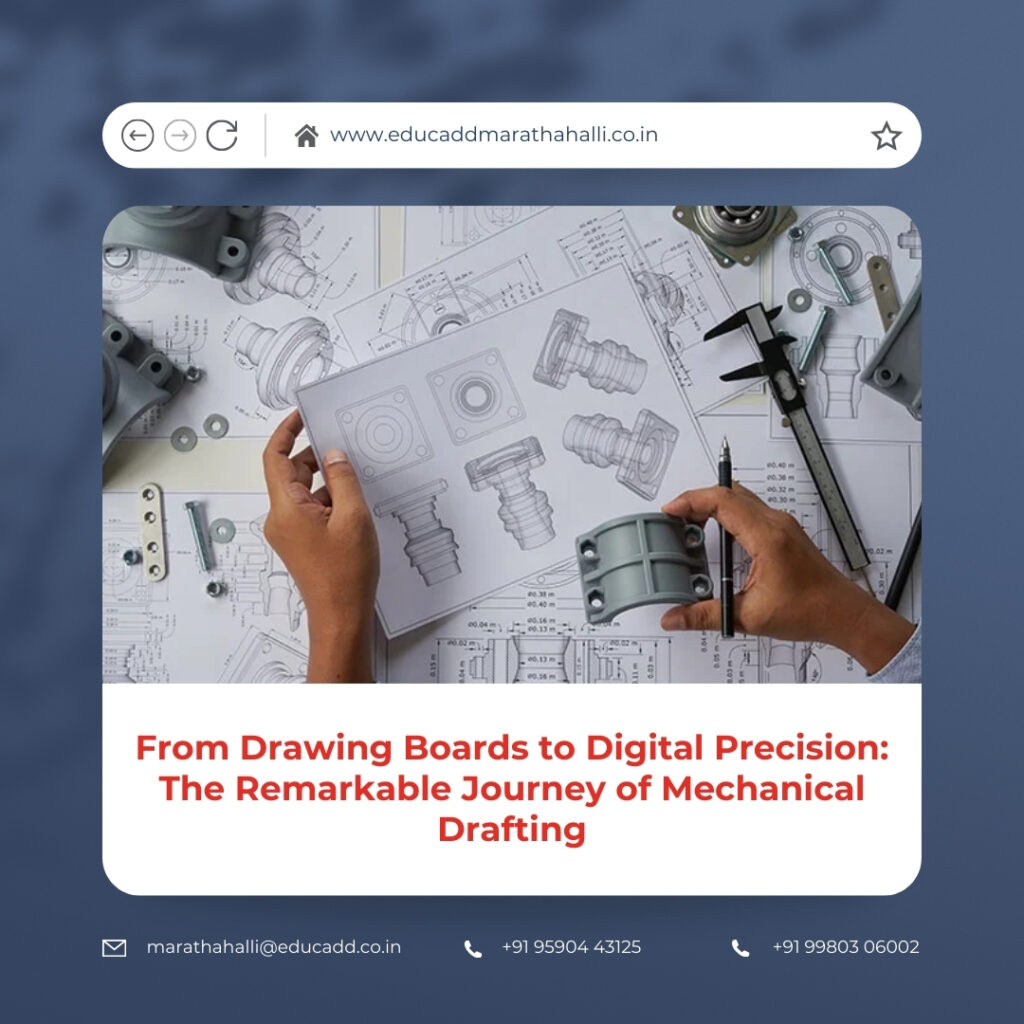
Mechanical Drafting Evolution History
Understanding the Mechanical Drafting Evolution History helps engineers appreciate the progress that has shaped modern design practices. It highlights how technology has enhanced productivity, improved collaboration, and enabled the creation of highly complex engineering systems. By exploring this journey from manual drafting to advanced CAD platforms, we can better understand the role of digital tools in shaping the future of engineering.
The Historical Roots of Mechanical Drafting
Mechanical drafting has a long and influential history that dates back to the earliest stages of industrial development. Before standardized engineering drawings existed, inventors relied on simple sketches to communicate mechanical concepts. These sketches often lacked precise measurements, but they provided a visual representation of innovative ideas. As engineering projects became more sophisticated, the need for accurate technical drawings became increasingly important.
During the Industrial Revolution, mechanical drafting developed into a structured discipline. Engineers began adopting standardized drawing practices to ensure consistency and clarity. Drafting tools such as rulers, compasses, protractors, and drawing boards became essential instruments for creating technical illustrations. These tools allowed designers to produce accurate and detailed drawings that could guide the manufacturing of machinery and equipment.
The Mechanical Drafting Evolution History accelerated during this period because industries required precise documentation for complex mechanical systems. Factories relied on detailed drawings to manufacture components that fit together perfectly. Engineers used drafting techniques such as orthographic projection to represent three-dimensional objects on two-dimensional paper.
As drafting methods became more standardized, engineering education began incorporating drafting skills into technical training programs. Skilled drafters were highly valued because they could translate complex engineering concepts into practical instructions for machinists and manufacturers. This structured approach helped establish drafting as an essential component of modern engineering practice.
Despite the effectiveness of these methods, manual drafting required significant effort and concentration. Engineers needed to maintain precision while working with physical tools and materials. Even minor mistakes could require extensive corrections, making the process both demanding and time-consuming.
Essential Tools Used in Traditional Drafting
Manual drafting relied on a collection of carefully designed instruments that helped engineers create precise technical drawings. The drafting board served as the primary workspace where drawing sheets were placed securely. Engineers used the T-square to draw straight horizontal lines while maintaining alignment with the board. Set squares allowed designers to draw vertical and angled lines accurately.
Compasses and dividers played an important role in creating circles, arcs, and repeated measurements. These tools enabled engineers to maintain consistent dimensions throughout their drawings. Technical pens and specialized pencils ensured that line thickness remained uniform and readable.
The Mechanical Drafting Evolution History during this era focused primarily on improving the accuracy and usability of these tools. Innovations such as adjustable drafting machines and improved measuring instruments helped streamline the drawing process. Engineers could produce more precise drawings while reducing manual effort.
Line types and drawing standards also became an important aspect of drafting practice. Engineers used different line styles to represent visible edges, hidden components, and centerlines. These conventions helped ensure that technical drawings communicated information clearly and effectively.
Although these tools significantly improved drafting accuracy, they still required considerable skill and training. Engineers had to develop steady hand control and strong spatial visualization abilities. Mastering manual drafting techniques often took years of practice and experience.
Despite its challenges, traditional drafting laid the groundwork for modern engineering design. The principles established during this period continue to influence digital drafting methods used today.
Difficulties Associated with Manual Drafting
While manual drafting provided reliable design documentation for many decades, it also presented several challenges that affected productivity. One of the most significant difficulties involved the amount of time required to create detailed engineering drawings. Complex mechanical designs often required multiple views, sections, and precise dimensions. Completing these drawings manually could take days or even weeks.
Revisions created additional complications in the drafting process. When engineers modified a design, drafters frequently needed to erase and redraw large portions of the drawing. This process increased the risk of smudges, inaccuracies, and inconsistencies.
The evolution of mechanical drafting revealed these limitations as industries demanded faster design cycles. Manufacturers needed quicker design updates to remain competitive in rapidly growing markets. Manual drafting methods struggled to keep pace with these evolving requirements.
Storage and organization of drawings also posed challenges. Engineering firms accumulated large volumes of paper drawings that required careful archiving. Retrieving specific drawings from physical storage systems could be time-consuming and inefficient.
Collaboration between teams often required duplicating drawings and physically transporting them between departments or locations. This process slowed communication and increased the possibility of outdated versions being used.
These limitations highlighted the need for a more efficient design system. Engineers began exploring new technologies that could improve drafting speed, accuracy, and flexibility.
Early Development of Computer-Based Drafting
The introduction of computer technology marked a turning point in the evolution of mechanical drafting. During the mid-twentieth century, researchers began exploring ways to use computers for graphical representation. Early experiments focused on generating simple shapes and lines using computer displays.
One of the earliest breakthroughs occurred when engineers developed interactive graphics systems that allowed users to manipulate objects directly on a screen. These systems demonstrated that computers could support the design process by providing digital drawing capabilities.
Although early computer hardware had limited processing power, the concept of digital drafting quickly attracted attention from engineering organizations. Researchers recognized that computers could simplify many aspects of technical drawing and design modification.
By the 1970s, several companies began developing specialized software programs for computer-aided drafting. These early systems allowed engineers to create digital drawings using command-based interfaces. While they lacked modern graphical user interfaces, they still provided significant efficiency improvements compared to manual methods.
The evolution of mechanical drafting gained momentum as industries began adopting these early CAD systems. Aerospace and automotive companies were among the first to recognize the benefits of computer-based design tools.
Although the initial cost of CAD technology was high, its advantages eventually justified the investment. Over time, advances in computing power and software design made CAD systems more accessible to engineering firms around the world.
Emergence of Two-Dimensional CAD Systems
Two-dimensional CAD software represented a major milestone in the evolution of mechanical drafting. These systems allowed engineers to create digital drawings that closely resembled traditional manual drafts while offering significantly improved efficiency.
2D CAD programs introduced tools for drawing geometric shapes with precise dimensions. Engineers could create lines, arcs, and circles by entering exact coordinates. This capability ensured consistent measurements and eliminated many errors associated with manual drafting.
Editing features made digital drafting far more flexible than traditional methods. Engineers could easily move, copy, or delete elements within a drawing. Design changes that once required extensive redrawing could now be completed in minutes.
The evolution of mechanical drafting continued as CAD software introduced features such as layer management. Layers allowed engineers to organize different components of a drawing separately. This organization improved drawing clarity and simplified complex designs.
CAD systems also supported automated dimensioning and annotation tools. Engineers could quickly add measurements and notes without manually calculating each detail.
Digital file storage replaced large paper archives, making it easier to retrieve and share drawings. Engineers could send design files electronically, improving communication across departments and locations.
Although 2D CAD significantly improved drafting efficiency, engineers still relied on multiple views to represent three-dimensional objects. This limitation eventually led to the development of advanced 3D modeling technologies.
Introduction of Three-Dimensional Modeling
Three-dimensional modeling represents one of the most transformative phases in the evolution of mechanical drafting. Unlike traditional drafting methods, 3D modeling allows engineers to create digital representations that accurately reflect the shape and structure of physical components.
3D CAD software enables designers to build solid models using geometric features such as extrusions, revolutions, and sweeps. These features allow engineers to construct complex shapes with remarkable accuracy.
Parametric modeling introduced another powerful capability. Engineers can define relationships between different dimensions and features within a model. When one parameter changes, related elements automatically update. This functionality greatly improves design flexibility.
The evolution of mechanical drafting advanced further as 3D modeling software incorporated assembly design tools. Engineers can combine multiple components into a single digital assembly and analyze how they interact with one another.
Visualization also improved significantly with 3D CAD technology. Engineers can generate realistic renderings and animations that help stakeholders understand design concepts more clearly.
These capabilities transformed mechanical design processes and established 3D modeling as a standard practice in modern engineering.
Improvements in Engineering Productivity
The adoption of CAD technology dramatically improved engineering productivity. The evolution of mechanical drafting allowed engineers to focus more on design creativity rather than repetitive drawing tasks.
Digital editing capabilities enable rapid design modifications without recreating entire drawings. Engineers can experiment with multiple design alternatives quickly and efficiently.
CAD software also includes tools that reduce errors and improve accuracy. Snap features, alignment guides, and measurement tools help ensure that components fit together correctly.
Another advantage involves design reuse. Engineers can store digital models and reuse them in future projects. This capability reduces redundant work and accelerates product development cycles.
The evolution of mechanical drafting has also improved documentation processes. CAD systems can automatically generate technical drawings, parts lists, and assembly instructions from digital models.
These improvements have significantly shortened product development timelines and enhanced engineering efficiency.
CAD Integration with Modern Manufacturing
Modern manufacturing systems rely heavily on digital design data. The evolution of mechanical drafting has expanded beyond drawing creation to support integrated manufacturing workflows.
CAD models often serve as the foundation for Computer-Aided Manufacturing systems. CAM software converts digital designs into machine instructions that guide CNC equipment during production.
Simulation tools allow engineers to test designs before physical manufacturing begins. Stress analysis, motion simulation, and thermal analysis help identify potential design flaws early in the development process.
The evolution of mechanical drafting also supports rapid prototyping technologies such as 3D printing. Engineers can convert CAD models into printable files that produce physical prototypes quickly.
These integrations improve product quality while reducing manufacturing costs and development time.
Enhanced Collaboration Through Digital Platforms
Modern CAD systems support collaborative design environments that enable engineers to work together more effectively. The evolution of mechanical drafting has transformed design into a connected digital process.
Cloud-based CAD platforms allow engineers to access design files from any location. Multiple team members can work on the same project simultaneously while maintaining version control.
Digital collaboration tools also support design reviews and feedback sessions. Engineers can share models, annotate designs, and track changes in real time.
The evolution of mechanical drafting has strengthened communication between engineering disciplines. Mechanical, electrical, and manufacturing teams can integrate their designs within shared digital platforms.
These collaborative workflows reduce project delays and improve design coordination.
Integration with Advanced Engineering Technologies
The evolution of mechanical drafting continues as CAD systems integrate advanced engineering technologies. Modern software platforms now include tools for simulation, optimization, and automated design generation.
Finite Element Analysis allows engineers to evaluate structural performance under various conditions. Computational Fluid Dynamics enables analysis of airflow and fluid behavior within mechanical systems.
Generative design technologies use artificial intelligence to produce multiple design alternatives based on specified constraints.
The evolution of mechanical drafting also includes immersive technologies such as virtual reality and augmented reality. Engineers can explore digital models in interactive environments that enhance spatial understanding.
These innovations demonstrate how CAD technology continues expanding beyond traditional drafting functions.
Growing Importance of CAD Skills in Engineering
As technology advances, CAD proficiency has become essential for engineering professionals. The evolution of mechanical drafting has transformed drafting from a manual skill into a digital design discipline.
Engineering students now learn advanced CAD software as part of their technical education. Training programs emphasize 3D modeling, simulation, and digital collaboration tools.
Employers seek engineers who can efficiently use CAD platforms to support product development. Professionals with strong CAD skills often play key roles in design teams.
The Mechanical Drafting Evolution History has also created specialized roles such as CAD designers, digital modelers, and design engineers.
Continuous learning remains essential because CAD technology evolves rapidly. Engineers who stay updated with new tools maintain a strong competitive advantage.
Future Outlook for Mechanical Drafting
The future of the evolution of mechanical drafting promises even greater technological advancements. Artificial intelligence is expected to automate many aspects of design creation and optimization.
Cloud computing will expand collaborative design capabilities, allowing engineers to work seamlessly across global teams.
Digital twin technology will create virtual models that mirror real-world products and update continuously using sensor data.
The evolution of mechanical drafting will also emphasize sustainable design practices. Engineers will use advanced tools to evaluate environmental impact and optimize material usage.
These innovations will continue transforming the way engineers design and develop mechanical systems.
Conclusion
The Mechanical Drafting Evolution History represents a remarkable transformation from traditional drawing boards to powerful digital design platforms. Manual drafting methods once served as the primary means of communicating engineering ideas, but they required significant time, effort, and expertise.
The introduction of CAD technology revolutionized the design process by providing faster, more accurate, and highly flexible tools. Engineers can now create detailed 3D models, perform simulations, and collaborate with teams across the globe.
Modern CAD systems integrate seamlessly with manufacturing technologies, enabling efficient production and product development. As digital tools continue evolving, the capabilities of mechanical design will expand even further.
Understanding the evolution of mechanical drafting highlights how technological innovation can reshape entire industries. This journey from manual sketches to advanced CAD systems demonstrates the power of digital transformation in engineering design.

