
Design the Future: Build a High-Impact Career with Machine Design Certification
Machine design is at the heart of modern engineering. Every machine, component, assembly, and production system begins with a well-planned design. As industries adopt advanced manufacturing methods, companies need professionals who can transform concepts into accurate and practical engineering solutions. This is where Machine Design Certification can create a strong career advantage. It helps learners develop technical knowledge, design skills, and software expertise required for modern engineering environments.
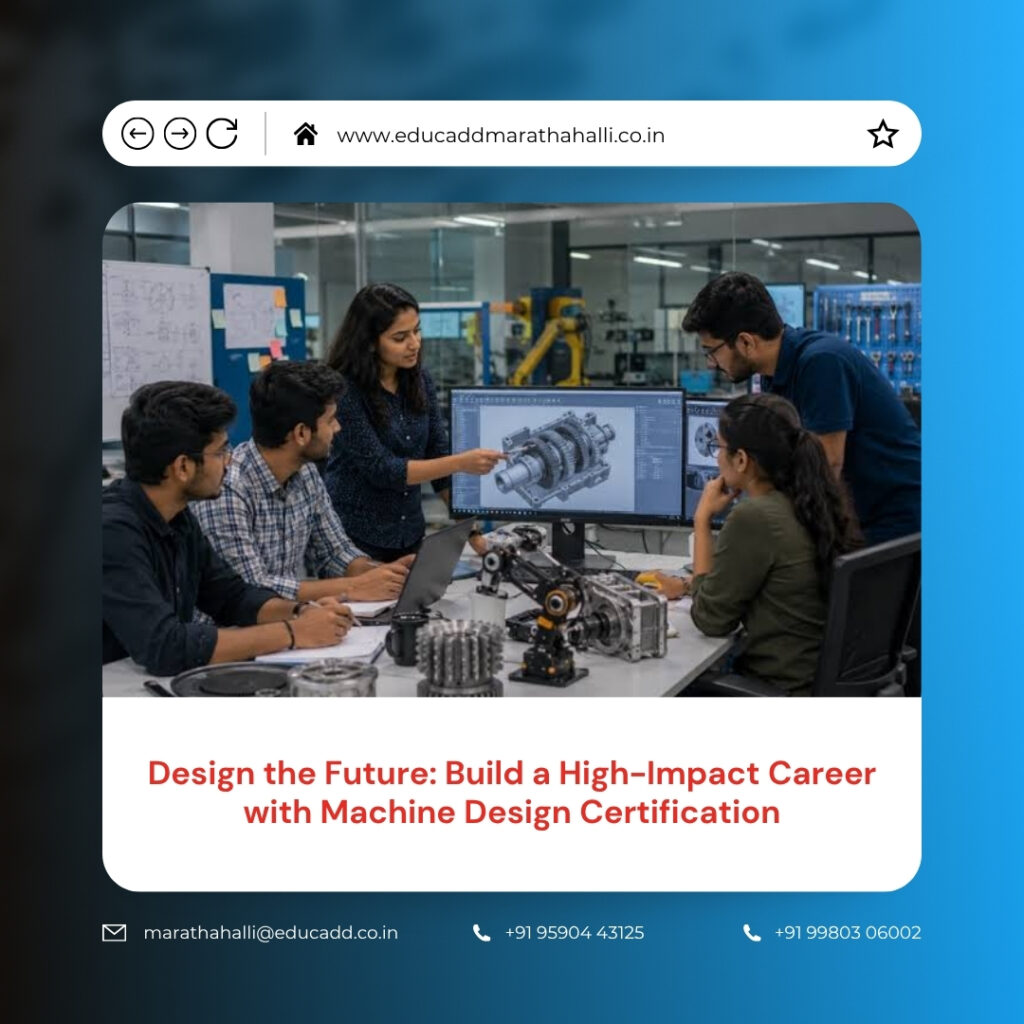
Machine Design Certification
With the right training, aspiring designers can understand machine components, create detailed models, prepare engineering drawings, and improve product performance. More importantly, certification can help candidates demonstrate their technical capabilities when entering a competitive engineering job market.
Understanding the Importance of Modern Machine Design
Machine design combines engineering principles, creativity, accuracy, and practical problem-solving. Designers must understand how different components work together before creating a complete machine. They also need to consider strength, materials, manufacturing processes, safety, cost, and maintenance. A professional Machine Design Certification introduces learners to these important concepts through structured training.
Students can gradually understand how theoretical engineering knowledge becomes an actual product design. This approach makes learning more practical and career-oriented. It also prepares learners to handle real design challenges instead of focusing only on textbook concepts.
Developing Strong Mechanical Design Fundamentals
A successful machine designer needs strong fundamentals. Knowledge of engineering drawing, mechanics, materials, manufacturing processes, tolerances, and machine elements forms the foundation of professional design work. Certification programs can help learners strengthen these areas through systematic training. They can learn about shafts, gears, bearings, couplings, fasteners, springs, and other mechanical components.
These concepts allow designers to select suitable components for different applications. Strong fundamentals also make advanced design software easier to understand. Therefore, students should focus on building engineering knowledge along with software skills during their Machine Design Certification journey.
Mastering Advanced CAD Design Techniques
Computer-Aided Design has transformed the way engineers develop mechanical products. Modern CAD platforms allow professionals to create accurate 2D drawings, detailed 3D models, assemblies, and manufacturing documentation. A quality certification program introduces learners to these tools through practical exercises. Students can learn sketching, part modelling, assembly design, surface modelling, drafting, and design modifications.
They can also understand how individual components combine to form complete mechanical systems. Regular CAD practice improves accuracy and design confidence. As a result, Machine Design Certification becomes more valuable when learners gain hands-on experience instead of simply studying software commands.
Learning to Create Production-Ready Engineering Drawings
A machine design is not complete until manufacturers can understand and produce it accurately. Engineering drawings communicate important information about dimensions, tolerances, materials, surface finishes, and manufacturing requirements. Professional training helps learners understand how to prepare clear and standardized drawings. They can also learn about section views, detail views, dimensions, symbols, and annotations.
These skills are essential because even a small drawing error can affect production quality. By practising engineering documentation, learners become better prepared for industrial design roles. A well-structured Machine Design Certification therefore connects digital modelling with actual manufacturing requirements.
Building Expertise in GD&T and Precision Engineering
Geometric Dimensioning and Tolerancing plays an important role in modern mechanical design. It helps engineers define acceptable variations in dimensions and geometry while maintaining product functionality. Understanding GD&T can improve communication between designers, manufacturers, and quality teams. Certification training can introduce learners to concepts such as form, orientation, location, profile, and runout.
Learners can also understand how tolerances influence assembly and product performance. This knowledge becomes especially useful in industries where precision is critical. Developing GD&T expertise alongside Machine Design Certification can therefore strengthen a candidate’s professional profile.
Understanding Materials and Manufacturing Processes
Good machine design must consider how a component will be manufactured. Designers need to understand materials, production methods, machining operations, casting, forging, welding, and other manufacturing techniques. These factors influence component strength, cost, durability, and production time. During professional training, learners can explore how material selection affects machine performance.
They can also understand why certain manufacturing methods suit specific designs. This practical awareness helps designers create solutions that are technically effective and commercially realistic. A strong Machine Design Certification should therefore encourage learners to connect design decisions with manufacturing possibilities.
Applying Design Calculations to Real Engineering Problems
Engineering calculations support every reliable machine design. Designers may need to calculate loads, stresses, forces, power requirements, dimensions, and safety factors before finalizing a component. Training programs help learners understand how these calculations influence design decisions. Instead of simply creating attractive 3D models, students learn to evaluate whether their designs can perform safely under expected conditions.
This analytical approach improves engineering judgment. It also helps learners identify potential failures before production begins. By combining calculations with CAD modelling, Machine Design Certification training can prepare students for practical responsibilities within engineering organizations.
Exploring Simulation and Design Validation
Modern engineering teams increasingly use simulation to evaluate designs before manufacturing physical prototypes. Simulation tools can help engineers study stress, deformation, thermal effects, motion, and other performance factors. Learners who understand design validation can make better decisions during product development. They can identify weak areas, modify components, and improve overall performance before production.
This approach can reduce development time and unnecessary manufacturing costs. Certification programs that introduce simulation concepts give learners a broader understanding of the design process. As a result, Machine Design Certification can support a transition from basic CAD modelling to advanced engineering design.
Creating a Portfolio That Demonstrates Technical Ability
A strong portfolio can make a major difference when applying for design-related positions. Employers often want to see what candidates can actually create rather than relying only on academic qualifications. Students can develop portfolio projects such as gear assemblies, mechanical mechanisms, machine components, industrial fixtures, and complete product designs. Each project can demonstrate modelling, drafting, assembly, calculations, and design decision-making skills.
A professional portfolio also gives candidates useful material for interviews. When combined with Machine Design Certification, project-based learning provides visible evidence of practical ability and technical confidence.
Preparing for Opportunities Across Engineering Industries
Machine designers can find opportunities across several sectors. Automotive, manufacturing, industrial machinery, aerospace, consumer products, automation, and engineering services all require skilled design professionals. Each industry may have different requirements, but strong fundamentals remain valuable everywhere. Candidates with CAD expertise, engineering knowledge, documentation skills, and problem-solving abilities can adapt to different work environments.
Certification can also help learners understand industry expectations before entering the workplace. Therefore, Machine Design Certification can serve as an important stepping stone for candidates who want to explore multiple mechanical engineering career paths.
Improving Career Growth Through Continuous Learning
The engineering industry continues to evolve with automation, digital manufacturing, simulation, and advanced product development methods. Designers must therefore continue learning even after completing their initial training. Professionals can expand their knowledge through advanced CAD tools, simulation software, GD&T, product lifecycle management, and emerging engineering technologies.
Continuous learning helps professionals remain competitive and adaptable. Certification provides a strong starting point, but consistent practice creates long-term expertise. Professionals who combine Machine Design Certification with ongoing skill development can position themselves for greater responsibilities and career advancement.
Choosing the Right Training Approach
Not every training program provides the same learning experience. Students should evaluate course content, practical assignments, software exposure, trainer expertise, project work, and industry relevance before selecting a program. A good course should balance theoretical concepts with hands-on design activities. Learners should also receive opportunities to create projects and solve practical engineering problems.
Structured feedback can further improve their technical skills. Choosing the right Machine Design Certification program can therefore make the learning journey more focused and productive. Candidates should look for training that develops both software proficiency and engineering thinking.
Turning Certification into a Professional Advantage
Certification alone does not guarantee career success. The real advantage comes from applying the knowledge gained during training. Learners should practise regularly, build multiple projects, understand engineering standards, and improve their problem-solving abilities. They should also develop communication and teamwork skills because professional designers frequently collaborate with engineers, manufacturers, quality teams, and project managers.
A candidate who combines certification, practical experience, and strong communication can present a more complete professional profile. In this way, Machine Design Certification becomes more than a qualification; it becomes part of a broader career development strategy.
Conclusion
Machine design offers exciting opportunities for professionals who enjoy engineering, technology, creativity, and problem-solving. From understanding mechanical components to creating detailed CAD models and production-ready drawings, the field requires a combination of technical knowledge and practical ability. A well-designed Machine Design Certification can help learners build this foundation through structured education, hands-on projects, and industry-focused skills.
However, the strongest results come when certification is supported by continuous practice and real project experience. For aspiring mechanical designers, investing in the right training today can create a stronger foundation for tomorrow’s engineering opportunities. With dedication, technical curiosity, and practical learning, a machine design career can become a rewarding path toward long-term professional growth.

