
Mastering Lighting Design: Precision Lux Calculation & Layout Using Electrical CADD
In the modern construction and design industry, lighting is no longer a mere functional element—it is a cornerstone of comfort, productivity, and aesthetics. A poorly lit space can lead to discomfort, reduced efficiency, and even safety hazards. Effective lighting design considers both the visual appeal and technical accuracy, which is where Lighting Design CADD Precision becomes essential.
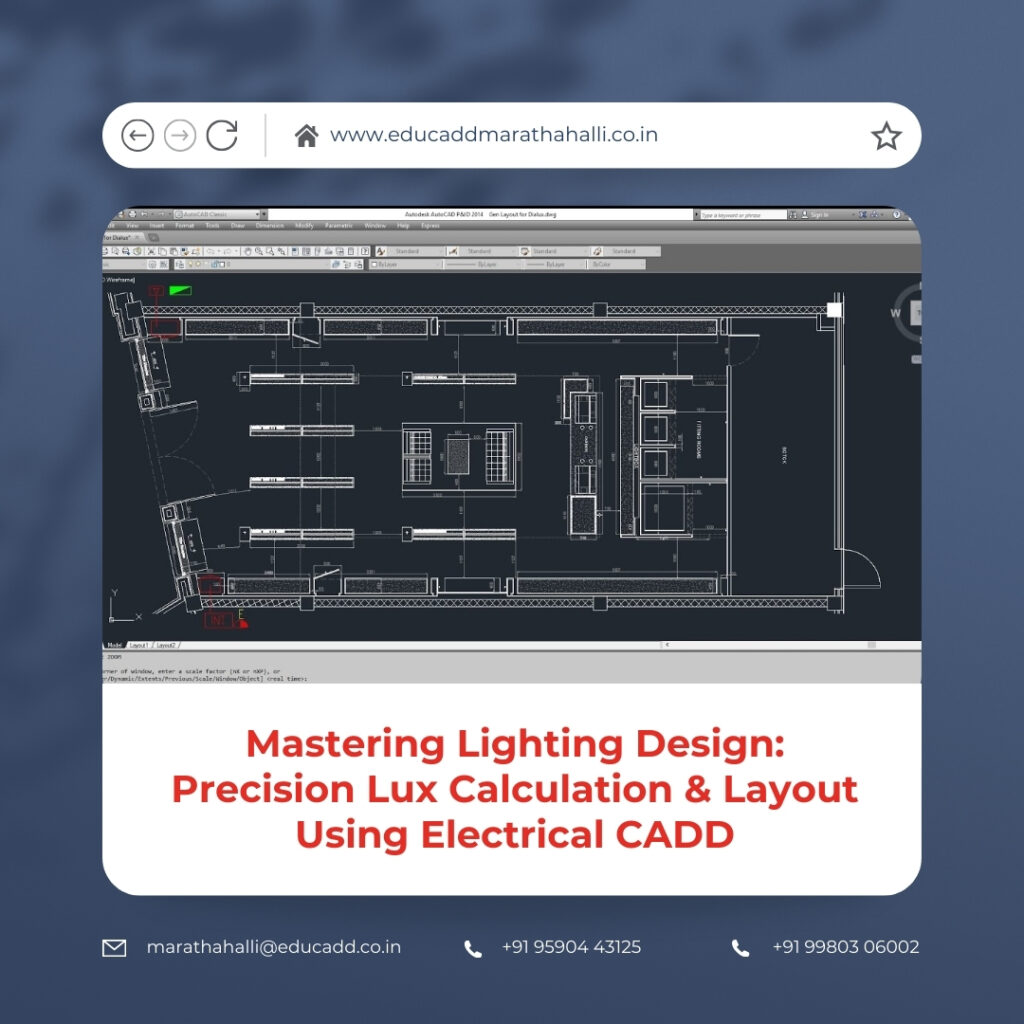
Lighting Design CADD Precision
By employing Lighting Design CADD Precision tools, designers can achieve accurate layouts, simulate light distribution, and ensure compliance with industry standards. This approach combines engineering precision with creative flexibility, resulting in spaces that are both efficient and visually appealing. In this blog, we explore every aspect of lighting layout and lux calculation, demonstrating why Electrical CADD is indispensable in modern electrical design.
1. Defining Lighting Layout in Electrical Design
Lighting layout refers to the strategic arrangement of light fixtures to provide uniform, functional illumination across a space. It takes into account room geometry, ceiling height, furniture positioning, and intended activities within the area. In Electrical CADD, layouts are created digitally using standardized symbols and layers, which ensures consistency and accuracy. This method reduces installation errors, improves coordination with other building services, and enables designers to visualize the final effect before physical implementation. A well-planned lighting layout balances aesthetic considerations with technical requirements, ensuring optimal performance.
2. Understanding Lux and Its Role in Lighting Design
Lux is the unit used to measure illuminance, indicating the amount of light received on a surface. Different environments require different lux levels; for example, a lecture hall needs lower lux compared to a laboratory or operating theatre. Calculating lux accurately ensures that spaces meet ergonomic standards and provide sufficient illumination for tasks. Using Electrical CADD, designers can simulate how light interacts with surfaces, accounting for factors such as reflectance, fixture type, and room dimensions. Proper lux calculation prevents under-lighting, which causes eye strain, and over-lighting, which wastes energy.
3. Why Electrical CADD Is Transforming Lighting Design
Traditional lighting design relied heavily on manual drawings and calculations, which were prone to errors and time-consuming. Lighting Design CADD Precision has revolutionized this process by providing tools for precise drafting, measurement, and simulation. It enables designers to test multiple scenarios quickly, make adjustments without redrawing, and maintain accurate records. The software supports integration with architectural and structural drawings, making collaboration seamless. Ultimately, Electrical CADD ensures that lighting layout and lux calculation are more accurate, efficient, and adaptable to complex project requirements.
4. Essential Elements of a Lighting Layout Drawing
A complete lighting layout drawing incorporates multiple details. It typically includes fixture symbols, mounting heights, spacing, switch locations, circuiting details, and legends. Electrical CADD allows designers to organize these components systematically. By maintaining uniform spacing and proper alignment, the layout enhances both the functional and visual aspects of a space. Accurate drawings also guide contractors during installation, reducing errors and saving time. Proper attention to these elements ensures that the lighting design is both compliant and practical.
5. Industry Standards for Lux Calculation
Compliance with lighting standards is critical for safety and efficiency. Organizations like the Illuminating Engineering Society (IES) and national standards bodies provide recommended illuminance levels for various spaces. Electrical designers must ensure that lux calculations adhere to these benchmarks to meet regulatory requirements. Electrical CADD streamlines this process by allowing designers to reference standards while drafting layouts. This ensures that lighting is neither insufficient nor excessive, enhancing user comfort and reducing energy consumption.
6. Stepwise Procedure for Lux Calculation in Electrical CADD
Lux calculation involves several steps. Designers first assess the space and determine the target illuminance based on its function. They then measure room dimensions, ceiling height, and consider surface reflectance. Next, fixture specifications such as lumen output, beam angle, and efficiency are selected. Electrical CADD enables these parameters to be input digitally, automatically calculating the resulting lux levels. If adjustments are needed, fixture placement or quantity can be modified in real time. This process ensures both accuracy and flexibility in achieving the desired lighting conditions.
7. Choosing the Right Lighting Fixtures
Selecting appropriate fixtures is crucial to achieving accurate illumination. Factors like wattage, lumen output, color temperature, and beam distribution must align with the calculated lux levels. Electrical CADD provides extensive fixture libraries and technical data, simplifying the selection process. By combining fixture choice with precise layout and lux calculation, designers ensure that lighting is functional, energy-efficient, and aesthetically pleasing. This integration allows the creation of spaces that are visually comfortable and technically optimized.
8. Energy Efficiency and Sustainable Lighting Practices
Modern electrical design emphasizes sustainability. Excessive lighting increases operational costs and carbon footprint, while insufficient lighting affects comfort and productivity. Electrical CADD supports energy-efficient design by enabling precise lux calculations and optimized fixture placement. Designers can minimize the number of fixtures while maintaining required illumination levels. Integration with LED and smart lighting systems further enhances energy efficiency. By planning lighting layouts thoughtfully, designers contribute to long-term sustainability and operational savings.
9. Coordinating Lighting Layout with Architectural and Interior Plans
Lighting must align seamlessly with architectural features, ceiling designs, and interior layouts. Electrical CADD allows designers to overlay lighting plans onto architectural drawings, ensuring proper alignment with walls, furniture, and structural elements. This prevents clashes during installation and enhances aesthetic consistency. Such coordination makes lighting layout and lux calculation not just a technical exercise but a collaborative process that harmonizes electrical design with overall building planning.
10. Avoiding Common Lighting Design Errors
Errors in lighting design, such as uneven illumination, incorrect fixture spacing, or non-compliance with standards, are common when relying on manual methods. Electrical CADD minimizes these risks through accurate drafting, automated calculations, and real-time simulations. Designers can visualize lighting distribution, verify lux levels, and adjust layouts before implementation. This reduces costly mistakes, improves client satisfaction, and ensures that the project meets both functional and aesthetic requirements.
11. Adapting Lighting Layouts for Various Building Types
Different building types have unique lighting needs. Offices require uniform, glare-free lighting for productivity, hospitals demand precise illumination for safety, and industrial spaces require high lux levels for accuracy in operations. Electrical CADD enables designers to customize layouts and lux calculations to meet the specific requirements of each building type. By simulating multiple scenarios and adjusting parameters, designers ensure optimal lighting performance across diverse applications.
12. Importance of Proper Documentation and Presentation
Clear, professional documentation is critical for successful project execution. Electrical CADD facilitates organized drawings with legends, notes, schedules, and specifications. This clarity ensures that contractors can interpret the design accurately, reducing errors and delays. Well-documented lighting layouts and lux calculations also serve as valuable references for maintenance and future modifications. Proper documentation enhances project efficiency, accountability, and client trust.
13. Career Advantages of Mastering Electrical CADD for Lighting Design
In the era of smart, energy-efficient buildings, professionals skilled in Electrical CADD have a competitive advantage. Mastery of lighting layout and lux calculation equips electrical engineers and designers to handle complex projects confidently. These skills are highly sought after in design consultancies, construction firms, and infrastructure projects. Learning Electrical CADD not only increases employability but also empowers professionals to contribute meaningfully to innovative and sustainable building solutions.
14. Emerging Trends in Lighting Design and Electrical CADD
The future of lighting design is increasingly integrated with technology. Smart lighting, automation, IoT-enabled controls, and adaptive systems are shaping modern projects. Electrical CADD evolves to accommodate these advancements, enabling designers to incorporate sensors, dimmers, and programmable controls into their layouts. With these tools, lighting layout and lux calculation become a dynamic process, allowing buildings to adapt to changing needs while conserving energy. Staying updated with these trends ensures designers remain relevant and capable of delivering cutting-edge solutions.
Conclusion
Lighting is a critical factor that affects how people perceive and function within a space. Accuracy, compliance, and energy efficiency are essential for delivering effective lighting solutions. Lighting Design CADD Precision equips designers with the tools and methodology to achieve these objectives efficiently. By integrating engineering precision with creative planning, designers can create spaces that are functional, aesthetically pleasing, and sustainable. As the construction industry embraces smarter, greener buildings, mastering Electrical CADD for lighting design is no longer optional—it is essential for professional growth and successful project execution.

