
From IT Graduate to Data Science Expert: A Complete Roadmap to Building a Future-Ready Career
The modern business landscape runs on data. Every click, transaction, customer interaction, and digital activity generates valuable information that organizations use to improve performance, understand consumer behavior, and make strategic decisions. As industries continue embracing digital transformation, the need for professionals who can extract meaningful insights from data has increased significantly. This growing demand has placed data science among the most promising and rewarding career fields in the technology sector. For IT Graduate Data Science, data science presents an exceptional opportunity to expand their technical expertise and enter a rapidly growing industry.
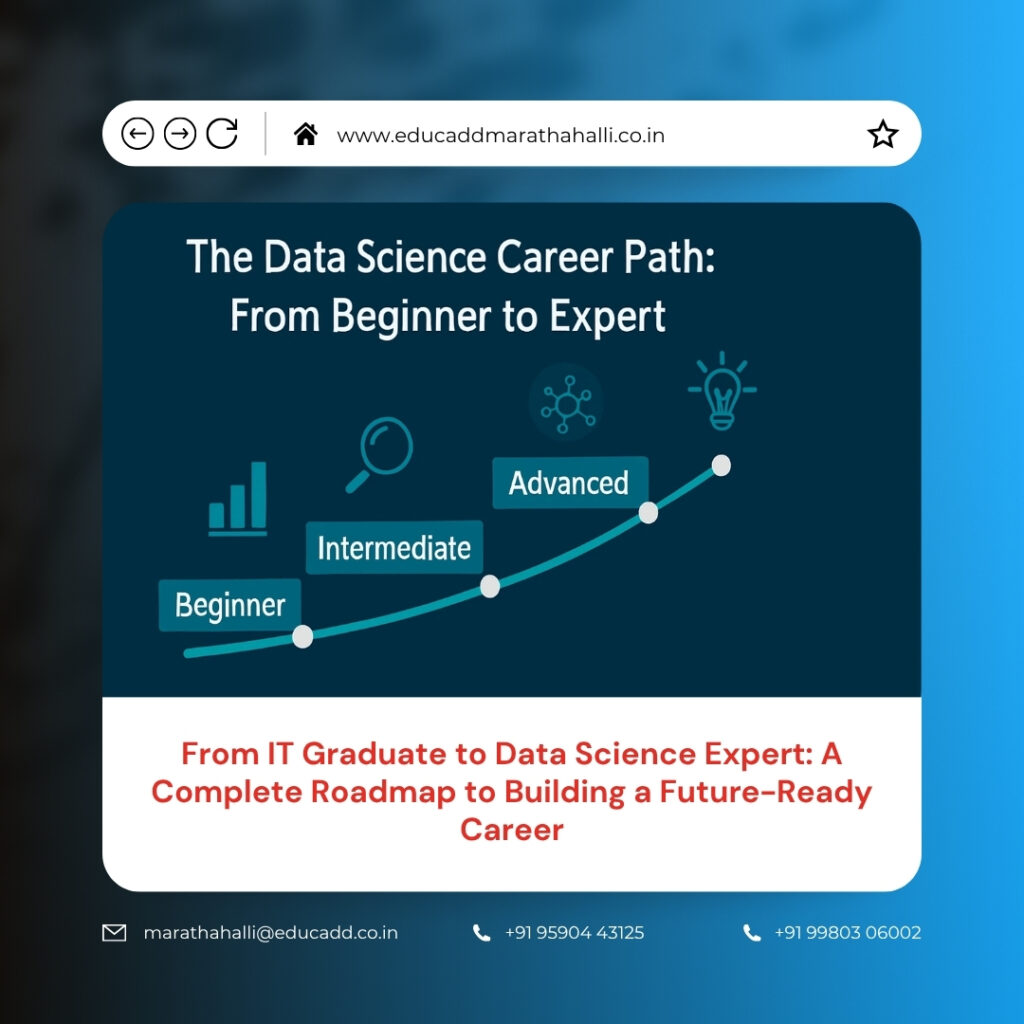
IT Graduate Data Science
Since most IT professionals already possess knowledge of programming, databases, and software systems, they have a strong foundation for transitioning into data science roles. However, success in this field requires a structured learning approach, practical experience, and a commitment to continuous development. Understanding the career path in data science can help IT graduates create a clear roadmap that leads to long-term professional growth, high-paying opportunities, and meaningful contributions to organizations worldwide.
Why Data Science Has Become a Preferred Career Choice
Data science has emerged as one of the most attractive career options because organizations across every sector depend heavily on data-driven strategies. Companies no longer rely solely on intuition when making business decisions. Instead, they use data analysis to identify trends, forecast outcomes, improve customer experiences, and optimize operations. This shift has created an unprecedented demand for skilled professionals who can interpret complex datasets and transform information into actionable insights.
For IT Graduate Data Science, the appeal of data science extends beyond job availability. The field offers challenging projects, diverse career opportunities, global demand, and excellent earning potential. Furthermore, professionals often work with cutting-edge technologies such as artificial intelligence, machine learning, and predictive analytics. As businesses continue investing in innovation, data science remains a future-proof career path that offers both stability and professional excitement.
Understanding the Core Responsibilities of a Data Scientist
Before pursuing a career in data science, IT Graduate Data Science should understand what the role involves. Data scientists work with large volumes of structured and unstructured data to identify patterns, solve business problems, and support strategic planning. Their responsibilities often include collecting data, cleaning datasets, performing statistical analysis, building predictive models, and communicating insights to stakeholders.
Unlike traditional software development roles, data science focuses more on analysis and decision support. Professionals spend significant time exploring data and uncovering meaningful relationships that influence business outcomes. Therefore, individuals who enjoy analytical thinking, problem-solving, and continuous learning often thrive in this profession. The role also requires collaboration with multiple departments, making it both technically challenging and highly impactful within organizations.
Leveraging Existing IT Skills for a Smooth Transition
One of the biggest advantages IT graduates possess is their technical background. Skills developed during academic studies and professional experience often align closely with the requirements of data science. Knowledge of programming, databases, software architecture, and logical problem-solving creates a strong starting point for entering the field.
Additionally, familiarity with coding practices enables IT professionals to learn data science tools more efficiently. Concepts such as algorithms, data structures, and system design provide valuable support when working with complex datasets and machine learning models. Instead of starting from scratch, IT graduates can build upon their existing expertise and gradually acquire specialized data science skills. This advantage often accelerates their learning journey and increases their competitiveness in the job market.
Strengthening Programming Skills for Data Science Success
Programming remains one of the most essential skills in any data science career. Although IT Graduate Data Science typically have coding experience, they should focus on languages that dominate the data science ecosystem. Python has become the preferred choice due to its simplicity, versatility, and extensive collection of libraries designed specifically for data analysis, machine learning, and visualization.
Beyond learning syntax, professionals should understand how to write efficient, scalable, and maintainable code. Strong programming skills enable data scientists to process large datasets, automate repetitive tasks, and develop sophisticated analytical solutions. Consistent coding practice through real-world projects helps strengthen technical abilities and enhances confidence when tackling complex challenges. As a result, programming proficiency becomes a major factor in long-term career growth.
Building a Strong Foundation in Statistics and Mathematics
Data science relies heavily on statistical reasoning and mathematical principles. Without a solid understanding of these subjects, professionals may struggle to interpret analytical results accurately or develop reliable predictive models. Therefore, IT graduates should invest time in learning core concepts such as probability, statistical inference, linear algebra, and calculus.
Statistics helps professionals understand data distributions, identify trends, measure relationships, and evaluate business outcomes. Mathematics, on the other hand, supports machine learning algorithms and optimization processes. Although these subjects may appear challenging initially, practical applications make them easier to understand and implement. By combining theoretical learning with hands-on exercises, aspiring data scientists can develop analytical capabilities that serve as the foundation for advanced concepts.
Learning Data Analysis Techniques for Business Impact
Data analysis forms the heart of every data science project. Organizations depend on accurate analysis to understand performance, identify opportunities, and address challenges. Therefore, IT graduates must develop the ability to collect, organize, clean, and interpret data effectively.
Successful data analysis involves more than working with numbers. Professionals must identify patterns, recognize anomalies, and derive meaningful conclusions that align with business objectives. Furthermore, analytical thinking helps data scientists ask the right questions before searching for answers. By mastering data analysis techniques, professionals can generate valuable insights that directly contribute to organizational growth and competitive advantage.
The Importance of Data Visualization Skills
Even the most sophisticated analysis loses value if stakeholders cannot understand the findings. This is where data visualization becomes essential. Visual representations help transform complex datasets into clear and engaging formats that support informed decision-making.
Some major benefits of strong data visualization skills include:
- Simplifying complex information for non-technical audiences.
- Improving communication between analysts and business leaders.
Professionals who can present insights through dashboards, charts, and interactive reports often gain greater influence within organizations. Effective visual storytelling allows stakeholders to grasp key findings quickly and make informed decisions with confidence. Consequently, data visualization has become an indispensable skill in the data science profession.
Understanding Databases and Data Management Systems
Since data serves as the primary resource in data science, professionals must understand how information is stored, managed, and accessed. Database knowledge allows data scientists to retrieve accurate information efficiently while maintaining data integrity and consistency.
Structured Query Language (SQL) remains one of the most important tools for managing and analyzing data. IT graduates should become comfortable writing queries, joining tables, filtering records, and optimizing database performance. In addition, familiarity with cloud databases, data warehouses, and big data platforms enhances career opportunities. Organizations increasingly rely on large-scale data infrastructures, making database expertise a valuable asset for aspiring data science professionals.
Exploring Machine Learning and Predictive Analytics
Machine learning has transformed the way organizations utilize data. Rather than relying solely on historical analysis, businesses now use predictive models to forecast future outcomes and automate decision-making processes. This capability has made machine learning one of the most exciting areas within data science.
IT graduates entering the field should begin by understanding foundational concepts such as supervised learning, unsupervised learning, regression, classification, and clustering. Practical implementation through projects helps reinforce theoretical knowledge and develops problem-solving skills. Over time, professionals can explore advanced topics such as deep learning, neural networks, and natural language processing. Mastering machine learning significantly expands career opportunities and positions individuals for specialized roles in emerging technologies.
Creating Practical Projects to Demonstrate Expertise
Employers increasingly value practical experience when evaluating candidates for data science positions. Therefore, building real-world projects is one of the most effective ways to demonstrate technical competence and industry readiness. Projects allow aspiring professionals to apply their knowledge while solving meaningful business problems.
Examples of valuable data science projects include customer segmentation, sales forecasting, recommendation systems, fraud detection, and sentiment analysis. These projects showcase an individual’s ability to work with data throughout the entire analytical process. Furthermore, a strong project portfolio helps candidates stand out during recruitment and interview processes. Practical experience often serves as the bridge between academic learning and professional success.
Entry-Level Opportunities in the Data Science Industry
The journey into data science typically begins with entry-level roles that provide exposure to real-world business environments. These positions help professionals develop practical skills while gaining a deeper understanding of industry expectations and workflows.
Popular entry-level opportunities include:
- Data Analyst
- Junior Data Scientist
- Business Intelligence Analyst
- Analytics Associate
- Data Engineering Trainee
These roles offer valuable experience in handling datasets, generating reports, and supporting decision-making processes. As professionals gain confidence and expertise, they can transition into more advanced and specialized positions within the data science ecosystem.
Advancing into Specialized and Leadership Roles
As professionals gain experience, new opportunities emerge within various specialized domains of data science. Some individuals focus on machine learning engineering, while others pursue careers in artificial intelligence, business analytics, data engineering, or research-oriented positions. Specialization allows professionals to align their careers with personal interests and industry demands.
In addition to technical growth, leadership opportunities become available over time. Experienced professionals often move into roles such as senior data scientist, analytics manager, machine learning architect, or head of data science. These positions involve strategic decision-making, team leadership, and organizational planning. Consequently, data science offers multiple pathways for both technical excellence and managerial advancement.
The Role of Continuous Learning and Professional Development
The technology landscape evolves rapidly, and data science is no exception. New tools, frameworks, algorithms, and methodologies emerge regularly, making continuous learning essential for career sustainability. Professionals who remain updated with industry trends are better equipped to adapt to changing market demands.
Certifications, workshops, online courses, industry conferences, and hands-on training programs contribute significantly to professional development. Continuous learning not only enhances technical expertise but also demonstrates commitment to growth and innovation. Employers value individuals who proactively improve their skills and stay ahead of industry developments. Therefore, lifelong learning remains a critical component of success in the data science profession.
Future Outlook and Opportunities for IT Graduates
The future of data science appears exceptionally bright as organizations continue embracing digital transformation, automation, and artificial intelligence. Businesses increasingly depend on data-driven insights to improve efficiency, enhance customer experiences, and maintain competitive advantages. This growing reliance ensures a steady demand for skilled professionals capable of extracting value from complex datasets.
For IT graduates, the opportunities extend far beyond traditional technology companies. Industries such as healthcare, banking, manufacturing, education, retail, logistics, and telecommunications actively recruit data science talent. Emerging fields including generative AI, intelligent automation, and advanced analytics are creating entirely new career possibilities. As technology continues reshaping the global economy, data science professionals will remain at the center of innovation, making this career path one of the most promising choices for ambitious IT graduates.
Conclusion
A career in IT Graduate Data Science the perfect combination of technical innovation, analytical problem-solving, and professional growth. With a strong foundation in programming, databases, and technology, IT professionals already possess many of the skills required to succeed in this dynamic field. By developing expertise in statistics, data analysis, machine learning, visualization, and data management, graduates can confidently transition into rewarding data science roles. Furthermore, practical projects, continuous learning, and specialization opportunities ensure long-term career advancement. As organizations increasingly rely on data to drive strategic decisions, the demand for skilled data science professionals will continue to rise, making it one of the most future-ready and lucrative career paths available today.

