
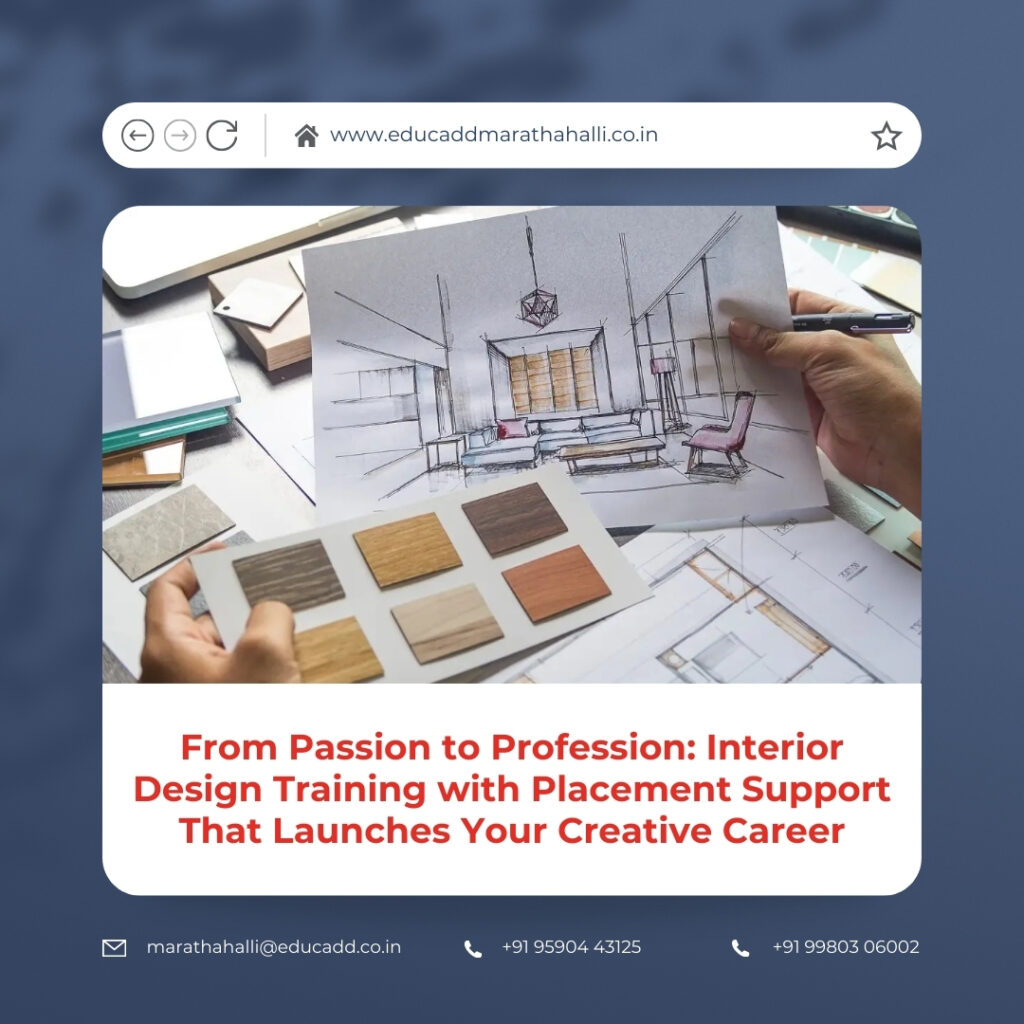
From Passion to Profession: Interior Design Training with Placement Support That Launches Your Creative Career
Interior design has transformed from a decorative art into a high-demand professional discipline that shapes how people live, work, and experience spaces. Modern interiors influence productivity, comfort, branding, and lifestyle. As urban development accelerates and consumer expectations rise, the need for skilled designers continues to expand. However, talent alone does not guarantee success. Structured learning, practical exposure, and guided career entry play a crucial role in building a sustainable profession. This is where Interior Design Placement Training becomes a strategic advantage. Such programs not only teach design fundamentals but also prepare students for real-world challenges and job opportunities.
Interior Design Placement Training
They combine creativity with technical precision and connect learning with industry needs. In this comprehensive guide, you will explore how specialized training shapes your expertise, how placement assistance simplifies career entry, and why choosing the right course can define your professional journey.
1. The Expanding Landscape of Interior Design
Interior design today covers far more than arranging furniture or selecting colors. It includes residential interiors, corporate offices, hospitality projects, retail environments, healthcare facilities, and institutional spaces. Each category demands a unique approach, technical understanding, and user-focused design strategy.
Through Interior Design Placement Training, students gain clarity about these diverse segments. They learn how spatial planning differs between homes and commercial offices. They also understand how branding elements influence retail design or how comfort and compliance matter in healthcare environments.
Additionally, urbanization has created smaller living spaces that require intelligent planning. Designers now solve space constraints while maintaining aesthetics. Sustainable materials, energy-efficient lighting, and ergonomic layouts have become standard expectations. Therefore, formal training introduces students to current trends and practical solutions early in their learning journey.
As demand continues to rise, professionals with structured training and career guidance find better growth opportunities. This evolving industry rewards those who combine creativity with technical mastery.
2. Why Structured Training Outperforms Informal Learning
Many aspiring designers attempt to learn through online tutorials and self-guided practice. While digital resources provide basic exposure, they rarely offer systematic progression or expert mentorship. Without feedback, learners often repeat mistakes or miss essential fundamentals.
In contrast, Interior Design Placement Training follows a carefully planned curriculum. Students begin with design principles and gradually move toward advanced software applications and project execution techniques. This organized structure ensures balanced growth.
Furthermore, professional trainers provide real-time corrections and personalized advice. They guide students on improving sketches, refining layouts, and enhancing presentations. Such mentorship accelerates skill development significantly.
Another advantage lies in accountability. Regular assignments, deadlines, and assessments encourage discipline. Group discussions and collaborative projects enhance problem-solving skills. Consequently, structured training prepares students not only technically but also professionally.
3. Core Design Principles That Form the Foundation
A strong base in design principles distinguishes professionals from amateurs. Balance, proportion, harmony, rhythm, contrast, and unity influence every successful interior project. Understanding these principles helps designers create cohesive and functional environments.
Within Interior Design Training with Placement Support, students explore these concepts in depth. They learn how to apply symmetry in formal spaces and asymmetry in contemporary layouts. They experiment with textures, patterns, and focal points to enhance visual interest.
Color theory also plays a critical role. Training programs teach how colors affect mood, perception, and spatial experience. For instance, lighter shades can create openness, while bold accents introduce energy.
By mastering foundational concepts, students gain confidence in handling complex projects. This clarity forms the backbone of long-term professional success.
4. Space Planning and Functional Efficiency
Effective interior design begins with thoughtful space planning. Every square foot must serve a purpose while maintaining comfort and flow. Poor planning leads to cluttered layouts and inefficient movement patterns.
Through Interior Design Training with Placement Support, learners understand zoning, circulation paths, and ergonomic standards. They practice drafting scaled floor plans and experimenting with furniture arrangements.
Moreover, they study human behavior and lifestyle needs. A family home requires flexibility, while a corporate office demands structured organization. Training teaches how to adapt layouts according to user requirements.
Hands-on exercises strengthen practical understanding. Students design mock residential and commercial projects, ensuring each space balances aesthetics with functionality. As a result, they graduate with confidence in managing real-life planning challenges.
5. Technical Drafting and Software Proficiency
Modern interior design heavily relies on technology. Clients expect precise drawings and realistic 3D visualizations before approving projects. Therefore, software expertise has become essential.
Most Interior Design Training with Placement Support programs include instruction in AutoCAD for drafting, SketchUp for modeling, and rendering tools for photorealistic outputs. Students also explore Photoshop for enhancing presentations.
Practical labs allow learners to convert hand sketches into digital formats. They practice generating floor plans, elevations, and detailed layouts. Step by step, they master the technical side of design.
Consistent software training improves efficiency and accuracy. Employers prefer candidates who can handle projects independently from concept to visualization. Therefore, strong digital skills significantly increase employability.
6. Material Knowledge and Sustainable Practices
Interior designers must understand materials thoroughly. Flooring, wall finishes, ceiling systems, and furniture materials impact durability and aesthetics. Incorrect material selection can compromise quality and safety.
In Interior Design Training with Placement Support, students explore wood types, laminates, stones, glass, metals, fabrics, and eco-friendly alternatives. They learn how environmental conditions influence material performance.
Sustainability has become a major industry focus. Designers now prioritize low-VOC paints, recycled materials, and energy-efficient lighting systems. Training introduces these concepts systematically.
Site visits and sample analysis deepen understanding. Students observe installation methods and finishing techniques firsthand. This practical exposure builds confidence in material selection and specification.
7. Lighting Design and Ambience Creation
Lighting transforms spaces dramatically. It highlights design elements, enhances mood, and improves functionality. Poor lighting can diminish even the most well-planned interiors.
Through Interior Design Training with Placement Support, learners study natural lighting, artificial lighting, and layered illumination techniques. They understand how ambient, task, and accent lighting work together.
Practical exercises involve designing lighting layouts for various environments. Students explore fixture types, wattage considerations, and energy efficiency standards.
By integrating lighting knowledge into overall planning, designers create balanced and inviting spaces. This expertise adds depth to their professional capabilities.
8. Live Projects and Real-World Exposure
Classroom knowledge gains true value when applied practically. Leading institutes incorporate live assignments within Interior Design Training with Placement Support to simulate real scenarios.
Students often work on residential layouts, office interiors, or retail concepts. They prepare mood boards, cost estimates, and 3D walkthroughs. Trainers provide continuous feedback at each stage.
Site visits further strengthen learning. Observing ongoing projects reveals construction processes and coordination challenges. Internships also expose students to client meetings and vendor interactions.
Such hands-on experience reduces the gap between academic learning and industry practice. Graduates enter the workforce with practical confidence and readiness.
9. Communication and Professional Development
Technical knowledge alone does not guarantee success. Designers interact with clients, contractors, and suppliers regularly. Clear communication ensures project clarity and smooth execution.
Comprehensive Interior Design Training with Placement Support includes personality development sessions. Students practice presentations, negotiation techniques, and client interaction scenarios.
They also learn how to interpret client briefs accurately. Strong listening skills prevent misunderstandings and costly revisions.
Time management and teamwork training further enhance professional growth. These soft skills contribute significantly to long-term career stability.
10. Portfolio Development and Career Preparation
A compelling portfolio showcases your abilities effectively. Recruiters evaluate portfolios before conducting interviews. Therefore, presentation quality matters immensely.
Within Interior Design Training with Placement Support, mentors guide students in organizing academic and live projects into professional portfolios. They emphasize storytelling, visual clarity, and logical sequencing.
Mock interviews and resume workshops strengthen career readiness. Placement teams connect students with design studios and construction firms.
This structured preparation increases employment opportunities. Graduates step into interviews with confidence and preparedness.
11. Diverse Career Opportunities
Interior design offers multiple career paths. After completing Interior Design Training with Placement Support, graduates may work as residential designers, commercial planners, 3D visualizers, or lighting consultants.
Opportunities also exist in architectural firms, real estate companies, and hospitality sectors. Some professionals pursue freelance assignments, while others establish independent studios.
With experience, designers may specialize in luxury interiors, sustainable design, or modular furniture solutions. Each specialization opens new growth avenues.
Thus, structured training expands both skillsets and career possibilities.
12. Salary Growth and Professional Advancement
Compensation in interior design varies based on expertise and location. Fresh graduates who complete Interior Design Training with Placement Support typically secure competitive entry-level roles.
As designers gain project experience, their earning potential increases. Managing independent clients or large-scale projects further enhances income.
Entrepreneurial designers often achieve higher financial rewards after building strong reputations. Continuous learning and certification upgrades accelerate advancement.
Therefore, investing in comprehensive training pays long-term dividends.
13. Entrepreneurial Pathways and Studio Establishment
Many interior designers aspire to run their own firms. Business knowledge becomes crucial for this transition.
Through Interior Design Training with Placement Support, students learn budgeting, vendor management, marketing basics, and branding strategies. These skills prepare them for independent practice.
Initial industry experience builds confidence and client networks. Gradually, designers can establish personal studios with clarity and competence.
Entrepreneurship in interior design offers creative freedom and scalability. Proper preparation increases success probability significantly.
14. Choosing the Right Training Program
Selecting an institute requires careful evaluation. Review curriculum depth, faculty expertise, infrastructure, and placement history.
A reliable Interior Design Training with Placement Support program emphasizes practical exposure and industry collaboration. Alumni success stories often reflect program credibility.
Visiting campuses, attending demo sessions, and interacting with current students provide valuable insights. Transparent communication and structured career guidance indicate professionalism.
An informed decision lays the groundwork for a fulfilling career journey.
Conclusion
Interior design combines creativity, technical precision, and human understanding. While passion ignites interest, structured education transforms talent into expertise. Interior Design Placement Training bridges the crucial gap between learning and employment. It equips students with foundational knowledge, practical experience, digital proficiency, communication skills, and direct career assistance.
As the industry continues to expand, trained professionals with guided placement support enjoy a competitive advantage. Whether you aspire to join leading design firms or establish your own studio, comprehensive training creates a solid foundation. By choosing the right program and committing to continuous improvement, you turn creative ambition into a successful and sustainable profession.

