
“Wired for Success: Design Smarter Industrial Electrical Layouts with EduCADD”
In every industrial setup, power is the invisible force driving progress. From assembly lines to control rooms, every component depends on a well-planned electrical system. This intricate framework is what keeps operations efficient, safe, and uninterrupted. At the heart of this system lies the Industrial Electrical Layout Design — the master plan that defines how electricity is distributed and managed across a facility.
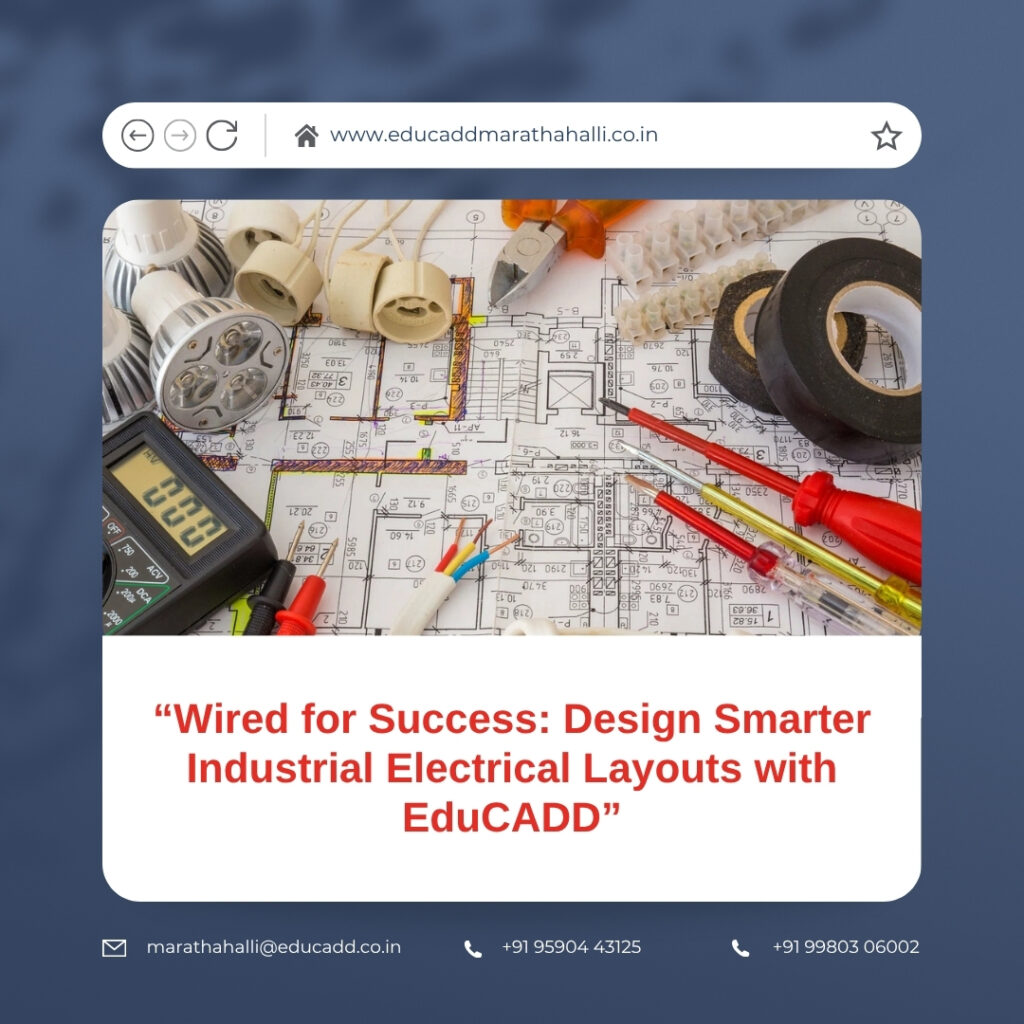
Industrial Electrical Layout Design
Designing these layouts requires more than technical skill; it demands accuracy, foresight, and a deep understanding of industrial processes. This is where EduCADD steps in — offering cutting-edge training that blends theory with practical application. Through structured modules, simulation tools, and expert guidance, EduCADD equips learners with the power to design, analyze, and implement electrical systems that meet real-world industrial demands.
Whether you’re a budding engineer or a professional looking to upskill, learning Industrial Electrical Layout Design at EduCADD opens the path to a career built on precision, innovation, and expertise.
1. Decoding Industrial Electrical Layouts
An Industrial Electrical Layout acts as the backbone of any production unit. It visually represents how energy flows through circuits, machines, and distribution panels, ensuring that every electrical connection performs safely and efficiently.
Unlike domestic or small commercial systems, industrial layouts are far more intricate. They must manage higher voltage levels, multiple load centers, automation equipment, and emergency backup systems. Each line and symbol on a layout tells a story — from how energy enters a plant to how it powers every workstation and sensor.
Errors in design can result in overloads, unplanned shutdowns, or even hazards. Hence, industries rely on professionals who can craft layouts that are precise, compliant with safety norms, and easy to maintain. EduCADD’s course is tailored to build that level of competence. Students start by understanding electrical fundamentals and gradually move on to advanced layout planning, system schematics, and CAD-based electrical design.
By combining classroom theory with project-based assignments, EduCADD helps learners grasp not just how to design but why each element matters. The result is a strong foundation in power distribution, load calculation, and electrical safety — essentials for anyone aspiring to enter the industrial design space.
2. The Importance of Electrical Layouts in Modern Industry
Industrial environments are energy-intensive. Every motor, lighting grid, and control panel depends on a dependable electrical framework. Without a properly planned layout, even the most advanced machinery can face inefficiencies or safety risks.
A well-prepared layout ensures:
-
Safety: Electrical circuits are protected from overloads and short circuits.
-
Operational Continuity: Energy flows evenly across all connected systems.
-
Flexibility: Future expansions or machine additions become simpler.
-
Cost Efficiency: Correct load planning reduces waste and maintenance costs.
Industries like oil refineries, automotive plants, and manufacturing units rely heavily on electrical design for continuous operation. A minor design flaw in cabling or panel arrangement can lead to massive production downtime.
EduCADD recognizes these challenges and trains students to design with precision and foresight. Learners are taught to follow international safety standards such as IEC, BIS, and NEC codes, ensuring that their designs meet global benchmarks. Additionally, modules include sustainability-focused topics like energy conservation, automation, and integration of renewable sources — preparing learners for the evolving needs of the industry.
By mastering these principles, students gain the confidence to take on real-world projects where reliability and accuracy are paramount.
3. EduCADD’s Approach to Training Industry-Ready Designers
EduCADD has built its reputation by combining academic excellence with real-world application. Its Industrial Electrical Layout Design program is structured to transform theoretical knowledge into professional-level competence.
Here’s how EduCADD builds skilled electrical designers:
-
Industry-Focused Curriculum: The course covers electrical basics, circuit analysis, fault calculations, and blueprint drafting.
-
Software Training: Students gain hands-on experience with tools like AutoCAD Electrical, Revit MEP, and ETAP for simulation and design.
-
Practical Exposure: Every learner works on case studies and real-time projects to apply what they learn.
-
Guidance from Experts: Experienced instructors share insights from active industrial projects.
-
Placement and Mentorship: EduCADD supports career development through placement assistance and portfolio building.
What makes EduCADD stand out is its emphasis on experiential learning. Instead of relying solely on theory, students practice live design challenges that replicate industry conditions. They learn to read technical drawings, interpret single-line diagrams, and develop power distribution layouts from scratch.
EduCADD’s teaching philosophy focuses on empowering learners to think like engineers. They are trained not just to follow instructions but to design intelligently — considering cost, safety, and performance together. With flexible schedules and both online and offline learning options, EduCADD ensures accessibility for students and professionals alike.
4. The Step-by-Step Process of Electrical Layout Design
Designing an industrial electrical layout is a detailed and methodical process that combines analysis, planning, and execution. Each stage builds upon the last, ensuring that the final design performs reliably once implemented on-site.
Here’s a closer look at the key stages:
-
Initial Assessment: Identify the power requirements of the facility and analyze the type of machinery or systems involved.
-
Conceptual Design: Outline the energy flow, determining transformer positions, switchgear locations, and load centers.
-
Load Calculations: Accurately calculate current flow, voltage drops, and cable sizes to maintain efficiency.
-
Cable Routing and Distribution: Plan paths that minimize interference and energy loss, using optimal conduit layouts.
-
Control and Protection Design: Integrate control panels, circuit breakers, and relays to ensure safety and automation.
-
Testing and Validation: Review the layout for compliance with engineering standards and safety codes before implementation.
At EduCADD, students go through this complete process step by step using real design projects. They start with concept sketches, then move to CAD drawings and finally to electrical simulations. This progression ensures a strong grasp of both design principles and technical execution.
Moreover, EduCADD’s instructors teach how to integrate smart systems and energy-efficient solutions into designs — such as using sensors, automation, and renewable sources. As industries move toward digital and sustainable operations, these skills make EduCADD graduates stand out in the job market.
5. Career Pathways After Mastering Industrial Electrical Layouts
Electrical layout design is a skill that opens doors to multiple career opportunities across engineering and industrial domains. Skilled professionals who can design efficient layouts are highly valued in power generation, manufacturing, infrastructure, and automation sectors.
After completing the course at EduCADD, learners can pursue roles such as:
-
Electrical Design Engineer – Responsible for planning and designing plant electrical systems.
-
AutoCAD Electrical Designer – Specializes in creating technical electrical drawings.
-
Project Engineer (Industrial) – Oversees design implementation on industrial sites.
-
Maintenance Planning Engineer – Manages operational efficiency and maintenance planning.
-
Energy Consultant – Focuses on optimizing power usage and improving sustainability.
What makes this career path even more appealing is its global relevance. The principles of electrical design are universal, allowing professionals trained at EduCADD to work on projects both in India and abroad.
Additionally, EduCADD provides strong placement support, connecting graduates with reputed engineering firms, manufacturing units, and infrastructure companies. The institute’s certifications are well-recognized and reflect practical proficiency, not just academic achievement.
With industries embracing automation, digital systems, and green energy, professionals skilled in Industrial Electrical Layouts are positioned at the heart of industrial innovation.
Conclusion
Every great industrial project begins with a single spark — the spark of intelligent design. A well-crafted Industrial Electrical Layout Design is what keeps factories running efficiently, safely, and sustainably. It transforms complex power systems into organized, reliable networks that drive productivity every day.
EduCADD empowers aspiring engineers and professionals to master this essential skill. Through its dynamic training programs, hands-on workshops, and expert mentorship, it helps learners turn theoretical knowledge into real-world capability. Whether your goal is to launch a career, upgrade your current skill set, or move into industrial design, EduCADD provides the right tools and guidance to get you there.
Now is the time to power your ambitions. Join EduCADD, learn the art of designing intelligent electrical systems, and become the professional who keeps industries wired for success.

