
The Complete 2025 Tech Blueprint: Essential Full Stack Development Skills for Future-Ready IT Professionals
The technology landscape in 2025 demands professionals who can move seamlessly across multiple layers of application development. Organizations no longer seek specialists who only understand front-end design or server-side scripting in isolation. Instead, they value individuals who can design interfaces, build scalable architectures, manage databases, deploy applications in the cloud, and ensure security from start to finish. This shift has placed Full Stack Development Skills at the center of modern IT careers.
Today’s enterprises operate in an ecosystem driven by digital transformation, automation, artificial intelligence, and cloud infrastructure. Applications must load quickly, scale instantly, and remain secure under constant cyber threats. At the same time, users expect smooth, intuitive experiences across web and mobile platforms. Because of these demands, mastering full stack development skills has become essential for IT professionals who aim to stay competitive and future-ready.
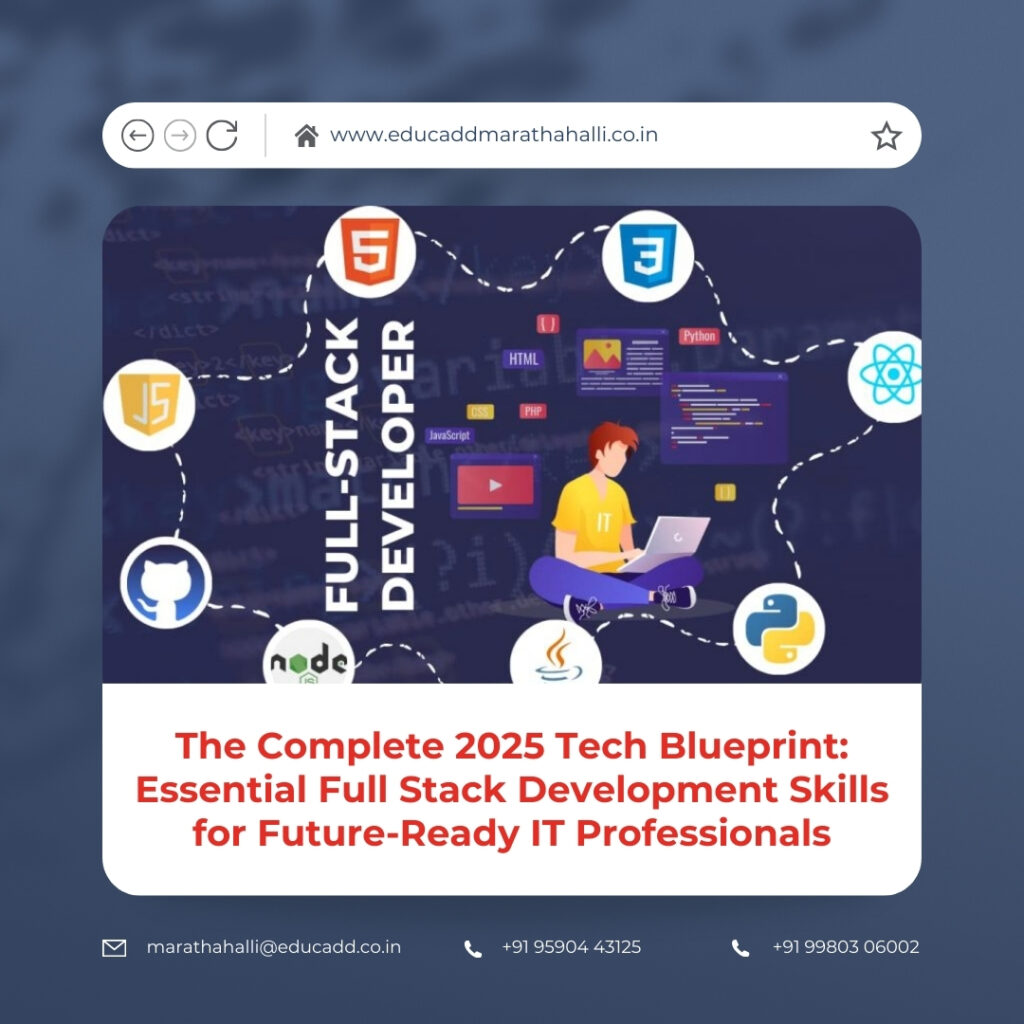
Full Stack Development Skills
This in-depth guide explores the most critical competencies required to thrive in 2025. Each section highlights practical capabilities, emerging technologies, and real-world applications that define a well-rounded developer. By the end, you will gain a comprehensive understanding of how to strengthen your Full Stack Development Skills and build a resilient, high-growth career path.
1. Front-End Engineering: Crafting Seamless User Experiences
The first layer users encounter is the interface. Therefore, strong front-end engineering forms a foundational pillar of full stack development skills. A well-designed interface influences engagement, trust, and usability. Developers must combine creativity with technical precision to deliver visually appealing and responsive applications.
Modern front-end development relies on HTML5, CSS3, and JavaScript. However, frameworks such as React, Angular, and Vue.js streamline component-based architecture and improve performance. These technologies allow developers to build dynamic interfaces with reusable modules.
In 2025, professionals must also understand responsive design principles. Applications should adapt smoothly across desktops, tablets, and smartphones. Additionally, accessibility standards ensure that platforms remain inclusive for all users. By focusing on usability, performance optimization, and clean code practices, developers significantly enhance their full stack development skills.
2. Back-End Development: Powering the Application Core
Behind every smooth interface lies a powerful back-end system. This layer handles business logic, authentication, server management, and data processing. Consequently, back-end proficiency remains a critical component of full stack development skills.
Technologies such as Node.js, Django, and Spring Boot dominate modern server-side development. These frameworks help build RESTful services, manage APIs, and structure scalable applications efficiently.
Developers must also understand middleware integration, server configuration, and error handling. Moreover, designing systems that handle high traffic without performance degradation is vital. By mastering efficient server-side architecture, professionals solidify their full stack development skills and create reliable digital products.
3. Database Architecture and Data Strategy
Applications thrive on data. Therefore, database management is indispensable for strengthening full stack development skills. IT professionals must know how to design schemas, manage relationships, and optimize queries effectively.
Relational databases like MySQL and PostgreSQL provide structured data management. In contrast, NoSQL systems such as MongoDB offer flexibility for unstructured datasets.
Beyond selecting tools, developers must focus on indexing, normalization, and data validation. Backup strategies and encryption protocols also protect sensitive information. By understanding how data flows within an application, professionals reinforce their full stack development skills and ensure long-term scalability.
4. Cloud Infrastructure and Deployment
In 2025, businesses operate primarily in cloud-based environments. As a result, cloud expertise has become a defining element of full stack development skills. Deploying applications on scalable infrastructure improves reliability and reduces operational costs.
Leading cloud providers include Amazon Web Services, Microsoft Azure, and Google Cloud Platform. These platforms offer serverless computing, container services, and storage solutions.
Developers must understand deployment pipelines, environment configuration, and cost monitoring. Containerization with Docker and orchestration using Kubernetes further streamline operations. By integrating cloud strategies into development workflows, professionals expand their full stack development skills and improve system resilience.
5. DevOps Practices and Automation
Software release cycles have shortened dramatically. Therefore, automation and DevOps integration play a significant role in strengthening full stack development skills. Continuous Integration and Continuous Deployment streamline development and reduce manual errors.
Professionals often use CI/CD tools to automate testing and deployment. Infrastructure as Code simplifies configuration management. Monitoring systems detect anomalies before they escalate into major issues.
By combining development and operations practices, IT professionals improve collaboration and speed. Consequently, DevOps knowledge enhances full stack development skills and supports agile environments.
6. Version Control and Collaborative Workflow
Modern development requires teamwork across global locations. Therefore, effective version control systems are essential for maintaining organized projects. Mastering Git and collaborative platforms strengthens full stack development skills.
Developers must manage branching strategies, resolve merge conflicts, and conduct code reviews. Clear documentation and structured commits prevent confusion and improve maintainability.
When teams collaborate efficiently, productivity increases and project risks decrease. Thus, disciplined version control practices form an integral part of full stack development skills in 2025.
7. Application Security and Risk Management
Cybersecurity threats continue to rise, making secure coding practices a mandatory aspect of full stack development skills. Developers must proactively protect applications against vulnerabilities.
Understanding common threats such as cross-site scripting and SQL injection helps prevent breaches. Implementing encryption, authentication tokens, and secure APIs strengthens application integrity.
Security should never be an afterthought. Instead, it must integrate into every development stage. By prioritizing protection measures, professionals elevate their full stack development skills and safeguard digital ecosystems.
8. API Design and System Integration
Modern applications rarely function independently. They connect with payment gateways, analytics tools, and third-party services. Therefore, API development forms a central element of full stack development skills.
Designing RESTful services with clear documentation improves usability. Developers must manage authentication, rate limiting, and error handling effectively.
Efficient integration enhances functionality and user experience. By mastering API architecture, professionals broaden their full stack development skills and enable seamless interoperability.
9. Testing Methodologies and Quality Assurance
Quality assurance ensures that applications remain stable and user-friendly. Consequently, testing expertise strengthens full stack development skills.
Unit tests validate individual components, while integration tests verify system behavior. Automated testing tools improve efficiency and reliability.
Performance testing identifies bottlenecks before deployment. By implementing consistent QA practices, developers reinforce their full stack development skills and deliver dependable products.
10. Algorithmic Thinking and Logical Problem-Solving
While tools evolve rapidly, logical thinking remains timeless. Algorithmic knowledge enhances efficiency and scalability. Therefore, analytical ability supports advanced full stack development skills.
Professionals must understand data structures, optimization strategies, and debugging techniques. Clear reasoning allows developers to resolve issues quickly and design efficient workflows.
By strengthening analytical foundations, IT professionals enhance their full stack development skills and adapt to new challenges confidently.
11. Mobile-First and Cross-Platform Development
User behavior increasingly favors mobile devices. Therefore, mobile-first strategies are vital for comprehensive full stack development skills.
Frameworks like Flutter and React Native simplify cross-platform application development.
Responsive layouts and API-driven architecture ensure consistency across devices. By embracing cross-platform tools, professionals broaden their full stack development skills and improve market reach.
12. Artificial Intelligence and Automation Integration
Artificial intelligence influences modern application design. Consequently, integrating AI strengthens full stack development skills.
Developers leverage APIs from OpenAI and frameworks such as TensorFlow to incorporate intelligent features.
Automation enhances analytics, personalization, and operational efficiency. By understanding AI fundamentals, professionals future-proof their full stack development skills in evolving digital landscapes.
13. Communication, Leadership, and Adaptability
Technical excellence alone does not guarantee career growth. Soft skills complement full stack development skills and improve team dynamics.
Clear communication ensures that stakeholders understand project requirements. Leadership fosters collaboration and innovation. Adaptability allows developers to embrace new technologies without hesitation.
By cultivating interpersonal strengths, IT professionals amplify the value of their full stack development skills across organizations.
14. Continuous Learning and Professional Growth
Technology changes rapidly, and stagnation leads to obsolescence. Therefore, continuous learning is essential for maintaining strong full stack development skills.
Professionals should pursue certifications, explore open-source contributions, and stay updated with industry trends. Experimenting with emerging frameworks expands expertise and confidence.
A growth mindset ensures long-term relevance in competitive markets. By committing to lifelong learning, developers sustain and elevate their full stack development skills well beyond 2025.
Conclusion
The future of IT belongs to versatile professionals who understand complete digital ecosystems. From interface design to server architecture, from database optimization to AI integration, every layer contributes to comprehensive Full Stack Development Skills.
In 2025, organizations prioritize individuals who can design, build, deploy, and maintain scalable applications independently or within collaborative teams. By mastering technical foundations, embracing cloud and DevOps practices, strengthening security awareness, and continuously learning, IT professionals position themselves for sustained success.
Ultimately, investing time and effort into refining full stack development skills is not merely a career strategy—it is a commitment to staying relevant in an ever-evolving technological world.

