
ETABS Certification: Your Gateway to Smarter Structural Design and Engineering Success
The modern construction industry relies heavily on advanced software to design structures that are safe, durable, and cost-effective. Among the many structural engineering applications available today, ETABS Certification Course Training has become one of the most valuable credentials for aspiring civil engineers. ETABS enables engineers to analyze and design buildings with greater precision while reducing manual calculations. As infrastructure projects continue to grow in complexity, employers increasingly seek professionals who possess practical software expertise.
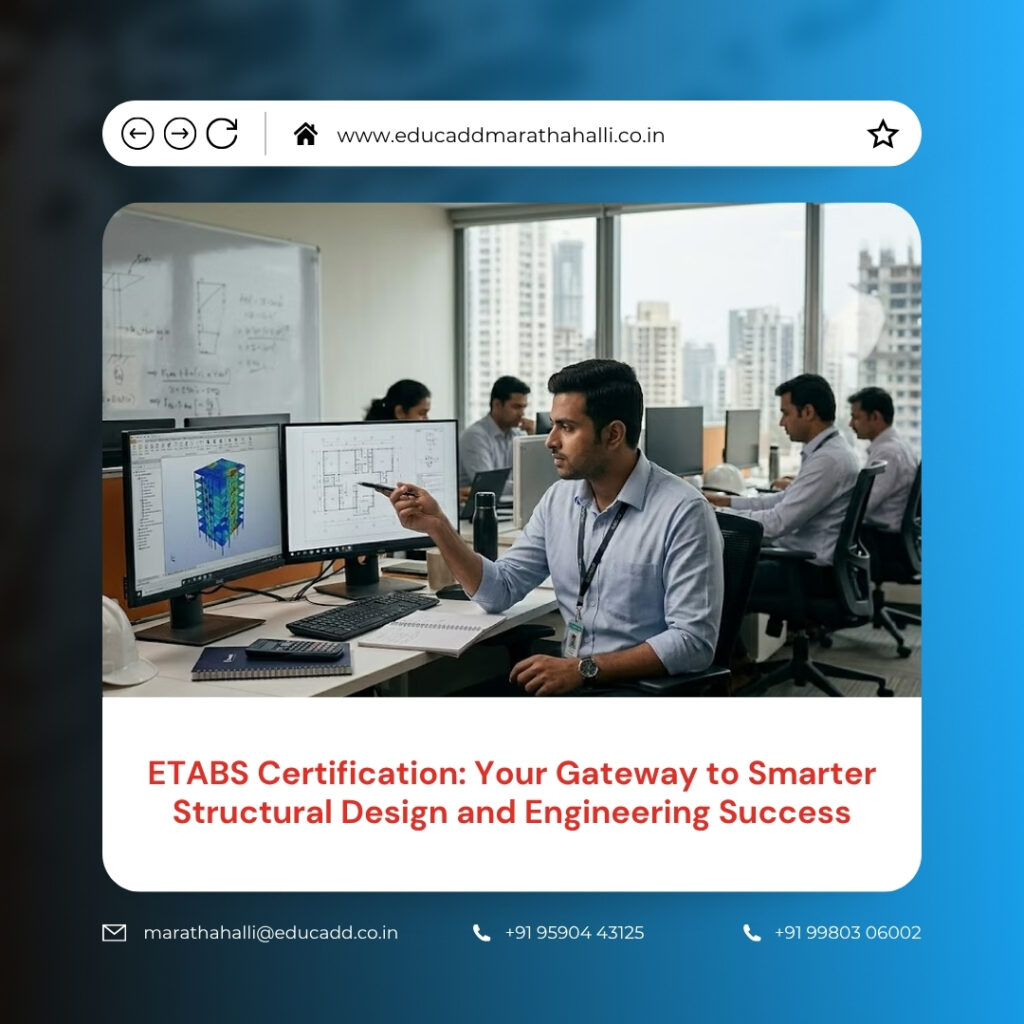
ETABS Certification Course Training
For civil engineering students, learning ETABS provides a strong competitive advantage in today’s job market. It not only enhances technical skills but also develops confidence in solving real-world structural challenges. This blog explores why ETABS Certification is an essential career investment, what students learn during training, and how it prepares them for successful engineering careers.
Why ETABS Certification Has Become an Industry Standard
The construction sector has embraced digital technologies to improve efficiency and project quality. Consequently, structural engineering firms expect fresh graduates to understand modern design software before entering the workplace. ETABS Certification Course Training helps civil engineering students develop practical knowledge that aligns with current industry standards. Instead of relying solely on theoretical calculations, students learn how professional engineers analyze complete structures using intelligent software tools. This practical exposure improves their understanding of structural behavior under different loading conditions.
Moreover, certified candidates often require less workplace training, making them attractive to employers. As engineering companies continue adopting digital workflows, ETABS Certification has become an important qualification that demonstrates technical competence and professional readiness.
Understanding the Purpose and Capabilities of ETABS
ETABS is a specialized software application created specifically for structural analysis and building design. Unlike general drafting software, ETABS focuses entirely on analyzing structural systems with remarkable speed and accuracy. During ETABS Certification Course Training training, students learn how to create three-dimensional building models while defining beams, columns, slabs, walls, and foundations. The software performs detailed calculations that help engineers evaluate the performance of buildings under various loading conditions.
Furthermore, ETABS generates comprehensive reports and graphical outputs that simplify design verification. Students also gain valuable insight into the relationship between structural components, allowing them to understand how different elements contribute to the overall stability and safety of a building.
Building Strong Structural Engineering Fundamentals
Before students begin advanced software modeling, they must understand the engineering principles behind structural design. Therefore, ETABS Certification Course Training combines theoretical concepts with practical applications to strengthen core knowledge. Students revisit topics such as structural mechanics, load transfer, material properties, and design standards before applying them within the software environment. This integrated learning approach ensures that learners understand not only how to use the software but also why each design decision matters. Additionally, practical demonstrations make complex engineering concepts easier to understand. As a result, students develop stronger analytical thinking while building the technical confidence required for professional structural engineering projects.
Learning Accurate Structural Modeling Techniques
Every successful structural analysis begins with an accurate digital model. For this reason, ETABS Certification Course Training places significant emphasis on developing professional modeling skills. Students learn how to establish grids, define story levels, assign material properties, create structural members, and organize building geometry efficiently. They also understand how incorrect modeling can produce misleading analysis results that affect structural safety. Through regular practice sessions, learners improve their ability to identify modeling mistakes before performing structural analysis.
Furthermore, instructors demonstrate industry-approved modeling techniques that increase productivity and maintain design accuracy. These practical experiences prepare students to handle real engineering projects with greater confidence and efficiency.
Mastering Structural Load Applications
One of the most important aspects of structural engineering involves understanding how different forces affect a building throughout its lifetime. During ETABS Certification, students learn how to define and apply dead loads, live loads, wind loads, seismic loads, and other environmental forces according to engineering standards. They also study various load combinations that simulate realistic structural conditions. Practical exercises help learners understand how different loading scenarios influence structural performance and member behavior.
In addition, students gain experience interpreting force diagrams, displacement results, and stress distributions generated by the software. This knowledge enables them to design safer and more reliable building structures while complying with engineering regulations.
Improving Design Accuracy Through Intelligent Analysis
Structural analysis requires precision because even small calculation errors may affect the safety of an entire building. Fortunately, ETABS provides advanced computational capabilities that simplify complex engineering calculations without compromising accuracy. Throughout ETABS Certification, students learn how to perform linear analysis, nonlinear analysis, response spectrum analysis, and other advanced engineering evaluations. They also explore graphical visualization tools that display structural deformations and internal force distributions clearly. These visual outputs improve conceptual understanding while helping students identify potential design weaknesses. Consequently, learners become capable of making informed engineering decisions based on reliable structural data rather than assumptions.
Designing Reinforced Concrete Structures Professionally
Reinforced concrete remains one of the most widely used construction materials because of its strength, durability, and versatility. Therefore, ETABS Certification includes extensive training on reinforced concrete building design. Students learn how to design beams, columns, slabs, shear walls, and other structural components according to recognized engineering codes. The software automatically checks member capacities and identifies sections requiring redesign or optimization.
Additionally, learners understand how reinforcement detailing contributes to structural safety and long-term performance. Practical design exercises encourage students to balance structural efficiency with material economy, preparing them to develop practical solutions for residential, commercial, and industrial construction projects.
Developing Earthquake and Wind Resistant Building Designs
Modern buildings must remain safe under challenging environmental conditions, making seismic and wind-resistant design an essential engineering skill. During ETABS Certification, civil engineering students learn how different forces affect buildings of various heights and structural configurations. They understand the principles of response spectrum analysis, dynamic analysis, and lateral load distribution using national and international design codes. Practical exercises help students evaluate structural drift, torsion, and stability while improving their ability to optimize designs for maximum safety.
Moreover, they learn how to interpret analysis results and implement design modifications whenever necessary. These skills enable future engineers to create structures that perform reliably during earthquakes and strong wind events while meeting regulatory requirements.
Hands-On Projects That Build Practical Confidence
Practical experience is one of the greatest advantages of pursuing ETABS Certification. Instead of limiting learning to classroom demonstrations, students complete real-world structural projects that replicate professional engineering workflows. They begin by creating a structural model, assigning material properties, applying various loads, performing structural analysis, and generating detailed design reports. Each project strengthens problem-solving abilities while improving software proficiency.
Furthermore, instructors provide continuous guidance that helps learners identify errors and refine their techniques. Working on multiple building types also exposes students to different structural challenges, allowing them to gain valuable experience before entering the construction industry. This project-based approach transforms theoretical knowledge into practical engineering expertise.
Career Opportunities After Completing ETABS Certification
The demand for skilled structural engineers continues to rise as infrastructure development expands across cities and industrial sectors. ETABS Certification Course Training opens doors to a wide range of rewarding career opportunities for civil engineering students. Certified professionals can pursue roles such as Structural Design Engineer, Civil Design Engineer, Structural Analyst, BIM Structural Modeler, Project Engineer, Design Consultant, or Technical Engineer. Construction companies, engineering consultancies, infrastructure firms, and real estate developers actively seek candidates with practical ETABS knowledge because they can contribute to projects from the beginning. Moreover, certification enhances professional credibility and often improves salary prospects, making it a valuable addition to every civil engineer’s qualifications.
Preparing for Higher Studies and Professional Growth
Beyond employment opportunities, ETABS Certification also supports students who wish to pursue postgraduate education or research in structural engineering. Advanced studies often involve structural simulations, performance evaluation, and analytical modeling, all of which require professional software knowledge. Students with ETABS expertise can complete research projects more efficiently while producing accurate analytical results.
Additionally, certification strengthens technical presentations, dissertations, and academic publications by enabling learners to validate theoretical concepts through practical simulations. As engineering education continues evolving toward technology-driven learning, ETABS provides students with a valuable foundation for lifelong professional development and continuous technical improvement.
Conclusion
In today’s technology-driven construction industry, ETABS Certification Course Training has become much more than a software qualification—it is a pathway to building a successful career in structural engineering. Civil engineering students who master ETABS gain practical experience in structural modeling, load analysis, reinforced concrete design, seismic evaluation, and professional project execution. These skills not only improve technical competence but also increase confidence when solving real engineering challenges.
As employers continue seeking professionals with industry-ready software expertise, certified candidates enjoy a significant advantage in recruitment and career advancement. Investing time in ETABS Certification equips aspiring engineers with the knowledge, practical exposure, and professional confidence needed to design safer, stronger, and more sustainable structures while contributing to the future of modern construction.

