
Master Product Design Excellence with a Creo Parametric Course for a Successful Engineering Career
The engineering world has evolved rapidly, and modern product development now depends on intelligent design software that delivers speed, precision, and innovation. Companies across automotive, aerospace, industrial manufacturing, consumer products, and heavy engineering industries increasingly rely on advanced CAD tools to design high-quality products while reducing development time. A Creo Parametric Course Training offers aspiring engineers and working professionals the opportunity to master one of the industry’s most trusted mechanical design platforms.
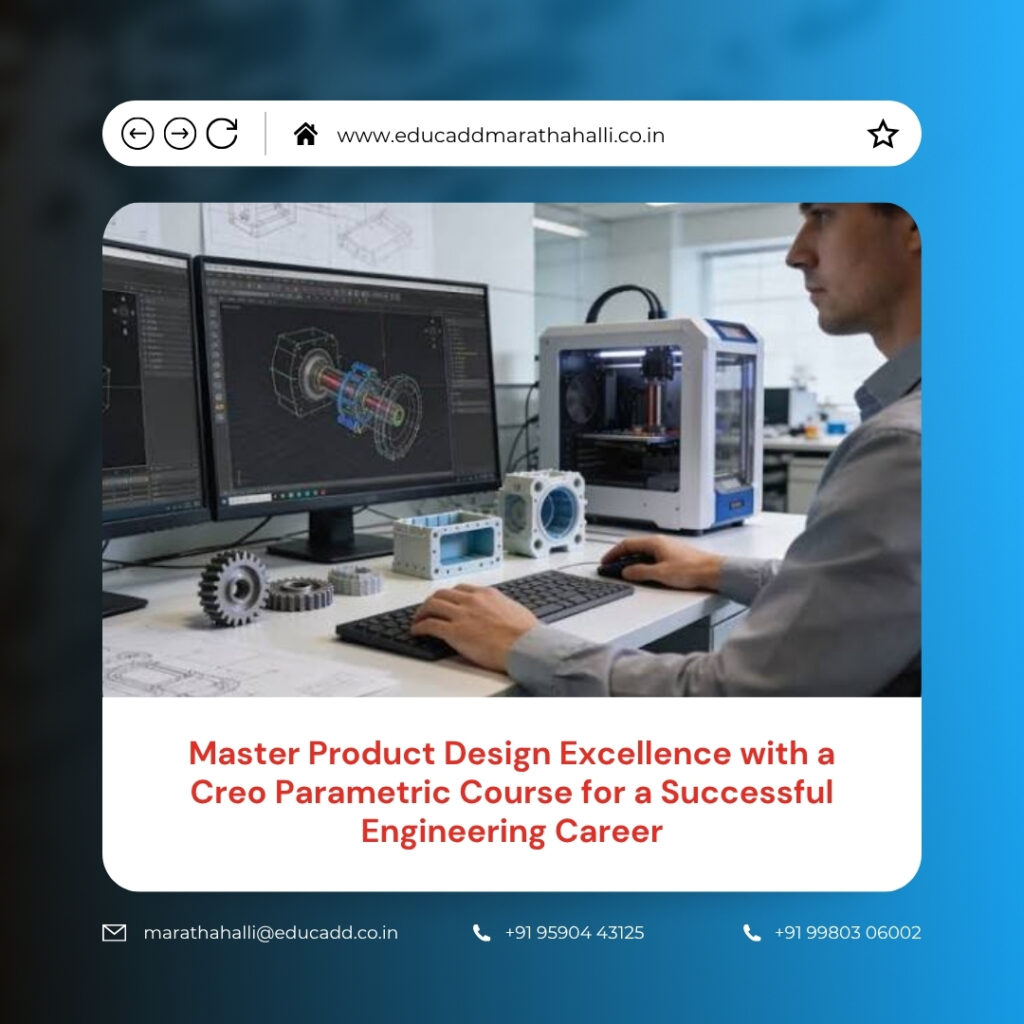
Creo Parametric Course Training
Whether you aim to become a design engineer, CAD specialist, or product development expert, learning Creo Parametric provides the technical skills needed to stay competitive in today’s engineering landscape. The course combines practical learning with real-world applications, enabling students to confidently handle complex design projects and meet industry expectations.
Discover Why a Creo Parametric Course Matters Today
Engineering organizations demand professionals who can transform ideas into functional products using modern digital tools. A Creo Parametric Course Training equips learners with the expertise to create precise 3D models, modify designs efficiently, and prepare manufacturing-ready documentation. Unlike traditional drafting methods, Creo allows engineers to update models quickly without recreating entire designs. As industries continue adopting digital engineering practices, professionals with Creo knowledge gain a clear advantage in recruitment and career growth. Moreover, mastering this software strengthens both technical competence and problem-solving abilities, making graduates valuable assets in competitive workplaces.
Learn the Fundamentals of Intelligent 3D Product Modeling
Every successful design begins with a strong understanding of modeling principles. During a Creo Parametric Course Training, students start by learning sketches, geometric constraints, dimensions, reference planes, and feature-based modeling. As their knowledge expands, they move toward creating sophisticated mechanical parts with greater accuracy and efficiency. Practical exercises help learners understand how every design feature contributes to the final product.
Furthermore, consistent practice develops confidence while improving design quality. This structured approach ensures that even beginners can gradually master advanced product modeling techniques.
Build Advanced Mechanical Assemblies with Confidence
Modern engineering products consist of numerous interconnected components that must function together seamlessly. A professional Creo Parametric Course Training teaches learners how to assemble individual parts into complete mechanical systems while maintaining design relationships. Students understand assembly constraints, component positioning, motion analysis, collision detection, and exploded assembly views. These essential skills allow designers to verify product functionality before manufacturing begins. Consequently, engineers can identify potential issues early, reducing development costs while improving overall product reliability.
Create Accurate Engineering Drawings for Manufacturing
Engineering drawings remain an essential communication tool between designers and manufacturers. A comprehensive Creo Parametric Course Training trains students to generate production-ready drawings that comply with international engineering standards. Learners gain expertise in orthographic projections, sectional views, detailed dimensions, geometric tolerances, annotations, welding symbols, and bill of materials creation.
Additionally, Creo automatically updates drawings whenever model modifications occur, ensuring design consistency throughout the product development cycle. This automation significantly improves productivity while minimizing documentation errors.
Understand the Power of Parametric Design Technology
One of Creo’s greatest strengths lies in its parametric modeling capabilities. A well-designed Creo Parametric Course Training explains how dimensions, constraints, and feature relationships enable engineers to modify products efficiently. Instead of rebuilding models from the beginning, designers simply update parameters to generate new design variations. This capability accelerates product development while maintaining design accuracy.
Moreover, parametric modeling supports continuous improvement, allowing engineering teams to respond quickly to customer requirements and manufacturing changes without unnecessary delays.
Gain Practical Knowledge Through Industry-Oriented Projects
Practical exposure plays a vital role in transforming theoretical understanding into professional expertise. Therefore, every quality Creo Parametric Course Training includes real-world engineering projects that simulate industrial product development. Students design machine components, sheet metal products, industrial assemblies, consumer goods, and manufacturing equipment using professional workflows. These projects strengthen technical thinking while helping learners understand practical engineering challenges. Furthermore, project experience enables students to build an impressive portfolio that demonstrates their capabilities during job interviews and placement opportunities.
Explore Advanced Design Features Used by Engineers
Beyond basic modeling, modern product development requires specialized tools that improve efficiency and design flexibility. An advanced Creo Parametric Course Training introduces learners to surface modeling, top-down design methodologies, family tables, flexible assemblies, skeleton models, and design automation features. Students also gain exposure to simulation-driven design concepts that help evaluate product performance before physical production. Consequently, they develop a deeper understanding of engineering workflows while preparing for complex industrial projects that demand higher levels of technical expertise.
Expand Career Opportunities Across Multiple Engineering Sectors
Professionals trained in Creo Parametric enjoy excellent employment prospects across diverse industries. Completing a Creo Parametric Course opens career opportunities in automotive manufacturing, aerospace engineering, industrial machinery, robotics, medical equipment, renewable energy, consumer electronics, and product development companies. Organizations actively recruit CAD professionals capable of delivering accurate designs within strict project timelines.
Additionally, growing demand for skilled mechanical designers ensures long-term career stability, attractive salary packages, and opportunities for continuous professional advancement.
Develop Manufacturing Awareness Alongside Design Skills
Successful product design extends beyond creating visually appealing models. Engineers must also understand how products will be manufactured efficiently. A professional Creo Parametric Course introduces learners to manufacturing considerations such as material selection, machining processes, sheet metal fabrication, tolerance analysis, assembly planning, and production optimization. Understanding these concepts enables designers to develop practical solutions that reduce manufacturing complexity while maintaining product quality. As a result, graduates become more effective contributors within multidisciplinary engineering teams.
Strengthen Engineering Logic and Design Problem-Solving
Engineering professionals regularly encounter design challenges that require creative yet practical solutions. Throughout a Creo Parametric Course, students solve real engineering problems by optimizing component geometry, improving assembly performance, and enhancing product functionality. Every assignment encourages analytical thinking while developing logical decision-making skills.
Furthermore, troubleshooting design errors teaches learners how to approach technical problems systematically rather than relying on trial and error. These valuable skills remain essential throughout an engineer’s professional career.
Prepare for Professional Certification and Placement Success
Employers increasingly value candidates who possess recognized technical certifications alongside practical experience. Many institutions offering a Creo Parametric Course align their curriculum with industry certification standards while providing placement-oriented training. Students receive interview preparation, resume-building guidance, portfolio development assistance, and technical assessment practice.
Certification validates professional competence while increasing confidence during recruitment processes. Combined with practical project experience, these advantages significantly improve employment opportunities for aspiring mechanical design engineers.
Stay Ready for Future Engineering Technologies
The engineering industry continues embracing digital transformation through automation, smart manufacturing, simulation-driven design, and collaborative product development. A modern Creo Parametric Course introduces students to these evolving technologies while demonstrating how Creo integrates with Product Lifecycle Management (PLM), Computer-Aided Manufacturing (CAM), simulation software, and digital engineering workflows.
Consequently, learners remain adaptable as industries adopt advanced manufacturing technologies. This future-focused approach ensures long-term career relevance in an increasingly technology-driven engineering environment.
Select the Best Training Institute to Maximize Your Learning
Choosing the right institute directly influences your learning experience and career outcomes. Before enrolling in a Creo Parametric Course, carefully evaluate the curriculum, trainer expertise, laboratory infrastructure, software version, practical project opportunities, certification support, and placement assistance. Institutes with experienced industry professionals often provide deeper insights into real engineering practices.
Moreover, continuous hands-on learning, personalized mentoring, and industrial case studies help students gain confidence while developing job-ready technical skills that employers genuinely value.
Conclusion
A Creo Parametric Course Training serves as a powerful foundation for anyone aspiring to build a successful career in mechanical design, product development, or manufacturing engineering. From mastering intelligent 3D modeling and complex assemblies to creating production-ready engineering drawings and understanding manufacturing principles, the course develops comprehensive technical expertise demanded by modern industries. Practical projects, industry-focused training, and professional certification further enhance career readiness and employability.
As engineering organizations continue investing in digital product development, Creo Parametric remains one of the most valuable CAD platforms for future-ready professionals. By choosing quality training and consistently practicing your skills, you can unlock rewarding career opportunities while contributing to innovative engineering solutions that shape tomorrow’s world.

