
The Future of Customer Engagement: Powerful Conversational Marketing and Chatbot Strategies for Modern Businesses
The way businesses communicate with customers has changed dramatically in recent years. Traditional marketing methods that relied heavily on emails, phone calls, and static advertisements no longer deliver the same level of engagement. Modern customers expect instant responses, personalized communication, and smooth digital experiences whenever they interact with a brand. Because of these changing expectations, businesses now invest heavily in Conversational Marketing Chatbot Strategies to create meaningful customer interactions in real time.
Conversational Marketing Chatbot Strategies focuses on building direct communication between businesses and customers through chat platforms, messaging apps, live chats, and AI-powered chatbots. Instead of forcing users to wait for responses or navigate complex websites, this strategy creates fast and interactive conversations that help customers find answers immediately. At the same time, chatbots work as virtual assistants that guide users through the buying process, answer questions, and provide support around the clock.
Today, companies across industries use Conversational Marketing Chatbot Strategies to improve customer experience, increase sales conversions, and strengthen brand loyalty. Whether it is an eCommerce store, educational institution, healthcare provider, or service-based company, chatbot technology helps businesses communicate more efficiently while reducing operational workload. Furthermore, artificial intelligence continues to improve chatbot capabilities, making conversations more natural and human-like than ever before.
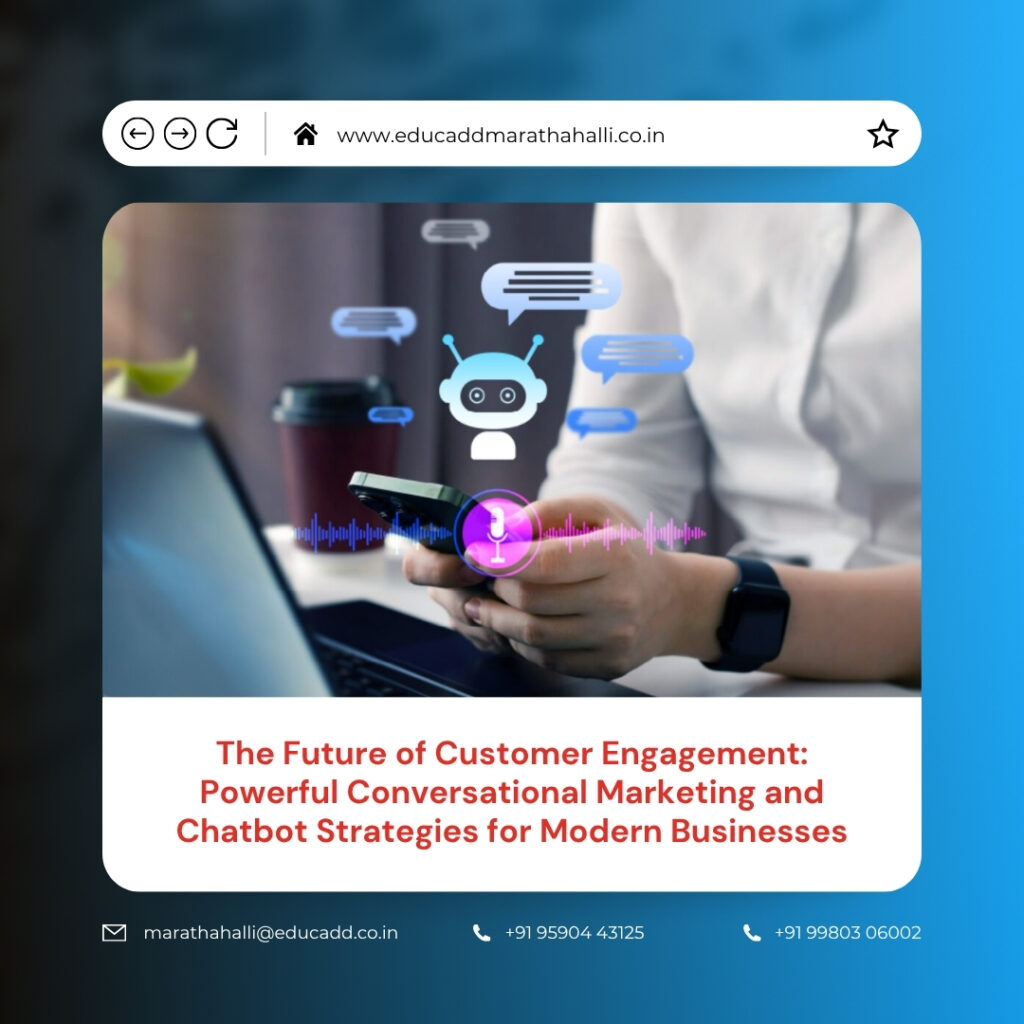
Conversational Marketing Chatbot Strategies
This blog explores how Conversational Marketing Chatbot Strategies are transforming modern business communication. It also explains their benefits, practical applications, future trends, implementation challenges, and methods businesses can use to improve customer engagement effectively in today’s highly competitive digital environment.
Understanding the Real Meaning of Conversational Marketing
Conversational Marketing Chatbot Strategies is a customer-focused communication approach that encourages real-time interaction between businesses and consumers. Unlike traditional marketing, which often depends on one-way communication, conversational marketing creates active discussions that help customers receive personalized assistance instantly.
Customers today want convenience and speed during online interactions. They prefer messaging businesses directly instead of filling out lengthy forms or waiting for email replies. Because of this behavior, conversational marketing has become one of the most effective methods for building customer relationships and increasing engagement.
This strategy works through multiple communication channels such as website live chats, Facebook Messenger, WhatsApp, Instagram DMs, and AI chatbot systems. These platforms allow businesses to answer questions quickly, guide users toward products or services, and solve customer concerns in real time.
Additionally, conversational marketing improves the customer journey significantly. Instead of navigating multiple pages to find information, users can simply ask questions and receive immediate guidance. As a result, businesses reduce customer frustration and increase satisfaction levels.
Another major advantage involves stronger personalization. Conversational tools collect user preferences and behavioral data, allowing brands to deliver tailored recommendations and customized communication that improves customer trust and purchasing decisions.
How Chatbots Are Changing Digital Communication
Chatbots have become one of the most important tools in digital marketing and customer support. These automated systems simulate human conversation and help businesses communicate with users efficiently across different digital platforms.
Earlier chatbot systems could answer only simple questions based on predefined rules. However, modern AI-powered chatbots understand customer intent, analyze conversation context, and deliver intelligent responses that feel more natural. Consequently, businesses can provide faster and more accurate customer service experiences.
One of the biggest reasons companies adopt chatbot technology is availability. Human support teams cannot operate continuously without limitations. Chatbots, on the other hand, work 24 hours a day without breaks. Therefore, customers can receive assistance anytime, regardless of business hours.
Chatbots also improve response consistency. Human agents may provide different answers depending on experience or workload, but chatbots deliver standardized information every time. This consistency strengthens brand reliability and reduces communication errors.
Moreover, chatbots can manage thousands of conversations simultaneously. During product launches, promotional campaigns, or holiday sales, businesses often experience large spikes in customer inquiries. Chatbots help handle this traffic efficiently without affecting service quality.
The Growing Importance of Instant Customer Interaction
Speed plays a critical role in customer satisfaction today. Online users expect immediate responses whenever they contact a business. Delayed replies often lead to frustration and increase the chances of losing potential customers to competitors.
Conversational marketing addresses this issue by enabling real-time communication. Customers no longer need to wait several hours or days for support. Instead, they receive answers within seconds through chatbot systems or live chat platforms.
Fast communication also improves buying decisions. When customers receive immediate product details, pricing information, or technical support, they feel more confident about completing purchases. Consequently, businesses improve conversion rates and reduce abandoned transactions.
Instant interaction also creates stronger engagement. Customers appreciate businesses that respond quickly because it demonstrates professionalism and customer commitment. Therefore, brands that prioritize conversational communication often build stronger relationships with their audiences.
In addition, real-time engagement allows businesses to identify customer concerns more efficiently. Companies can address problems immediately before they become major issues, which helps improve customer retention and long-term loyalty.
Artificial Intelligence and the Evolution of Smart Chatbots
Artificial intelligence has transformed chatbot technology into a powerful communication tool. AI-powered chatbots can now understand language patterns, customer emotions, and user intent with remarkable accuracy.
Natural language processing enables chatbots to interpret human conversations in a more intelligent manner. Instead of relying only on keywords, modern systems analyze sentence meaning and conversation flow. As a result, chatbot responses feel more personalized and conversational.
Machine learning further improves chatbot performance over time. These systems learn from previous interactions and continuously refine their responses. Therefore, customer experiences become smoother and more effective with ongoing usage.
AI also supports predictive customer engagement. Chatbots can analyze browsing history, purchase behavior, and user preferences to recommend products or services proactively. This capability allows businesses to increase upselling and cross-selling opportunities naturally.
Another important advancement involves multilingual support. AI-driven chatbots can communicate in multiple languages, helping companies connect with global audiences more efficiently. Consequently, businesses expand their market reach without hiring large multilingual support teams.
Why Businesses Use Conversational Marketing for Lead Generation
Lead generation remains one of the most important objectives in digital marketing. Conversational marketing helps businesses attract and qualify leads more effectively by creating personalized communication experiences.
Traditional lead generation forms often discourage users because they require too much effort. Conversational marketing replaces static forms with engaging chat-based interactions that feel easier and more natural. Consequently, customers participate more willingly in conversations.
Conversational Marketing Chatbot Strategies customer information step by step instead of overwhelming users with lengthy questionnaires. This approach improves lead capture rates while making the experience more comfortable for visitors.
Conversational marketing also identifies buyer intent faster. Chatbots analyze user responses and determine whether customers are ready to purchase or require additional information. As a result, sales teams can focus on highly qualified prospects more efficiently.
Some highly effective conversational lead generation strategies include:
- Interactive product recommendation chats
- Automated appointment booking and follow-up sequences
These methods not only increase lead quality but also create stronger customer engagement throughout the buying journey.
Furthermore, businesses can nurture leads automatically through personalized messaging campaigns. This continuous communication keeps potential customers connected to the brand and increases future conversion opportunities.
Enhancing Customer Support Through Chatbot Automation
Customer support directly affects brand reputation and customer satisfaction. Businesses that provide fast and helpful support experiences often build stronger customer loyalty. Chatbots significantly improve customer service by automating repetitive tasks and delivering instant assistance.
One major advantage of chatbot automation involves handling frequently asked questions. Customers commonly ask about pricing, delivery times, return policies, and account information. Chatbots answer these questions immediately, reducing pressure on human support teams.
Automation also minimizes customer waiting times. Instead of staying in long support queues, users receive instant guidance through conversational interfaces. Consequently, businesses improve customer satisfaction and operational efficiency simultaneously.
Chatbots additionally support ticket management systems. They can collect customer issues, categorize requests, and transfer complex problems to human representatives when necessary. This organized workflow improves support quality and reduces resolution time.
Another benefit involves continuous service availability. Customers from different time zones can access support anytime without depending entirely on staff availability. Therefore, businesses create more reliable and accessible customer experiences.
Conversational Commerce and the Future of Online Shopping
Conversational commerce combines online shopping with messaging-based communication. This approach allows customers to discover products, ask questions, and complete purchases directly within chat interfaces.
Modern consumers prefer convenience during shopping experiences. Conversational commerce simplifies the buying process by eliminating unnecessary navigation steps. Customers can communicate with chatbots, receive product recommendations, and complete transactions within the same conversation.
Product recommendation systems play an important role in conversational commerce. Chatbots analyze user preferences and browsing behavior to suggest relevant products. Consequently, businesses increase customer engagement and improve sales performance.
Additionally, conversational commerce supports personalized shopping experiences. Customers receive customized offers and recommendations that align closely with their interests and purchase history.
Some major advantages of conversational commerce include:
- Faster customer purchasing decisions
- Reduced shopping cart abandonment rates
Furthermore, businesses can provide post-purchase assistance through conversational platforms. Customers can track orders, request support, and provide feedback directly through messaging systems, which strengthens customer relationships.
Social Media Platforms and Conversational Engagement
Social media platforms have become powerful tools for conversational marketing. Customers spend significant time on applications like Instagram, Facebook, WhatsApp, and Telegram. Therefore, businesses increasingly use these platforms to build direct communication with audiences.
Messaging apps create more personal customer experiences compared to traditional advertisements. Instead of receiving one-way promotional content, customers engage in interactive discussions that feel more authentic and human.
Chatbots integrated with social media platforms improve response speed and customer engagement. Businesses can automate replies, share product information, and manage inquiries efficiently without manual effort.
Social media conversational marketing also improves customer accessibility. Users can contact brands through familiar platforms they already use daily. Consequently, communication becomes more convenient and comfortable for customers.
Additionally, businesses use conversational engagement to run personalized marketing campaigns. Automated messaging systems send promotions, reminders, and product recommendations based on customer interests and behavior patterns.
The Role of Personalization in Conversational Marketing
Personalization has become essential for successful customer engagement strategies. Generic marketing messages no longer capture attention effectively because customers expect brands to understand their specific needs and preferences.
Conversational Marketing Chatbot Strategies supports deep personalization by analyzing user data and interaction history. Chatbots use this information to provide relevant recommendations, personalized greetings, and tailored communication experiences.
Customers respond positively to personalized interactions because they feel valued and understood. Therefore, businesses that implement personalized conversational strategies often experience higher customer retention rates and improved brand loyalty.
Personalization also increases conversion rates. When customers receive product suggestions aligned with their interests, they are more likely to complete purchases. This targeted approach improves marketing efficiency significantly.
Furthermore, personalized conversational experiences create emotional connections between customers and brands. Customers appreciate businesses that remember their preferences and provide meaningful recommendations during future interactions.
Challenges Businesses Face While Implementing Chatbots
Although chatbot technology offers many advantages, businesses also face several implementation challenges. Understanding these difficulties helps companies create more effective conversational marketing systems.
One major challenge involves designing intelligent conversation flows. Poorly structured chatbots can frustrate users by providing irrelevant or repetitive responses. Therefore, businesses must invest time in proper chatbot training and optimization.
Another issue relates to balancing automation with human interaction. While chatbots improve efficiency, some customers still prefer speaking with human representatives for complex situations. Consequently, businesses need smooth transitions between chatbot systems and live support agents.
Data privacy and security also remain important concerns. Customers share sensitive information during conversations, so businesses must protect this data carefully. Transparent privacy policies and secure systems help maintain customer trust.
Additionally, chatbot maintenance requires continuous updates. Customer preferences, language trends, and business information change regularly. Without ongoing improvements, chatbot performance may decline over time.
Measuring the Success of Conversational Marketing Campaigns
Businesses must evaluate conversational marketing performance regularly to understand whether strategies deliver positive results. Proper measurement helps marketers improve communication methods and customer engagement quality.
Response time is one important metric. Faster responses usually increase customer satisfaction and improve overall interaction experiences. Businesses should monitor how quickly chatbot systems answer customer inquiries.
Conversion rate analysis also provides valuable insights. Marketers track how many conversations lead to purchases, subscriptions, or appointments. Higher conversion rates indicate effective conversational marketing performance.
Customer satisfaction surveys help businesses understand user experience quality. Feedback collected through conversational platforms reveals whether customers find chatbot interactions useful and engaging.
Engagement metrics such as conversation duration, click-through rates, and repeat interactions also help evaluate campaign effectiveness. These indicators show how actively users communicate with brands through conversational channels.
Moreover, businesses should monitor customer retention and loyalty improvements because successful conversational strategies often strengthen long-term customer relationships.
Future Trends in Conversational Marketing Technology
Conversational marketing continues evolving rapidly as technology advances. Future innovations will make chatbot systems even more intelligent, personalized, and interactive for businesses and customers alike.
Voice-enabled conversational systems represent one of the biggest upcoming trends. Smart speakers and voice assistants have increased customer interest in voice communication technologies. Consequently, businesses now invest in voice-based conversational marketing solutions.
Emotion recognition technology may also shape future chatbot interactions. Advanced AI systems could detect customer emotions through text or voice patterns and adjust responses accordingly. This capability would create more empathetic communication experiences.
Another emerging trend involves hyper-personalization. Future chatbot systems will analyze real-time customer behavior to deliver highly customized recommendations and interactions instantly.
Augmented reality integration may further improve conversational commerce experiences. Customers could interact with products virtually while communicating with AI assistants during shopping journeys.
As artificial intelligence continues improving, conversational marketing will become more human-like, predictive, and customer-focused than ever before.
Why Small and Medium Businesses Should Adopt Conversational Marketing
Many small and medium businesses believe advanced chatbot systems are suitable only for large corporations. However, conversational marketing offers significant advantages for businesses of all sizes.
Small businesses often operate with limited resources and staff. Chatbots help automate communication tasks, allowing companies to handle customer interactions efficiently without increasing operational costs.
Conversational marketing also improves customer accessibility. Small businesses can respond quickly to inquiries through messaging platforms, which strengthens customer trust and brand reputation.
Additionally, chatbot platforms have become more affordable and easier to implement. Many modern tools require minimal technical expertise, making conversational marketing accessible for smaller companies.
Local businesses especially benefit from messaging-based communication because customers prefer direct and fast interactions through WhatsApp and social media applications.
By adopting conversational marketing early, small businesses can compete more effectively, improve customer relationships, and increase sales opportunities in highly competitive digital markets.
Conclusion
Conversational Marketing Chatbot Strategies have completely transformed the way businesses interact with customers in the modern digital landscape. Today’s consumers expect fast communication, personalized experiences, and convenient support across every platform they use online. Because of these expectations, businesses that invest in conversational technologies gain a significant competitive advantage.
Chatbots improve customer engagement by providing instant responses, intelligent recommendations, and continuous support throughout the customer journey. At the same time, conversational marketing creates meaningful real-time interactions that strengthen customer trust, improve loyalty, and increase conversion rates.
Although implementation challenges such as chatbot optimization and data privacy exist, businesses that develop strong conversational strategies achieve long-term benefits in customer satisfaction and operational efficiency. Furthermore, advancements in artificial intelligence continue making conversational systems smarter, more natural, and more effective every year.
As digital communication continues evolving, conversational marketing will play an even greater role in business growth and customer relationship management. Companies that embrace chatbot technology and interactive communication strategies today will be better prepared for the future of digital marketing and customer engagement.

