
Master the Blueprint of Success with a Civil Design and Drafting Certification Program
The global construction industry is transforming faster than ever before, creating countless opportunities for skilled professionals who can contribute to modern infrastructure development. Every building, bridge, highway, industrial facility, airport, railway station, and smart city project starts with an accurate design and detailed engineering drawings. As technology continues to reshape the construction sector, companies are actively searching for candidates who possess practical software skills, engineering knowledge, and the ability to produce precise construction documentation. A Civil Design Drafting Certification Program is one of the most valuable career-oriented courses for students and professionals who want to build a successful future in civil engineering.
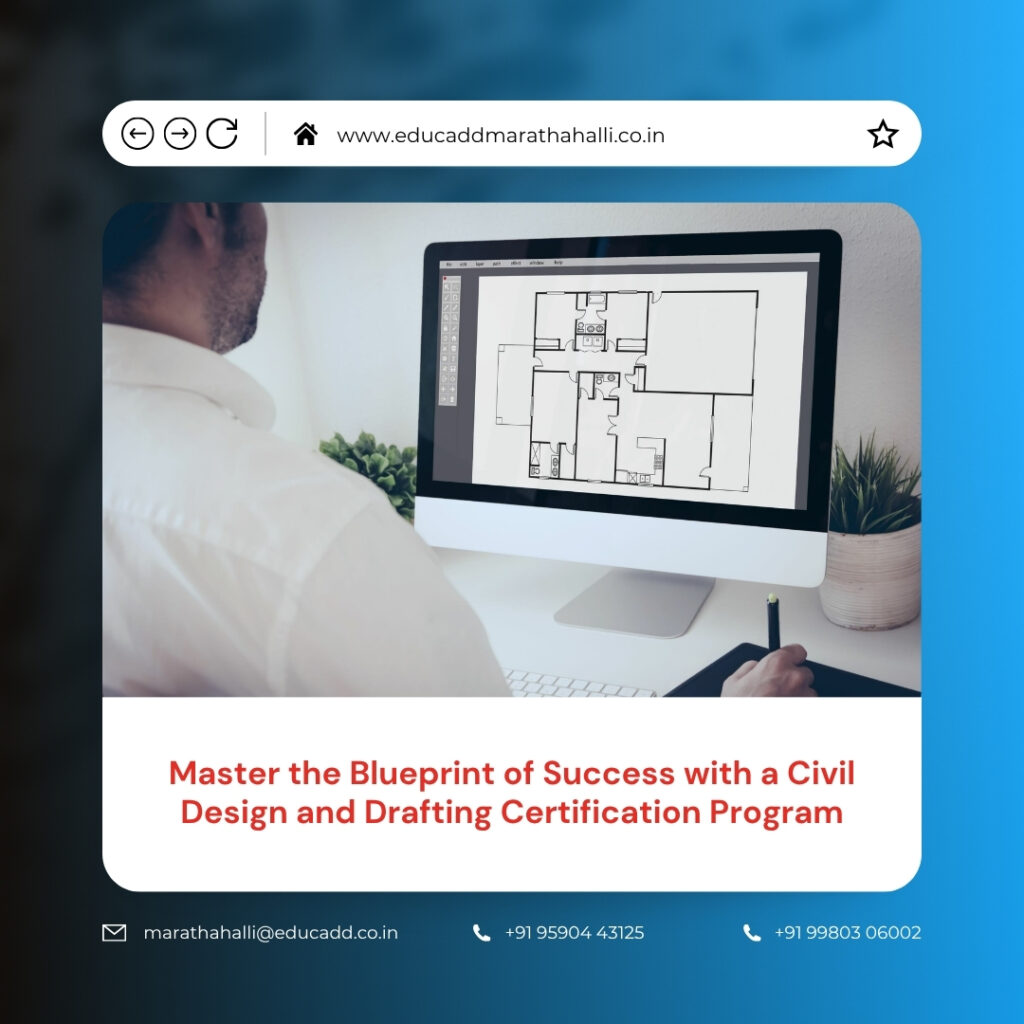
Civil Design Drafting Certification
Whether you are a diploma holder, engineering graduate, site engineer, working professional, or someone planning to enter the engineering field, this program equips you with the technical expertise needed to succeed. Moreover, the growing investment in infrastructure projects around the world ensures consistent demand for certified civil drafting professionals. By developing industry-ready skills through structured training, learners position themselves for rewarding careers in engineering design, construction, and project management.
The Rising Importance of Civil Design in Modern Construction
Construction projects today are far more sophisticated than they were a decade ago. Architects, structural engineers, contractors, and project managers now rely on digital collaboration to execute complex projects efficiently. Every successful project depends on accurate engineering drawings that communicate design intent clearly to every stakeholder involved in construction. Because of this increasing complexity, civil design has become one of the most important functions within the engineering industry.
A Civil Design Drafting Certification prepares students to meet these changing industry requirements with confidence. Rather than simply teaching drawing techniques, the program develops a complete understanding of engineering documentation, construction planning, drafting standards, and digital workflows. Students gain practical exposure to preparing foundation plans, floor layouts, elevation drawings, sectional details, reinforcement drawings, grading plans, drainage layouts, and site development plans. These competencies allow graduates to contribute effectively from the very beginning of their careers. Furthermore, organizations appreciate professionals who understand both engineering concepts and drafting accuracy because they reduce project delays and improve coordination between departments. As infrastructure investments continue to grow across residential, commercial, industrial, and public sectors, skilled civil drafting professionals remain indispensable.
Understanding What a Civil Design and Drafting Certification Program Offers
Many aspiring engineers wonder what makes a Civil Design Drafting Certification different from a traditional civil engineering degree. The answer lies in its practical approach to learning. While degree programs provide strong theoretical knowledge, certification programs concentrate on developing technical skills that employers immediately value. Students spend significant time working with engineering software, creating technical drawings, solving practical design challenges, and understanding industry workflows.
The curriculum generally covers engineering graphics, drafting principles, building planning, structural detailing, site development, quantity estimation, construction documentation, engineering standards, and project coordination. Students also become familiar with drawing management systems, revision control procedures, and documentation practices followed in professional engineering organizations. Throughout the training, instructors encourage learners to work on realistic engineering assignments that simulate actual construction projects. This hands-on approach strengthens technical accuracy while improving analytical thinking and problem-solving abilities. Consequently, graduates leave the program with practical experience instead of only theoretical knowledge, making them far more attractive to employers looking for job-ready professionals.
Why Practical Training Makes a Significant Difference
Engineering employers consistently emphasize one important requirement during recruitment: practical skills. While academic qualifications remain important, companies increasingly prioritize candidates who can perform real project tasks with minimal supervision. This is precisely where a Civil Design Drafting Certification creates a major advantage for learners. Practical exposure bridges the gap between classroom learning and workplace expectations, allowing students to understand how engineering concepts translate into actual construction drawings.
During practical sessions, students prepare complete drawing sets for residential buildings, commercial complexes, industrial facilities, road networks, and infrastructure developments. They also learn to identify drawing inconsistencies, coordinate design revisions, and maintain documentation quality throughout the project lifecycle. Working on simulated engineering projects improves confidence because students experience challenges similar to those encountered in professional practice. In addition, instructors guide learners through industry-standard drafting procedures, helping them understand quality requirements followed by engineering consultancies and construction companies. This practical knowledge significantly enhances employability while preparing graduates to contribute productively from their first day on the job.
Industry-Standard Software That Powers Professional Civil Design
Technology has revolutionized every stage of engineering design. Manual drafting methods have largely been replaced by sophisticated software platforms that improve productivity, reduce errors, and support collaborative project execution. Therefore, software proficiency has become one of the most sought-after skills in the construction industry. A comprehensive Civil Design Drafting Certification focuses extensively on teaching these modern engineering applications through practical assignments and real-world projects.
Students commonly learn AutoCAD for creating precise engineering drawings, Revit for Building Information Modeling, Civil 3D for infrastructure and land development projects, STAAD.Pro for structural analysis, ETABS for structural design, and Navisworks for project coordination. Some training programs also introduce project planning software such as Primavera to help students understand scheduling and construction management concepts. Instead of simply demonstrating software commands, instructors encourage students to complete practical projects that mirror actual engineering workflows. This approach develops software confidence while strengthening technical understanding. As employers increasingly seek professionals who can contribute immediately, mastery of these applications becomes a powerful competitive advantage in today’s engineering job market.
Essential Technical and Professional Skills You Will Develop
A Civil Design Drafting Certification is designed to develop far more than software knowledge. It helps students build a complete skill set that prepares them for the challenges of modern engineering projects. Employers expect civil drafting professionals to understand engineering concepts, communicate effectively with project teams, and produce accurate documentation within strict deadlines. Therefore, the program focuses equally on technical expertise and professional development.
During the training, students learn engineering drawing interpretation, construction documentation, blueprint reading, drafting standards, dimensioning techniques, annotation methods, and drawing organization. They also improve their understanding of structural components, foundation layouts, reinforcement detailing, site grading, road alignments, drainage systems, and utility planning. In addition, learners develop analytical thinking, problem-solving abilities, time management, communication skills, and attention to detail. These professional qualities play a significant role in delivering successful engineering projects because even a small drafting mistake can create costly construction issues. Through continuous practice and instructor feedback, students gradually improve their accuracy, confidence, and productivity. As a result, they become capable of handling engineering documentation independently while collaborating efficiently with architects, structural engineers, consultants, and project managers.
Exciting Career Opportunities After Certification
Completing a Civil Design Drafting Certification opens the door to numerous career opportunities in both the private and public sectors. Infrastructure development continues to expand across the world, creating a consistent demand for qualified professionals who can prepare technical drawings and support engineering teams. Since every construction project requires accurate planning and documentation, certified civil designers enjoy diverse employment options across multiple industries.
Graduates can begin their careers as Civil CAD Designers, Civil Draftsmen, Structural Drafting Engineers, BIM Coordinators, Site Planning Engineers, CAD Technicians, Quantity Survey Assistants, Estimation Engineers, Project Documentation Specialists, Design Coordinators, or Infrastructure Design Engineers. With experience, professionals often progress into senior design positions, project management roles, technical consulting, or engineering coordination. Many multinational engineering companies also recruit certified drafting professionals for international projects because digital collaboration allows engineering teams to work across different countries. Furthermore, professionals with strong software expertise frequently explore freelance opportunities, allowing them to work with multiple clients while building independent careers. The flexibility and variety of career paths make this certification highly valuable for long-term professional growth.
Industries That Continuously Recruit Civil Drafting Professionals
One of the greatest advantages of completing a Civil Design Drafting Certification is the broad range of industries that require these specialized skills. Civil drafting professionals are not limited to building construction alone. Instead, their expertise is essential across numerous sectors where engineering design and construction documentation form the foundation of successful project execution.
Construction companies regularly hire certified professionals to prepare residential and commercial building drawings. Infrastructure firms require drafting specialists for highways, bridges, metro rail systems, airports, tunnels, and transportation projects. Industrial organizations recruit civil designers for manufacturing plants, warehouses, factories, and logistics facilities. Water resource departments employ professionals to prepare irrigation layouts, drainage systems, water treatment plants, and pipeline networks. Renewable energy companies also need drafting experts for solar parks, wind energy projects, and sustainable infrastructure developments. In addition, architectural consultancies, engineering consultants, urban planning agencies, real estate developers, and government departments continue to recruit skilled civil drafting professionals. Since infrastructure development remains a priority in every growing economy, career opportunities continue to expand year after year.
How Certification Enhances Your Employability
Today’s employers prefer candidates who can contribute immediately instead of spending several months learning workplace procedures. A Civil Design Drafting Certification provides this advantage by combining practical learning with industry-recognized certification. Employers recognize that certified candidates have already received structured training in drafting standards, engineering software, documentation practices, and project workflows.
Certification demonstrates commitment to professional development while validating technical competence. During recruitment, companies often shortlist candidates who possess practical certifications because they require less onboarding and can adapt quickly to project environments. Furthermore, many reputed training institutes offer placement assistance, resume preparation workshops, mock interviews, portfolio development sessions, and career guidance. These additional services improve students’ confidence during job interviews and increase their chances of securing employment. Graduates who present a portfolio containing professionally prepared engineering drawings often make a stronger impression than candidates who only possess academic qualifications. Consequently, certification serves as both a learning experience and a career-enhancing credential that significantly improves employability.
Why Industry Standards Matter in Civil Drafting
Engineering drawings must communicate information clearly and consistently. Every line, symbol, annotation, dimension, and note serves a specific purpose during construction. If drafting standards are ignored, misunderstandings can occur, leading to expensive project delays and quality issues. Therefore, a well-designed Civil Design Drafting Certification places strong emphasis on internationally accepted drafting standards and engineering documentation practices.
Students learn proper layer management, text formatting, drawing scales, plotting techniques, title block preparation, sheet organization, revision control, cross-referencing, dimension styles, and construction notation. They also understand how different engineering disciplines coordinate their drawings to eliminate conflicts before construction begins. Following these standards improves drawing readability while supporting efficient communication among architects, structural engineers, contractors, and project managers. Employers appreciate professionals who consistently produce organized and accurate documentation because it reduces errors and increases project efficiency. By mastering these industry standards during training, students develop habits that continue benefiting them throughout their professional careers.
The Impact of Digital Transformation on Civil Engineering Careers
Technology continues to reshape the engineering and construction industry at an extraordinary pace. Traditional paper-based workflows are rapidly being replaced by intelligent digital systems that improve collaboration, accuracy, and project efficiency. As a result, professionals who understand digital engineering tools enjoy greater career opportunities than ever before. A modern Civil Design and Drafting Certification Program prepares students to succeed within this technology-driven environment by introducing them to current industry practices and digital design methodologies.
Building Information Modeling, cloud-based collaboration platforms, integrated project management systems, and intelligent infrastructure planning have transformed how engineering projects are designed and executed. Instead of working with isolated drawings, engineering teams now collaborate using connected digital models that improve coordination across multiple disciplines. Students learn how digital workflows reduce design conflicts, simplify revisions, improve construction planning, and enhance communication throughout the project lifecycle. They also understand how automation improves productivity without compromising engineering accuracy. By becoming familiar with these modern technologies, graduates remain relevant in an industry that increasingly values innovation, efficiency, and collaborative engineering practices.
Choosing the Right Training Institute for Long-Term Success
Selecting the right institute is just as important as choosing the right course. Although many organizations offer training, not every Civil Design and Drafting Certification Program provides the same level of practical exposure or industry relevance. Students should carefully evaluate several factors before enrolling to ensure they receive quality education that aligns with current engineering practices.
A reputable training institute should provide experienced faculty members, updated software laboratories, project-based learning, practical assignments, industry-oriented curriculum, flexible learning schedules, certification support, and dedicated placement assistance. Exposure to real engineering projects greatly enhances learning because students gain confidence while solving practical design challenges. Institutes that regularly update their curriculum to reflect technological advancements also provide greater value since the engineering industry evolves continuously. Prospective students should review alumni success stories, employer partnerships, placement records, and student testimonials before making a decision. Choosing a high-quality training institute not only strengthens technical knowledge but also creates better employment opportunities after completing the certification.
Why This Program Is Ideal for Students, Graduates, and Working Professionals
One of the strongest advantages of a Civil Design and Drafting Certification Program is that it caters to learners at different stages of their careers. Students pursuing diploma or degree courses can strengthen their practical knowledge before graduation, giving them an advantage during campus placements. Instead of entering the job market with only theoretical knowledge, they gain hands-on experience in drafting, design software, and engineering documentation. This practical exposure increases their confidence and helps them perform better during technical interviews and recruitment assessments.
Engineering graduates who struggle to secure employment often discover that employers expect practical software skills in addition to academic qualifications. The certification program fills this gap by providing project-based learning that reflects actual industry requirements. Working professionals also benefit because they can upgrade their technical expertise, learn the latest design software, and qualify for better positions within their organizations. Site engineers who wish to transition into design roles, CAD operators who want to expand their knowledge, and professionals returning to the workforce after a career break can all use this certification to strengthen their resumes. Since the program combines technical learning with industry exposure, it supports career growth for beginners and experienced professionals alike.
Future Scope of Civil Design and Drafting in a Technology-Driven World
The future of civil engineering is closely connected with innovation, sustainability, and digital transformation. Governments and private organizations continue to invest heavily in infrastructure development, including highways, smart cities, metro rail systems, airports, industrial corridors, renewable energy facilities, and affordable housing projects. Every one of these developments depends on detailed engineering drawings and digital models before construction begins. Consequently, professionals with expertise gained through a Civil Design and Drafting Certification Program will remain in demand for many years.
The growing adoption of Building Information Modeling (BIM), digital twins, artificial intelligence, cloud collaboration, and automated construction planning is creating new opportunities for civil design professionals. Companies are seeking individuals who can adapt to modern workflows while maintaining engineering accuracy and quality standards. Professionals who continue upgrading their skills can progress into specialized roles such as BIM Engineer, BIM Coordinator, Design Manager, Digital Construction Specialist, Project Engineer, or Engineering Consultant. International engineering firms also recruit certified professionals for global projects because digital collaboration enables teams to work seamlessly across different countries. As technology advances further, the demand for trained civil drafting experts will continue to increase, making this certification a valuable investment for long-term career success.
Why a Civil Design and Drafting Certification Program Is a Smart Career Investment
Investing in education is one of the most important decisions for any aspiring professional. However, choosing a program that directly improves employability is even more valuable. A Civil Design and Drafting Certification Program offers an excellent return on investment because it equips learners with practical skills that employers actively seek. Rather than focusing only on theoretical concepts, the program prepares students to solve real engineering challenges using industry-standard tools and techniques.
The certification helps learners build an impressive technical portfolio that showcases engineering drawings, design projects, structural detailing, and digital models completed during training. This portfolio becomes a powerful asset during interviews because recruiters can evaluate practical abilities instead of relying solely on academic records. In addition, certified professionals often enjoy better salary prospects, faster career progression, and greater job stability because they possess specialized technical expertise. Many employers also encourage continuous learning and provide additional responsibilities to professionals who demonstrate advanced drafting skills. Therefore, the knowledge gained through this certification not only supports immediate employment but also creates opportunities for leadership roles and long-term professional advancement. For individuals who aspire to build a rewarding career in engineering design, this program serves as a strong foundation for future success.
Conclusion
The construction industry continues to evolve with new technologies, larger infrastructure projects, and increasing expectations for precision and efficiency. In this dynamic environment, practical skills have become just as important as academic qualifications. A Civil Design Drafting Certification Program provides learners with the technical expertise, software proficiency, and industry knowledge required to thrive in modern engineering careers. Through comprehensive training, students learn to prepare accurate engineering drawings, understand construction standards, collaborate with multidisciplinary teams, and contribute confidently to real-world projects.
Beyond technical knowledge, the program develops critical thinking, problem-solving abilities, communication skills, and professional discipline that remain valuable throughout an engineering career. Whether you are beginning your journey in civil engineering, upgrading your existing skills, or preparing for better career opportunities, this certification can help you achieve your goals with confidence. As infrastructure development continues across the globe, the demand for qualified civil design and drafting professionals will remain strong. By enrolling in a high-quality Civil Design and Drafting Certification Program, you are not simply learning software or drafting techniques—you are building the expertise needed to shape skylines, strengthen communities, and contribute to the future of sustainable infrastructure. The right training today can become the foundation of a successful, stable, and rewarding engineering career for years to come.

