
Civil CAD Projects That Build Your Future Portfolio
Building a strong portfolio is essential for every civil engineering student and professional. In today’s competitive environment, employers seek proof of practical skills beyond academic grades. One of the most effective ways to showcase these abilities is through Civil CAD Projects Portfolio. These projects not only reflect technical knowledge but also demonstrate problem-solving, creativity, and hands-on application of concepts.
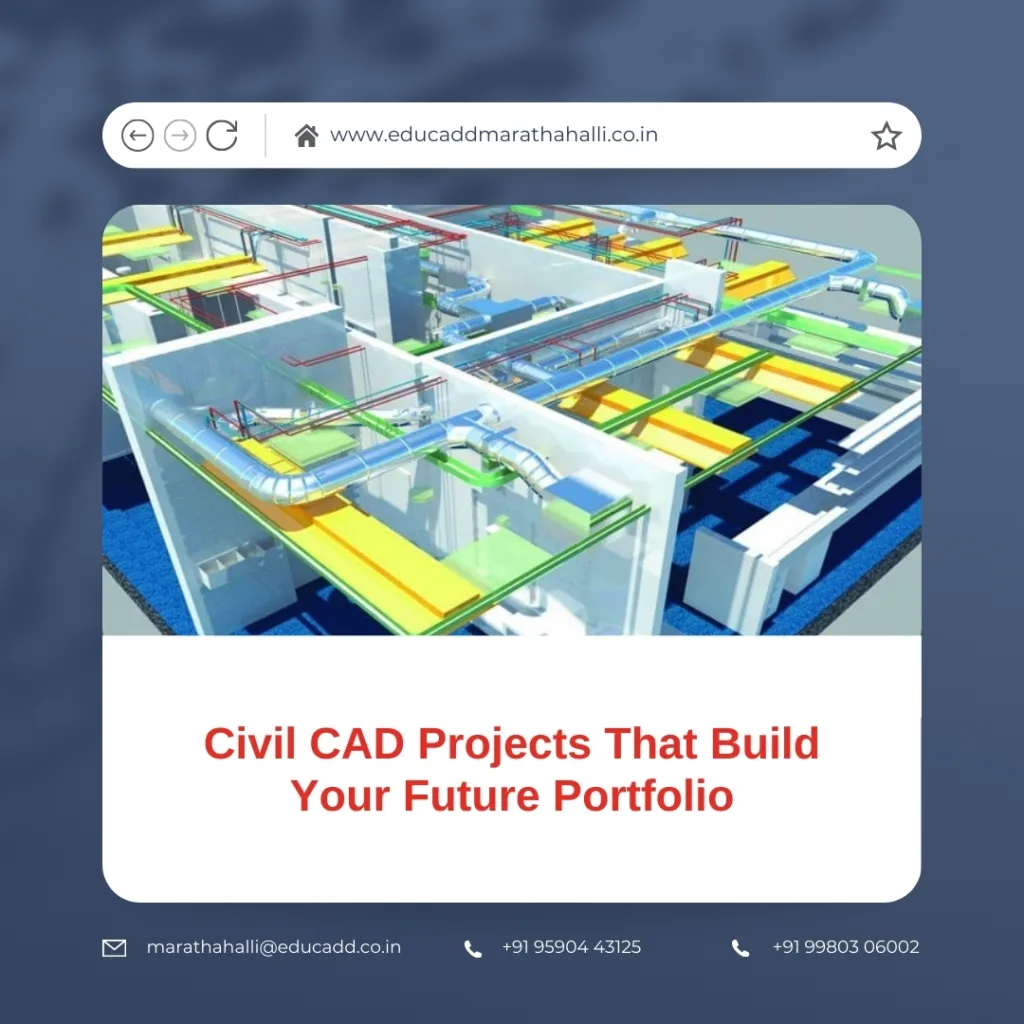
Civil CAD Projects Portfolio
This blog explores different types of civil CAD projects that build your portfolio, explains why they matter, and highlights how they set you apart in the job market. With a focus on practical learning, each section offers guidance on what projects to choose, how to execute them, and the specific skills they highlight.
Why Civil CAD Projects Matter in Your Career
Employers in civil engineering look for professionals who can apply theory to real-world challenges. A well-designed CAD project bridges that gap by showing your ability to transform concepts into workable designs. Unlike written exams, projects provide visible evidence of your skill level.
Civil CAD projects also prove that you are comfortable with tools like AutoCAD, Revit, STAAD Pro, or Civil 3D. This matters because industries prefer candidates who can begin contributing immediately without extensive training. Moreover, these projects give you confidence when tackling large-scale tasks in your professional life.
Most importantly, projects add credibility to your portfolio. Recruiters can see your design files, drawings, and simulations. This concrete proof builds trust in your capabilities. As a result, you stand out among competitors with only theoretical knowledge.
Types of Civil CAD Projects to Showcase
Not every project carries the same weight in a portfolio. Some are basic exercises, while others highlight advanced knowledge and creativity. Choosing the right set of civil CAD projects that build your portfolio is crucial. Below are project types that attract employers and clients:
1. Residential Building Design
Designing a residential structure is one of the most common and impactful CAD projects. It demonstrates skills in layout planning, dimensioning, and detailing. A well-designed residential project can include floor plans, elevation drawings, structural details, and even electrical layouts. Recruiters appreciate this project because it shows your ability to manage multiple design aspects in one model.
2. Highway and Roadway Design
Civil engineers play a critical role in transportation planning. Roadway CAD projects highlight your understanding of road alignment, grading, cross-sections, and drainage systems. Such designs show that you can manage large-scale projects requiring precision and compliance with safety standards.
3. Bridge or Flyover Design
Bridge projects highlight advanced structural design skills. CAD tools allow you to model load distribution, material stress, and safety factors. These projects impress because they reflect both creativity and technical knowledge.
4. Water Supply and Drainage Networks
Urban infrastructure depends on well-planned water systems. A CAD project in this area shows expertise in hydraulics, environmental engineering, and municipal planning. Recruiters appreciate candidates who can design efficient and sustainable networks.
5. Commercial Complex or Smart Building Design
Commercial projects allow you to showcase creativity while managing complex requirements such as HVAC, fire safety, and vertical transport systems. By adding elements of sustainability and smart technology, you can make your project more attractive.
Essential Skills Your Projects Should Display
While choosing projects is important, the skills you demonstrate through them matter even more. Every recruiter looks for specific abilities when evaluating portfolios. The right civil CAD projects that build your portfolio should highlight the following:
-
Technical Accuracy: Precision in measurements, scaling, and detailing.
-
Software Proficiency: Mastery of CAD tools relevant to civil engineering.
-
Problem-Solving: Ability to address real challenges such as material limits, budget, or environmental concerns.
-
Creativity: Innovative solutions that improve functionality or efficiency.
-
Documentation: Clear presentation of design drawings, specifications, and reports.
Adding these skills into your projects makes them not just visually appealing but also practically relevant.
How to Select the Right CAD Projects
Many students feel confused about which projects to add to their portfolio. The key is alignment with your career goals. If you aim to work in construction firms, focus on residential and commercial projects. If transportation interests you, roadway or bridge designs will be more effective.
You should also consider the complexity of the project. Start with simple residential designs to build confidence, then move on to larger urban infrastructure projects. Transitioning step by step ensures steady growth in skills.
Another factor is uniqueness. Recruiters often see repetitive projects. Adding unique elements such as green building concepts, smart drainage systems, or sustainable materials makes your portfolio stand out.
Steps to Create Impressive Civil CAD Projects
Executing a CAD project goes beyond software skills. The process you follow reflects your professionalism. Below is a structured approach to create impactful civil CAD projects that build your portfolio:
-
Choose a Problem Statement: Identify a real-world issue to address.
-
Conduct Research: Gather standards, codes, and examples for reference.
-
Plan the Workflow: Break the project into manageable phases.
-
Model in CAD Software: Start with layouts, then add structural and service details.
-
Check for Accuracy: Review dimensions, scaling, and compliance with design norms.
-
Add Sustainability Features: Include eco-friendly design elements.
-
Prepare Documentation: Create a project report with drawings, assumptions, and conclusions.
Following these steps ensures your project is professional, detailed, and portfolio-ready.
Conclusion: Building a Career with Strong Civil CAD Projects
Your portfolio is your professional identity. By adding high-quality Civil CAD Projects Portfolio, you show recruiters and clients that you can deliver results. From residential designs to smart infrastructure, each project proves your technical depth, creativity, and commitment to real-world applications.
Investing time in CAD projects today secures better career opportunities tomorrow. Start small, grow steadily, and ensure every project reflects your future as a skilled civil engineer.

