
Master Precision Engineering with CATIA Design Training for a High-Growth Career
Modern engineering is driven by innovation, accuracy, and digital product development. From designing automobiles and aircraft to creating industrial machinery and consumer products, industries depend on advanced CAD software to transform ideas into reality. Among the leading design platforms, CATIA Design Training Course has become a preferred choice for engineering students and professionals who want to build strong technical skills and secure rewarding career opportunities.
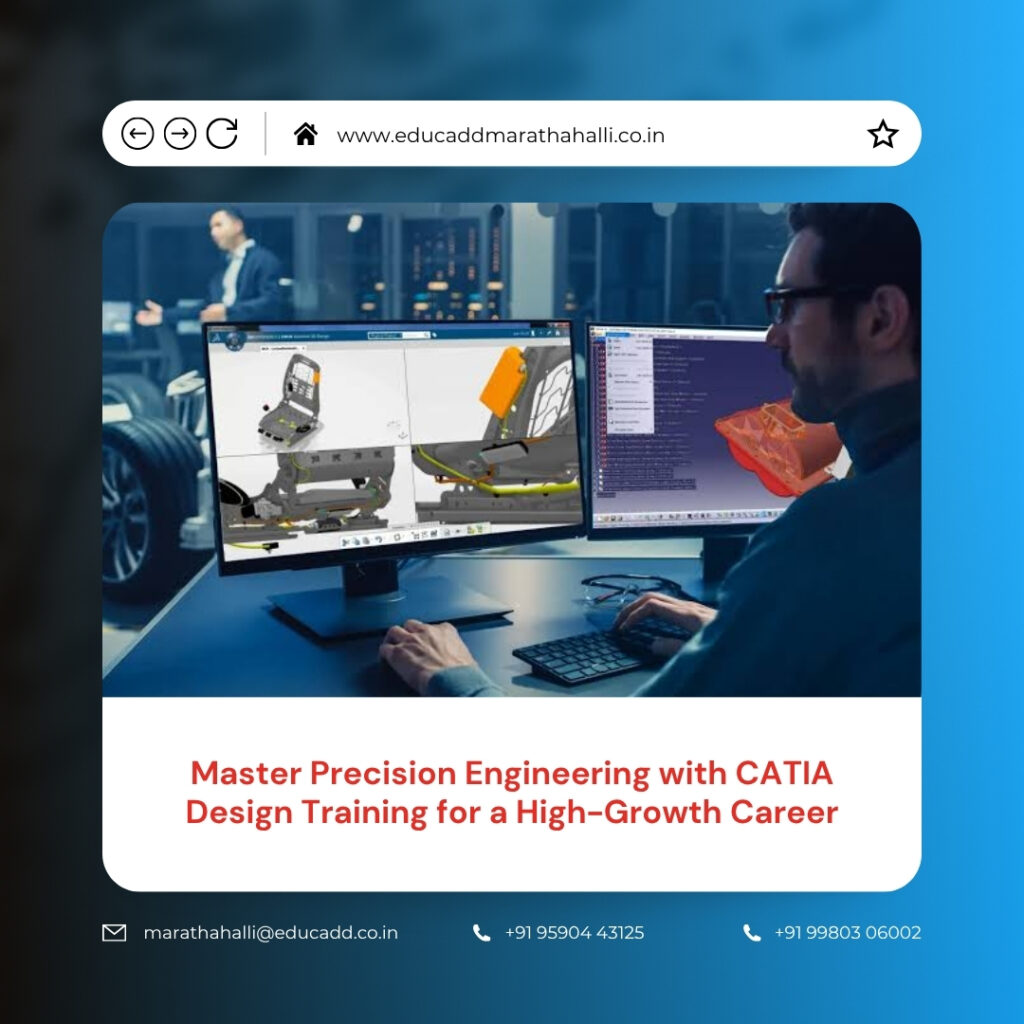
CATIA Design Training Course
A structured CATIA course teaches learners how to create intelligent 3D models, develop detailed engineering drawings, design complex assemblies, and optimize products for manufacturing. As industries continue to embrace digital engineering, CATIA expertise has become an essential skill that helps professionals stay competitive in today’s evolving job market.
CATIA Design Training Opens the Door to Advanced Product Design
Engineering companies seek professionals who can create designs that are not only innovative but also practical for manufacturing. CATIA Design Training Course introduces learners to industry-standard product design techniques while helping them understand the complete engineering workflow. Instead of limiting education to software operations, professional training focuses on developing logical thinking, design strategies, and technical accuracy.
Students also gain valuable exposure to engineering standards followed by leading manufacturing organizations. This practical approach allows learners to understand how digital designs move from the concept stage to final production. As a result, they become capable of handling complex design challenges with greater confidence and efficiency.
Learning CATIA Builds a Strong Engineering Foundation
CATIA is recognized worldwide as one of the most powerful CAD applications because it supports every stage of product development. From conceptual sketches to production-ready models, the software provides advanced tools for creating highly detailed engineering designs. Engineers use CATIA to improve design quality while reducing product development time and manufacturing errors.
During CATIA Design Training Course, students learn how different design modules work together to create a seamless engineering environment. They also understand how digital product development improves collaboration among design, manufacturing, and quality control teams. These skills prepare learners for modern engineering workplaces where integrated design processes are becoming increasingly important.
Essential Modules Included in CATIA Design Training
A comprehensive training program covers multiple CATIA workbenches that are widely used across engineering industries. Learners begin with Sketcher and Part Design before progressing to Assembly Design, Drafting, and Surface Design. Each module introduces practical concepts that help students build confidence through continuous hands-on practice.
Advanced courses may also include Sheet Metal Design, Wireframe and Surface Modeling, Weld Design, and Generative Shape Design. These specialized modules allow learners to work on complex engineering projects while developing technical expertise that matches current industry expectations.
Practical Design Projects Improve Technical Confidence
Hands-on learning is one of the biggest advantages of professional CATIA Design Training Course. Practical assignments encourage students to apply classroom concepts to real engineering components instead of relying only on theoretical knowledge. Every project strengthens modeling skills while improving creativity and design accuracy.
Working on industrial case studies also helps learners understand engineering constraints, manufacturing feasibility, and product optimization. Consequently, they gain practical experience that makes the transition from classroom learning to professional employment much smoother and more effective.
Industries That Continuously Hire CATIA Professionals
CATIA has become an indispensable software solution across numerous engineering sectors. Automotive manufacturers depend on it for designing engines, transmission systems, vehicle interiors, and structural components. Aerospace organizations utilize CATIA to develop aircraft assemblies, lightweight structures, and precision-engineered components that require exceptional accuracy.
The software is equally valuable in industrial equipment manufacturing, heavy engineering, shipbuilding, consumer electronics, medical device development, and defense projects. Because of its versatility, professionals with CATIA Design Training Course enjoy opportunities across multiple industries rather than being limited to a single engineering domain.
Career Opportunities After Completing CATIA Design Training
Learning CATIA significantly expands career possibilities for engineering graduates and experienced professionals. Entry-level positions include CAD Designer, Mechanical Design Engineer, Product Development Engineer, Tool Design Engineer, and Design Executive. These roles provide valuable experience in product development and digital engineering.
As professionals gain expertise, they can progress into senior design engineering, project management, technical consulting, research and development, or engineering leadership positions. Since advanced product development continues to grow worldwide, CATIA professionals often experience excellent career stability and attractive salary growth.
Mastering Parametric Modeling Enhances Productivity
One of CATIA’s strongest capabilities is parametric modeling, which allows engineers to modify product designs without recreating entire models. Every design feature remains interconnected, enabling automatic updates whenever dimensions or specifications change. This intelligent functionality saves valuable engineering time while maintaining complete design consistency.
Professional CATIA Design Training teaches learners how to create flexible models that support future modifications with minimal effort. Consequently, organizations can respond more efficiently to design revisions while reducing engineering costs and improving overall productivity.
Surface Design Skills Create Innovative Engineering Solutions
Modern engineering products demand sophisticated shapes that combine functionality with aesthetics. CATIA offers advanced surface modeling tools that enable engineers to design complex curves, aerodynamic profiles, and visually appealing products. These capabilities are especially valuable in automotive, aerospace, and consumer product industries.
During training, learners practice creating, trimming, joining, and refining surfaces using professional design techniques. This specialized knowledge enhances creativity while preparing students to work on high-end engineering projects that require exceptional design precision.
Engineering Drafting Connects Design with Manufacturing
Although three-dimensional modeling has transformed engineering, technical drawings remain essential for manufacturing and quality control. CATIA Drafting enables engineers to generate highly accurate production drawings directly from digital models. This integration reduces manual effort while ensuring consistency throughout the design process.
Students also learn geometric dimensioning, tolerancing, annotations, section views, exploded assemblies, and bill of materials preparation. These documentation skills ensure that manufacturing teams receive clear and accurate engineering information for successful production.
Industry-Oriented Training Makes Students Job Ready
Companies increasingly prefer candidates who possess practical engineering experience alongside software knowledge. High-quality CATIA Design Training emphasizes industrial workflows, engineering documentation, collaborative product development, and professional design practices. This approach prepares students to contribute effectively from the beginning of their careers.
Many training institutes further strengthen learning through workshops, live projects, mock interviews, and placement assistance. These additional activities improve communication skills, technical confidence, and professional readiness for competitive engineering recruitment processes.
Professional Certification Adds Career Value
Completing a recognized CATIA certification demonstrates technical competence and commitment to professional growth. Employers often consider certified candidates more reliable because certification validates practical software knowledge and engineering proficiency. It also enhances credibility during recruitment and career advancement.
Furthermore, certified professionals frequently receive greater opportunities to participate in specialized design projects involving advanced manufacturing technologies. Continuous learning and certification therefore become important factors in long-term engineering success.
Choosing the Best CATIA Design Training Institute
Selecting a reputed training institute is equally important as choosing the right course. Learners should evaluate trainer experience, curriculum quality, practical laboratory facilities, industry projects, placement support, software availability, and certification recognition before enrolling. A structured learning environment greatly improves both technical development and career outcomes.
Student reviews and alumni success stories also provide valuable insights into training quality. An institute that emphasizes practical learning, individual guidance, and real-world engineering exposure helps learners build confidence while developing skills demanded by modern employers.
Future Engineering Trends Increase CATIA Career Opportunities
The future of engineering is being shaped by digital transformation, smart manufacturing, automation, artificial intelligence, and Industry 4.0 technologies. As products become increasingly sophisticated, companies require engineers who can create intelligent digital models that integrate seamlessly with manufacturing systems. CATIA Design Training equips learners with the expertise needed to thrive in this technology-driven environment.
Emerging technologies such as digital twins, collaborative cloud engineering, sustainable product development, and advanced simulation will further increase the demand for CATIA professionals. Engineers who continuously enhance their technical skills will remain valuable contributors to global innovation while enjoying long-term career growth across multiple industries.
Conclusion
The engineering world is rapidly evolving, making advanced design skills more valuable than ever before. CATIA Design Training Course empowers students and professionals with practical knowledge in 3D modeling, assembly design, surface modeling, drafting, and product development using industry-leading tools. More importantly, it develops analytical thinking, engineering precision, and real-world problem-solving abilities that employers actively seek.
Whether your goal is to work in automotive, aerospace, manufacturing, industrial design, or product development, mastering CATIA provides a competitive advantage in today’s engineering landscape. By enrolling in comprehensive CATIA Design Training and continuously improving your technical expertise, you can build a successful, future-ready career while contributing to innovative engineering solutions that shape tomorrow’s world.

