
Shape Your Future with Advanced Mechanical CADD Training with Placement Support
The engineering world is becoming more technology-driven every year, and companies are constantly searching for professionals who possess both theoretical knowledge and practical software skills. From automobiles and heavy machinery to aerospace equipment and industrial automation systems, digital engineering has become the backbone of product development. As industries continue to adopt smart manufacturing practices, the demand for highly skilled Mechanical CADD professionals continues to grow across India and around the world. Advanced Mechanical CADD Training with Placement Support has become one of the most valuable career programs for aspiring engineers, diploma holders, and working professionals who want to build a successful future in mechanical design.
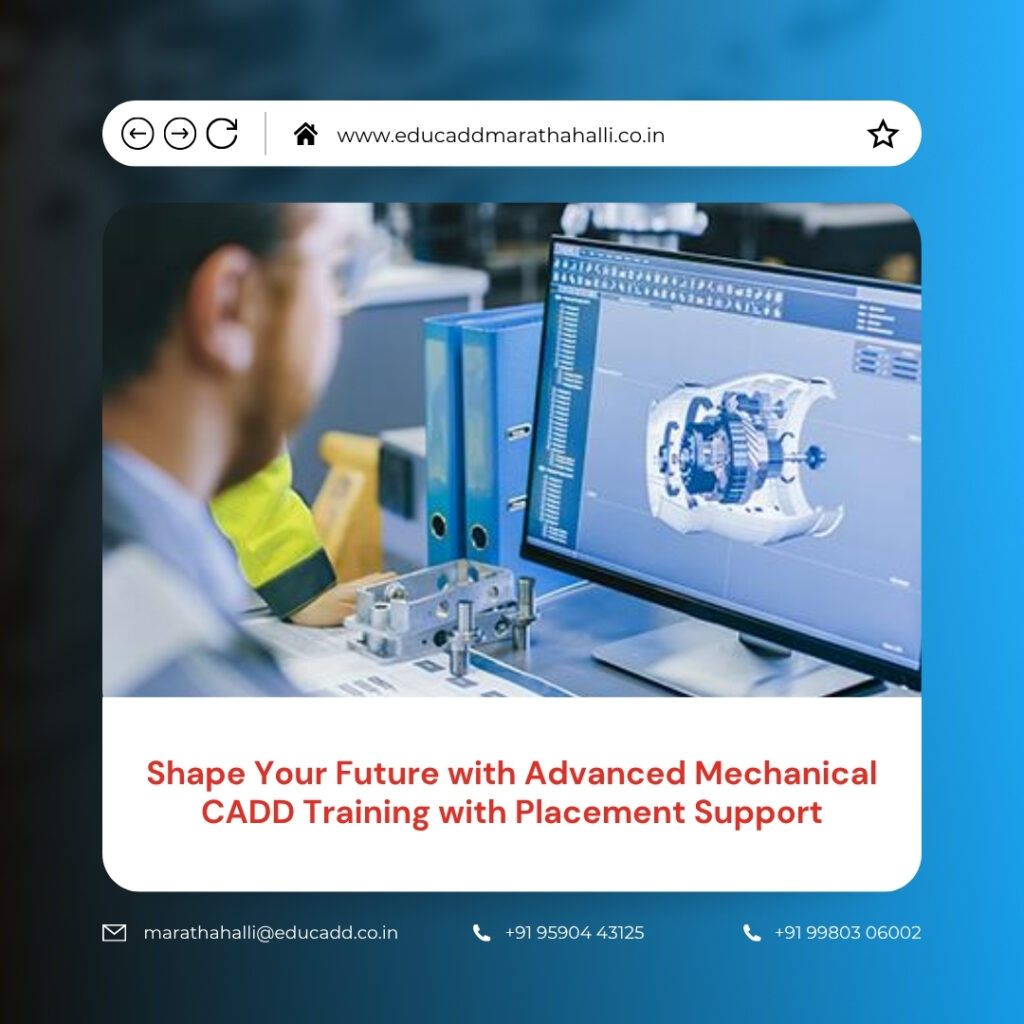
Advanced Mechanical CADD Training
Students not only master leading Mechanical CADD software but also develop the confidence to work on real engineering assignments from day one. With expert trainers, live projects, interview preparation, and career guidance, learners become job-ready professionals capable of contributing to modern engineering organizations. If you are looking for a career that offers stability, excellent salary growth, and long-term opportunities, this training program provides the perfect foundation.
Why Modern Industries Prefer Skilled Mechanical CADD Professionals
Manufacturing industries are evolving rapidly because customers expect innovative products with higher quality and shorter production cycles. To achieve these goals, companies depend heavily on engineers who can design accurate components, prepare manufacturing drawings, improve product performance, and reduce production costs. Mechanical CADD software has transformed the way products are designed by allowing engineers to visualize ideas digitally before production begins. This approach minimizes errors, reduces material wastage, improves communication, and shortens product development time.
As a result, organizations actively recruit candidates who have practical knowledge of Mechanical CADD applications instead of relying solely on academic qualifications. Professionals who understand drafting standards, assembly modeling, sheet metal design, and engineering documentation can immediately contribute to ongoing projects. Furthermore, industries appreciate engineers who are familiar with real production workflows because they require less training after recruitment. Therefore, enrolling in Advanced Mechanical CADD Training significantly increases your employability while helping you stay ahead in today’s competitive engineering job market.
Learn Industry-Leading Mechanical CADD Software from Experts
One of the biggest advantages of joining an advanced Mechanical CADD program is the opportunity to learn multiple software applications that industries use every day. Instead of limiting students to a single design platform, professional training introduces several engineering tools that prepare learners for diverse industrial environments. This comprehensive approach ensures graduates remain flexible and adaptable throughout their careers.
Students generally begin with AutoCAD Mechanical to develop strong drafting skills and understand engineering drawing standards. Once these fundamentals become clear, they move toward powerful three-dimensional modeling software such as SolidWorks, CATIA, Creo Parametric, Autodesk Inventor, or Siemens NX. These applications enable students to create detailed parts, complex assemblies, exploded views, production drawings, and manufacturing documentation. Additionally, learners gain exposure to surface modeling, sheet metal components, weldment structures, product visualization, simulation basics, and engineering modifications. Since every software platform has unique industrial applications, mastering multiple tools greatly expands career opportunities across different manufacturing sectors.
Practical Project-Based Learning Creates Industry-Ready Engineers
Theoretical knowledge alone cannot prepare someone for the challenges of today’s engineering workplace. Companies expect engineers to understand practical design processes, solve technical problems, and complete projects within deadlines. Therefore, project-based learning forms an essential part of Advanced Mechanical CADD Training. Every concept taught in the classroom is reinforced through extensive hands-on practice that closely resembles actual industrial work.
Students design machine components, industrial equipment, automotive assemblies, mechanical fixtures, conveyors, production tools, and manufacturing systems throughout the course. Each project develops technical accuracy while encouraging logical thinking and creativity. Moreover, learners understand how design decisions affect manufacturing, quality, assembly, maintenance, and overall product performance. Regular assignments also improve speed, precision, and confidence while familiarizing students with professional engineering documentation. By completing numerous industry-oriented projects, students graduate with an impressive portfolio that demonstrates their technical abilities during placement interviews.
Comprehensive Curriculum That Matches Current Industry Requirements
Engineering technology changes continuously, which means outdated training methods cannot prepare students for modern careers. A well-designed Mechanical CADD curriculum focuses on current industrial practices rather than simply teaching software commands. The objective is to develop engineers who understand complete product development instead of becoming software operators alone.
The curriculum generally includes engineering drawing interpretation, geometric dimensioning and tolerancing, manufacturing processes, machine elements, material selection, assembly techniques, design validation, tolerance analysis, drafting standards, product lifecycle concepts, and documentation practices. Students also learn how engineering departments coordinate with production, procurement, quality assurance, and maintenance teams throughout the product development cycle. In addition, they understand design optimization methods that improve efficiency while reducing production costs. This balanced combination of engineering knowledge and software expertise enables students to perform effectively from their very first job while adapting quickly to evolving industrial technologies.
Experienced Trainers Make Learning Practical and Career-Focused
The quality of training depends greatly on the expertise of the instructors. Learning Mechanical CADD software from professionals who have worked in real engineering environments provides students with knowledge that goes far beyond textbooks. Experienced trainers explain not only how software tools function but also why specific design methods are preferred in different industries. Their practical exposure allows students to understand the complete engineering workflow, from conceptual design to manufacturing and final product inspection.
During Advanced Mechanical CADD Training, trainers share valuable insights gained from working on live industrial projects. They explain common design mistakes, methods for improving productivity, techniques for reducing manufacturing errors, and best practices followed by leading engineering companies. Students are encouraged to ask questions, solve challenging design problems, and explore different engineering approaches. Regular interaction with industry experts helps learners develop confidence while strengthening their technical foundation. Personalized guidance ensures that every student progresses steadily regardless of their previous experience. This practical mentoring creates a positive learning environment where students continuously improve their knowledge, software skills, and problem-solving abilities.
Hands-On Workshops Strengthen Technical Confidence
Classroom instruction becomes much more effective when it is supported by extensive practical sessions. Engineering is a profession that requires continuous practice, and every successful Mechanical CADD professional spends countless hours refining design techniques. Therefore, advanced training programs dedicate significant time to laboratory sessions, workshops, and software practice instead of relying only on theoretical explanations.
Students repeatedly work on industrial drawings, create three-dimensional models, prepare assembly layouts, generate manufacturing documentation, and perform design modifications based on changing project requirements. Every workshop introduces new challenges that improve technical accuracy and efficiency. As learners gain experience, they become comfortable handling complex assemblies, intricate machine components, and detailed production drawings. Furthermore, repeated practice improves keyboard shortcuts, modeling speed, drafting precision, and design consistency. These improvements make students more productive and confident during technical interviews as well as in professional engineering environments. Continuous practical exposure transforms beginners into capable engineers who can confidently contribute to real industrial projects.
Placement Support Gives Students a Competitive Advantage
One of the biggest reasons students choose Advanced Mechanical CADD Training is the opportunity to receive structured career guidance along with technical education. Even highly skilled candidates sometimes struggle to secure employment because they lack interview preparation, resume-building skills, or confidence during recruitment processes. A comprehensive placement program bridges this gap by preparing students for every stage of the hiring process.
Placement assistance usually begins with professional resume creation that highlights technical competencies, software expertise, academic achievements, and project experience. Students then participate in aptitude training, communication development sessions, group discussions, mock interviews, and technical interview practice. Trainers also conduct personality development workshops that help candidates present themselves professionally before recruiters. In addition, students receive guidance on corporate etiquette, workplace expectations, and career planning. Since many reputed training institutes maintain strong relationships with manufacturing companies, engineering consultancies, automotive industries, and design firms, learners receive regular interview opportunities. This combination of technical preparation and placement assistance significantly improves the chances of securing rewarding engineering positions immediately after course completion.
Diverse Career Opportunities Await Skilled Mechanical CADD Professionals
Mechanical engineering offers one of the broadest career landscapes because almost every manufacturing sector depends on skilled design professionals. After completing Advanced Mechanical CADD Training, graduates can explore opportunities across industries that manufacture products ranging from small consumer appliances to massive industrial machinery. The versatility of Mechanical CADD skills allows professionals to work in organizations of different sizes while choosing roles that match their interests and long-term career goals.
Fresh graduates often begin as Mechanical CAD Engineers, Design Engineers, Drafting Engineers, Product Development Engineers, Tool Design Engineers, Production Support Engineers, Design Documentation Specialists, or Mechanical Modeling Engineers. As they gain practical experience, they can advance into senior design roles, project engineering positions, technical consultancy, product development leadership, or engineering management. Industries such as automotive manufacturing, aerospace engineering, industrial equipment production, heavy machinery, robotics, renewable energy, construction equipment, consumer products, and precision engineering actively recruit skilled Mechanical CADD professionals. Because these sectors continue expanding with technological advancements, qualified engineers enjoy stable employment, attractive salary packages, and continuous professional growth throughout their careers.
Building Essential Workplace Skills Beyond Technical Knowledge
Technical software expertise forms the foundation of an engineering career, but employers also value professionals who possess strong workplace skills. Successful engineers communicate effectively, collaborate with multidisciplinary teams, solve problems efficiently, and adapt to changing project requirements. For this reason, modern training programs integrate professional development alongside technical education to prepare students for corporate environments.
Throughout Advanced Mechanical CADD Training, students participate in technical presentations, collaborative assignments, engineering discussions, and design review sessions. These activities improve communication skills while encouraging teamwork and critical thinking. Learners also develop project planning abilities, time management techniques, analytical reasoning, and decision-making skills that help them perform efficiently under project deadlines. Furthermore, they understand professional ethics, documentation standards, quality awareness, and organizational responsibilities expected in engineering companies. These additional competencies make graduates more valuable to employers because they can contribute effectively to both technical tasks and collaborative engineering projects. As a result, students enter the workforce with the confidence to handle responsibilities independently while maintaining high professional standards.
Keeping Pace with Emerging Engineering Technologies
Engineering is experiencing one of the biggest technological transformations in history. Modern manufacturing companies are adopting smart factories, automation, digital twins, cloud collaboration, and intelligent production systems to improve efficiency and product quality. These innovations have changed the role of mechanical engineers, making advanced digital design skills more important than ever before. Professionals who continuously update their knowledge remain valuable because they can quickly adapt to new engineering methods and contribute to innovation within their organizations.
Advanced Mechanical CADD Training with Placement Support introduces students to the latest trends shaping the future of mechanical engineering. Along with mastering design software, learners gain an understanding of modern product development workflows, design automation, simulation techniques, manufacturing integration, and digital engineering practices. They also become familiar with concepts such as parametric modeling, design optimization, collaborative engineering, and product lifecycle management. These technologies allow engineering teams to reduce design errors, improve communication, and accelerate product development. Since industries increasingly rely on digital solutions, professionals who understand these advanced engineering concepts enjoy stronger career prospects and greater job security. Continuous learning also enables engineers to remain competitive as technology evolves throughout their professional journey.
A Valuable Learning Path for Fresh Graduates and Working Professionals
One of the greatest strengths of Advanced Mechanical CADD Training with Placement Support is its suitability for learners from different educational and professional backgrounds. Fresh graduates often possess strong theoretical knowledge but require practical exposure before entering the engineering industry. This training bridges that gap by providing extensive software practice, live projects, and industry-oriented learning that transforms academic knowledge into practical expertise.
Working professionals also benefit significantly from advanced Mechanical CADD training. Many engineers begin their careers in production, quality control, maintenance, or manufacturing support before realizing the importance of advanced design skills. By upgrading their knowledge, they become eligible for higher-paying design roles, product development positions, and leadership opportunities. Diploma holders can strengthen their technical capabilities and compete confidently with engineering graduates in the job market. Even professionals looking for a career transition into design engineering find this course highly beneficial because it provides structured learning and practical experience. Regardless of previous experience, every learner gains valuable skills that support long-term career growth. The combination of technical education, project exposure, and placement support creates opportunities for individuals who are committed to building successful engineering careers.
Continuous Assessments and Industrial Projects Build Professional Confidence
Learning becomes more effective when students regularly evaluate their progress through practical assignments and real-world challenges. Instead of depending only on written examinations, professional Mechanical CADD training emphasizes continuous assessment throughout the learning process. Each practical exercise helps students strengthen their understanding while gradually increasing their confidence in handling complex engineering tasks.
Students complete numerous drafting assignments, component modeling exercises, assembly projects, sheet metal designs, manufacturing drawings, and engineering documentation during the course. Every project introduces new technical concepts while encouraging logical thinking and creative problem-solving. Trainers carefully review each assignment and provide constructive feedback that helps students improve accuracy, efficiency, and design quality. In addition, learners participate in project presentations where they explain design decisions and demonstrate their technical knowledge. This experience prepares them for technical interviews and workplace discussions with confidence. By the end of Advanced Mechanical CADD Training with Placement Support, students have developed a strong project portfolio that showcases their abilities to prospective employers. Such practical achievements often become a deciding factor during recruitment because companies prefer candidates who can demonstrate real engineering capabilities instead of theoretical understanding alone.
Invest in Mechanical CADD Skills for a Rewarding Long-Term Career
Every successful engineering career begins with the right investment in knowledge and practical skills. As industries continue expanding and adopting advanced manufacturing technologies, the demand for qualified Mechanical CADD professionals will continue to increase. Organizations require engineers who can design innovative products, improve manufacturing efficiency, reduce development costs, and support business growth through modern engineering solutions. Professionals with advanced software expertise therefore enjoy excellent opportunities for career advancement across multiple industries.
Completing Advanced Mechanical CADD Training with Placement Support is not merely about learning software—it is about building a strong professional foundation that supports lifelong career success. Graduates develop technical expertise, practical experience, industry awareness, communication skills, and professional confidence that remain valuable throughout their careers. With continuous learning and experience, Mechanical CADD professionals can specialize in product design, industrial automation, automotive engineering, aerospace systems, heavy equipment manufacturing, research and development, or engineering consultancy. Many also advance into project management, technical leadership, and entrepreneurial ventures after gaining industry experience. This broad range of opportunities makes Mechanical CADD one of the most promising career paths for aspiring engineers who seek stability, professional satisfaction, and continuous growth.
Conclusion
The future of mechanical engineering belongs to professionals who combine strong engineering fundamentals with advanced digital design expertise. Industries across the world are investing heavily in innovative product development, intelligent manufacturing, and modern engineering technologies, creating a growing demand for highly skilled Mechanical CADD professionals. Students who develop practical knowledge through structured training gain a significant advantage because they can contribute immediately to industrial projects while adapting quickly to changing technological requirements.
Advanced Mechanical CADD Training with Placement Support offers a complete career development experience by combining comprehensive software education, hands-on project work, expert guidance, industry-oriented curriculum, professional skill development, and dedicated placement assistance. Rather than focusing only on software commands, the program prepares students to solve real engineering challenges with confidence and precision. Whether you are a fresh graduate, diploma holder, or experienced professional aiming for career advancement, this training equips you with the technical knowledge and practical exposure needed to achieve your goals. By choosing a high-quality Mechanical CADD program today, you invest in a future filled with exciting opportunities, continuous learning, excellent career growth, and long-term success in the ever-evolving world of engineering.

