
Design Beyond Imagination: Build a Rewarding Career with an Advanced Interior Design Training Program
Interior design is no longer limited to decorating homes with attractive furniture and colorful accessories. Today, it has become a highly respected profession that combines creativity, technical expertise, functionality, and innovation. Every modern residential apartment, luxury villa, corporate office, retail showroom, hotel, restaurant, healthcare facility, and commercial building requires carefully planned interiors that enhance both aesthetics and user experience. As people’s expectations continue to evolve, the demand for skilled interior designers is growing rapidly across industries. An Advanced Interior Design Training Program offers the perfect pathway for aspiring designers who want to transform their creativity into a successful profession. Instead of teaching only design theories, this comprehensive training emphasizes practical learning, software mastery, project execution, and professional portfolio development.
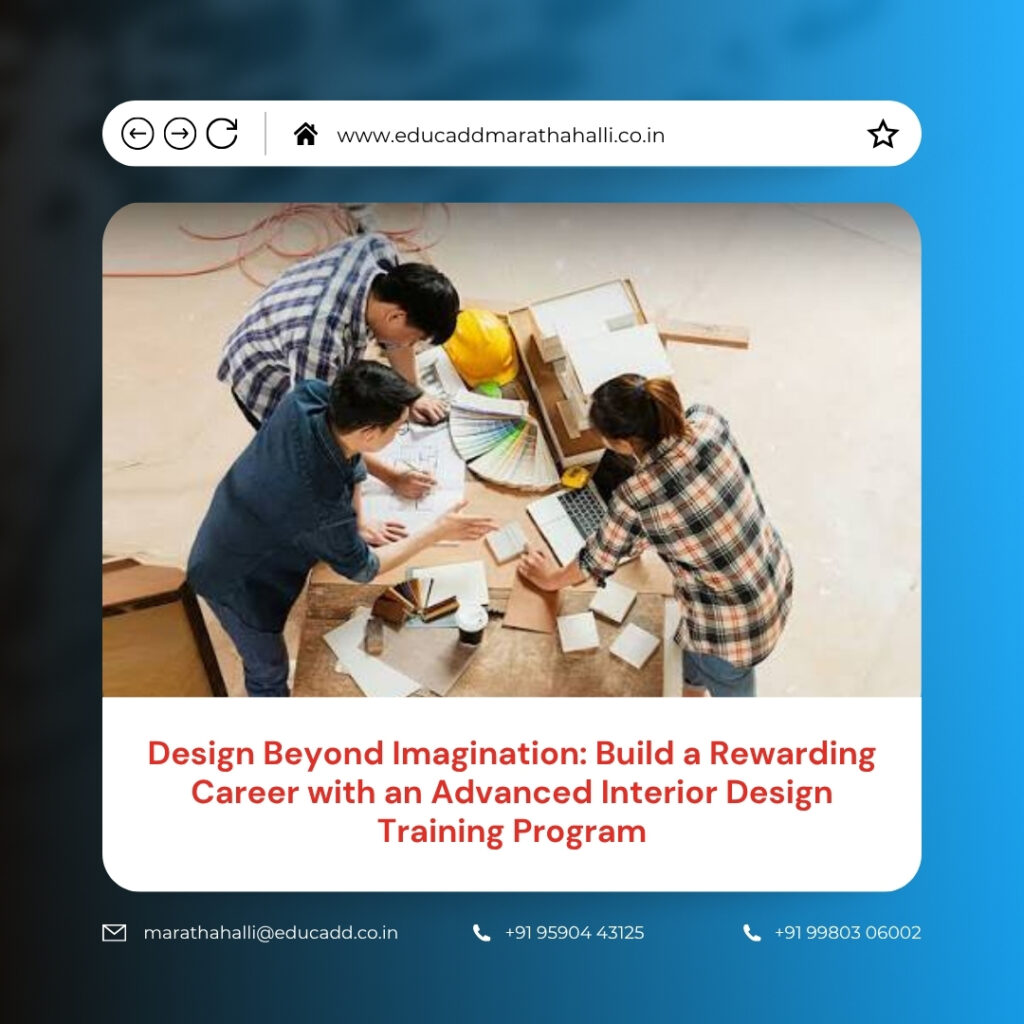
Advanced Interior Design Training
Students gain valuable industry exposure while learning from experienced trainers who understand current market expectations. Whether you are a beginner looking for your first opportunity or a professional seeking career advancement, this program provides the knowledge, confidence, and practical skills needed to succeed in today’s competitive interior design industry.
Discover the True Scope of Modern Interior Design
Interior design has expanded far beyond traditional decoration. Today’s designers actively participate in planning spaces that improve comfort, productivity, functionality, and sustainability. An Advanced Interior Design Training introduces students to the complete scope of modern interior design while preparing them for real-world responsibilities.
Students learn how interior designers collaborate with architects, civil engineers, contractors, lighting consultants, and clients throughout every stage of a project. They understand how different design elements work together to create practical and visually appealing environments. This broad understanding helps learners appreciate the importance of professional planning before construction begins. As a result, they develop the ability to approach projects with confidence while balancing creativity with technical precision.
Build Strong Design Fundamentals That Last Throughout Your Career
Every outstanding designer begins by mastering the basic principles of interior design. These principles remain relevant regardless of changing trends or technological advancements. An Advanced Interior Design Training ensures students build a strong foundation before progressing toward advanced concepts.
Learners study balance, harmony, rhythm, scale, proportion, contrast, emphasis, texture, and color relationships. They also understand human behavior, spatial organization, furniture arrangements, circulation planning, and ergonomic considerations. These concepts allow designers to create interiors that not only look attractive but also function efficiently for everyday use. Strong fundamentals make it easier to solve design challenges and produce consistent results across residential and commercial projects.
Master Professional Design Software Used Across the Industry
Technology has revolutionized the interior design profession. Clients expect realistic visualizations before approving any project, making software proficiency an essential skill for every designer. An Advanced Interior Design Training provides extensive training on professional software widely used throughout the design and construction industries.
Students become familiar with AutoCAD for technical drafting, SketchUp for three-dimensional modeling, 3ds Max for realistic visualization, V-Ray for high-quality rendering, and Photoshop for presentation enhancement. Practical assignments help learners convert concepts into detailed drawings and lifelike interior views. By mastering these digital tools, students improve their productivity while meeting the professional standards expected by employers and clients alike.
Develop Practical Skills Through Real Project Experience
Practical learning creates the biggest difference between ordinary education and career-focused training. Employers prefer candidates who understand actual project workflows rather than theoretical concepts alone. Therefore, an Advanced Interior Design Training emphasizes extensive hands-on experience throughout the learning journey.
Students complete residential layouts, office interiors, retail stores, hospitality projects, modular kitchens, living rooms, bedrooms, commercial workspaces, and luxury villa concepts. Each project involves planning layouts, selecting materials, preparing furniture arrangements, designing lighting schemes, and presenting complete visualizations. Working on diverse assignments allows learners to experience realistic design challenges while steadily improving their technical and creative abilities.
Understand Space Planning for Functional and Beautiful Interiors
Successful interiors combine visual appeal with practical usability. Even the most attractive design loses its value if people cannot use the space comfortably. An Advanced Interior Design Training Program teaches students how to maximize available space without sacrificing beauty or convenience.
Learners understand zoning techniques, movement patterns, furniture placement, storage optimization, accessibility standards, and room proportions. They evaluate how natural light, ventilation, circulation, and furniture dimensions influence everyday comfort. This knowledge enables designers to create spaces that support different lifestyles and business requirements. Effective space planning also improves client satisfaction because well-designed interiors remain comfortable for many years.
Explore Materials, Textures, and Modern Finishing Techniques
Material selection significantly influences the appearance, durability, maintenance, and overall performance of interior spaces. Professional designers must understand how different materials behave before recommending them for specific projects. An Advanced Interior Design Training Program provides detailed knowledge of modern interior materials and finishing solutions.
Students learn about flooring systems, ceiling materials, wall treatments, decorative panels, furniture finishes, laminates, veneers, glass applications, metal finishes, fabrics, wallpapers, lighting fixtures, and sustainable alternatives. They compare material properties while considering durability, maintenance requirements, aesthetics, environmental impact, and project budgets. This comprehensive understanding helps designers make informed decisions that satisfy both functional and visual expectations.
Transform Creative Ideas into Practical Design Concepts
Creativity forms the heart of interior design, but successful designers also know how to organize creative ideas into structured concepts. An Advanced Interior Design Training Program teaches learners systematic methods for converting inspiration into complete design solutions that meet client expectations.
Students prepare concept boards, mood boards, color palettes, furniture themes, lighting concepts, material collections, and presentation layouts that communicate their vision clearly. They study contemporary, minimalist, Scandinavian, industrial, luxury, traditional, and modern interior styles while understanding how each style influences user experience. This creative process strengthens visualization skills and encourages innovative thinking without losing sight of practical requirements. As students complete more design exercises, they become increasingly confident in presenting original concepts that balance creativity, functionality, and aesthetic excellence.
Improve Client Communication and Professional Presentation Skills
Technical knowledge alone cannot guarantee success in the interior design industry. Designers must also communicate their ideas effectively to clients, architects, contractors, and project teams. An Advanced Interior Design Training focuses on strengthening professional communication skills alongside technical training. Students learn how to understand client expectations, ask the right questions, identify project requirements, and convert ideas into practical design solutions.
The program also teaches learners how to prepare professional presentations using detailed drawings, 3D visualizations, mood boards, material boards, and rendered images. They practice explaining layouts, furniture arrangements, lighting concepts, and material selections with confidence. As their presentation skills improve, students become better prepared to handle client meetings, design discussions, and project approvals. Clear communication builds trust, minimizes misunderstandings, and helps designers establish lasting professional relationships throughout their careers.
Gain Practical Knowledge of Interior Construction and Site Execution
Creating an attractive design is only one part of an interior designer’s responsibility. Understanding how those designs are executed at construction sites is equally important. An Advanced Interior Design Training Program introduces students to construction methods that help them work efficiently with contractors and project managers during execution.
Students study false ceiling systems, flooring installation methods, wall partitions, modular furniture assembly, electrical planning, plumbing coordination, lighting installations, painting techniques, and finishing processes. They also understand construction sequences, quality control procedures, and safety considerations. This practical exposure enables learners to identify potential issues before they become costly mistakes. Consequently, designers develop greater confidence while supervising projects and ensuring that the final outcome matches the approved design.
Create a Professional Portfolio That Impresses Employers
A strong portfolio often creates a more powerful impression than a resume alone. Employers and clients prefer to evaluate practical work before selecting an interior designer. Therefore, an Advanced Interior Design Training Program encourages every student to develop a professional portfolio that reflects creativity, technical accuracy, and problem-solving abilities.
Throughout the course, students compile residential projects, commercial layouts, furniture plans, ceiling designs, lighting plans, rendered perspectives, 3D visualizations, and complete presentation sheets. Every project demonstrates their understanding of design principles, software applications, and project execution. In addition, trainers provide valuable feedback that helps students improve each project before adding it to their portfolio. A polished portfolio increases confidence during interviews and creates stronger opportunities for employment or freelance work.
Explore Diverse Career Opportunities in the Interior Design Industry
The interior design profession offers numerous career opportunities across different industries. As construction activities continue to expand, organizations actively seek professionals who can create attractive and functional spaces. Completing an Advanced Interior Design Training Program prepares students for these growing opportunities while equipping them with industry-relevant skills.
Graduates can pursue careers as Interior Designers, Space Planners, Furniture Designers, Residential Interior Consultants, Commercial Interior Designers, CAD Designers, 3D Visualization Artists, Interior Stylists, Lighting Consultants, Project Coordinators, Exhibition Designers, Kitchen Designers, or Design Consultants. Some professionals also choose entrepreneurship by establishing independent interior design firms after gaining practical experience. This wide range of career options allows learners to select paths that align with their interests, creativity, and long-term professional goals.
Stay Ahead with Emerging Interior Design Trends and Technologies
The interior design industry evolves continuously as technology, materials, and client preferences change. Designers who remain updated with modern trends consistently deliver better solutions and enjoy stronger career growth. An Advanced Interior Design Training Program introduces students to the latest developments that influence contemporary interior spaces.
Learners explore sustainable design practices, smart home integration, energy-efficient lighting, modular furniture systems, flexible workspaces, wellness-focused interiors, biophilic design concepts, eco-friendly materials, and digital visualization technologies. They also study how lifestyle changes affect residential and commercial interior planning. By understanding these emerging trends, students become capable of designing innovative spaces that satisfy current market demands while preparing themselves for future industry developments.
Learn from Experienced Industry Professionals
Expert guidance plays a significant role in professional development because experienced mentors provide practical insights that textbooks cannot offer. An Advanced Interior Design Training Program allows students to learn directly from trainers who have worked on real interior design projects across various sectors.
Through workshops, live demonstrations, project reviews, and interactive discussions, learners receive constructive feedback that helps them refine both their creative and technical skills. Trainers share industry best practices, explain common project challenges, and demonstrate effective problem-solving techniques. Students also gain valuable exposure to professional workflows, documentation standards, and client expectations. This mentorship builds confidence while preparing learners to transition smoothly from classroom learning to professional practice.
Build a Future-Proof Career with Advanced Interior Design Skills
Interior design continues to remain one of the most promising creative professions because every new building requires carefully planned interiors. Residential developments, commercial complexes, educational institutions, hospitals, hotels, retail outlets, and corporate offices all depend on skilled designers who understand functionality, aesthetics, and user experience. As urbanization continues to grow, the demand for qualified professionals is expected to increase even further.
An Advanced Interior Design Training Program equips learners with comprehensive technical knowledge, creative thinking abilities, software expertise, construction awareness, and practical project experience that employers value highly. These combined skills enable graduates to adapt confidently to changing industry requirements while delivering exceptional design solutions. Whether students choose employment, freelancing, or entrepreneurship, advanced training creates a strong foundation for continuous professional growth, financial stability, and long-term career success.
Conclusion
Choosing an Advanced Interior Design Training Program is a smart investment for individuals who aspire to build a successful career in the rapidly expanding interior design industry. The program goes beyond traditional classroom learning by combining creative development, technical expertise, software proficiency, construction knowledge, and hands-on project experience into one comprehensive learning journey. Students graduate with the confidence to handle real-world projects, communicate effectively with clients, and deliver innovative interior solutions that balance beauty with functionality.
As the demand for skilled interior designers continues to rise across residential, commercial, hospitality, healthcare, and retail sectors, professionally trained designers enjoy excellent career prospects and continuous opportunities for growth. By enrolling in an Advanced Interior Design Training, learners prepare themselves to meet industry expectations, embrace new technologies, and create inspiring spaces that leave a lasting impact. With dedication, practical training, and continuous learning, aspiring designers can transform their passion into a rewarding and future-ready profession.

