
Sheet Metal Design Course: Turn Your Design Skills into Precision Engineering Excellence
Introduction
Modern manufacturing needs designers who can turn simple ideas into accurate, practical, and production-ready products. Sheet metal plays a major role in industries such as automotive, aerospace, electronics, construction, and industrial machinery. As product designs become more advanced, companies need professionals who understand both design concepts and manufacturing requirements. This is where a Sheet Metal Design Course can make a real difference.
A strong course helps learners understand how sheet metal components are planned, modeled, developed, and prepared for manufacturing. It also builds practical knowledge of design software, material behavior, bending, cutting, joining, and fabrication methods. As a result, students can develop skills that match real industry needs.
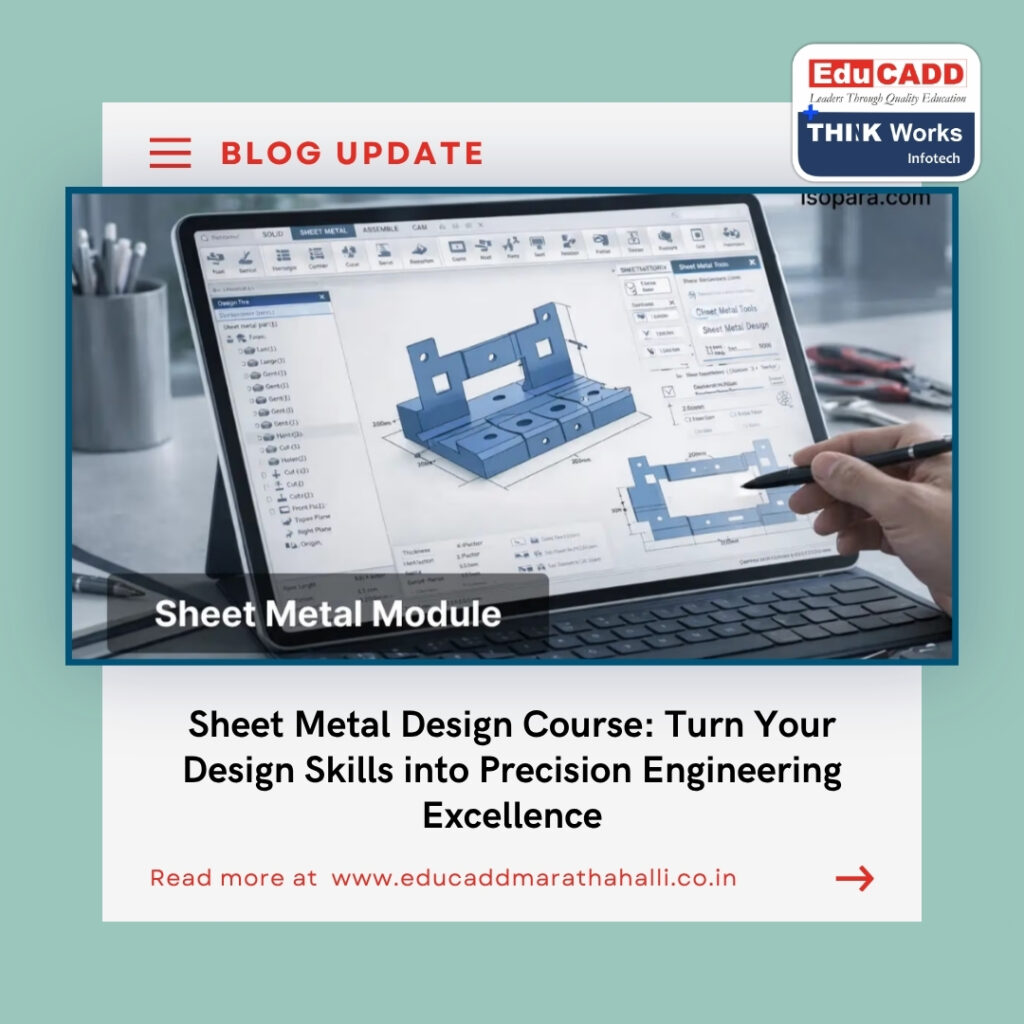
Sheet Metal Design Course
Whether you are a mechanical engineering student, graduate, working professional, or aspiring CAD designer, learning sheet metal design can open new career opportunities. With practical training and consistent practice, you can move from basic CAD knowledge to confident product design.
Why Sheet Metal Design Is Important in Modern Manufacturing
Sheet metal components are found in almost every modern product. Electrical cabinets, automotive panels, machine covers, brackets, enclosures, ducts, and equipment frames often use sheet metal. These parts need accurate dimensions and clean designs. Even a small design error can affect assembly, strength, cost, and production time.
A Sheet Metal Design Course introduces learners to the complete design process. You learn how to create accurate components while considering real manufacturing limitations. This approach is important because good design is not only about appearance. It must also support efficient production.
Sheet metal design also helps companies reduce material waste. Designers can plan bends, holes, cutouts, and flat patterns before production begins. This improves accuracy and saves valuable resources. Therefore, skilled sheet metal designers have an important role in product development and manufacturing.
What You Learn in a Sheet Metal Design Course
A well-structured Sheet Metal Design Course covers both fundamental concepts and practical applications. Instead of focusing only on software commands, quality training connects CAD tools with actual manufacturing processes.
Students can learn how to create sheet metal parts from basic sketches and convert them into detailed 3D models. They can also understand how different features affect the final manufactured component.
Important topics generally include:
- Sheet metal fundamentals and manufacturing concepts
- Material selection and thickness considerations
- 2D sketching and technical drawing
- 3D sheet metal part modeling
- Bend creation and bend allowances
- Flanges, hems, and jogs
- Cutouts, holes, and forming features
- Corner treatments and reliefs
- Flat pattern development
- Assembly and component integration
- Engineering drawings and detailing
- Design for manufacturing principles
- CAD standards and documentation
- Practical sheet metal design projects
These topics help learners understand the relationship between digital design and physical manufacturing. Moreover, project-based practice can improve confidence and problem-solving skills.
Mastering CAD Tools for Professional Sheet Metal Design
Computer-aided design software is an essential part of modern engineering. Designers use CAD platforms to create accurate models, modify components, prepare drawings, and develop manufacturing-ready designs.
During a Sheet Metal Design Course, learners can gain practical experience with industry-relevant CAD tools. Depending on the training program, this may include platforms such as SolidWorks, CATIA, Creo, AutoCAD, or other mechanical design software.
The goal is not simply to memorize commands. Instead, learners should understand why and when each tool is used. For example, creating a flange may seem simple. However, its dimensions, bend radius, material thickness, and manufacturing method can affect the final product.
Practical CAD training allows students to build models from real design requirements. This approach makes learning more useful and helps learners develop professional design habits.
Understanding Bends, Thickness, and Material Behavior
Sheet metal behaves differently from solid components. Designers must consider material thickness, bend radius, bend direction, and material properties. These factors can influence the final dimensions of a component.
Bend allowance is another important concept. When a flat sheet is bent, the material stretches or compresses. Therefore, the flat pattern cannot always use the same dimensions as the finished part. Designers need to understand how bending changes the material.
A professional Sheet Metal Design Course explains these concepts through practical examples. Learners can understand how design decisions affect manufacturing accuracy.
Material selection also matters. Steel, stainless steel, aluminum, and other materials have different properties. Their strength, flexibility, thickness, and manufacturing behavior can vary. A good designer considers these factors before finalizing a component.
From 3D Models to Accurate Flat Patterns
One of the most important skills in sheet metal design is flat pattern development. Manufacturers often begin with a flat sheet before cutting and bending it into the required shape.
CAD software can generate flat patterns from 3D sheet metal models. However, the designer must create the model correctly first. Incorrect bend settings or unsuitable design features can result in inaccurate manufacturing data.
A Sheet Metal Design Course helps learners understand this complete workflow. They can create the 3D component, apply suitable bends, generate the flat pattern, and prepare the design for production.
This skill is highly useful in industries that depend on CNC cutting, laser cutting, punching, bending, and fabrication. It also helps designers communicate clearly with production teams.
Designing for Manufacturing and Assembly
A successful design must be easy to manufacture and assemble. This principle is known as design for manufacturing and assembly, or DFM and DFA.
During a Sheet Metal Design Course, learners can develop an understanding of practical manufacturing requirements. They learn to avoid unnecessary complexity and design components that can be produced efficiently.
For example, a designer should consider:
- Suitable bend radii
- Proper hole placement
- Material thickness
- Tool access
- Bend sequence
- Minimum flange dimensions
- Corner relief
- Assembly requirements
- Manufacturing tolerances
- Material utilization
These factors can reduce production problems. They can also improve product quality and reduce manufacturing costs.
Real-World Applications of Sheet Metal Design
Sheet metal design is used across many industries. Its applications continue to grow as manufacturers develop lighter, stronger, and more efficient products.
In the automotive sector, designers work on brackets, body components, enclosures, supports, and structural parts. Aerospace companies use sheet metal for aircraft components and equipment structures. Electronics manufacturers use it for cabinets, panels, server enclosures, and protective covers.
Construction and industrial equipment companies also require skilled designers. HVAC systems use sheet metal for ducts and related components. Machinery manufacturers use sheet metal for guards, covers, frames, and control panels.
Because of this wide application, learning sheet metal design can provide flexibility across different engineering industries.
Career Opportunities After Sheet Metal Design Training
A Sheet Metal Design Course can help learners prepare for several technical career paths. The exact role depends on education, software skills, experience, and industry knowledge.
Potential career opportunities include:
- Sheet Metal Designer
- CAD Designer
- Mechanical Design Engineer
- Product Design Engineer
- CAD Engineer
- Design Engineer
- Sheet Metal Draftsman
- Manufacturing Design Engineer
- Production Design Engineer
- Mechanical CAD Professional
Fresh graduates can use project portfolios to demonstrate their abilities. Working professionals can use advanced sheet metal skills to expand their technical responsibilities.
Employers often value candidates who understand both CAD software and manufacturing processes. Therefore, practical training can provide an advantage during interviews and technical assessments.
Why Practical Training Makes a Difference
Learning software through theory alone may not prepare students for professional work. Real design tasks often include incomplete information, changing requirements, and manufacturing limitations.
Practical projects provide an opportunity to solve these challenges. Students can work on components such as brackets, enclosures, cabinets, machine covers, and fabricated assemblies.
A strong Sheet Metal Design Course should encourage learners to create complete projects. Each project can involve concept development, modeling, modification, detailing, and documentation.
This hands-on approach also helps students understand mistakes. They can identify why a model fails and learn how to improve it. Over time, this builds stronger design thinking and confidence.
Skills That Can Strengthen Your Design Career
Technical software knowledge is important, but successful designers need more than CAD commands. They must understand dimensions, tolerances, materials, manufacturing processes, and engineering communication.
Important skills include:
- 3D modeling
- Engineering drawing
- Design interpretation
- Manufacturing awareness
- Problem-solving
- Technical documentation
- Design modification
- Assembly understanding
- Attention to detail
- Communication skills
Developing these skills alongside CAD knowledge can help learners become more effective professionals.
Who Should Join a Sheet Metal Design Course?
A Sheet Metal Design Course can benefit learners from different backgrounds. Mechanical engineering students can use it to strengthen their practical knowledge. Recent graduates can develop job-ready CAD skills before entering the industry.
Working professionals can also benefit from advanced training. If you already work with mechanical components, learning sheet metal design can help you handle a wider range of projects.
The course can also suit aspiring CAD designers who want to specialize in manufacturing-oriented design. With regular practice, learners can build a portfolio that demonstrates their capabilities.
How to Choose the Right Training Program
Choosing the right training program is important for achieving useful results. A good course should balance software learning with engineering concepts.
Before enrolling, check whether the program provides practical projects and industry-focused exercises. Also consider the software covered, trainer experience, course structure, and opportunities for hands-on practice.
Look for training that covers the complete design workflow rather than isolated software features. Learning how to create a model is useful. Learning how to create a manufacturable model is even more valuable.
It is also helpful to review the course syllabus. Make sure it covers sheet metal modeling, bends, flat patterns, drawings, assemblies, and manufacturing considerations.
Build Your Future with Sheet Metal Design Skills
Manufacturing is becoming more technology-driven. Companies need professionals who can create accurate designs while understanding production requirements. This creates a strong need for skilled CAD and mechanical design professionals.
A Sheet Metal Design Course can help learners develop this combination of technical and practical knowledge. It can introduce them to professional CAD workflows and manufacturing concepts.
With consistent practice, learners can improve their modeling speed, design accuracy, and problem-solving ability. They can also create a portfolio that reflects their technical skills.
The most important step is to keep learning. CAD software continues to evolve, and manufacturing technologies are becoming more advanced. Designers who continue developing their skills can remain competitive in a changing industry.
Conclusion
Sheet metal design connects engineering ideas with real manufacturing. It requires creativity, accuracy, technical knowledge, and an understanding of production processes. From creating 3D models to developing flat patterns, every stage requires careful planning.
A Sheet Metal Design Course can provide a structured way to develop these valuable skills. It can help students and professionals understand CAD tools, sheet metal features, manufacturing principles, and design documentation.
With practical training and project experience, learners can prepare for opportunities in mechanical design, manufacturing, product development, and CAD engineering. If you want to build a career that combines design software with real-world engineering, sheet metal design can be a strong skill to develop.
The right training can turn your CAD knowledge into practical design expertise. Start building your skills, create meaningful projects, and take your first step toward becoming a confident sheet metal design professional.

