
BIM Online Training Courses: Turn Digital Building Skills into a Future-Ready Career
Introduction
The construction industry is changing rapidly as digital technology becomes part of everyday project planning and execution. Architects, engineers, contractors, and project managers now depend on digital tools to improve accuracy, coordination, and productivity. BIM Online Training Courses provide a flexible way to develop these skills without disrupting regular studies or work. Building Information Modeling, commonly known as BIM, has become one of the most important technologies supporting this transformation. It helps professionals create intelligent digital representations of buildings and manage information throughout a project’s lifecycle.
For students and working professionals, learning BIM can open the door to exciting career opportunities in architecture, engineering, construction, and infrastructure.. Learners can understand BIM concepts, explore industry software, and practice digital workflows from almost anywhere. With the right training approach, online BIM education can become a strong foundation for building a future-ready career.
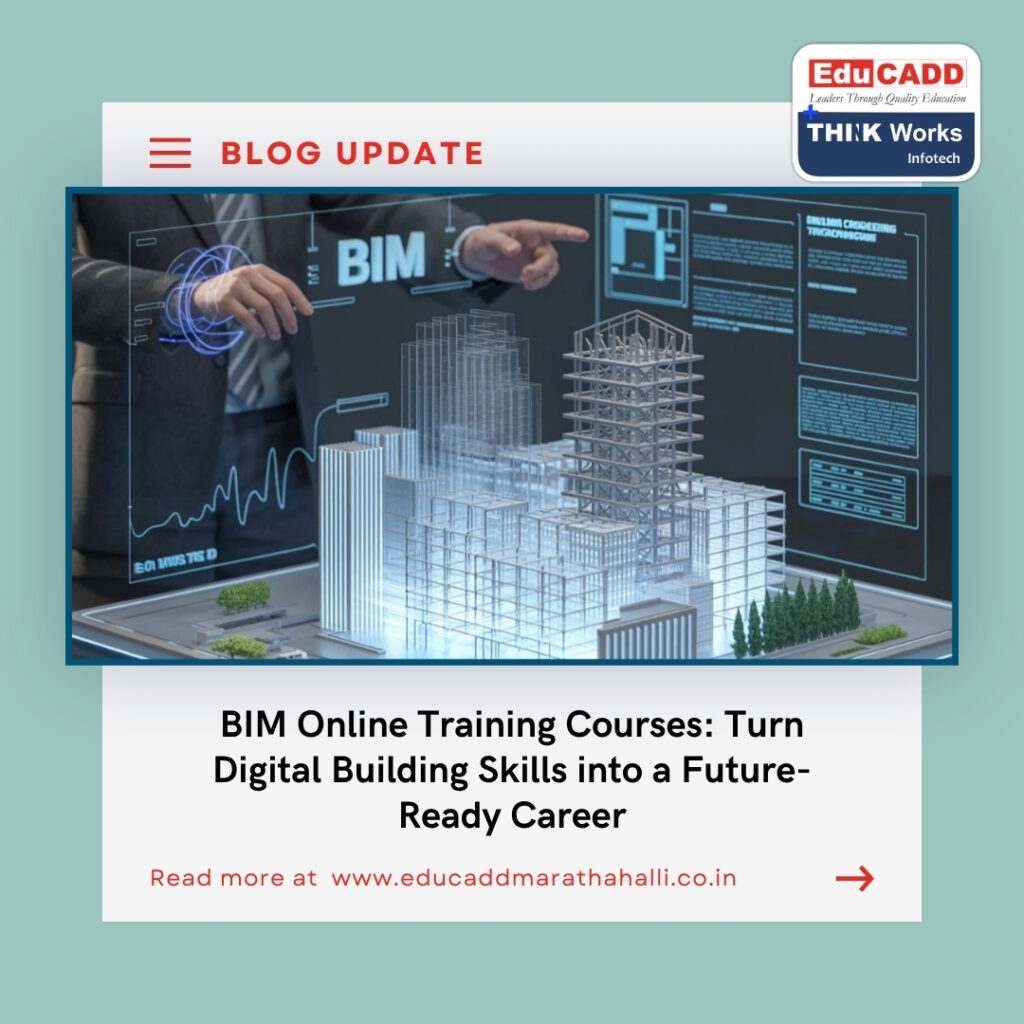
BIM Online Training Courses
Why BIM Has Become Important in Modern Construction
Traditional construction workflows often depend on separate drawings, spreadsheets, documents, and communication between multiple teams. Managing these resources can become difficult when projects become large and complex. BIM creates a more connected digital environment where project information can be organized within a shared model.
BIM allows different professionals to work with coordinated information. Architects can develop building designs, structural engineers can work on structural elements, and MEP professionals can coordinate services within the same digital environment. This approach can reduce misunderstandings and help teams identify potential issues before construction begins.
The growing use of BIM has also increased the demand for professionals who understand digital construction workflows. Therefore, learning BIM is no longer limited to software knowledge. It also involves understanding coordination, visualization, documentation, and project information management.
What Makes BIM Online Training Courses a Practical Learning Option?
Online education has changed how technical skills are developed. Instead of depending entirely on classroom schedules, learners can access lessons and practice materials through digital platforms. BIM Online Training Courses can offer a convenient learning structure for students, graduates, and professionals with different schedules.
Online training also makes it easier for learners to revisit difficult concepts. A student can review a software demonstration several times before attempting the same task independently. This creates a more comfortable learning environment, especially when dealing with complex modeling techniques.
However, the quality of training matters. A useful BIM program should combine theoretical knowledge with practical assignments. Learners should not simply watch software demonstrations. They should also create models, solve coordination challenges, prepare documentation, and understand how BIM workflows operate on real projects.
Core Skills You Can Develop Through BIM Training
BIM education covers much more than creating attractive three-dimensional models. A structured program can introduce learners to several technical and professional skills that support modern construction projects.
One important skill is digital modeling. Learners understand how to develop building components such as walls, floors, doors, windows, roofs, structural elements, and service systems. They also learn how these elements contain useful project information.
Another important area is documentation. BIM models can support the creation of plans, sections, elevations, schedules, and other construction documents. Understanding this connection helps learners see how changes within a model can influence project documentation.
Coordination is another major part of BIM. Different disciplines must work together to create a buildable project. BIM training can help learners understand how architectural, structural, and MEP models interact and how potential conflicts can be identified.
Software Knowledge Can Strengthen Your BIM Profile
Software forms an important part of BIM learning. Different projects may use different platforms, but Autodesk Revit remains widely associated with BIM-based architectural, structural, and MEP workflows. Learning Revit can help students develop detailed building models while understanding how project information connects across different views.
Navisworks is another useful platform for coordination and project review. It can help professionals combine models from different disciplines and examine potential clashes. This makes coordination skills particularly valuable for large construction projects.
AutoCAD can also remain relevant because many organizations continue to use CAD drawings alongside BIM workflows. Understanding how traditional CAD documentation connects with modern BIM processes can give learners a broader technical perspective.
Depending on the training program, learners may also explore tools related to structural analysis, project planning, visualization, quantity estimation, and construction management.
Who Can Benefit from BIM Online Learning?
BIM is useful for people from several educational and professional backgrounds. Architecture students can use it to develop better digital design and documentation skills. Civil engineering students can explore structural and construction-related workflows. Mechanical, electrical, and plumbing professionals can learn how building services coordinate within a digital model.
Working professionals can also use online training to upgrade their existing skills. Since online learning offers greater flexibility, professionals can study outside their regular working hours. This can make skill development easier without requiring a complete career break.
Graduates who are preparing for their first professional role can also benefit. Practical BIM knowledge can strengthen a portfolio and demonstrate familiarity with current digital construction practices.
Practical Projects Make BIM Learning More Valuable
One of the strongest ways to understand BIM is through project-based learning. Instead of focusing only on individual commands, learners should understand how different skills come together during a complete project.
For example, a learner might develop a residential building model from the initial layout through documentation. The project could include architectural modeling, structural coordination, MEP elements, schedules, views, and presentation drawings.
Practical projects also help learners understand common challenges. A model may contain overlapping elements, incorrect dimensions, inconsistent levels, or coordination problems. Solving these issues can develop stronger problem-solving abilities.
A good project portfolio can also become useful during interviews. Employers can gain a clearer understanding of a candidate’s practical capabilities when they can see completed models and project documentation.
Career Opportunities After Learning BIM
The growing adoption of digital construction methods has created several career paths for professionals with BIM skills. Depending on their education and specialization, learners may explore roles related to modeling, coordination, documentation, design, and project information management.
Some professionals begin their careers as BIM modelers and gradually develop advanced coordination skills. Others may specialize in architectural, structural, or MEP modeling. With experience, professionals can progress toward coordination and management responsibilities.
Potential career paths can include:
- BIM Modeler
- BIM Coordinator
- Architectural BIM Professional
- Structural BIM Professional
- MEP BIM Modeler
- BIM Engineer
- BIM Project Coordinator
- Digital Construction Professional
The exact role depends on education, technical knowledge, software expertise, project experience, and organizational requirements. Therefore, learners should focus on developing practical abilities instead of relying only on a course certificate.
How BIM Can Improve Project Efficiency
Construction projects involve many interconnected activities. Even a small design change can affect drawings, quantities, services, schedules, and construction decisions. BIM helps teams manage this information in a more connected way.
A coordinated model can make it easier to visualize a project before construction starts. Teams can identify potential design conflicts earlier and make decisions before those issues create expensive site problems.
BIM can also support better communication. A three-dimensional model can make complex design information easier to understand for both technical and non-technical stakeholders. As a result, project teams can discuss design decisions using a shared digital reference.
This does not mean BIM automatically eliminates every project problem. Instead, it provides teams with better information and tools for identifying and managing potential challenges.
What Should You Look for in BIM Online Training Courses?
Choosing the right training program is important because BIM is a practical technical discipline. Learners should evaluate the course structure before enrolling.
A strong program should provide a balance between concepts, software training, and practical assignments. Trainers should explain not only which tool to use but also why and when it should be used.
Look for training that includes:
- Industry-relevant BIM software
- Practical modeling exercises
- Realistic project assignments
- Architectural, structural, or MEP workflows
- Coordination concepts
- Documentation practice
- Trainer guidance and feedback
- Portfolio development
- Career-oriented learning
A course with practical exposure can provide more value than one focused entirely on theoretical explanations.
BIM Skills and the Future of the AEC Industry
The Architecture, Engineering, and Construction industry continues to move toward greater digital integration. BIM is becoming an important part of this transition because it connects design information with project workflows.
Future construction professionals are likely to work with increasingly connected digital environments. Technologies such as cloud collaboration, digital twins, automation, artificial intelligence, and data-driven project management may further expand the role of BIM.
For this reason, learning BIM can be viewed as more than learning a particular software application. It can help professionals develop a digital mindset that supports modern construction practices.
How to Build Confidence While Learning BIM
Learning BIM requires patience and consistent practice. Beginners may initially find digital modeling complicated because several tools and concepts need to be understood together. However, regular practice can make the learning process much easier.
Start with fundamental concepts before moving toward advanced workflows. Understand levels, views, components, families, dimensions, documentation, and project organization. Once the foundation becomes clear, learners can gradually explore advanced modeling and coordination techniques.
It is also useful to practice outside formal lessons. Recreating a simple building, experimenting with different design options, and reviewing completed projects can strengthen technical confidence.
Most importantly, learners should focus on understanding the workflow rather than memorizing commands. Software features may change over time, but strong BIM principles remain valuable.
Why BIM Can Be a Smart Career Investment
The construction industry needs professionals who can combine technical knowledge with digital capabilities. A qualification in architecture, civil engineering, mechanical engineering, electrical engineering, or a related field can become even more valuable when supported by practical BIM skills.
BIM Online Training Courses can provide a flexible route for learners who want to develop these capabilities. They can study technical concepts, practice software, complete projects, and gradually build a professional portfolio.
However, career growth depends on more than completing training. Continuous learning, project exposure, communication skills, problem-solving ability, and industry awareness also play important roles.
Building a Future with Digital Construction Skills
BIM is changing how construction professionals plan, design, coordinate, and manage projects. As digital workflows become more common, professionals who understand these systems can position themselves for evolving opportunities across the AEC industry.
Choosing quality BIM Online Training Courses can be an important first step for anyone who wants to enter or advance within this field. With structured learning, practical projects, software knowledge, and consistent practice, learners can develop skills that align with modern construction requirements.
The most valuable BIM professionals will not simply know how to create models. They will understand how those models support communication, coordination, decision-making, and project delivery. Building that combination of technical and practical knowledge can create a stronger foundation for long-term career growth.
Conclusion
The future of construction is becoming increasingly digital, and BIM is at the center of this transformation. From design and documentation to coordination and project management, BIM helps professionals work with information in a more connected way.
For students, graduates, and working professionals, BIM Online Training Courses offer an accessible way to develop relevant digital construction skills. The right program can provide software knowledge, practical experience, and an understanding of real project workflows.
With consistent practice and a strong learning foundation, BIM skills can become a valuable addition to your professional profile. More importantly, they can prepare you to participate confidently in an industry that is becoming smarter, more connected, and increasingly technology-driven.

