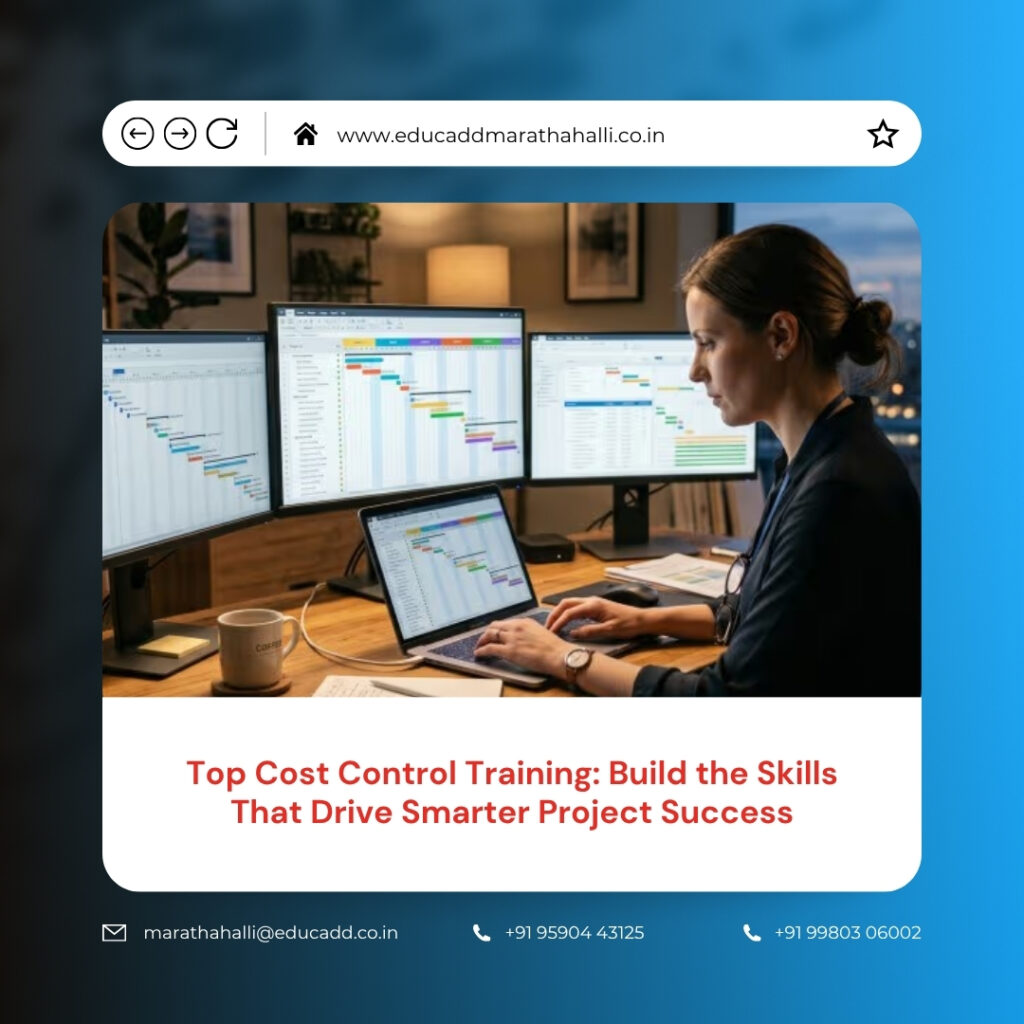
Top Cost Control Training: Build the Skills That Drive Smarter Project Success
In today’s competitive construction, engineering, manufacturing, and infrastructure industries, managing project costs has become more important than ever. Every organization aims to complete projects on time, maintain quality standards, and stay within the approved budget. This is where Top Cost Control Training plays a vital role. Professionals who understand cost planning, budgeting, forecasting, and financial monitoring are highly valued because they help organizations reduce waste and improve profitability.
Top Cost Control Training
Whether you are a civil engineer, project manager, quantity surveyor, planning engineer, or fresh graduate, enrolling in Top Cost Control Training can significantly improve your career prospects. This specialized training equips learners with practical knowledge, industry-standard techniques, and software skills that enable them to control project expenses efficiently. As industries continue to demand better financial management, trained cost control professionals enjoy better career opportunities, higher salaries, and increased responsibilities.
Why Top Cost Control Training Is Essential for Modern Projects
Projects today involve multiple stakeholders, complex workflows, and strict financial targets. Even a small deviation in cost planning can affect the entire project schedule and profitability. Therefore, organizations actively seek professionals who can monitor expenses while ensuring that project quality remains uncompromised.
Top Cost Control provides a structured understanding of project budgeting, cost estimation, financial reporting, and variance analysis. It enables professionals to identify cost overruns early and implement corrective actions before they become major financial issues. As a result, companies achieve better project performance and improved client satisfaction.
Understanding the Fundamentals of Cost Control
Cost control begins long before project execution. It starts with accurate planning, estimating, budgeting, and continuous monitoring throughout the project lifecycle. Professionals learn how each phase influences the final project cost and how proper financial management contributes to successful project delivery.
During Top Cost Control Training, participants understand the relationship between project scope, schedule, resources, and budget. They also learn how changes in one area affect overall project costs. This holistic approach helps professionals make informed financial decisions while minimizing unnecessary expenditures.
Key Skills Developed Through Top Cost Control Training
A quality training program focuses on practical skills that employers actively seek. Learners gain expertise in preparing budgets, tracking project expenses, forecasting future costs, and evaluating financial performance using real-world case studies.
Additionally, Top Cost Control Training enhances analytical thinking and decision-making abilities. Professionals become skilled at interpreting cost reports, identifying financial risks, and recommending effective solutions. These competencies improve project efficiency while supporting organizational profitability and long-term business growth.
Learning Cost Estimation Techniques for Better Planning
Accurate cost estimation serves as the foundation of successful project management. Poor estimates often lead to budget overruns, delayed schedules, and dissatisfied clients. Therefore, mastering estimation techniques is essential for every project professional.
During Top Cost Control Training, learners explore various estimation methods, including conceptual estimates, preliminary estimates, detailed estimates, and quantity-based calculations. They understand how labor, materials, equipment, subcontractors, and contingency costs contribute to total project expenses. Consequently, professionals develop greater confidence when preparing reliable project budgets.
Budget Preparation and Financial Planning Strategies
Creating a realistic budget requires more than simply adding estimated costs. It involves resource allocation, financial forecasting, risk assessment, and contingency planning. Proper budgeting ensures sufficient funding remains available throughout project execution.
Top Cost Control Training teaches professionals how to prepare comprehensive budgets using systematic approaches. Participants learn budget allocation techniques, cash flow planning, funding schedules, and expenditure tracking methods. Furthermore, they discover how proactive financial planning minimizes unexpected expenses and supports successful project completion.
Monitoring Project Costs Throughout Execution
Cost monitoring remains one of the most critical responsibilities during project execution. Without continuous monitoring, small financial deviations can quickly develop into major budget problems that threaten project success.
Professionals attending Top Cost Control Training learn how to compare planned costs with actual expenditures regularly. They understand how to generate financial reports, monitor resource utilization, evaluate contractor performance, and measure project progress. Therefore, organizations can identify potential cost overruns early and implement timely corrective actions.
Using Earned Value Management for Performance Analysis
Earned Value Management has become an essential project management technique for evaluating schedule and cost performance simultaneously. It provides measurable indicators that help project teams assess overall project health.
Within Top Cost Control Training, learners understand concepts such as Planned Value, Earned Value, Actual Cost, Cost Performance Index, and Schedule Performance Index. These valuable performance indicators enable professionals to measure productivity accurately while predicting future project outcomes with greater confidence.
Software Tools Used in Cost Control Management
Modern projects rely heavily on digital technologies for financial management and reporting. Manual calculations consume valuable time and often increase the possibility of errors. Therefore, software knowledge has become equally important.
Top Cost Control Training introduces participants to widely used project management and cost control software. Learners gain practical exposure to Microsoft Excel, Primavera P6, Microsoft Project, ERP systems, and specialized cost management applications. As a result, they improve reporting accuracy while increasing workplace productivity and efficiency.
Managing Risks That Influence Project Costs
Every project faces uncertainties that can affect financial performance. Material price fluctuations, labor shortages, design modifications, weather conditions, and supply chain disruptions all contribute to cost variations.
Professionals enrolled in Top Cost Control Training learn systematic risk management techniques that minimize financial uncertainty. They identify potential risks, evaluate their impact, prepare mitigation strategies, and develop contingency plans. Consequently, organizations maintain stronger financial control even when unexpected situations arise.
Career Opportunities After Completing Top Cost Control Training
The demand for skilled cost control professionals continues to grow across multiple industries. Construction companies, manufacturing organizations, oil and gas firms, infrastructure developers, consulting companies, and engineering contractors all require qualified specialists.
Completing Top Cost Control Training opens career opportunities such as Cost Control Engineer, Planning Engineer, Project Cost Analyst, Budget Controller, Quantity Surveyor, Project Coordinator, Financial Planner, Estimation Engineer, and Project Controls Specialist. These positions offer excellent career growth because organizations increasingly recognize the importance of effective financial management.
Industries That Benefit from Cost Control Professionals
Cost control skills are valuable across numerous sectors beyond traditional construction. Industries involved in large-scale investments require professionals capable of maintaining financial discipline while supporting operational excellence.
Graduates of Top Cost Control Training find rewarding careers in infrastructure development, renewable energy, transportation, manufacturing, aviation, real estate, healthcare projects, industrial plants, marine engineering, and government development initiatives. Since financial accountability remains a universal requirement, cost control expertise continues to enjoy strong global demand.
Choosing the Right Top Cost Control Training Program
Selecting the appropriate training institute significantly influences learning outcomes and career success. A comprehensive program should combine theoretical knowledge with practical project experience, industry software, and real-life case studies.
Before enrolling in Top Cost Control Training, students should evaluate trainer experience, curriculum quality, software coverage, certification value, placement support, hands-on assignments, and industry recognition. Choosing a reputable training provider ensures learners gain practical skills that employers truly value.
How Cost Control Training Supports Long-Term Professional Growth
Continuous learning remains essential in today’s rapidly evolving industries. Organizations increasingly prefer professionals who can combine technical knowledge with strong financial management capabilities. Cost control expertise strengthens both project management and leadership potential.
Professionals who complete Top Cost Control Training often advance into senior project management, commercial management, contract administration, and executive leadership positions. Their ability to optimize project finances makes them valuable assets in strategic business decisions while supporting sustainable organizational growth.
Conclusion
Investing in Top Cost Control Training is one of the smartest career decisions for professionals involved in project planning, construction, engineering, manufacturing, and infrastructure development. The training develops practical skills in budgeting, estimation, financial planning, cost monitoring, risk management, and performance analysis, enabling professionals to deliver projects within budget while maintaining quality standards.
As industries continue to prioritize efficiency and profitability, the demand for qualified cost control specialists will only increase. By mastering modern cost management techniques and industry-standard software, professionals position themselves for rewarding career opportunities and long-term success. Whether you are beginning your career or looking to enhance your existing expertise, Top Cost Control Training provides the knowledge, confidence, and competitive advantage needed to excel in today’s project-driven world.

