
Master Tomorrow’s Construction Industry with a BIM Professional Certification Program
The construction sector is undergoing one of the biggest technological transformations in its history. Digital workflows, intelligent modeling, and collaborative project management have replaced many traditional construction practices. As infrastructure projects become larger and more complex, organizations require professionals who can work efficiently with advanced digital technologies. This shift has made Building Information Modeling (BIM) one of the most valuable skills for engineering and construction professionals. A BIM Professional Certification Program provides the knowledge and practical expertise needed to succeed in this fast-changing environment. It helps learners understand modern construction processes while developing technical skills that employers actively seek.
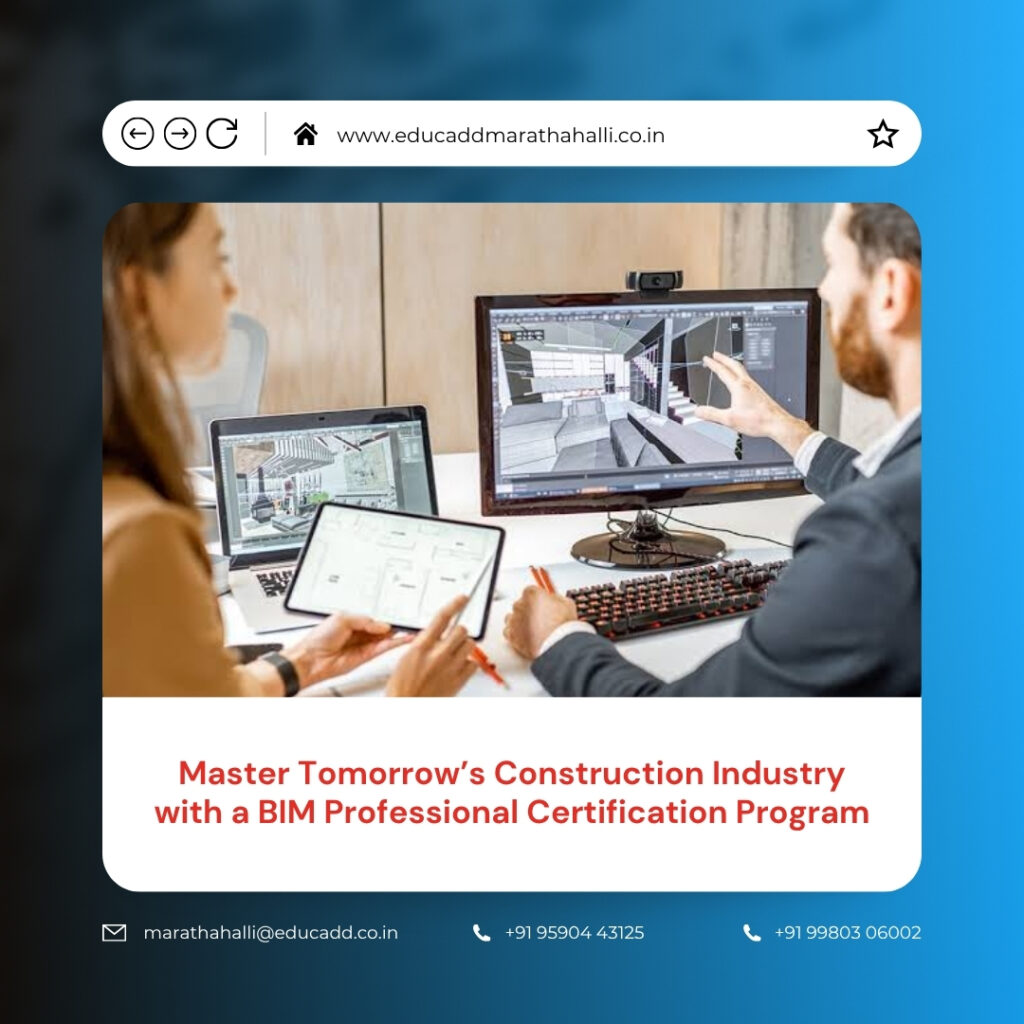
BIM Professional Certification Program
Whether you are a civil engineer, architect, interior designer, MEP engineer, or recent graduate, BIM certification can significantly improve your career prospects. With industries rapidly adopting digital construction practices, certified BIM professionals continue to enjoy excellent employment opportunities in both domestic and international markets.
The Rise of Digital Construction Technologies
Construction is no longer limited to paper drawings and disconnected software applications. Today, organizations depend on intelligent digital models that integrate planning, design, engineering, construction, and facility management into one unified workflow. This transformation allows project teams to make informed decisions before actual construction begins.
Building Information Modeling has become the foundation of this digital transformation. It enables architects, engineers, contractors, and project managers to collaborate using a shared model that contains accurate project information. As a result, communication improves, project risks decrease, and construction activities become more efficient throughout every phase of development.
Understanding a BIM Professional Certification Program
A BIM Professional Certification Program is designed to prepare learners for real-world construction projects using industry-standard BIM workflows. Unlike basic software training, professional certification focuses on practical implementation, project coordination, and digital collaboration that reflect actual industry practices.
Participants learn to create intelligent building models while understanding how different engineering disciplines work together within a coordinated environment. The curriculum usually combines classroom learning, practical assignments, live projects, and software applications to ensure students develop comprehensive technical expertise that meets current industry requirements.
Core Concepts Covered During BIM Training
A professional BIM course introduces learners to every major stage of digital construction management. Students begin by understanding BIM fundamentals before progressing toward advanced modeling, project coordination, documentation, and collaboration techniques used in professional environments.
The training generally includes architectural modeling, structural modeling, MEP systems, BIM execution planning, clash detection, construction documentation, quantity take-offs, scheduling, project visualization, and collaborative workflows. These concepts enable learners to understand how information flows across multiple teams while maintaining project accuracy and efficiency.
Industry-Standard Software You Will Master
Software proficiency plays an essential role in every BIM Professional Certification Program. Employers expect BIM professionals to work confidently with widely accepted digital construction platforms that support design, coordination, and project management activities.
Most advanced certification programs provide practical experience with Autodesk Revit Architecture, Revit Structure, Revit MEP, Navisworks Manage, AutoCAD, Autodesk Construction Cloud, BIM Collaborate, BIM 360, Dynamo, and supporting visualization tools. Learning multiple applications prepares students to adapt quickly to various project requirements and organizational workflows.
Practical Skills That Make You Job Ready
Modern employers prefer professionals who possess practical experience instead of only theoretical understanding. Therefore, quality BIM training focuses heavily on developing workplace skills through realistic engineering projects that simulate actual construction environments.
Students learn to create coordinated models, resolve design conflicts, prepare documentation, manage project revisions, generate construction drawings, perform quantity estimation, and support multidisciplinary collaboration. These practical experiences help learners build confidence while preparing them for technical interviews and professional responsibilities.
Career Opportunities After Completing BIM Certification
The growing adoption of BIM technology has created numerous career opportunities across the engineering and construction sectors. Government projects, private developers, multinational companies, consulting firms, and infrastructure organizations all require skilled BIM professionals to manage digital construction workflows.
Certified professionals can pursue positions such as BIM Modeler, BIM Engineer, Architectural BIM Specialist, Structural BIM Engineer, MEP BIM Coordinator, BIM Consultant, Revit Modeler, Digital Construction Engineer, BIM Coordinator, and BIM Manager. With experience, professionals can also transition into leadership roles involving project planning and digital transformation.
How BIM Improves Construction Project Performance
Building Information Modeling offers substantial advantages throughout the project lifecycle. Instead of relying on separate drawings and isolated communication, BIM integrates every aspect of construction into one coordinated digital model that everyone can access and update.
This approach improves design accuracy, minimizes rework, reduces material waste, identifies clashes before construction, enhances scheduling, supports better budgeting, and improves overall project quality. Consequently, organizations experience higher productivity while delivering projects more efficiently and cost-effectively.
Why Practical Project Experience Matters
Learning BIM software alone is not enough to become an industry-ready professional. Employers value candidates who understand real project workflows, coordination challenges, and multidisciplinary collaboration because these abilities directly contribute to successful project execution.
A strong BIM Professional Certification Program includes practical assignments based on residential buildings, commercial complexes, hospitals, educational institutions, industrial plants, and infrastructure developments. Working on realistic projects allows learners to apply theoretical concepts while gaining valuable professional experience before entering the workforce.
Why Companies Prefer Certified BIM Professionals
Construction organizations increasingly prioritize certified professionals because certification demonstrates verified technical competence and commitment to continuous learning. Hiring managers often recognize certification as evidence that candidates understand industry standards and can contribute effectively from the beginning.
Certified professionals are familiar with BIM implementation strategies, project coordination methods, documentation standards, and collaborative workflows. Their ability to deliver accurate digital models reduces project risks while improving communication between different engineering disciplines, making them highly valuable members of any construction team.
Expanding Global Demand for BIM Experts
Digital construction practices continue to expand across the world, creating significant demand for skilled BIM professionals. Many countries have already incorporated BIM into public infrastructure projects, while private developers increasingly rely on BIM to improve project efficiency and long-term asset management.
Certified professionals enjoy career opportunities in countries such as the United States, Canada, the United Kingdom, Australia, Germany, Singapore, the United Arab Emirates, Qatar, and Saudi Arabia. As international adoption continues to grow, BIM certification becomes an increasingly valuable qualification for professionals seeking global career advancement.
Who Can Benefit from BIM Certification?
One of the greatest strengths of a BIM Professional Certification Program is its accessibility to professionals from multiple educational backgrounds. Students pursuing engineering or architecture can develop industry-ready skills before graduation, giving them a competitive advantage in the job market.
Experienced professionals can also enhance their expertise by learning advanced BIM workflows and digital collaboration techniques. Civil engineers, architects, structural engineers, MEP engineers, interior designers, construction managers, quantity surveyors, diploma holders, and project coordinators all benefit from BIM certification as industries increasingly embrace digital construction technologies.
Selecting the Best BIM Training Institute
Choosing the right institute is an important step toward building a successful BIM career. A reputable training center offers experienced faculty, updated software, practical project exposure, modern computer laboratories, placement assistance, and an industry-focused curriculum that reflects current market expectations.
Prospective students should also evaluate certification credibility, internship opportunities, flexible learning schedules, trainer expertise, and student support services. A well-designed learning environment helps learners develop both technical knowledge and professional confidence, ensuring they are fully prepared for industry challenges after completing the program.
Future Scope of BIM and Digital Construction
The future of construction will be shaped by technologies that extend far beyond three-dimensional modeling. Artificial Intelligence, Digital Twins, cloud-based collaboration, automation, Virtual Reality, Augmented Reality, and data-driven decision-making are becoming closely integrated with BIM workflows across the construction industry.
Professionals who complete a BIM Professional Certification Program position themselves at the forefront of this technological evolution. As organizations continue investing in smarter construction methods, the demand for certified BIM specialists will keep increasing. Developing these advanced digital skills today creates long-term career stability, higher earning potential, and exciting opportunities to contribute to the next generation of sustainable and intelligent construction projects.
Conclusion
Building Information Modeling has transformed the way modern construction projects are planned, designed, executed, and managed. Organizations now depend on skilled professionals who understand digital collaboration, intelligent modeling, and integrated project delivery. A BIM Professional Certification Program provides comprehensive technical training, hands-on project experience, and industry-recognized certification that prepares learners for these evolving responsibilities.
Whether you are starting your professional journey or upgrading your existing skills, BIM certification is a valuable investment in your future. It enhances employability, expands career opportunities, strengthens technical expertise, and prepares professionals for both national and international construction markets. As digital transformation continues to reshape the engineering industry, certified BIM professionals will remain essential contributors to innovative, efficient, and sustainable construction projects. By enrolling in a quality BIM certification program, you can confidently build a successful career while helping shape the future of the global construction industry.

