
Master Modern Construction with a BIM Modeling and Coordination Course for Future-Ready Careers
The architecture, engineering, and construction (AEC) industry is experiencing a major digital transformation. Traditional drafting methods are rapidly being replaced by intelligent technologies that improve design accuracy, collaboration, and project delivery. Among these advancements, Building Information Modeling (BIM) has emerged as one of the most valuable innovations for modern construction projects. Enrolling in a BIM Modeling Coordination Course is one of the smartest decisions for students, architects, engineers, and construction professionals who want to build successful careers in this competitive industry. The course develops practical skills that help learners design, coordinate, and manage construction projects with greater efficiency while preparing them for the future of smart infrastructure development.
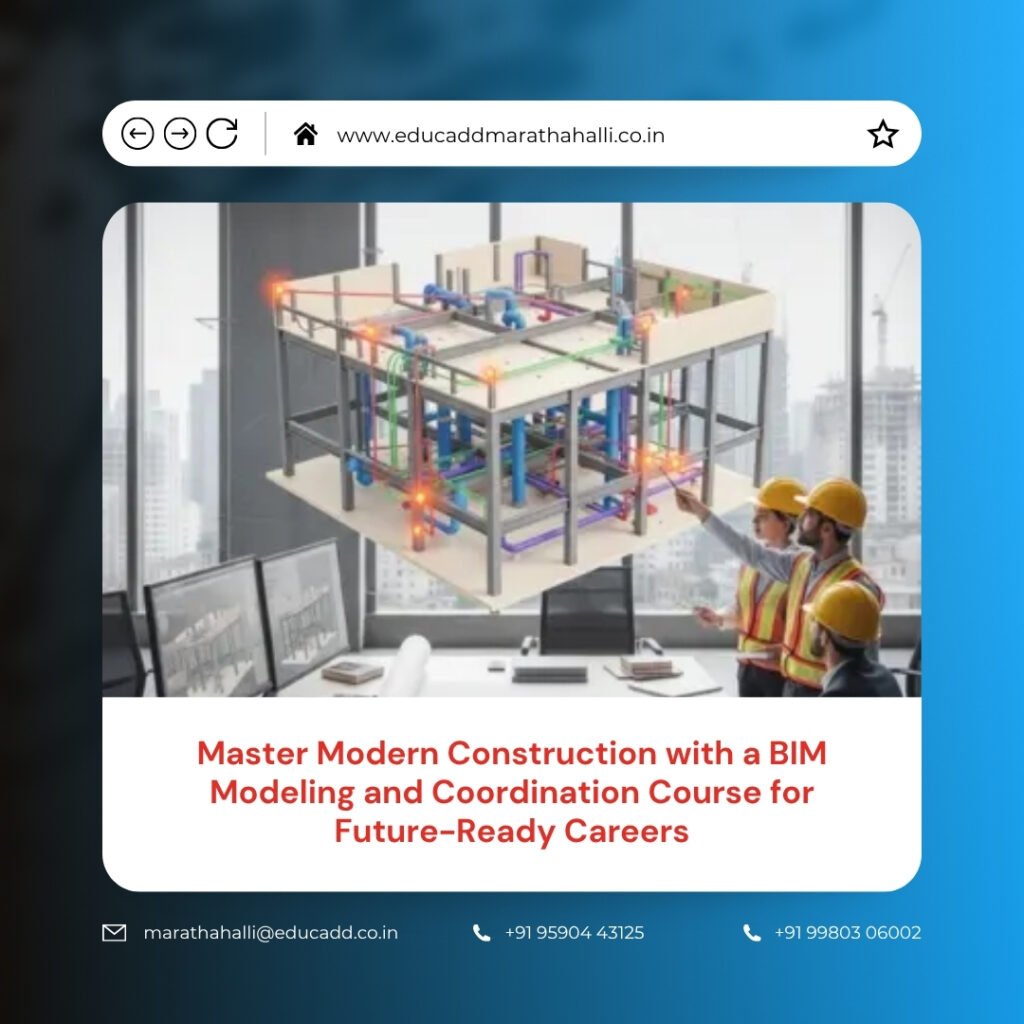
BIM Modeling Coordination Course
Why a BIM Modeling and Coordination Course Is Essential Today
The construction industry has evolved beyond simple 2D drawings. Today, companies expect professionals to create intelligent digital models that contain detailed project information throughout every construction phase. A BIM Modeling Coordination Course introduces learners to this advanced workflow while helping them understand how different disciplines collaborate within a shared digital environment.
Instead of working independently, architects, structural engineers, MEP designers, contractors, and project managers contribute to a common model that improves communication and project accuracy. As a result, design conflicts decrease, productivity improves, and project teams make better decisions from planning through execution. Therefore, learning BIM has become an important career milestone for anyone entering the construction sector.
Building Information Modeling Is Transforming Construction
Building Information Modeling is much more than three-dimensional visualization. It creates intelligent virtual representations of buildings that include geometry, material specifications, scheduling information, cost data, and maintenance details. Every modification made to the model automatically updates related drawings and documentation, ensuring consistency across the project.
Furthermore, BIM supports informed decision-making because every project stakeholder has access to reliable information throughout the project lifecycle. Consequently, organizations complete projects faster while maintaining higher quality standards. This digital approach has become the preferred method for delivering residential, commercial, industrial, and infrastructure projects around the world.
Learning Architectural BIM Modeling from the Ground Up
Architectural modeling serves as the foundation of every BIM project. During the training program, students learn how to create intelligent architectural components such as walls, doors, windows, roofs, ceilings, floors, staircases, and curtain walls using professional BIM software. Every building element stores valuable information that supports design coordination and construction planning.
Additionally, learners understand how architectural models improve visualization for clients and project teams. Design modifications become easier because updates automatically reflect throughout the model and documentation. Consequently, architects save valuable time while maintaining exceptional design accuracy during every project stage.
Understanding Structural Modeling for Smarter Designs
Structural engineering plays a crucial role in delivering safe and durable buildings. A comprehensive BIM course teaches students how to develop structural models that include foundations, beams, slabs, columns, steel members, reinforcement, and load-bearing systems with exceptional precision. These intelligent models improve engineering accuracy while simplifying project coordination.
Moreover, structural BIM integrates seamlessly with architectural and MEP models, allowing professionals to evaluate compatibility before construction begins. Early coordination minimizes costly design revisions and improves construction efficiency. Therefore, structural BIM has become an indispensable component of modern engineering workflows.
Mastering MEP Modeling and Coordination Techniques
Mechanical, Electrical, and Plumbing systems form the operational backbone of every building. A BIM Modeling Coordination Course helps learners understand how these systems interact within architectural and structural environments while maintaining proper installation standards. Students develop detailed models for HVAC systems, electrical layouts, plumbing networks, and fire protection services.
Furthermore, coordinated MEP modeling improves communication among various engineering disciplines. Designers can evaluate available space, identify routing challenges, and optimize system layouts before construction begins. Consequently, contractors reduce installation errors while achieving better project performance and improved building functionality.
Clash Detection Prevents Expensive Construction Problems
One of the strongest advantages of BIM coordination lies in its ability to detect conflicts before physical construction starts. During professional BIM training, students learn how specialized coordination software identifies clashes between structural, architectural, and MEP components with remarkable accuracy. This proactive approach significantly reduces project risks.
Additionally, clash reports provide clear information that enables project teams to resolve design issues efficiently. Contractors no longer need to depend on costly on-site corrections because potential problems are identified during the design phase. As a result, organizations save time, reduce expenses, and improve overall construction quality.
BIM Collaboration Creates Better Project Communication
Construction projects involve multiple stakeholders who must work together efficiently to achieve project goals. BIM introduces collaborative workflows that connect architects, engineers, consultants, contractors, and clients through centralized digital models. Everyone accesses updated project information, ensuring greater transparency throughout every project stage.
Cloud-based collaboration platforms further strengthen communication by allowing teams to review, update, and coordinate project data from different locations. Consequently, project decisions become faster, misunderstandings decrease, and construction schedules remain on track. Effective collaboration ultimately leads to higher productivity and better project outcomes.
Quantity Estimation and Cost Control with BIM
Accurate quantity estimation plays an important role in project planning and financial management. BIM technology automatically generates precise material quantities directly from intelligent models, eliminating many manual calculation errors. During the course, learners understand how digital quantity takeoffs improve budgeting and procurement planning.
Moreover, project managers can monitor resource requirements more effectively because quantity information updates automatically whenever the model changes. This capability improves cost forecasting while minimizing unnecessary material waste. Consequently, construction companies achieve stronger financial control and more efficient project execution.
Software Skills That Employers Value
A professional BIM Modeling and Coordination Course provides practical exposure to globally recognized software used by leading construction organizations. Students typically work with Autodesk Revit for modeling, Navisworks Manage for coordination and clash detection, AutoCAD for drafting support, and cloud collaboration platforms for project management.
Hands-on exercises, real-world case studies, and project-based learning strengthen software proficiency while improving technical confidence. Additionally, learners understand how multiple BIM applications integrate into complete project workflows. This comprehensive software knowledge significantly increases employability within the global construction industry.
Career Opportunities Continue to Expand Worldwide
Digital transformation has created enormous demand for professionals with BIM expertise across architecture, engineering, infrastructure, manufacturing, and facility management sectors. After completing a BIM Modeling and Coordination Course, graduates can pursue rewarding positions including BIM Modeler, BIM Coordinator, BIM Engineer, Design Coordinator, BIM Technician, Project Engineer, and BIM Manager.
Furthermore, international consulting firms, construction companies, and engineering organizations actively recruit BIM professionals because digital project delivery has become an industry requirement. Consequently, certified professionals often enjoy competitive salaries, excellent career growth, and opportunities to participate in prestigious global projects.
Industries Driving the Demand for BIM Professionals
The adoption of BIM continues expanding across numerous sectors beyond traditional building construction. Residential developments, commercial complexes, airports, hospitals, metro rail systems, educational campuses, manufacturing facilities, highways, bridges, and smart city projects increasingly depend on BIM-based workflows for efficient project delivery.
Governments and private organizations also recognize the long-term value of BIM in improving sustainability, reducing construction waste, and enhancing facility management. As digital construction standards continue evolving, professionals with BIM coordination expertise will remain highly sought after across domestic and international markets.
Choosing the Right BIM Training Institute
Selecting the right learning institution is an important step toward building a successful BIM career. An industry-oriented training center should provide experienced instructors, updated software versions, practical assignments, live projects, placement assistance, and globally recognized certification. Practical learning remains the key to developing real industry competence.
Students should also evaluate infrastructure, laboratory facilities, project exposure, and trainer expertise before making their decision. A quality learning environment not only improves technical knowledge but also builds confidence in handling multidisciplinary construction projects with professionalism and accuracy.
Future Trends in BIM and Digital Construction
The future of construction is becoming increasingly intelligent as BIM integrates with technologies such as Artificial Intelligence, Digital Twins, Virtual Reality, Augmented Reality, cloud computing, robotics, and automation. These innovations are revolutionizing project planning, design validation, construction monitoring, and facility management while improving sustainability and operational efficiency.
As governments and private developers continue investing in digital transformation, BIM professionals will play an increasingly important role in delivering smarter buildings and infrastructure. Continuous learning, software expertise, and coordination skills will help professionals remain competitive in this rapidly evolving industry while unlocking exciting career opportunities across the global construction landscape.
Conclusion
A BIM Modeling Coordination Course provides much more than technical software training. It develops the practical knowledge, coordination expertise, and collaborative mindset required to succeed in today’s digital construction environment. From architectural and structural modeling to MEP coordination, clash detection, quantity estimation, and cloud-based collaboration, the course prepares learners for real-world industry challenges.
As BIM adoption continues growing across residential, commercial, industrial, and infrastructure projects, professionals with these specialized skills will enjoy stronger career prospects and long-term job security. Investing in BIM education today is a strategic step toward becoming a valuable contributor to the future of smart construction and sustainable infrastructure development.

